
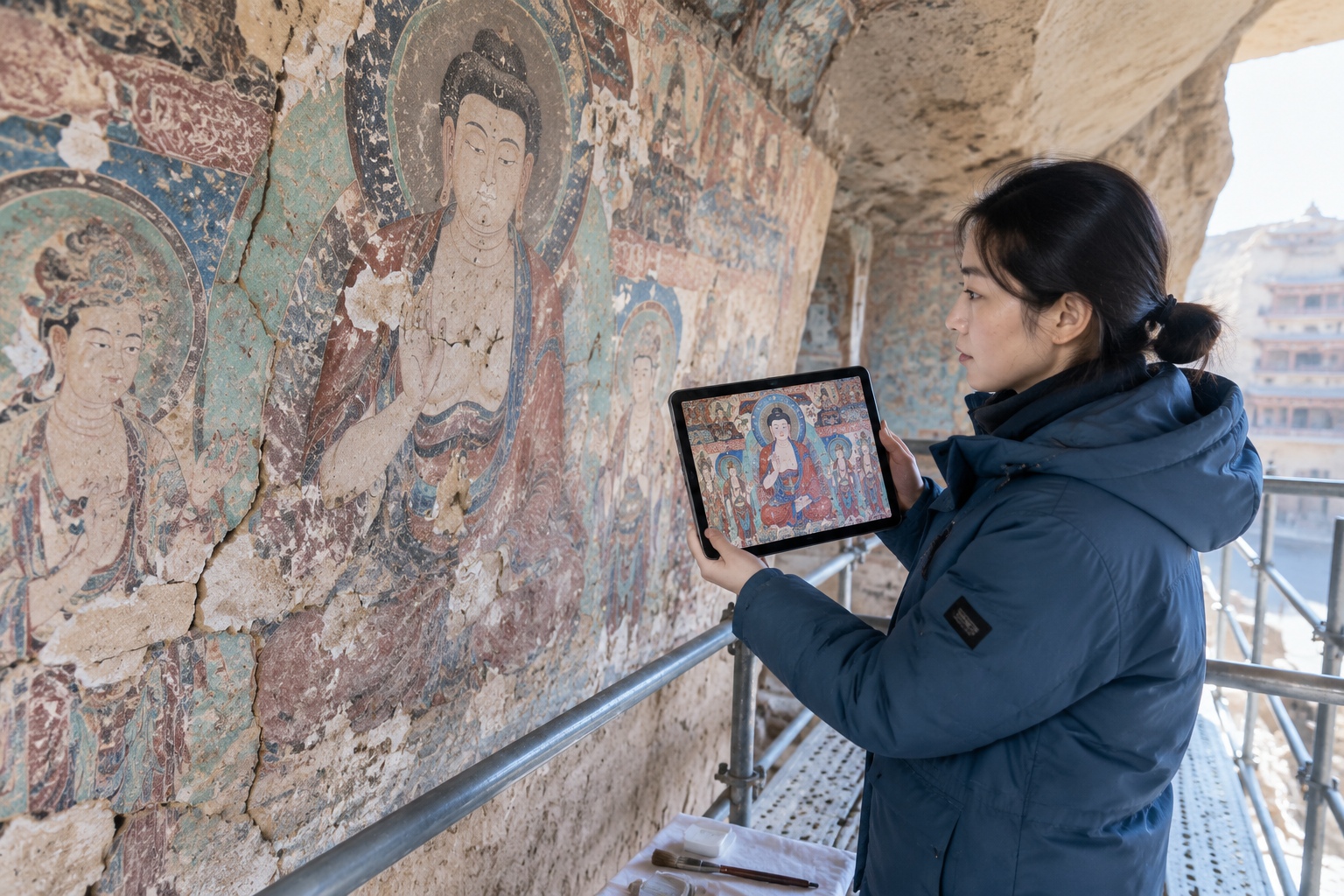

Cave 285, 7:10 a.m.
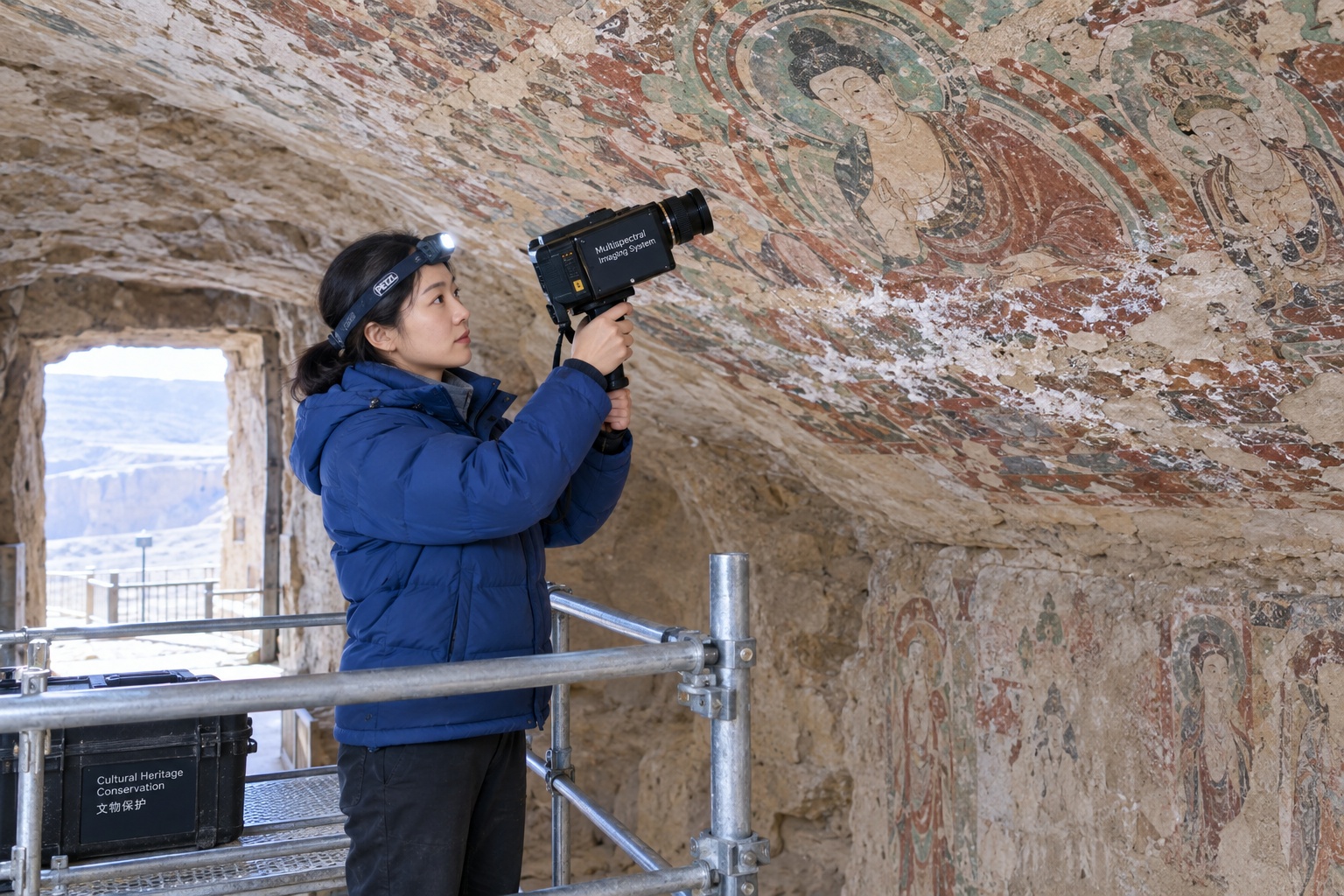
The air inside Cave 285 at the Mogao Caves in Dunhuang, Gansu province, is about 6°C before the first tour group of the day arrives. It smells of dry sand, cold plaster and the faint mineral dust that never quite settles. A conservator in a padded blue jacket climbs a steel scaffold to within arm’s length of a painted ceiling finished during the Western Wei dynasty, roughly 1,500 years ago, and switches on her headlamp.
The ceiling is not intact. A bodhisattva’s face has faded to the color of ash. Along a hairline crack, salt crystals have pushed pigment off the plaster and left a white bloom. Near the eastern slope, a strip of painted clay the width of a hand has separated from the rock and curls slightly at its edge, the way paper curls before it tears.
She does not touch any of it. Her job this morning is to photograph: visible light, infrared, ultraviolet, 400 frames from six angles. Later, in a lab 25 kilometers away, software will compare those frames with scans taken in 2011 and flag every spot where the surface has moved by more than a fraction of a millimeter.
That is what artificial intelligence looks like in a Chinese cave. Not a robot with a brush. A very patient microscope that never gets tired.
What is actually at stake
Mogao is not one cave but a cliff face of them: 735 chambers cut into the sandstone and conglomerate southeast of Dunhuang, on the edge of the Gobi, between the 4th and 14th centuries. Of those, 492 still hold wall paintings and sculpture. By the Dunhuang Academy’s count, the site carries roughly 45,000 square meters of mural — about the area of six football pitches — and more than 2,000 painted figures. UNESCO listed it as a World Heritage Site in 1987.
The paintings are a record of a trade route: Sogdian merchants, Chinese officials, Tibetan monks, Uyghur patrons and pilgrims who came to a desert crossroads where Buddhism entered China. They are also chemistry, and the chemistry is losing.
Damage measured in decades, not days
Most Dunhuang pigment is mineral: cinnabar for red, azurite for blue, malachite for green, ground lead for white. Some of it changes on its own. Lead red oxidizes into black plattnerite, which is why so many Tang-dynasty figures look as though they were painted with soot. That darkening is not dirt and it is not damage in the ordinary sense — it is the paint turning into something else, and it cannot be scrubbed back.
Then there is the human part. When Mogao opened to visitors in 1979, annual numbers were in the tens of thousands. By the 1990s they had climbed into the hundreds of thousands, and each visitor exhaled moisture and carbon dioxide into spaces that had been dry and stable for a millennium. Salt moved. Paint lifted. The Academy capped daily admissions and now rotates which caves stay open; most visitors see only a handful of chambers in a single morning.
Conservators have fought this for eighty years with syringes, bamboo knives and animal glue. The new tools are digital.
What AI does on a mural, step by step
Finding what the eye misses
A trained conservator can spot flaking at a glance. She cannot spot the small shift that happened last winter. Convolutional neural networks can. Fed thousands of labeled images of cracks, salt blooms, mold and loss, a model learns to draw a damage map across an entire cave wall in hours — a task that once took a team weeks with a sketchbook and a loupe. Repeated year after year, those maps become a time series: not only where the damage is, but how fast it is growing.
Reversing chemistry on a screen
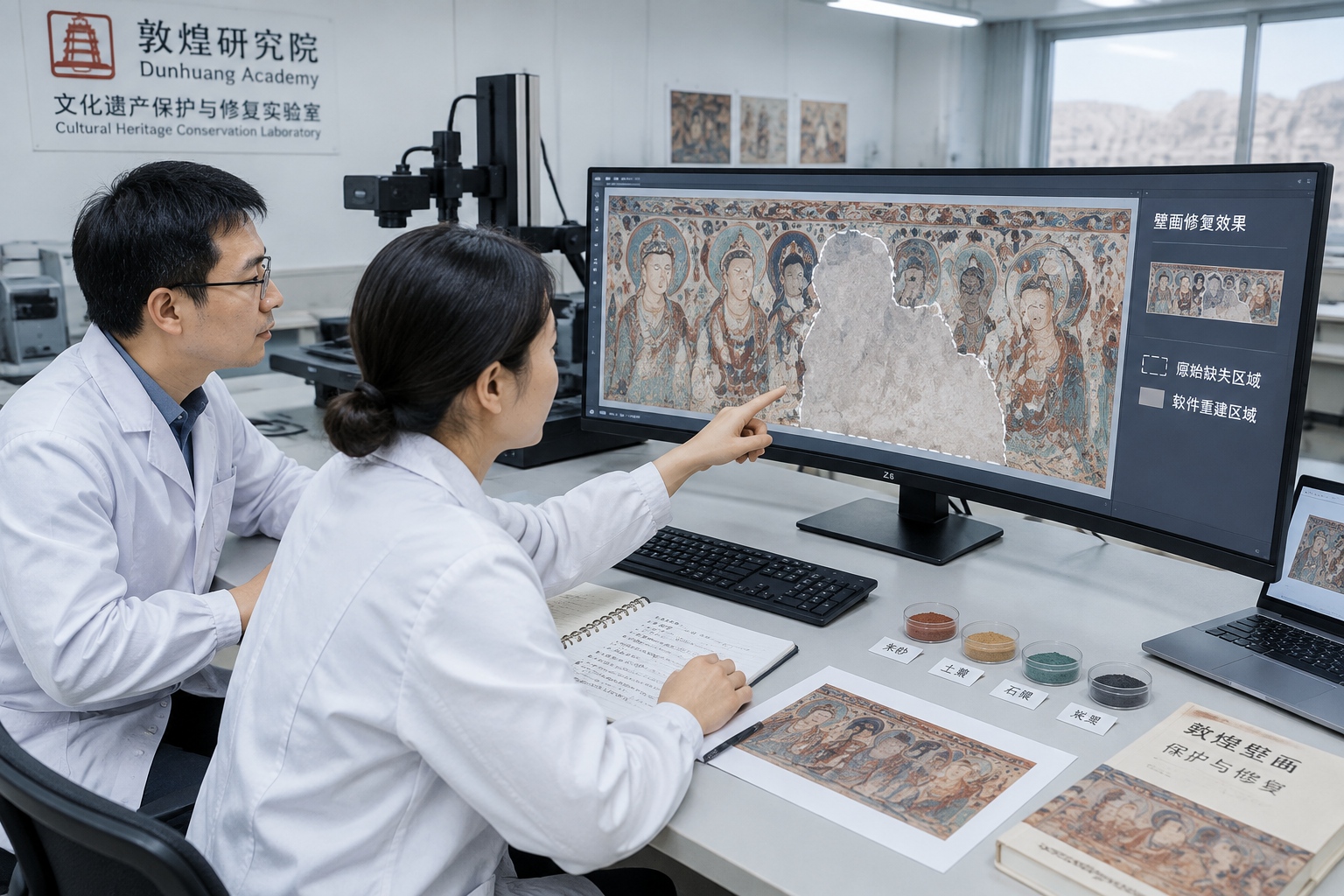
Multispectral imaging does something a camera cannot. By capturing a dozen narrow bands of light, from ultraviolet to near-infrared, and unmixing the resulting signal, researchers can identify pigments beneath a darkened surface and sometimes see underdrawings that were never meant to be visible. Software can then push a lead-darkened face back toward the flesh tone the painter mixed, as a hypothesis rendered on screen.
The Dunhuang Academy shows some of these reconstructions in exhibitions. It does not paint them on the wall. A reconstructed color is an argument, not a fact, and everyone in the room knows it.
Filling in what is gone
The harder job is the hole. Where plaster has fallen away, there is simply no information. Generative models — GANs in earlier work, diffusion models more recently — propose an answer by studying what surrounds the gap and thousands of similar motifs in the same cave or in caves from the same century. Lines connect. Color gradients close. A missing stretch of decorative border reappears plausibly.
Chinese university labs publish a steady stream of this research. Whether the result is correct is a different question, and it is not the algorithm’s to answer.
The human in the loop is not decoration
Inside the Dunhuang Academy, the working phrase is assistance, not replacement. Every AI proposal is reviewed by conservators, art historians and pigment chemists before it is shown to anyone.
Iconography is where machines tap out. If a bodhisattva’s hand is missing, the model can generate a hand. Only a specialist can say whether it should hold a lotus, a flask, or nothing at all — based on the sutra the cave was painted to illustrate and on comparable figures elsewhere. Dunhuang’s own manuscripts, scattered between London, Paris, St. Petersburg and Beijing, often hold that textual key.
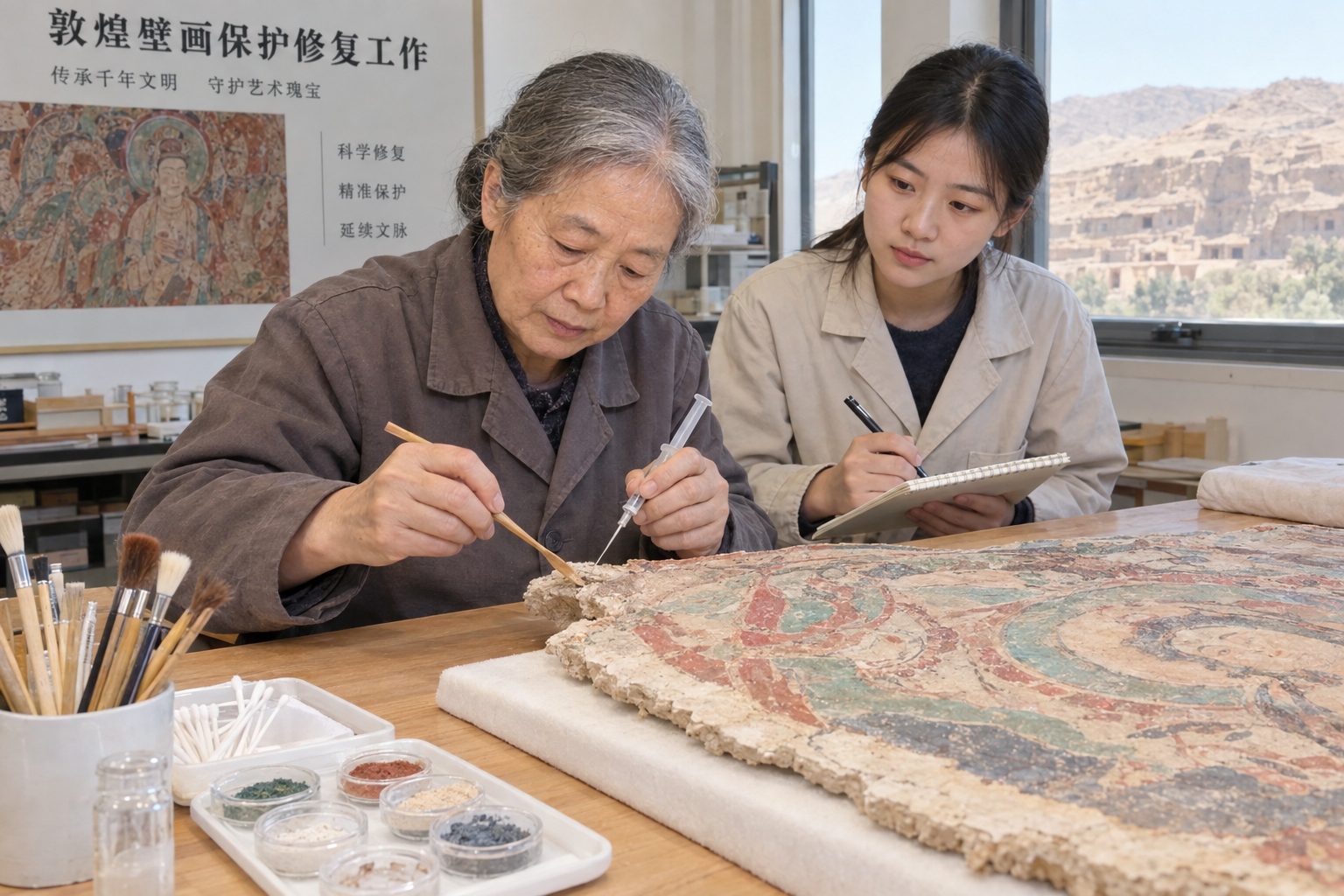
There is also the ethical architecture governing physical work. Chinese conservation follows the principles of minimal intervention and reversibility, codified in the national Principles for the Conservation of Heritage Sites in China. On the wall, that means injecting grout behind lifting plaster, re-adhering edges, and stopping. Nothing is repainted. Which is exactly why the digital layer is where AI gets to be imaginative: a restored image can be bold because it can be switched off.
Li Yunhe, who joined the Academy in 1956 and is now in his nineties, still comes to the site. His tools have barely changed: bamboo knives, syringes, animal glue, a steady hand. Colleagues describe him smoothing a plaster edge in an afternoon — something a machine could only photograph. Both things are true at once.
Speed, precision, and the numbers that matter
The efficiency case is real, but narrower than the headlines suggest. Digitizing a single cave takes three to four days of shooting and months of processing; the Academy has now captured more than 290 of the painted caves. A traditional condition survey of the same surface would take far longer and be less precise.
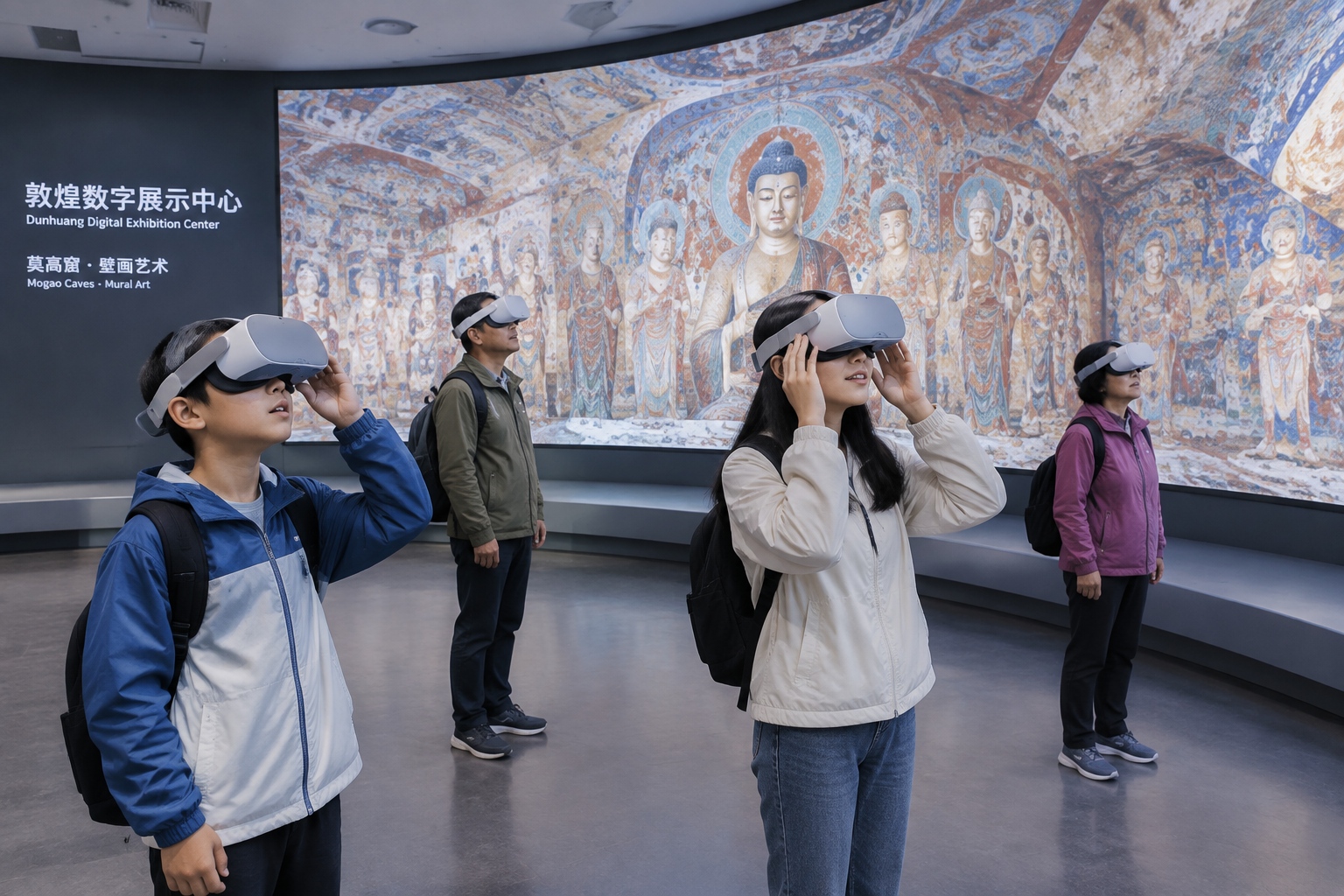
For visitors, the change is already visible. Since 2014, guests stop first at the Dunhuang digital exhibition center to watch two films, then take a shuttle to the cliff. Time inside the caves has dropped from around two hours to roughly 75 minutes. Tencent’s Digital Dunhuang mini-program, launched in 2020, has let millions of people walk through the caves on a phone; a 2022 project rebuilt the sealed Library Cave as an interactive 3D space. Fan Jinshi, the Academy’s director from 1998 to 2014, spent years arguing for exactly this: preserve permanently, use sustainably.
The uncomfortable question
AI can make the past look better than it ever was. That is a feature and a hazard. Restore too confidently and you erase evidence: a darkened face is data about how lead pigment ages in a desert, and future researchers may need it.
There is a data problem too. A model trained on photographs of an already-faded mural learns faded colors and reproduces them. Training on the Academy’s calibrated, multispectral archive solves part of this, but only part. Every reconstruction carries the assumptions of the people who labeled the training set.
So the working rule stays modest. On the wall: as little as possible. On the server: as much as you like, clearly labeled as a hypothesis.
From the cliff to the cloud
The archive is becoming the reference. If salt lifts another patch of Cave 285 in 2050, the 2024 scan is what the world will compare it to. Newer work points toward real-time 3D capture, VR tours that keep their bearings, and models that predict where damage will appear next rather than only describing where it already is.
None of that makes the cave less important. The point is the opposite. Because the digital copy can be examined, annotated and, if necessary, restored in ways the original never could survive, the original is left alone.
At six in the evening, the conservator climbs down, logs the temperature and humidity, and pulls the aluminum door shut. The lock clicks. Inside, the bodhisattva with the ash-gray face stays as she is. On a server in Lanzhou, a second version of her blinks awake, wearing the colors a painter mixed in the sixth century, waiting for someone to argue with it.
Start the discussion at forum.chinacomes.com