
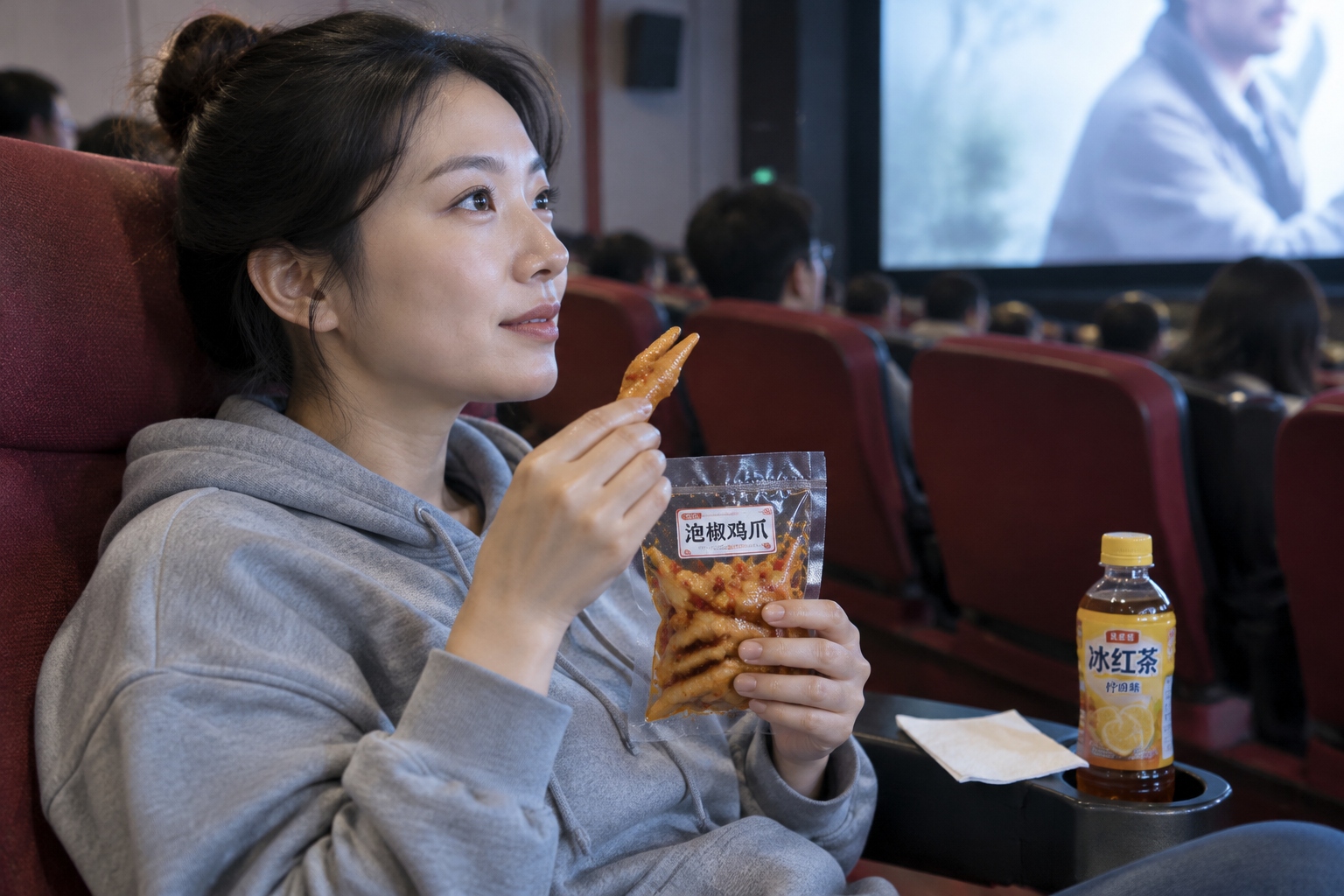

A bag of chicken feet, opened in the dark
The trailer is still running. A woman two seats to my left unzips a small plastic bag, and the whole row suddenly smells of vinegar, chili and something faintly chickeny. She lifts out a pale, knuckly foot, bites down, and works a small bone out of her mouth with her tongue. Nobody turns around. Nobody sighs. On screen, a car explodes.
This is a weekday evening in a Chengdu cinema, and the snack in question is paojiao fengzhua — pickled chili chicken feet. In a theater in London or Ohio, that bag would earn her a few long stares and probably a polite word from staff. Here, it barely registers. Half the row is eating something.
That gap — between what a cinema is for in China and what it is for in most of the English-speaking world — is a good way into a snack that outsiders find either fascinating or horrifying, and that Chinese shoppers buy by the billion.
What exactly is paojiao fengzhua?
Start with the name. Paojiao means vegetables — usually chili peppers — fermented in a salt-and-vinegar brine, a staple of Sichuan and Chongqing kitchens. Fengzhua is the polite word for chicken feet, literally “phoenix claws.” Put them together and you get chicken feet that have been cooked, chilled, then left to sit in that sour, salty brine until the skin turns translucent and the flavor reaches the bone.
You will find them packed in vacuum-sealed plastic and sold at room temperature. They sit on convenience store shelves next to the bottled tea, in supermarket aisles, on the snack trolley of a high-speed train, and by the cash register in just about every neighborhood shop. A typical bag costs 5 to 15 yuan — roughly 70 cents to two dollars.
Chicken feet have been eaten in China for a very long time. But the packaged, pickled version is a modern industrial product. A Chongqing company called Youyou Food started selling them in the 1990s and listed on the Shanghai Stock Exchange in 2019 — a chicken-foot manufacturer large and profitable enough to go public. That tells you most of what you need to know about the size of the market.

Why nobody here finds it strange
The first thing to understand is that chicken feet are not a dare, a stunt, or a poverty food. They are ordinary. They show up on dim sum menus, in the cold case of every neighborhood luwei (braised snack) shop, in hot pot, at the barbecue stall, and in the lunchbox a colleague brings from home.
Part of the reason is economic history. Feet, necks, wing tips and other bony cuts were cheap for decades, so they became the food of long conversations and small budgets — the kind of thing you eat slowly because there is not much meat on it. That slowness is the whole point. A bag of chicken feet takes twenty minutes to get through. It occupies your hands. It does not fill you up. It is the perfect companion to a two-hour movie, a four-hour train ride, or a table of beer.
It is also strikingly cross-generational. Children start on the milder, sweeter versions. Grandparents eat them with baijiu and pick out the cartilage with practiced precision. In my experience, the most dedicated chicken-foot eaters in any given room are usually women over 50, who will tell you, correctly, that a good foot has more collagen and more flavor than a chicken breast ever will.
What it actually tastes like
Texture first, flavor second. That is the order of operations, and it is the opposite of how most Western food writing works.
The flavor is sour, salty and gently hot — a slow burn rather than a punch. The texture is the interesting part. Meat is maybe a third of each bite. The rest is skin, tendon, cartilage and those small knuckles, which have a springy resistance that Chinese eaters describe with the word jiaojin: chewiness, in the positive sense. Something worth chewing.
This is a genuine cultural difference. Anglo-European cooking tends to treat tenderness as the highest virtue; if it is tough, something went wrong. In Chinese snacking, chewiness is a goal, not a defect. The same logic explains why people here chew on dried squid, beef jerky, duck necks and konjac strips. The pleasure is not in swallowing. It is in the work.
If you are curious but cautious, here is the practical route. Buy a bag of hu pi feng zhua — “tiger skin” chicken feet, which are fried and then braised, softer, sweeter and much milder than the pickled kind. Or start with boneless feet, which remove the entire bone-spitting problem. Eat them cold or at room temperature, with cold beer, tea, or nothing at all. Keep napkins nearby.

The business behind the bones
China’s packaged snack industry is measured in the hundreds of billions of yuan a year, and industry reports routinely put the broader leisure-food market above one trillion yuan. Chicken feet are a narrow but unusually vivid slice of it.
Look at the supply chain and you see how global it is. China does not produce enough chicken feet for its own appetite, so it imports large volumes of frozen feet — hundreds of thousands of tonnes a year, much of it from Brazil and the United States. The trade is politically visible: American chicken feet became a bargaining chip during the 2018–2019 tariff fight, and exporters on both sides felt it.
On the brand side, competition is fierce. Youyou dominates the pickled category. A younger company called Wang Xiaolu, founded in 2016, built a national brand almost entirely on one product — the tiger-skin foot — and sells it through livestreams on Douyin, where hosts eat on camera and the crunch is the selling point. Bestore and Three Squirrels sell feet alongside dried mango and nuts. Supermarkets sell their own cheaper versions.
The quieter structural story is retail. In the past two years, discount snack chains such as Snack Busy and Zhao Yiming have opened thousands of brightly lit stores in smaller cities, selling branded snacks at 20 to 30 percent below supermarket prices. Chicken feet are a standard item on those shelves. The format works because the products are cheap, non-perishable, bought on impulse, and bought again.
So why the cinema?
China has the largest movie theater network in the world — more than 80,000 screens — and cinemas here run on a different business model from their American cousins. In the US, concessions can account for a huge share of a theater’s profit. In China, cinemas lean hard on ticket sales, advertising, and increasingly on whatever else they can sell you.
But the bigger reason is simpler: most Chinese cinemas do not enforce a strict outside-food ban, and audiences treat the auditorium a bit like a train carriage. A holiday screening can feel like a picnic. Staff will usually step in only for the obvious offenders — durian, or a bag of sunflower seeds being cracked open through the quiet parts.
None of this is universal. Arthouse cinemas in Shanghai and Beijing ask patrons to leave strong-smelling food at the door. In fancier malls, the audience is quieter and the snack bags fewer. But walk into a mid-priced multiplex in Chengdu, Changsha or Xi’an on a Friday night and you will hear a soft percussion of plastic, bone and teeth all the way through the credits.
What this says about how Chinese cities relax
Two shifts sit behind the chicken-foot-in-the-cinema picture.
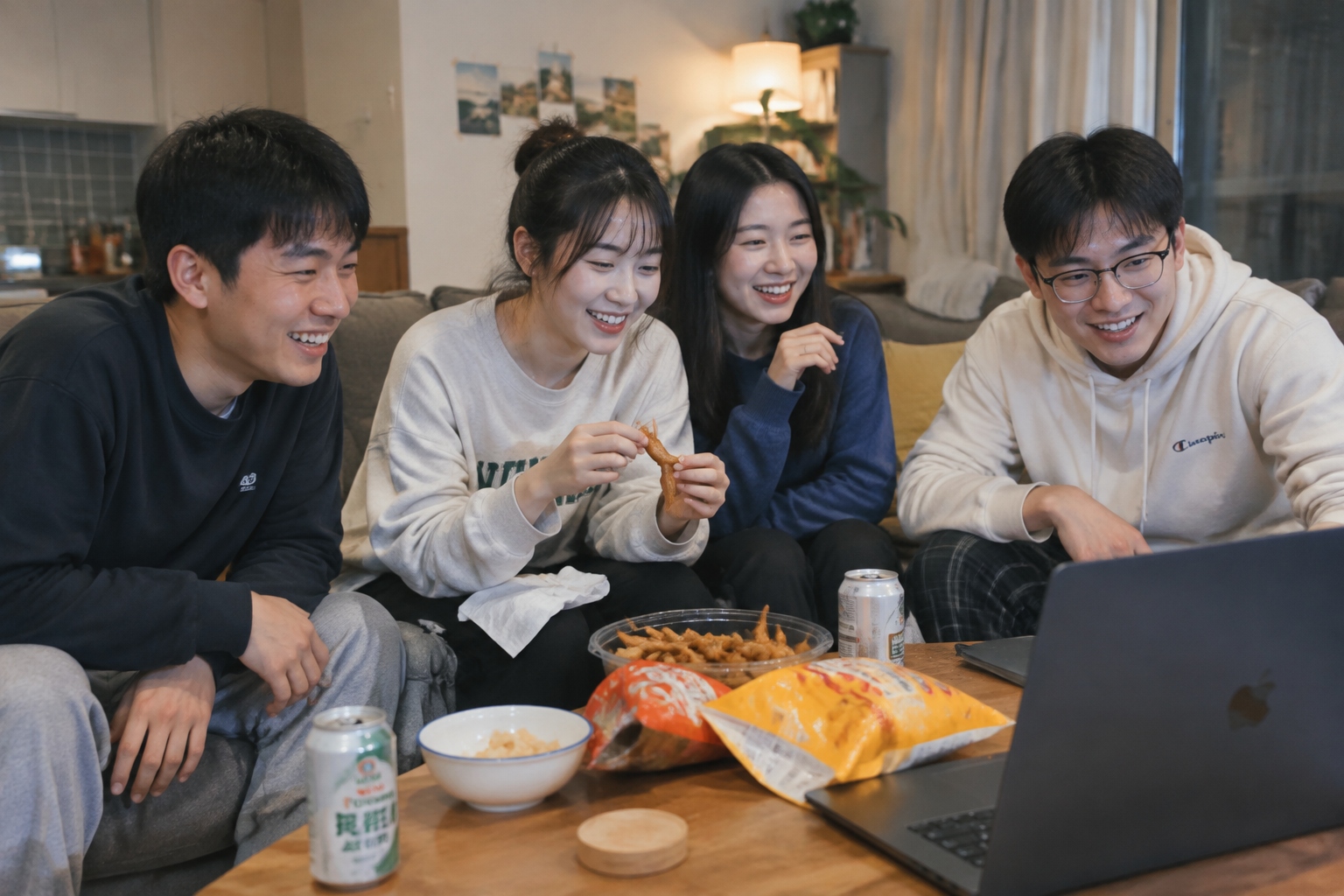
The first is that snacking moved out of the home. Twenty years ago, snacks meant a plate on the coffee table for guests. Now it means a bag in your pocket — on the subway, on a hike, at a campsite, on a citywalk through old neighborhoods. The pandemic accelerated it, and the discount snack chains industrialized it.
The second is that going to the movies became routine rather than an event. The 2024 box office fell noticeably from 2023, and theaters have been chasing audiences with cheaper tickets, themed screenings and more food options. A cinema that sells you a vacuum-packed bag of chicken feet has decided that being a place to hang out matters more than being a temple of silence.
For a visitor, that is useful to know. Chinese urban leisure is often cheap, social and slightly messy. An evening out is not built around a seated dinner with a check at the end. It is built around a long stretch of time filled with small things to eat.
If you want to try it
Buy a small bag first — 8 yuan at a convenience store is a fair introduction. Start with tiger-skin or boneless. Eat it cold, with tea or beer. Keep napkins on hand, and do not be shy about the bones; everyone spits them out. If you hate it, you are out two dollars and you have a story. If you like it, you will find yourself buying a second bag at the airport on the way home.
The point
A chicken foot is a small document of how a society spends its evenings: cheap, shared, unpretentious and a little messy. You do not have to like it. But if you sit in a Chinese cinema and hear the wet snap of a knuckle bone somewhere in the dark, you are listening to a country relax.
Start the discussion at forum.chinacomes.com