
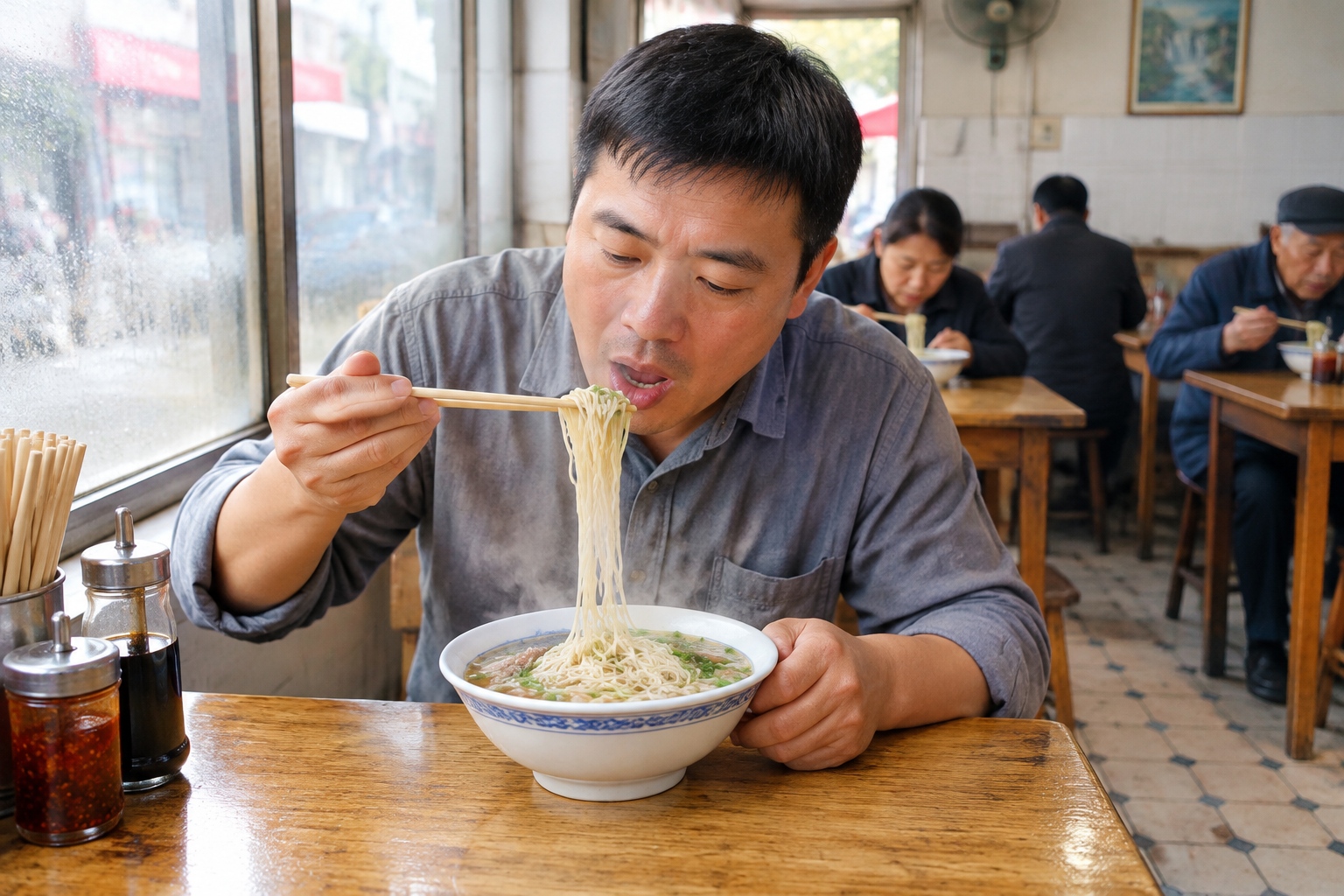

7:40 a.m., and the Room Is Already Loud
You hear a Chinese noodle shop before you understand it. The sound arrives first — a wet, cheerful, completely unembarrassed shhhhlurp — and it comes from every table at once, like weather.
A friend of mine from Manchester spent her first week in Chengdu apologizing. Every time she lifted noodles to her mouth, she would make a noise, then glance up, bracing for the polite British freeze. Nobody ever looked. The woman next to her was making the same noise, only louder, and with more conviction.
That is the part most visitors get wrong. In China, slurping noodles is not a lapse in manners. It is closer to applause.
Slurping Is Not Rude. It Is a Review.
The verb is suo (嗦) — a character that sounds like what it means. It began as a regional word and migrated into mainstream Chinese, mostly through suo fen, the act of demolishing a bowl of rice noodles in Hunan or Guangxi. English has no neutral equivalent, because English has no word for eating something efficiently and happily at the same time.
Here is the cultural logic: a slurp tells the cook you are eating fast because the bowl deserves it. It is an audible five-star review, typed with your mouth. Eating noodles in silence does not read as good manners. It reads as hesitation.
There is a practical side too. Noodles keep cooking in hot broth. Mian served at 11:50 is not the same noodle at 12:10. A slow, delicate eater is not being refined; they are letting lunch turn to paste.
The Physics of a Good Slurp
Noodle soup lands on the table somewhere between 75 and 85°C (165-185°F). Nobody can bite cleanly through a hot bundle of noodles, and nobody wants to wait fifteen minutes for lunch to become safe.
So you lift, you inhale, and the air does two jobs at once. It cools the noodles a few degrees on the way in. And it carries aroma compounds up the back of your throat into your nasal cavity — retronasal olfaction, the same trick that makes coffee smell better than it tastes. Chewing alone sends flavor to your tongue; slurping sends it to your nose. Most of what we call taste is actually smell, which is why a properly slurped bowl of Lanzhou beef noodles tastes like more than noodles and salt.
There is a sauce argument as well. In dry or semi-dry noodles, the slurp drags chili oil, sesame paste and scallion oil into every strand instead of leaving them pooled at the bottom of the bowl.
What a Noodle Shop Actually Sounds Like
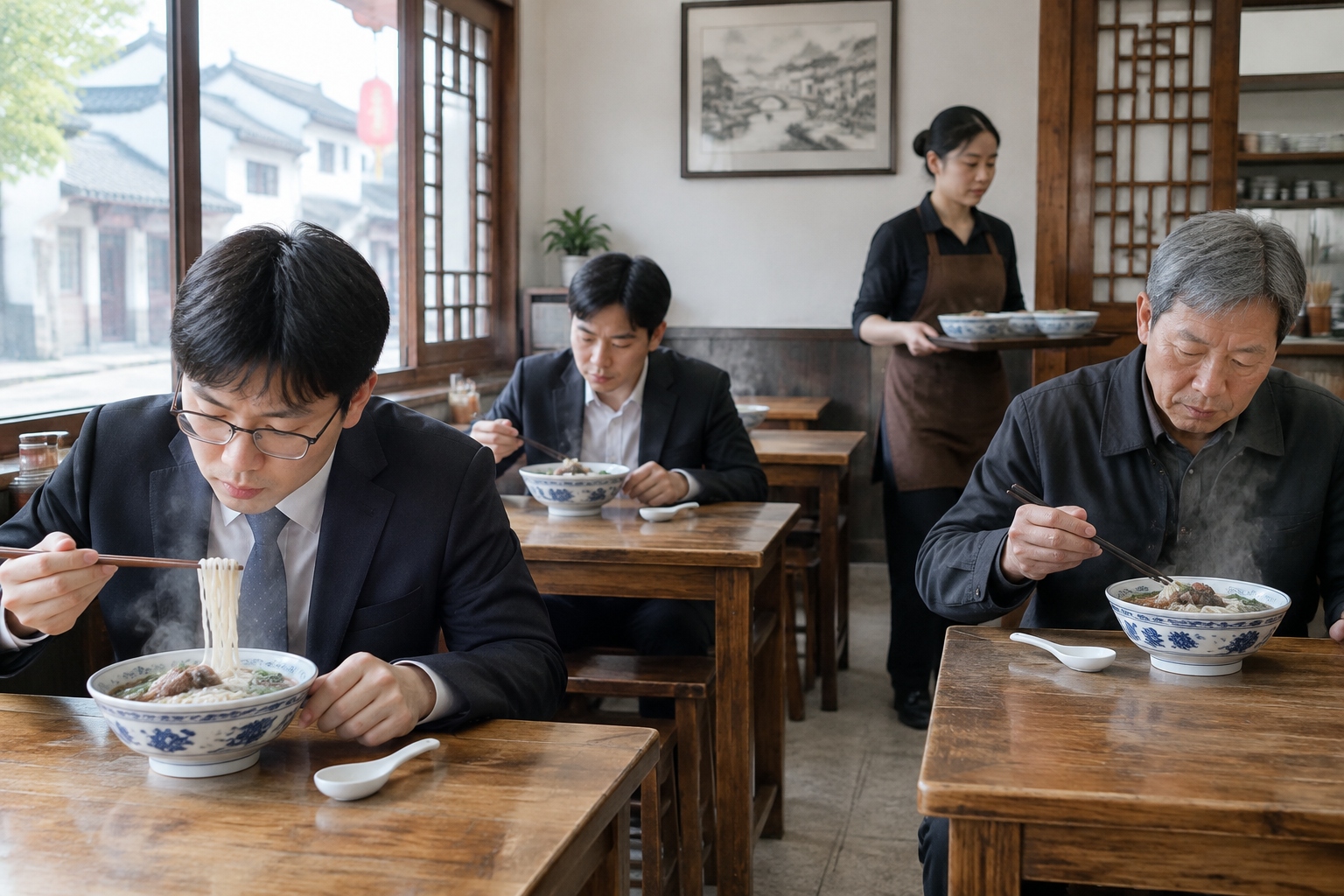
Suzhou, 7 a.m. Men in shirtsleeves, bowls of menrou mian — pork belly noodles — steaming on small tables. Almost nobody is talking. The sound is not one noise but a texture, rising and falling, punctuated by the clink of porcelain spoons and the hiss of the kitchen behind the plastic curtain.
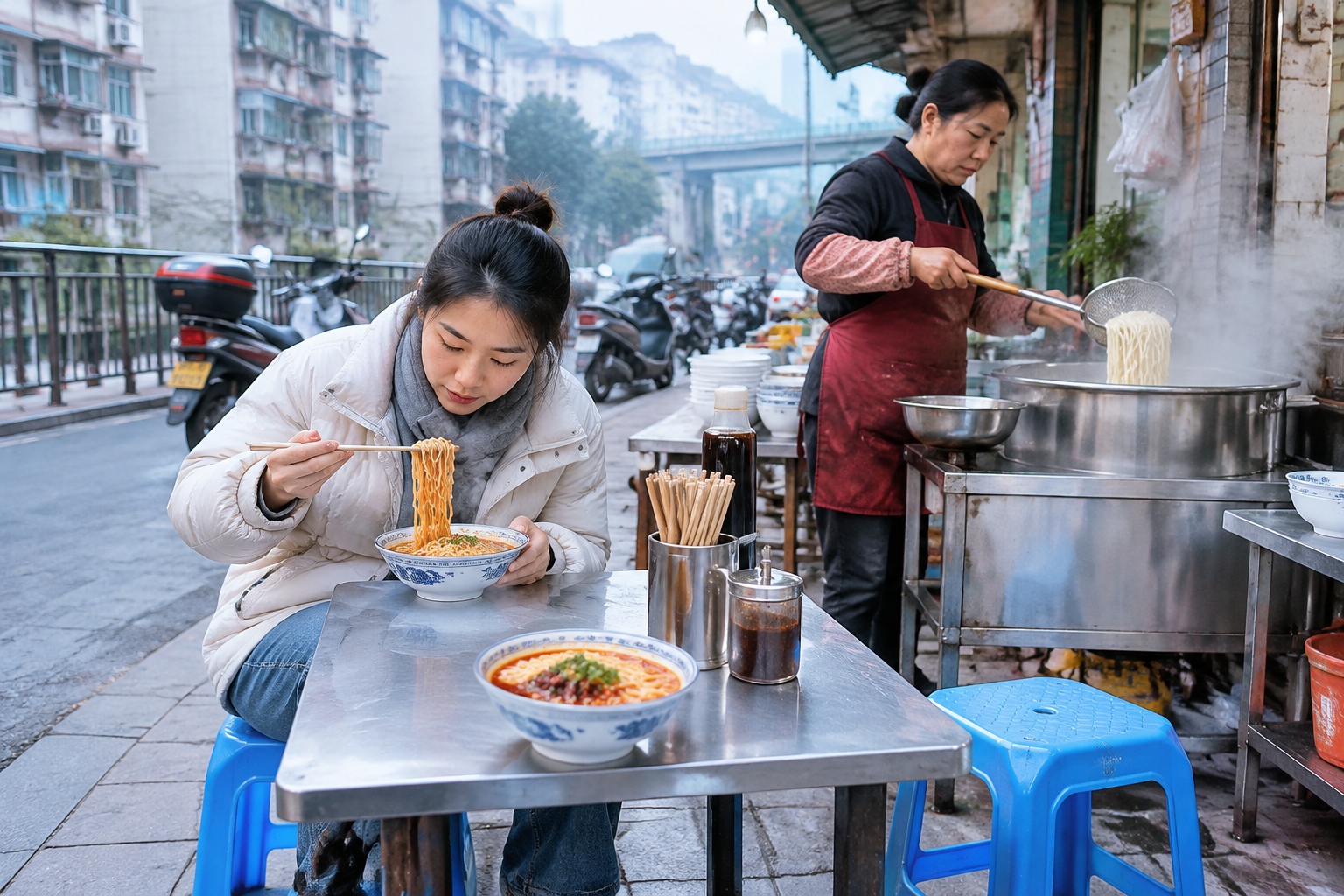
Chongqing, same hour. Bowls of xiaomian balanced on plastic stools along the sidewalk, chili oil already staining the rims. The slurping overlaps like rain on a tin roof.
Wuhan has its own variant. Reganmian — hot dry noodles — are so dry that the slurp comes out short and businesslike, and many stalls hand you a small bowl of soup on the side to reset your mouth. Wuhan eats breakfast standing on the street, at a speed that unsettles first-time visitors.
A quiet noodle shop in most Chinese cities would be a failing noodle shop.
Not Every Noodle Slurps the Same Way
Once you start listening, you notice the technique changes with the bowl.
Thin noodles in hot broth
Lanzhou beef noodles, Yangchun noodles. Long, open, aspirated slurp. Served so hot that speed is the only option. In Lanzhou-style shops — and there are tens of thousands of them across China, from Gansu to Shenzhen — you finish by lifting the bowl and drinking the broth. This is not rude. It is the standard ending.
Dry mixed noodles
Zhajiangmian, Wuhan reganmian, Sichuan dandan noodles. No broth, so the sound changes: the shhk-shhk of chopsticks lifting and turning, then a shorter, less musical inhale. Mix harder than you think you should. The whole point is to get the sauce off the bottom.
Wide, chewy noodles
Xi’an’s biangbiang noodles, Shanxi knife-cut noodles, liangpi. You cannot slurp what you cannot lift. Biangbiang are belt-sized; the technique is bite-and-pull, and the sound is closer to a chew. Loud chewing is completely fine. Nobody is counting.
Rice noodles
Hunan rice noodles, Guangxi luosifen. These are the slipperiest noodles in the country and therefore the most slurpable. In Changsha and Liuzhou, suo is the default verb for eating them. Luosifen — the famously pungent fermented bamboo shoot soup — is also, in practice, a meal you can hear from the other end of the street.
Rule of thumb: the thinner and wetter the noodle, the louder the slurp. The wider and drier, the more it becomes a chew.
When to Let It Rip, and When to Dial It Down
Slurp freely:
- Any neighborhood noodle shop between 7 and 9 a.m. This is the natural habitat of the slurp.
- Street stalls, food courts, night markets, train station noodle counters.
- Family tables, where the person who finishes first usually gets the last of the soup.
Dial it down:
- Formal banquet dinners, where noodles arrive at the end as a symbol of long life. Eat them, enjoy them, but a full-volume slurp in a banquet room is a bit like wearing a t-shirt to a wedding.
- Any shared serving bowl. Never slurp directly from the bowl everyone else is eating from. Serve yourself first, then slurp.
- Soup dumplings, or tangbao. These are not noodles. A full slurp will send scalding broth onto your palate and you will remember it for a week. Nibble a hole, sip carefully, then eat.
And one more thing: do not use slurping as a performance. Enthusiasm is welcome; theater is not. The point is not to prove how relaxed you are. The point is to eat your lunch before it goes soft.
A Field Guide for Nervous Beginners
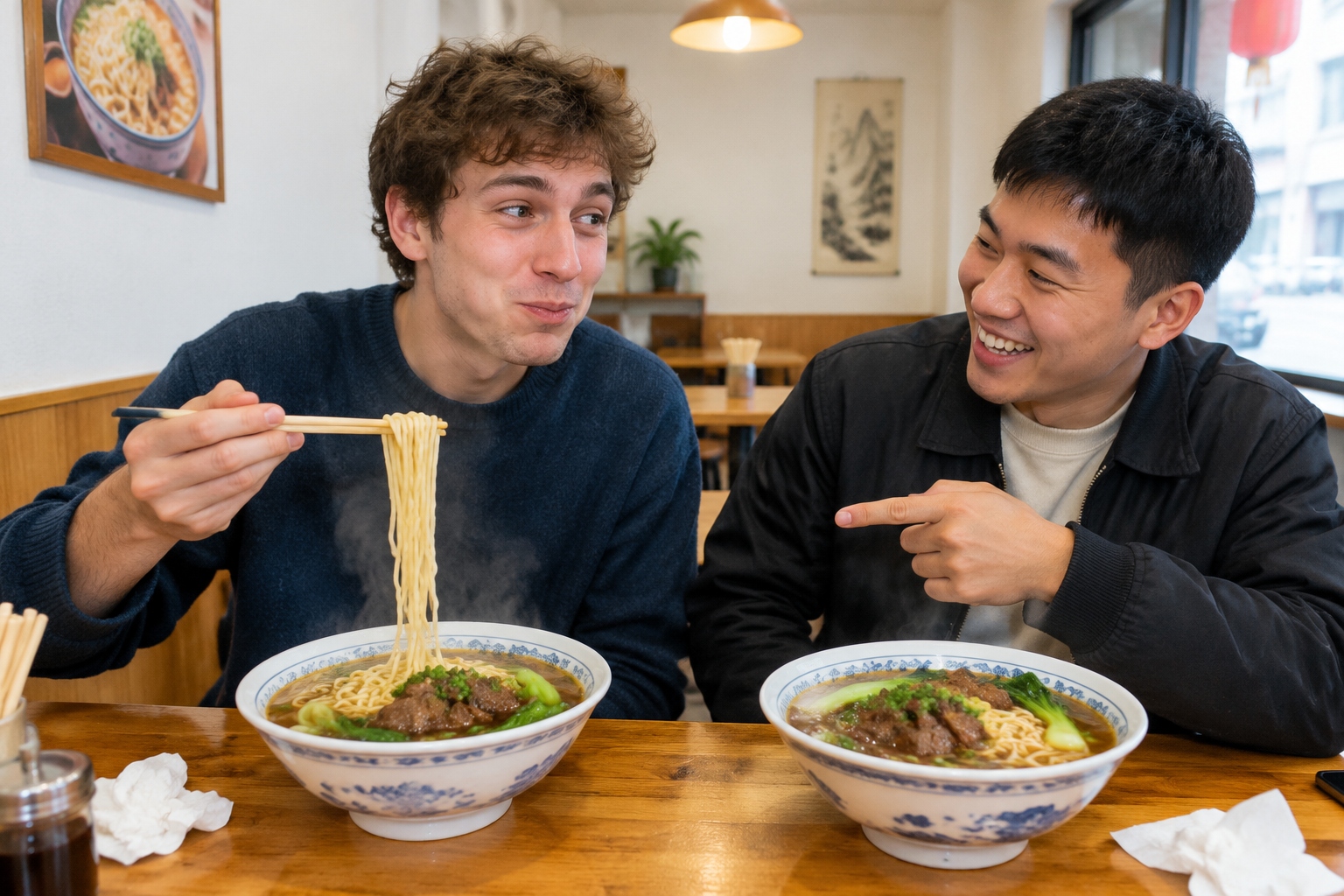
- Order small. Xiao wan — a small bowl. You can always order a second one, and you learn the shop’s rhythm first.
- Chopsticks right, spoon left if you are right-handed. Noodle shops set both down by default, and the spoon is for broth, not for noodles.
- Lift four to six strands, not twenty. An oversized bundle means a chili-oil facial.
- Bring your head to the bowl, not the bowl to your face. This is the single biggest difference between a confident eater and a tourist.
- Breathe in as you lift. A short, natural inhale. If it feels theatrical, it probably sounds theatrical too.
- Add vinegar and chili oil yourself. In Lanzhou beef noodle shops, a splash of black vinegar changes the entire bowl. Raw garlic cloves on the table are optional and socially acceptable, with consequences.
- Take more napkins than you need. This is not a delicacy contest. Everybody splashes.
Nobody Is Watching You. Everybody Is Listening.
Noodle shops are among the most democratic rooms in China. In Suzhou, a retired teacher and a delivery rider share a table over the same bowl of pork noodles. In Chongqing, a bowl of xiaomian often costs 8 to 15 yuan — roughly one to two US dollars — which makes it one of the last genuinely classless meals in any city on earth.
So the slurp is not only about temperature or aroma. It is a shared permission slip. When you make the noise, you stop being a guest at the table and become part of the room. The noise says: I am eating, I am not performing, and this bowl is good.
The first slurp is awkward. By the third bowl you stop noticing you are doing it. Then one day, in a noodle bar in London or Toronto, you will lift a bundle of noodles, hear yourself, and look up — into a room of people quietly wondering what is wrong with you. That is when you know the habit stuck.
And if a chef in Chengdu ever hears you slurp from across the room, they probably will not think you are rude. They will just assume you liked it.
Start the discussion at forum.chinacomes.com