

Morning in an Old Alley: From Noodle Pot to Phone Stand
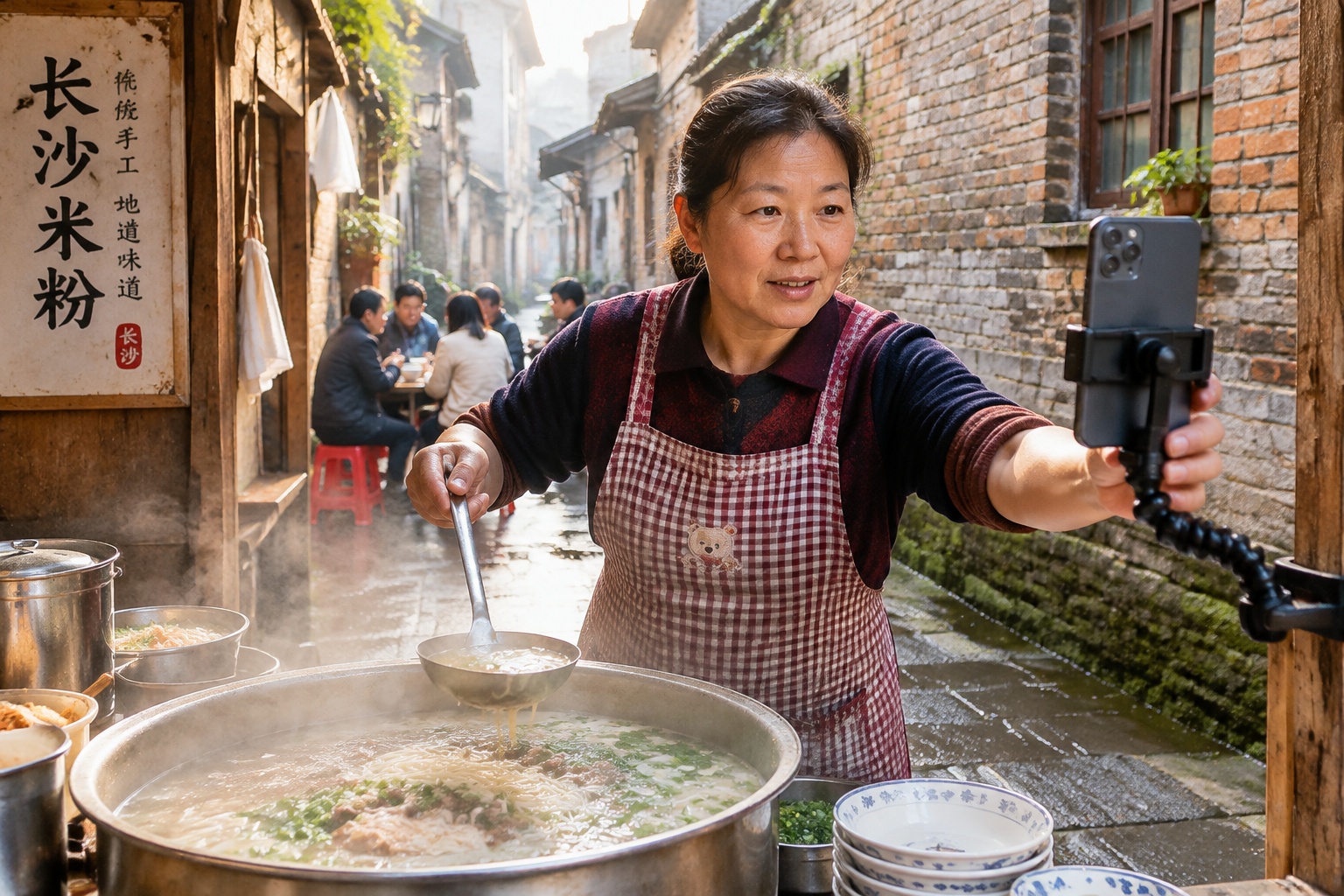
At 6:40 a.m., the alley off Taiping Street in Changsha is still wet from last night’s rain. A middle-aged woman named Zhou Lifang lifts the lid off a simmering pot of pork bone broth. Steam fogs her glasses. She wipes them with the corner of her apron, then reaches for a phone mounted on a flexible tripod clamped to the edge of her stall.
“Good morning, everyone. The broth is ready today. See that? That’s real bone broth, not powder.” She speaks into the phone the way she might talk to a customer standing two feet away—direct, a little hurried, with the unmistakable Changsha accent that turns every sentence slightly upward at the end.
Zhou is 52. She has run this six-square-meter rice noodle shop for 18 years. The shop has no signboard—regulars just call it “the one next to the vegetable market.” But for the past two years, she has also been a live streamer on Douyin, China’s version of TikTok. Her channel has 43,000 followers. Most of them will never set foot in Changsha. They watch her chop scallions, scald noodles, and argue with her neighbor about whose stinky tofu smells better.
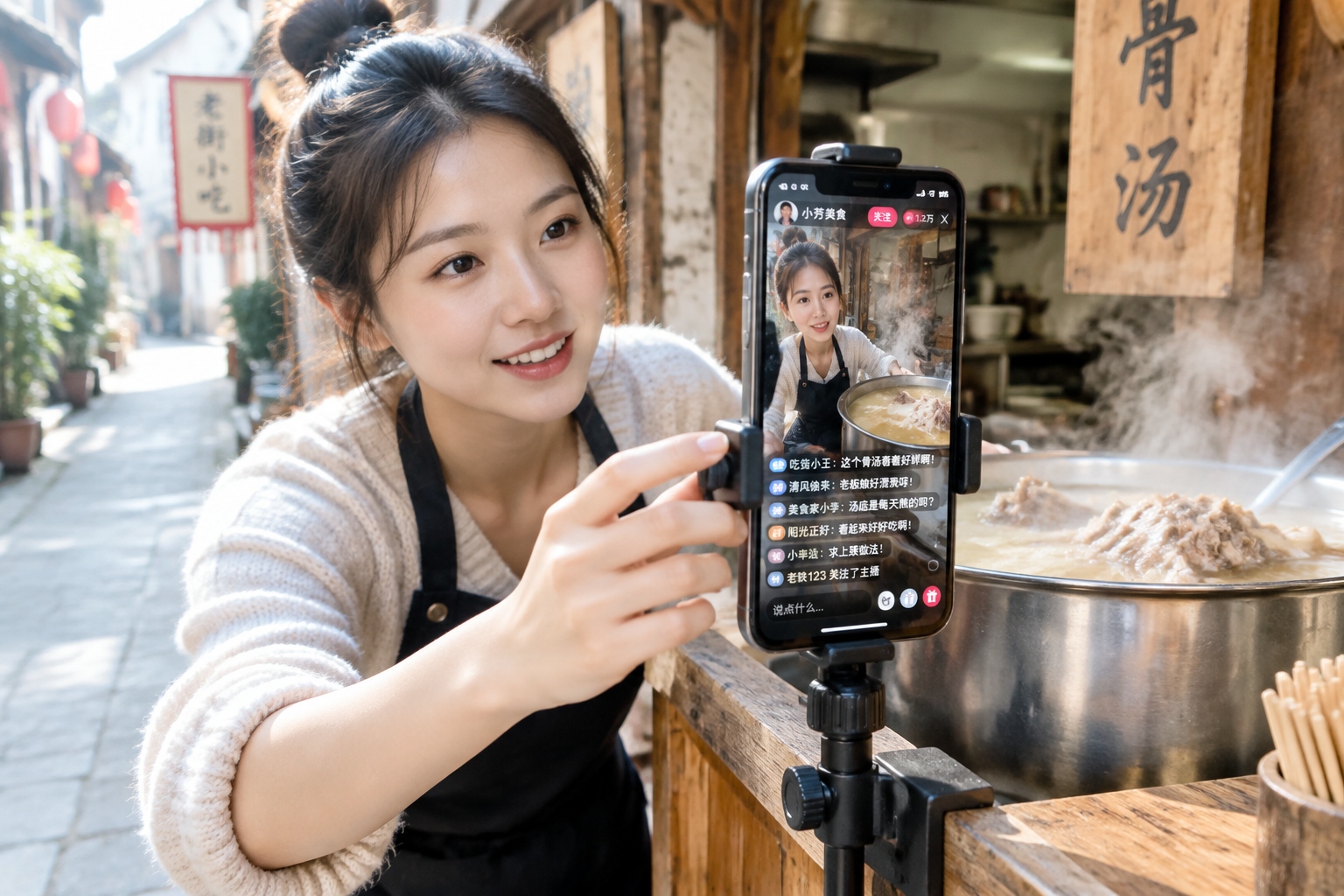
Live streaming has become as ordinary as the morning broth for many small food businesses in China. It is not a tech-industry spectacle. It is a tool, like a ladle or a wok, picked up because the old ways of getting customers stopped working.
From Stove to Screen: One Shop Owner’s Shift
Zhou’s shop sits at the mouth of an alley that connects a residential block to a busy wet market. Before 2020, she had a steady rhythm: 200 to 300 bowls of noodles a day, mostly breakfast and lunch. Office workers, market vendors, elderly neighbors. She knew most of them by name.
Then the pandemic hit. The alley emptied. For three months, she sold maybe 30 bowls a day. “I sat there watching the broth cool,” she says. “You can’t reheat bone broth forever. It turns cloudy.”
Her daughter, a 24-year-old who works in e-commerce in Shenzhen, suggested she try live streaming. “She sent me a phone stand and a ring light. I didn’t know what a ring light was. I thought it was for taking selfies.”
Her first live stream was in June 2021. She set up the phone, pressed the red button, and then froze. “I just stared at the screen. I didn’t know what to say. Twenty people came in. One person typed ‘Is this a real noodle shop?’ I said yes. Then I said nothing for three minutes.”
She laughs about it now. But that awkwardness—the silence, the fumbling—is exactly what drew her first followers. “People told me later they liked it because it wasn’t a performance. It was just a woman making noodles.”
What Live Streaming Changed: Customers, Income, and Neighborhood
Two years in, the numbers are modest but real. Zhou streams for about 90 minutes each morning, from 6:30 to 8:00, while she preps and serves breakfast. She averages 200 to 400 viewers at a time. On a good day, online orders—mostly for her packaged chili oil and dried noodles—bring in an extra 200 to 300 yuan. That’s roughly 30% of her monthly income now.
The bigger change is not the money. It’s the people.
“Last month a couple from Wuhan came. They said they watched me every morning for a year. They ordered two bowls of beef noodles and cried a little when they ate. I didn’t know what to say. I just gave them extra beef.”
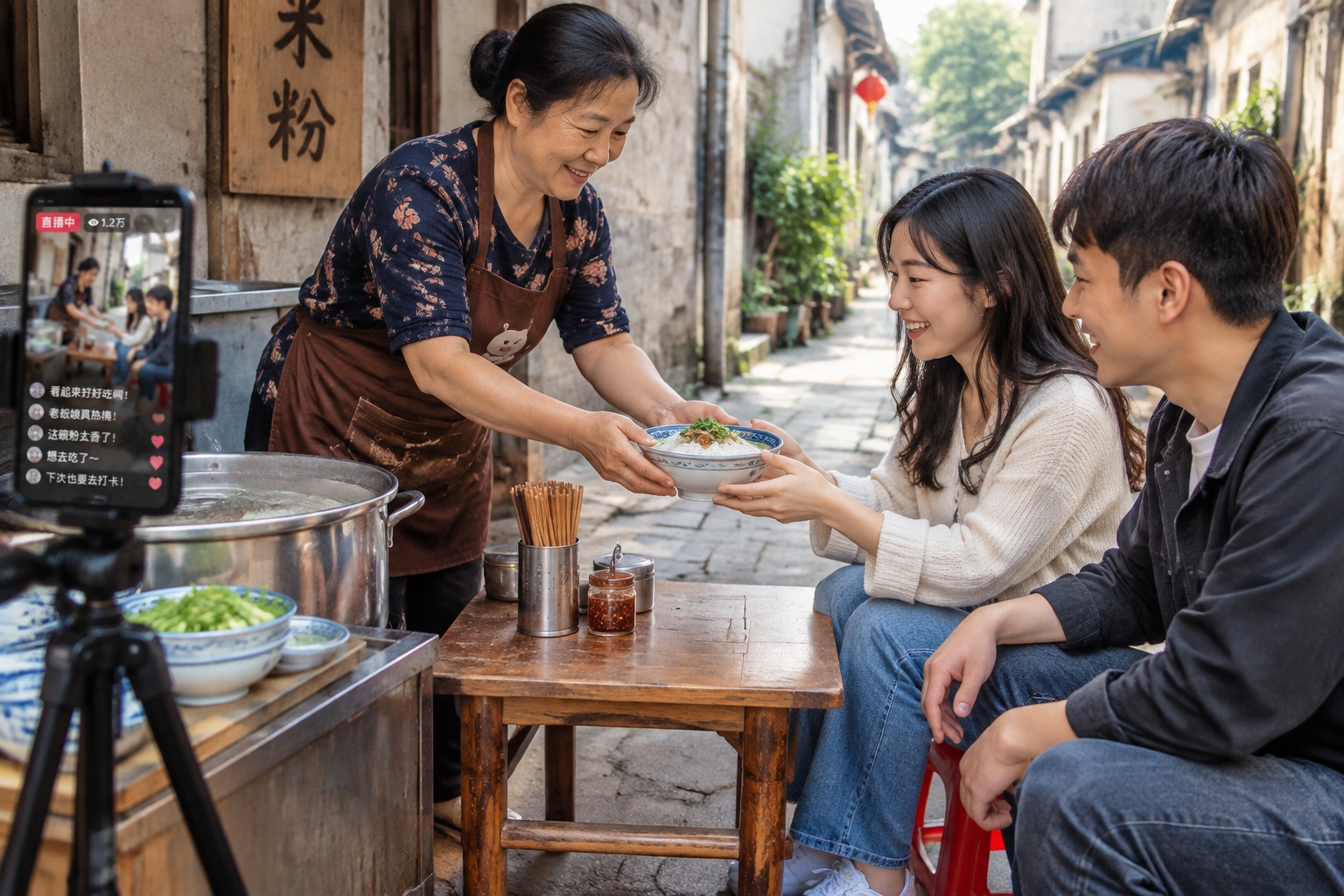
Local customers have changed too. Her neighbor, a 60-year-old man who sells stinky tofu three stalls down, used to mock her phone stand. “He said, ‘Who wants to watch you cook? We all know how to cook.'” Then he saw her online orders. Now he has his own account. He streams in the afternoon, mostly frying tofu and complaining about the weather. He has 8,000 followers.
The alley has become a small ecosystem. A tea shop owner next door started streaming her tea brewing sessions. A young man who makes handmade hairpins from the back of his parents’ grocery store now sells them on live stream to customers in Shanghai and Guangzhou. “We help each other,” Zhou says. “If I’m busy, the tea shop lady holds my phone. If she’s busy, I watch her chat.”
The Barriers and Tricks: Not Every Old Shop Can Just Start Streaming
It would be misleading to suggest this is easy. Zhou lists the obstacles without drama.
First, equipment. She spent 600 yuan on a basic setup: phone stand, ring light, external microphone, and a power bank. “That’s a lot for a shop that sells six-yuan bowls of noodles.”
Second, the learning curve. “I didn’t know what a ‘comment’ was. I didn’t know how to block someone. Once a man typed something rude about my daughter. I cried after I turned off the stream. My daughter had to teach me how to ban him.”
Third, the platform rules. Douyin’s algorithm favors frequent, long streams with high engagement. “If I stream for only 20 minutes, nobody sees me. If I talk too much about prices, they think I’m advertising. You have to learn the rules, and the rules keep changing.”
Her own tricks are simple and hard-won. She streams only during breakfast hours because that’s when she’s busiest and most natural. She never reads negative comments out loud. She always shows the broth pot first—”people want to see steam.” She names regular customers when they walk in. “It makes viewers feel like they’re part of the neighborhood.”
Support has come from unexpected places. The local street committee organized a free training session on live streaming for small vendors. A Douyin representative came to the neighborhood and explained how to set up a shop window. “I didn’t understand half of it,” Zhou says. “But my daughter watched the recording and explained it to me.”
A New Ecology in the Old Alley: How Live Streaming Reshapes Street Life
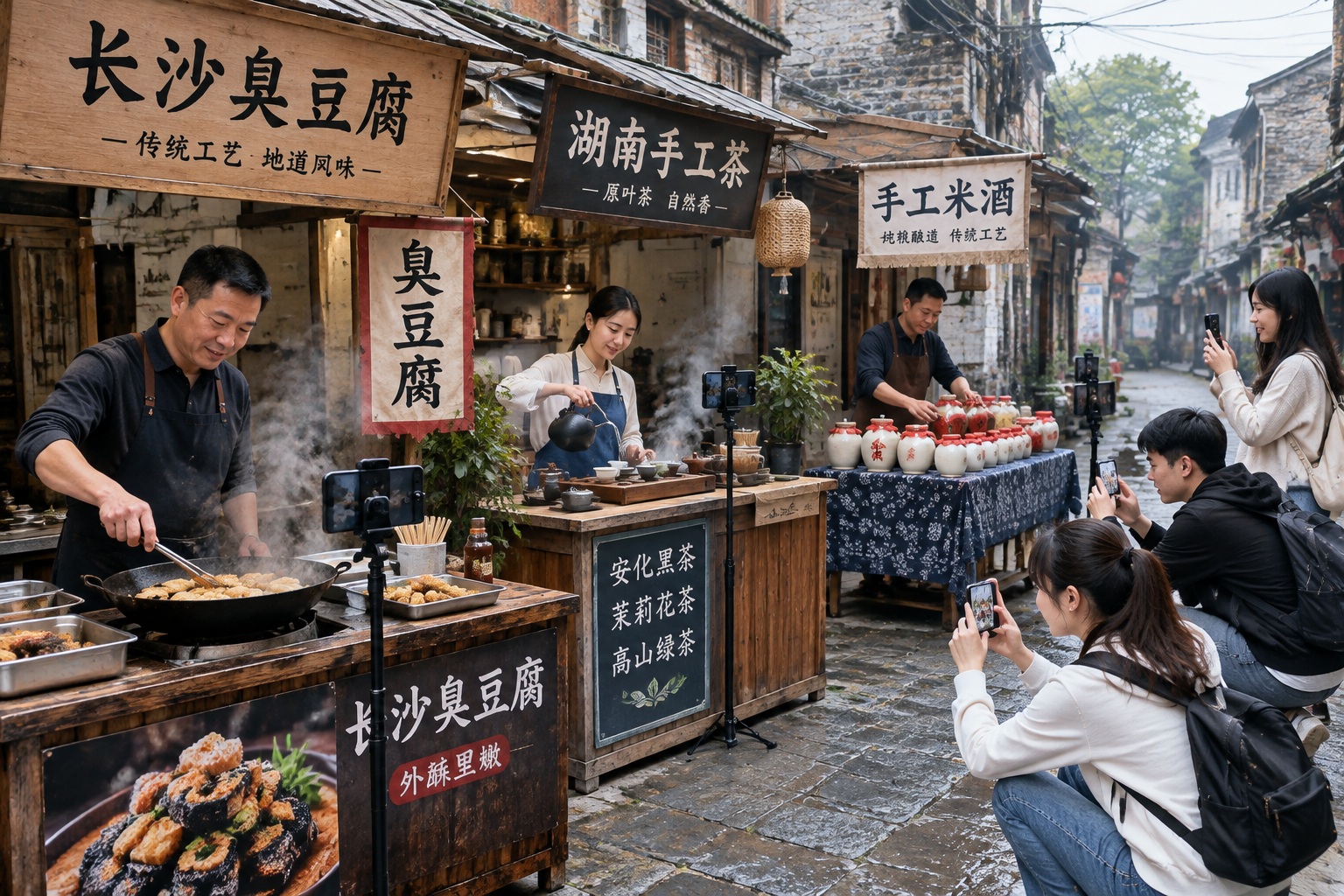
Walk down Zhou’s alley on a weekday morning and you’ll see more than one phone stand. The braised meat shop has one. The tea shop has one. A young woman selling handmade rice wine has one, angled to catch the light from the alley’s single window.
The demographics have shifted too. Zhou’s daughter now helps her edit short videos from Shenzhen. A neighbor’s son, a 19-year-old who dropped out of vocational school, runs live streams for three different shops in the alley. “He’s better at it than any of us,” Zhou says. “He knows when to zoom in, when to play music.”
The alley itself has become a destination. On weekends, young people come to take photos of the old brick walls and the steaming pots. Some of them are drawn by the live streams. They order a bowl of noodles, film themselves eating it, and post it on Xiaohongshu, China’s Instagram. The shop owners don’t mind. “More people means more business,” Zhou says. “And it’s nice to see young faces.”
But there is tension too. Rent has gone up slightly. Some older residents complain about the noise. A few shops have closed because they couldn’t adapt. “It’s not for everyone,” Zhou says. “My neighbor who sells vegetables, she’s 70. She tried for a week and gave up. She said, ‘I’d rather just sell vegetables.'”
The Bigger Picture: Digital Survival for Ordinary Chinese
Zhou’s story is not unique. According to Chinese media reports, by 2023, more than 100 million small businesses and individual vendors in China had tried live streaming or short video commerce in some form. The infrastructure that makes it possible—cheap smartphones, near-universal 4G and 5G coverage, mobile payment systems like WeChat Pay and Alipay, and a logistics network that can deliver a package to a village in two days—is something many outside China underestimate.
But sustainability is an open question. Platform algorithms change. Consumer attention is fickle. Zhou’s online orders dropped 40% last month when a popular influencer started selling competing chili oil. “You can’t rely on it,” she says. “The noodles are still the main thing. The phone is just a window.”
Other shop owners echo this. The stinky tofu seller says he streams “for fun, not for money.” The tea shop owner says she does it “because my daughter told me to.” None of them see live streaming as a replacement for their core business. They see it as a supplement—a way to reach people who might otherwise never know they exist.
Conclusion: The Future of the Old Alley Is Decided by Specific People
At 7:55 a.m., Zhou’s breakfast rush is winding down. She picks up the phone, turns it to face the alley, and says goodbye to her viewers. “That’s it for today. The broth is almost gone. Come early tomorrow if you want the good parts.”
She turns off the stream, wipes down the counter, and sits on a small stool to eat her own bowl of noodles. No phone. No ring light. Just the alley, the steam, and the sound of a neighbor’s radio playing Xiang opera.
Tomorrow she will do it again. Not because she loves technology or believes in digital transformation. Because it works—enough. And because, like most people, she is just trying to keep her small business alive in a changing world.
“I don’t know if I’ll still be streaming in five years,” she says. “Maybe. Maybe not. But I’ll still be making noodles. That part doesn’t change.”
Start the discussion at forum.chinacomes.com