


Two hours, one straight line
On a July morning in front of the Hall of Supreme Harmony, the Forbidden City looks like rush hour on a very old and very beautiful subway platform. Tens of thousands of people, all moving along the same invisible line: south gate in, north gate out. Phone up, water bottle in hand, photos taken, done in about two hours.
This is the version of the Palace Museum that most of its roughly 17 million annual visitors see, and it is a good version. It is also, by area, maybe a third of the place.
The walled complex covers 72 hectares — about 180 acres — and holds around 980 surviving buildings and some 8,700 rooms. The famous north–south axis, with the three main halls at its center, is the spine of it. Those halls are where emperors held court, and they are genuinely worth queuing for. But over the past decade the museum has pushed its public area from roughly half the site to about 80 percent, and most of that new territory sits off the axis, in the eastern and western wings.
That is where the other Forbidden City lives: conservators, scientists, a small digital team, and about 200 cats with names, territories and, in some cases, more online fans than the museum director.
Behind the gates, a workshop that never really closes
Walk west from the central axis and the crowd noise drops within two minutes. The courtyards known as the Western Three Compounds, or Xisan Suo, once housed imperial consorts — the kind of place where a Qing dynasty woman might spend a long, quiet life. Today they house the museum’s conservation department.
About 200 conservators work here, split into specialties so narrow they sound invented: clocks, bronzes, ceramics, lacquerware, inlaid objects, textiles, wooden furniture, the mounting of calligraphy and paintings, and the custom-built boxes that hold everything else. You can spend thirty years and end up the world’s leading authority on Qing dynasty clockwork — because there are only a handful of people alive who need to be.
The work happens inside listed Ming and Qing buildings, which adds its own set of rules: no drilling, no heavy machinery, careful climate control, and in June, apricots falling off the trees in the courtyard, which the staff collect and share.
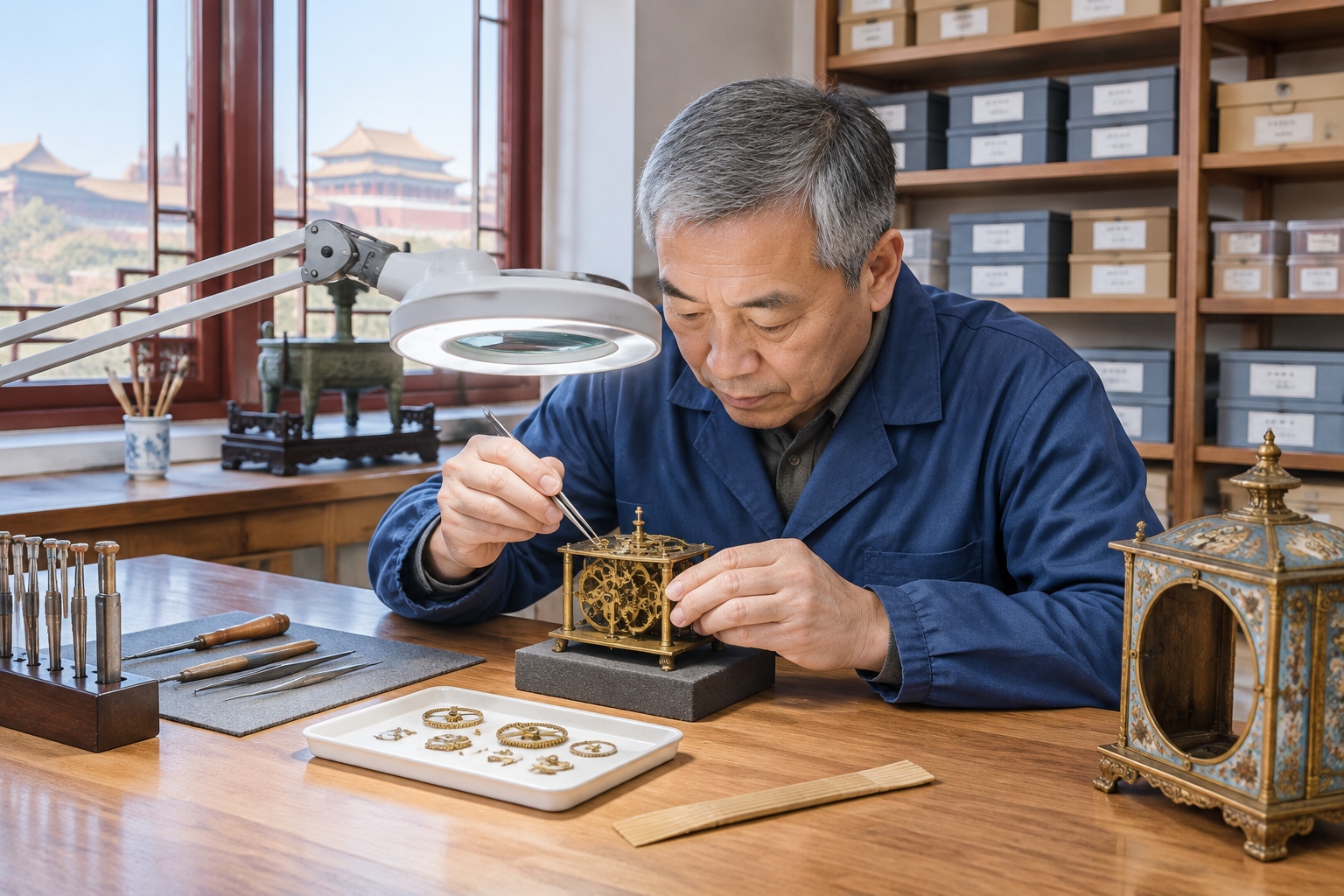
A CT scan for a clock that still ticks
In 2016 the museum finished a dedicated conservation science building. Staff call it the “relic hospital,” and the name is accurate. It has X-ray and CT scanning, Raman spectroscopy, microscopy and climate-controlled rooms — plus windows onto the corridor, so visitors can watch conservators work through the glass.
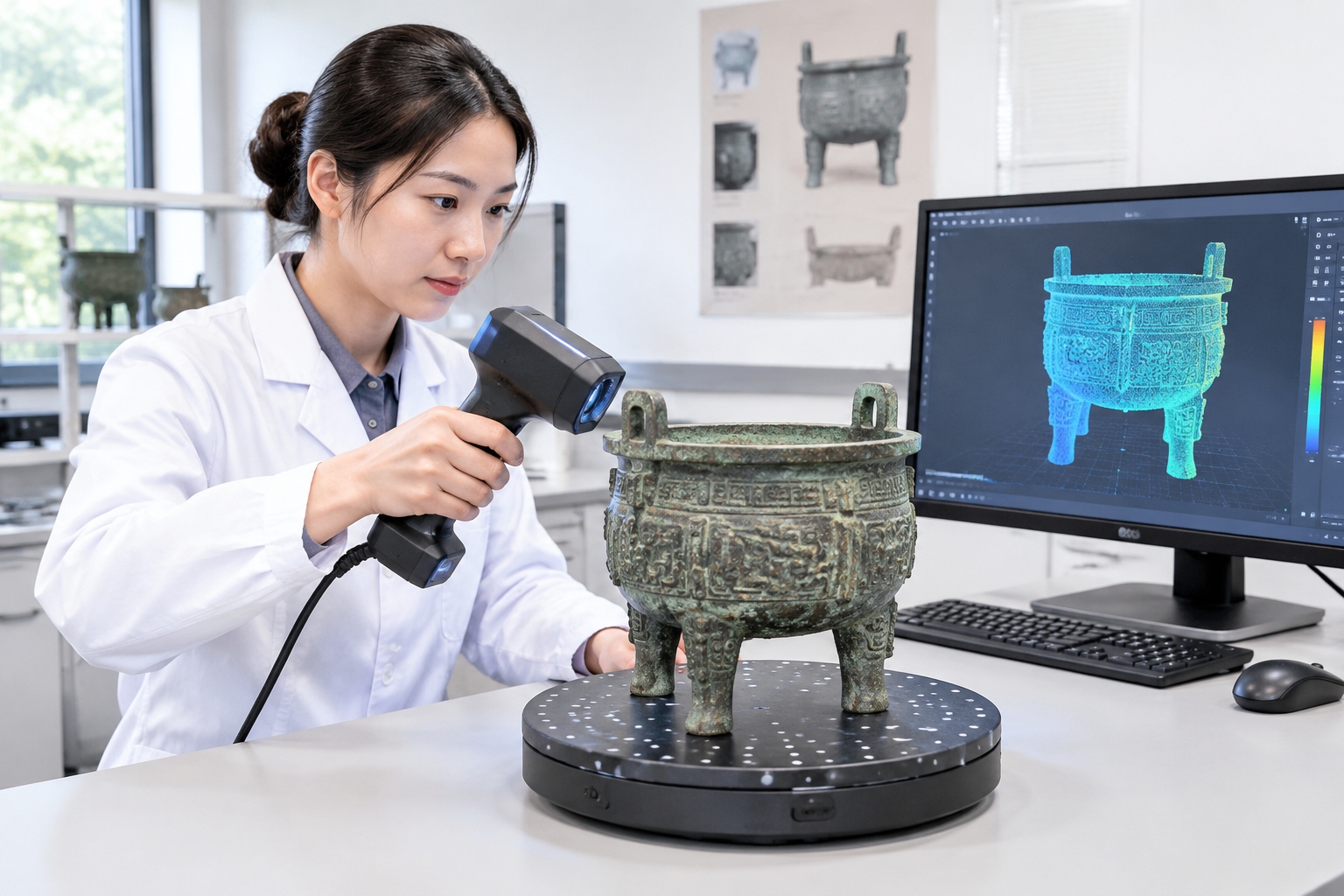
The toolkit is a mix of centuries. Mounting a 900-year-old painting still means mulberry paper, wheat-starch paste and a bamboo splint, the same method recorded in Song dynasty manuals. A bronze that cannot be opened gets scanned instead, so researchers can see the casting flaws and repairs hidden inside it.
Wang Jin, the museum’s best-known clock restorer, has spent more than 40 years with roughly 300 imperial clocks, many of which still run. In interviews he tends to shrug off the word “master.” He fixes clocks.
Nobody here is in a hurry. A new conservator may spend years as an apprentice before touching anything important. The 2016 documentary series Masters in the Forbidden City (我在故宫修文物) became a hit on the video site Bilibili, and the scenes people quoted most were the slow, unglamorous ones: staff sweeping a courtyard, picking apricots in June, bicycling home through empty palace lanes after closing. Applications for conservation jobs reportedly jumped after it aired — a strange and slightly wonderful outcome for a job that involves a lot of sweeping.
The cats are not a marketing invention (mostly)
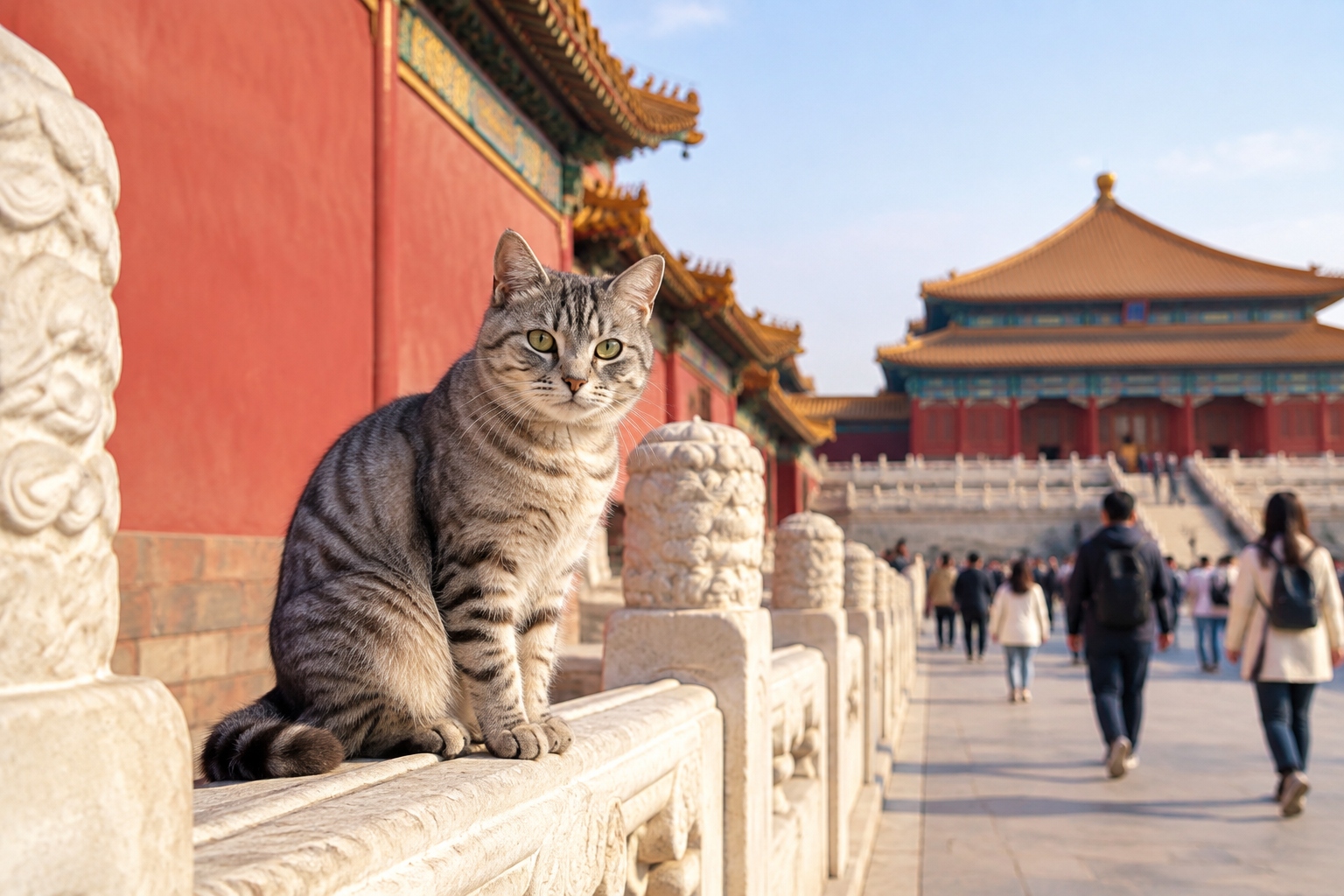
Around 200 cats live in the Forbidden City. They are not quite strays: some are descendants of palace cats, others were left at the gates and taken in. They are vaccinated and sterilized, fed on a schedule, and each has a name and a rough territory. Fans track them online, the museum publishes a cat map for visitors, and the gift shops sell cat scarves, cat pens and cat postcards.
Cats have been here for centuries. A palace built of wood, silk, paper and stored grain needs rodent control, and the imperial household kept cats for exactly that reason. The modern program is partly pest control and partly affection — and then the internet got involved, which is why a grey tabby near the Imperial Garden can now have a fan club.
Now the honest part. You are not supposed to pet them. The museum asks visitors not to feed, chase or grab them, and the staff who care for them would rather you didn’t either. So downgrade the dream slightly: you will not be petting a palace cat. You will be looked at by a palace cat while it decides whether to move, and it will decide not to. Which is, honestly, the more authentic imperial experience.
Best odds: the quieter courtyards on the east side and around the Imperial Garden, late afternoon, when the stone is still warm and the tour groups have drained away. Look up as well — roof tiles are prime real estate.
The part of the collection that leaves as data
The Palace Museum holds about 1.86 million objects. At any given time, less than 2 percent of them are on display. The rest are in storage, in the lab, or waiting their turn on a list that is never, arithmetically, going to end.
Since 2019, part of that list has been online. The Digital Artifact Library launched with roughly 78,000 high-resolution images and has grown past 100,000, with zoom close enough to see brush strokes and glaze cracks. There is also a panoramic virtual tour of the whole complex, which is genuinely useful when tickets sell out — and around holidays, they always do.
Digitization is not a marketing side project. Multi-spectral imaging can pull faded ink off a manuscript that looks blank to the eye. 3D scanning lets researchers measure a surface without touching it. When a piece is too fragile to exhibit, the scan goes out instead.
Why this matters beyond one palace
Museum-going in China has become a young people’s habit in a way that still surprises visitors from Europe and the United States. Weekend tickets to the big national museums vanish in minutes; “reservation” is now standard weekend vocabulary; the gift shop is not an afterthought. The Palace Museum’s cultural-creative products — 文创, wénchuàng, roughly “cultural merch” — have been widely reported to earn more than ticket sales, somewhere around 1.5 billion yuan in a strong year.
But the interesting shift is not the scale. It is where the attention went. The blockbuster halls pull the crowds; the laboratories, the conservation courtyards, the digital library and, yes, the cats are where the museum has invested in depth. Shanghai, Nanjing and Sanxingdui have been running the same play — digitize the storage rooms, open the workshops, let people see the unglamorous middle of the process.
A visitor with three spare hours can walk into parts of the Forbidden City that almost nobody photographs. That is a rarity at any famous site in the world.
Two practical notes. Entry is online-only and real-name: tickets are released several days ahead on the official WeChat mini-program and disappear fast around holidays. And the museum is closed on Mondays except for public holidays.
If you go
Do the central axis early, when it is cool and the light is good, then turn west and stay there. The western courtyards are quietest between 2 and 4 p.m., when tour groups bunch up around the main halls.
Save the last 90 minutes of your ticket. Crowds thin out, the light goes sideways and gold, the courtyards empty, and staff start moving through the site on bicycles.

At closing time the loudspeakers begin their polite eviction notices. Conservators lock their benches. A few wheel bicycles out of side gates. The cats take up their evening positions. On a warm roof tile above an empty courtyard, one of them watches you leave with the expression of a resident who has been here far longer than you, and has no plans to go anywhere.
Start the discussion at forum.chinacomes.com