
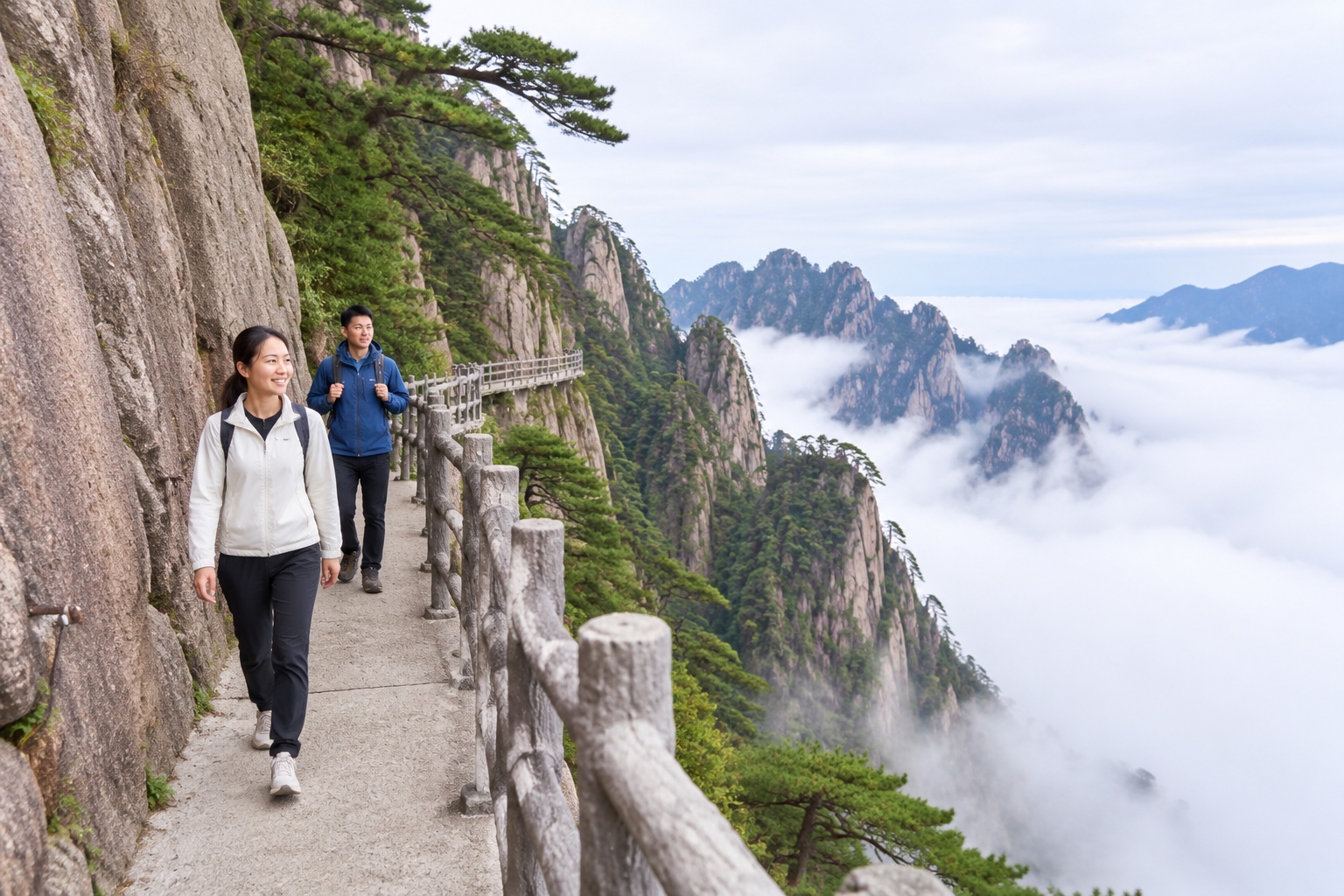

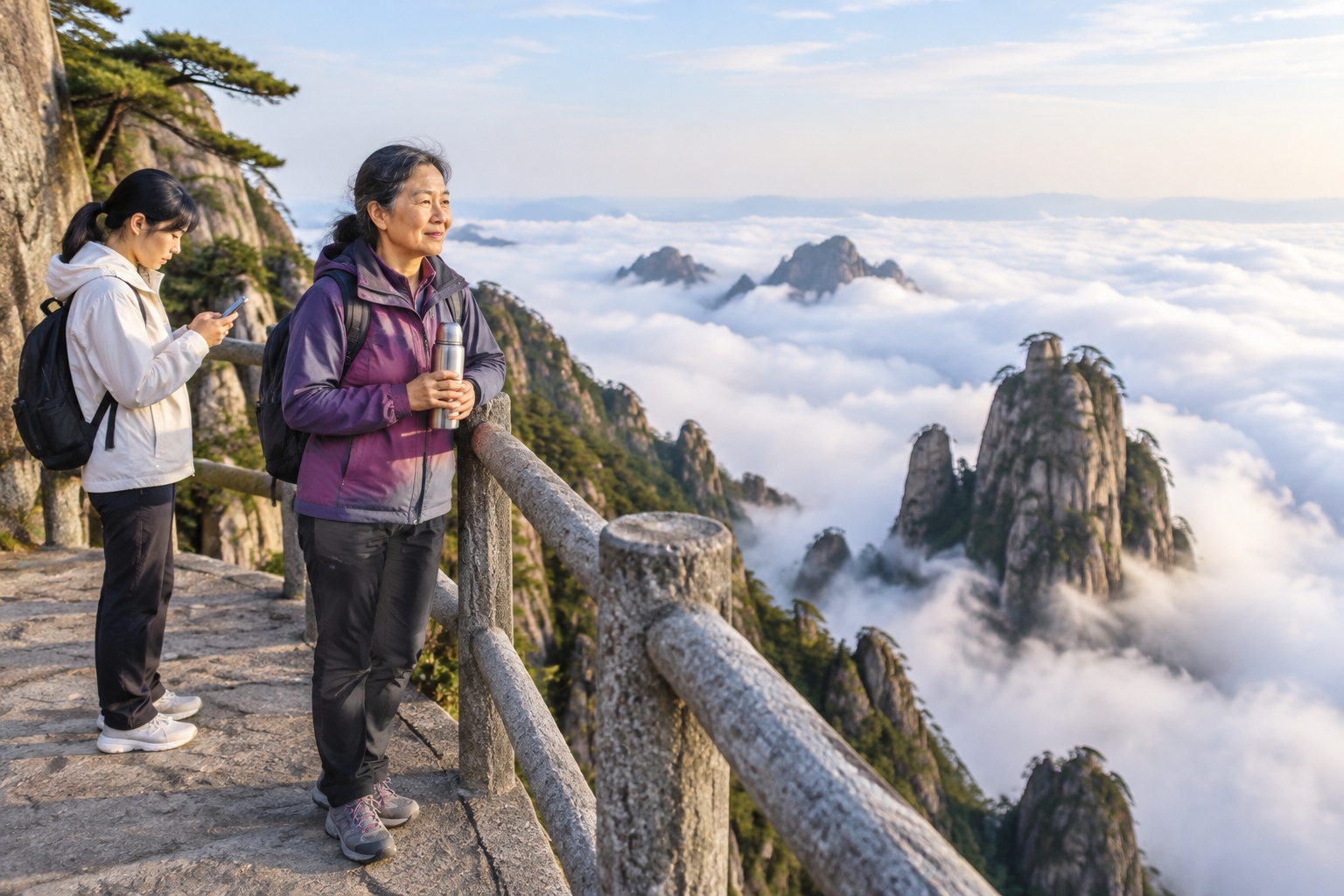
At around 1,600 metres above sea level on Sanqingshan, the path under your feet is flat. Level. Wide enough for two people to pass side by side. There is a handrail at hip height, and beyond the handrail the granite drops away a few hundred metres into a valley of pine trees and moving cloud.
The woman who overtakes me is in her sixties, wearing cloth shoes, holding a steel thermos in one hand and dictating a WeChat voice message with the other. She does not look at the view. She has clearly walked this way before.
I had come expecting danger — something closer to a via ferrata, or a glass bridge with a line of people crawling on their hands and knees. What I found was more like a suburban footpath that happens to be bolted to a vertical cliff. That gap between expectation and reality is the most interesting thing about Sanqingshan, and the reason it deserves more attention from travellers outside China than it currently gets.
Where this is, and what the walkway actually is
Sanqingshan — literally “Three Pure Ones Mountain” — sits in Yushan County, Shangrao, in Jiangxi Province, about three hours by high-speed train from Shanghai. UNESCO added it to the World Heritage list in 2008 for its granite landforms: dozens of stone pillars and pinnacles, many over 100 metres tall, rising straight out of subtropical forest. The most photographed is “Giant Python Emerging from the Mountain,” a 128-metre granite column that stands almost detached from the cliff behind it.
The walkways are the other signature. Two long ones — Xihai, or “West Coast,” at roughly four kilometres, and Sunshine Coast — are pinned to the cliff face at about 1,600 metres, with shorter connecting sections between them. Together they add up to several kilometres of path in places where no natural ledge exists.
How you build a road on a vertical cliff
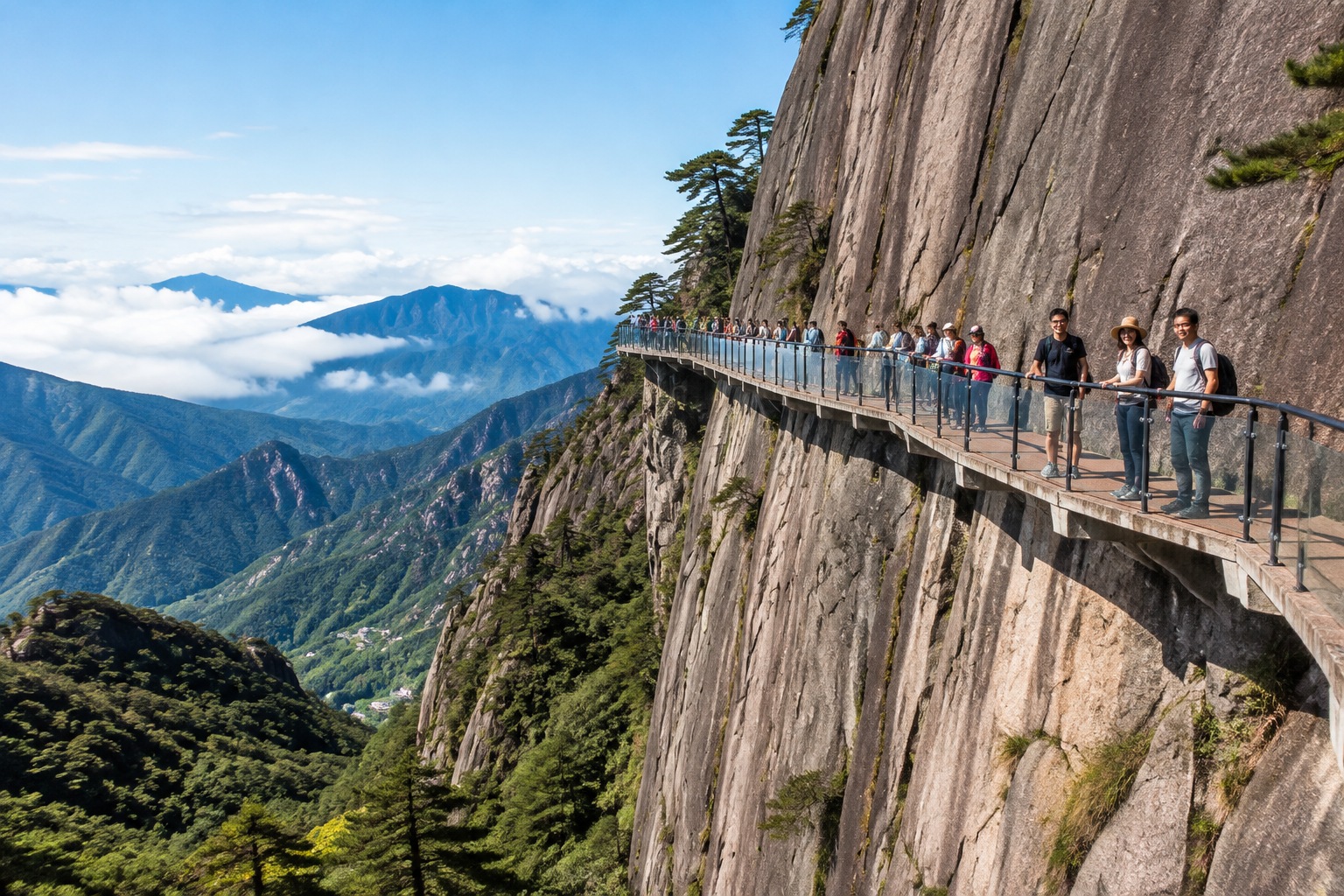
Steel brackets are drilled into the granite. A deck of concrete and stone is laid across them, then a railing. The engineering is deliberately unglamorous, and that is the whole point: no swaying, no ropes, no scrambling, nothing that requires a guide.
Construction began in the early 2000s — the Xihai section opened around 2002 — and the crews did it with no road access and no cranes. Materials went up by cable car and by hand. Workers hung on ropes against the rock face to drill anchor holes, and maintenance teams still work that way today. Rope-access crews check bolts, replace cracked planks and knock loose stones off the cliff above the path, often starting before the first cable car leaves at dawn.
Part of the reason the walkways exist is environmental. Before they were built, hikers cut their own trails across the slopes and the vegetation wore away. An elevated path concentrates hundreds of thousands of footsteps onto a hard surface and lets the ground beneath recover. It also opens the scenery to people who cannot manage 3,000 stone steps — and older visitors make up a big share of the crowd up here.
The parts your body notices
The first hundred metres are the strangest. Your eyes keep checking the drop while your legs keep reporting flat pavement, and the two messages refuse to match.
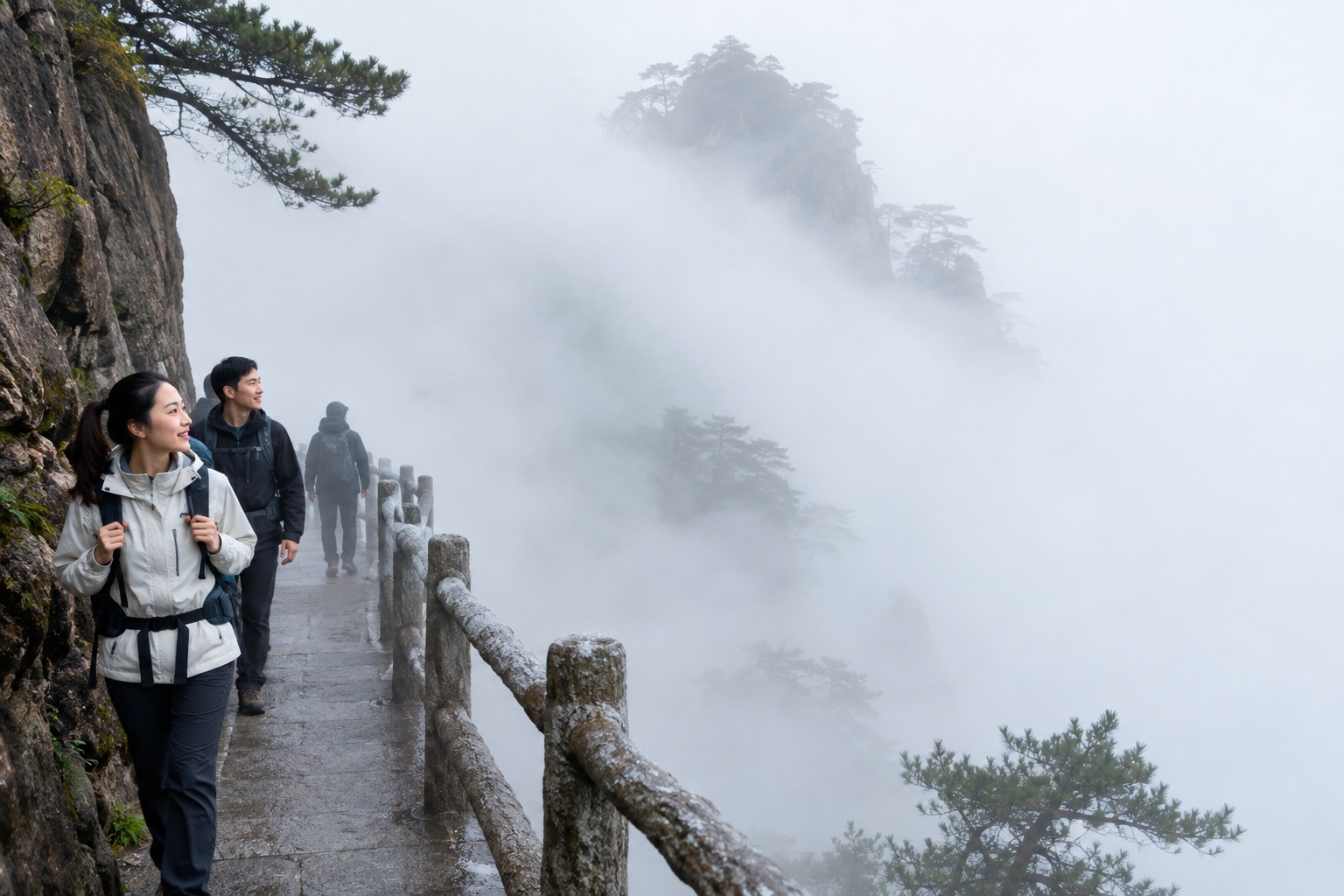
Then the scale catches up with you. You can lean over the railing and see treetops the size of broccoli several hundred metres below. On a clear day you can trace the whole forested valley and the next ridge of granite pillars. On a foggy one — which is most mornings in spring — the valley simply isn’t there. Visibility can fall to 30 metres in a few minutes, the temperature drops several degrees, and the people ahead of you turn into silhouettes. The fog isn’t a disappointment. It’s the better show.
A short stretch near one of the viewing platforms has glass panels set into the deck. Behaviour there is its own small theatre: some people stride across without breaking stride, some sit down and slide, a few take their shoes off, and a surprising number lie flat on the glass for photographs while a queue forms behind them. Nobody is in any actual danger, and everyone knows it, which is exactly why the glass section works as an attraction.
Wild Tibetan macaques patrol some of the rest points. They are quick, unafraid and very interested in snacks. Signage asks visitors not to feed them, and the people who ignore it usually regret it within thirty seconds.
The people you pass on the way
Because the walking is easy, the crowd is not the usual mountain crowd. Grandparents in slip-on shoes. Parents carrying toddlers. Office workers in jeans and sneakers rather than hiking boots. A young man livestreaming to a few hundred viewers, narrating the view into his phone, calling his audience “family” the way Chinese streamers do.
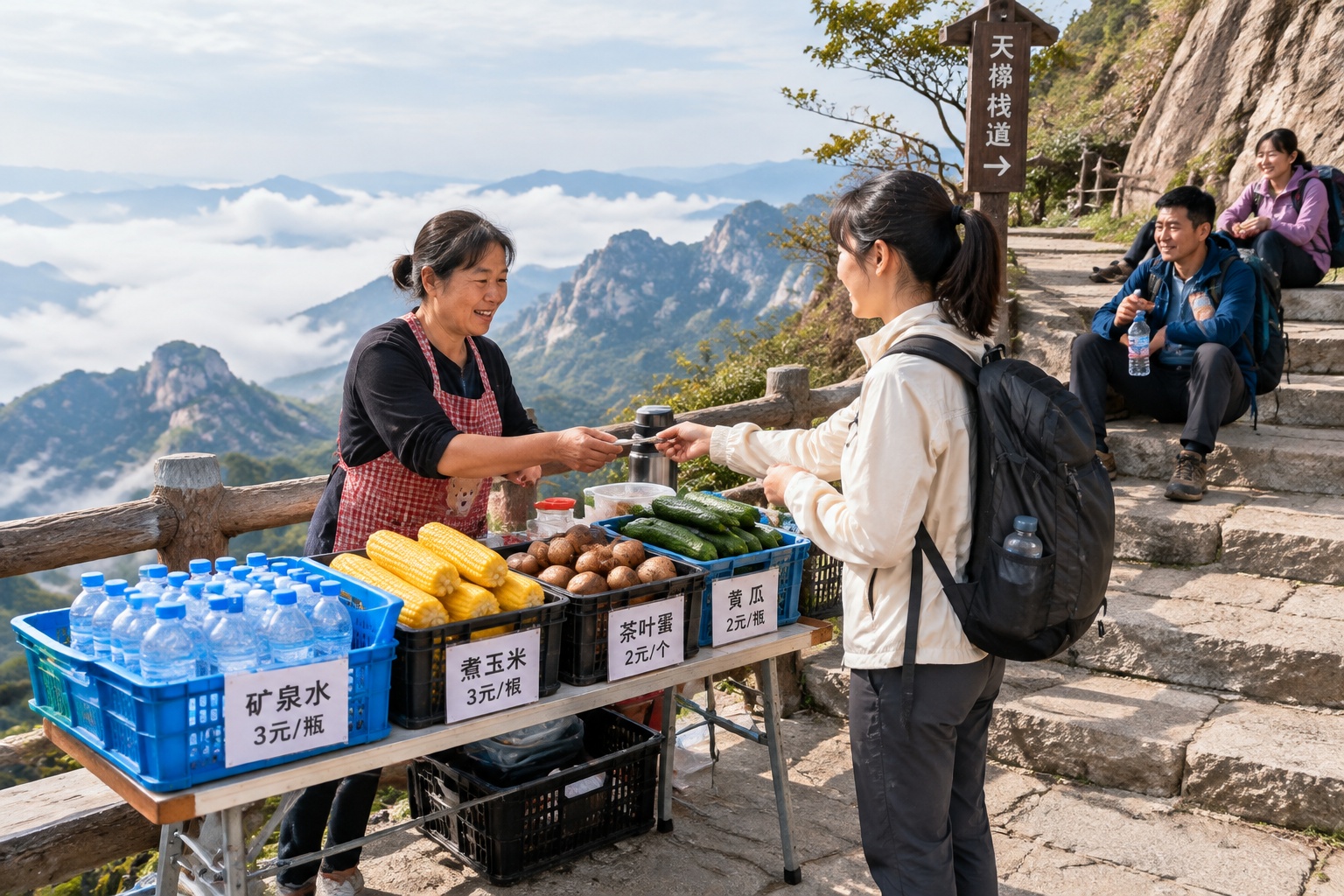
At the rest points, women sell boiled corn, tea eggs, cucumbers and bottled water out of plastic crates. Everything on those tables was carried up — by cable car, by shoulder pole, or both. A bottle of water costs five to ten yuan, roughly a dollar, which is fair for something that came up a mountain to reach you. Porters with shoulder poles still do part of that work, though the cableways now move most of the weight.
What surprises foreign visitors most, I think, is how ordinary the whole thing feels to the people using it. This is a morning walk. A place to bring your parents. Somewhere to eat a bag of sunflower seeds while your friend takes photos.
If you go
Getting there
High-speed rail to Shangrao Station or Yushan South, then roughly an hour by bus or taxi to the cable car base. There are two cableways: Jinsha on the east side and Waishuangxi on the south. Tickets run about 120 yuan, and a round-trip cable car ticket about 125 yuan. Foreign visitors can buy at the counter with a passport; the automated machines mostly expect a Chinese ID card. Mobile payments linked to international cards now work almost everywhere on the mountain, but carry a little cash for the small vendors.
When to go
Avoid Chinese public holidays. The first week of October and the first week of May are the worst — cable car queues can run two hours. Weekdays in April, May, October and November are calm, and those are also the months with the best odds of a sea of clouds. The walkway itself rarely feels crowded, even when the queue below does.
What to bring
The summit is five to eight degrees colder than the base. Bring a rain shell — umbrellas are useless in wind — or buy a five-yuan plastic poncho at the bottom. The walkways are flat, but you still climb stone stairs to reach them, so knees matter more than cardio. If stairs are a problem, take the eastern route up.
What stays with you afterwards
I expected to remember the fear. Instead I remember the flatness — a man sitting cross-legged on a rock at 1,600 metres, watching football highlights on his phone with the sound off, 400 metres of empty air behind him. Two kids racing each other to the next bend. Someone eating instant noodles at a viewing platform above a sea of cloud.
Engineered infrastructure has a way of making the extraordinary ordinary. On Sanqingshan that is precisely the point: a cliff that would once have been a climbing route for a few dozen people a year is now a place where a 70-year-old can take her thermos for a morning walk. Something is lost in that. Something much larger is gained.
Then the fog comes up the valley, the railing fades ten metres ahead of you, and the mountain goes back to being a mountain.
Start the discussion at forum.chinacomes.com