

Nine Towers in the Desert, and a Language Nobody Speaks
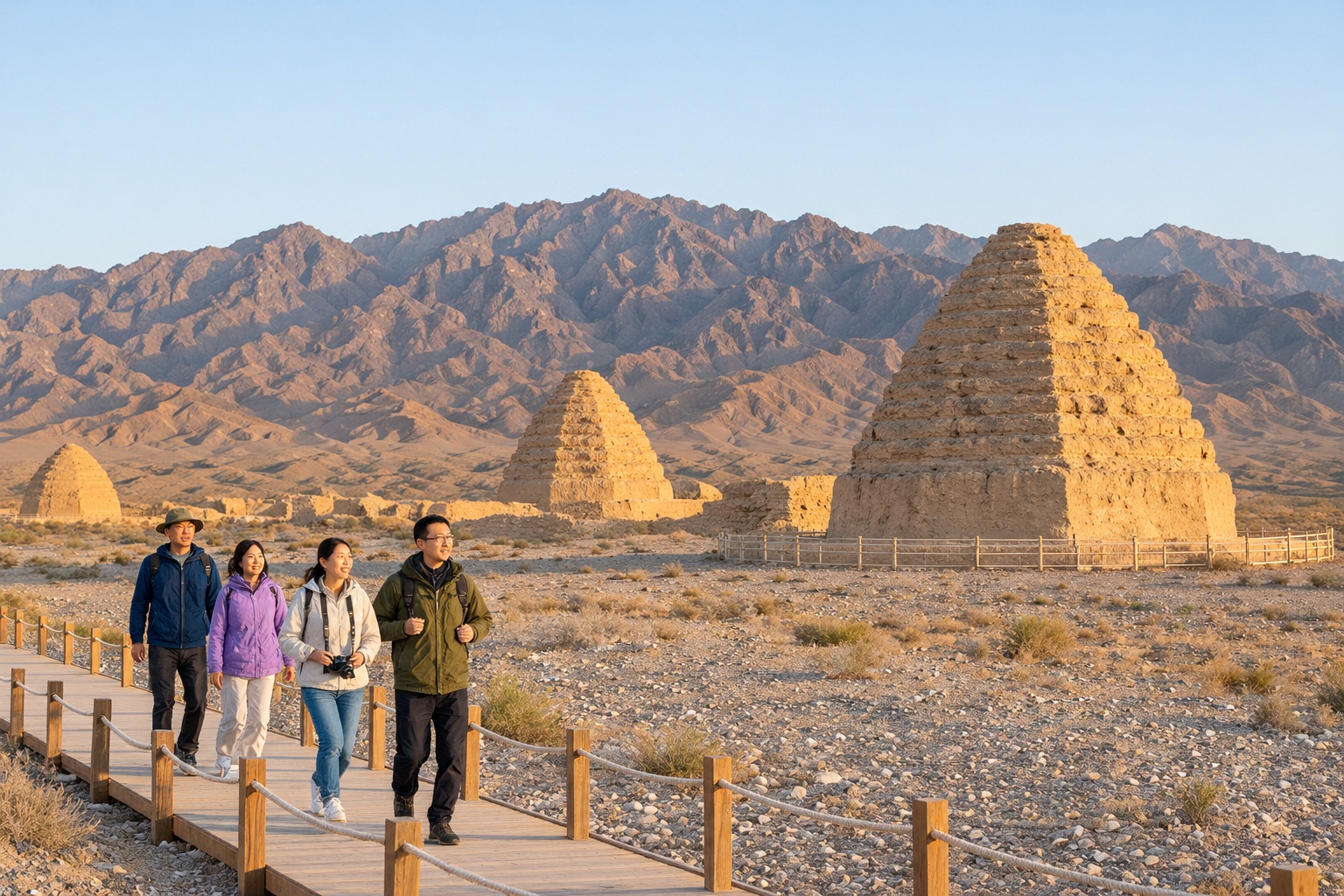
About 35 kilometers west of Yinchuan, the capital of Ningxia in northwest China, the road turns to gravel and runs out of buildings. Then the Helan Mountains appear — a bare grey ridge with barely a tree on it — and at its foot stand nine towers of packed yellow earth, tapered like pyramids with the tips sanded off. The tallest is around 20 meters. They have been there for 800 years.
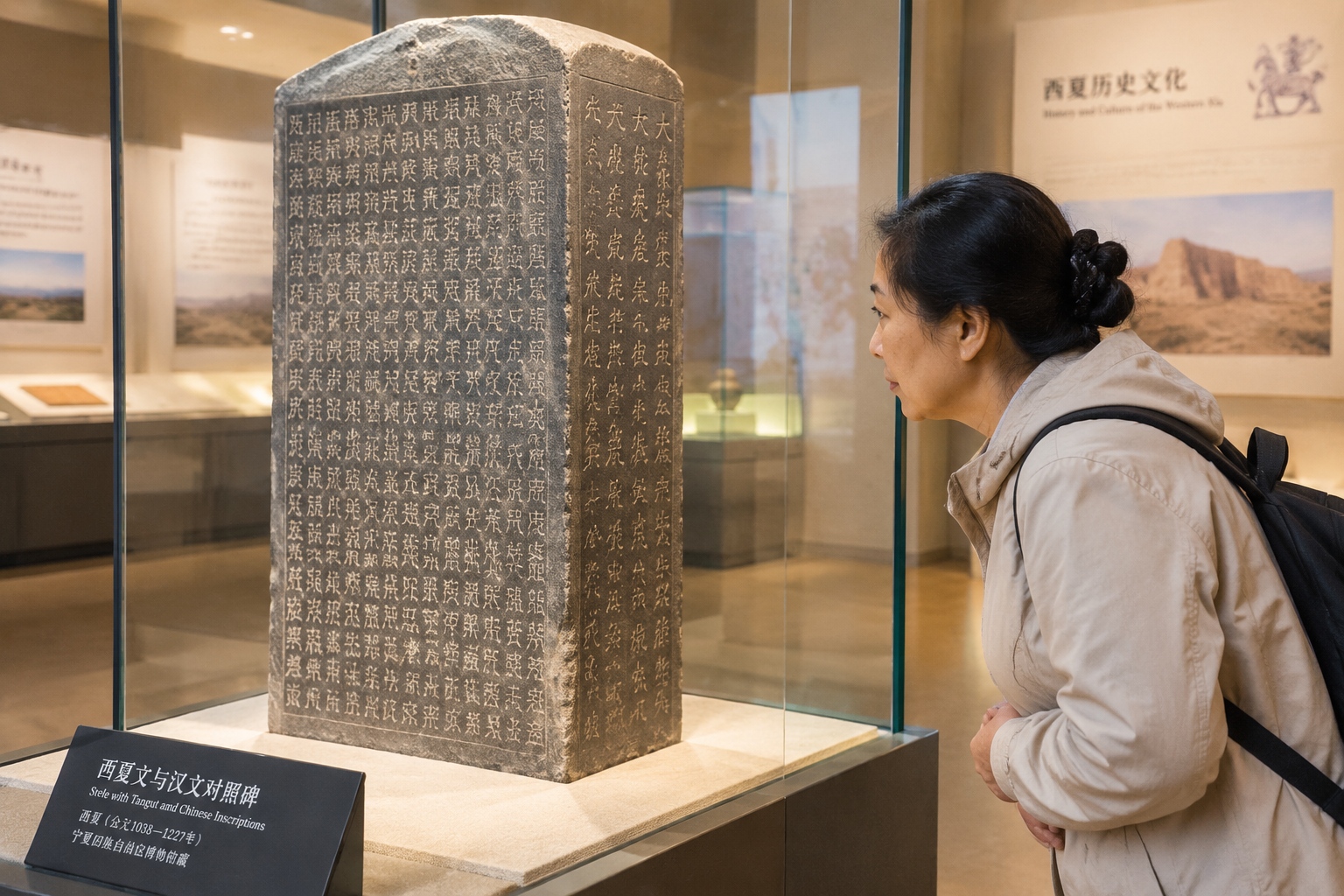
Tour groups photograph them, caption the post “China’s pyramids,” and head back to the shuttle bus. Then they walk into the museum and meet something stranger: a slab of carved text in square, dense characters that look exactly like Chinese — and that no Chinese reader can decipher. Not one word.
These are the Western Xia Imperial Tombs, listed by UNESCO as a World Heritage Site in July 2024. Overseas they are usually sold as the “Oriental Pyramids.” The nickname is catchy and slightly wrong, and the real story is better.
What Is Actually Standing Out There
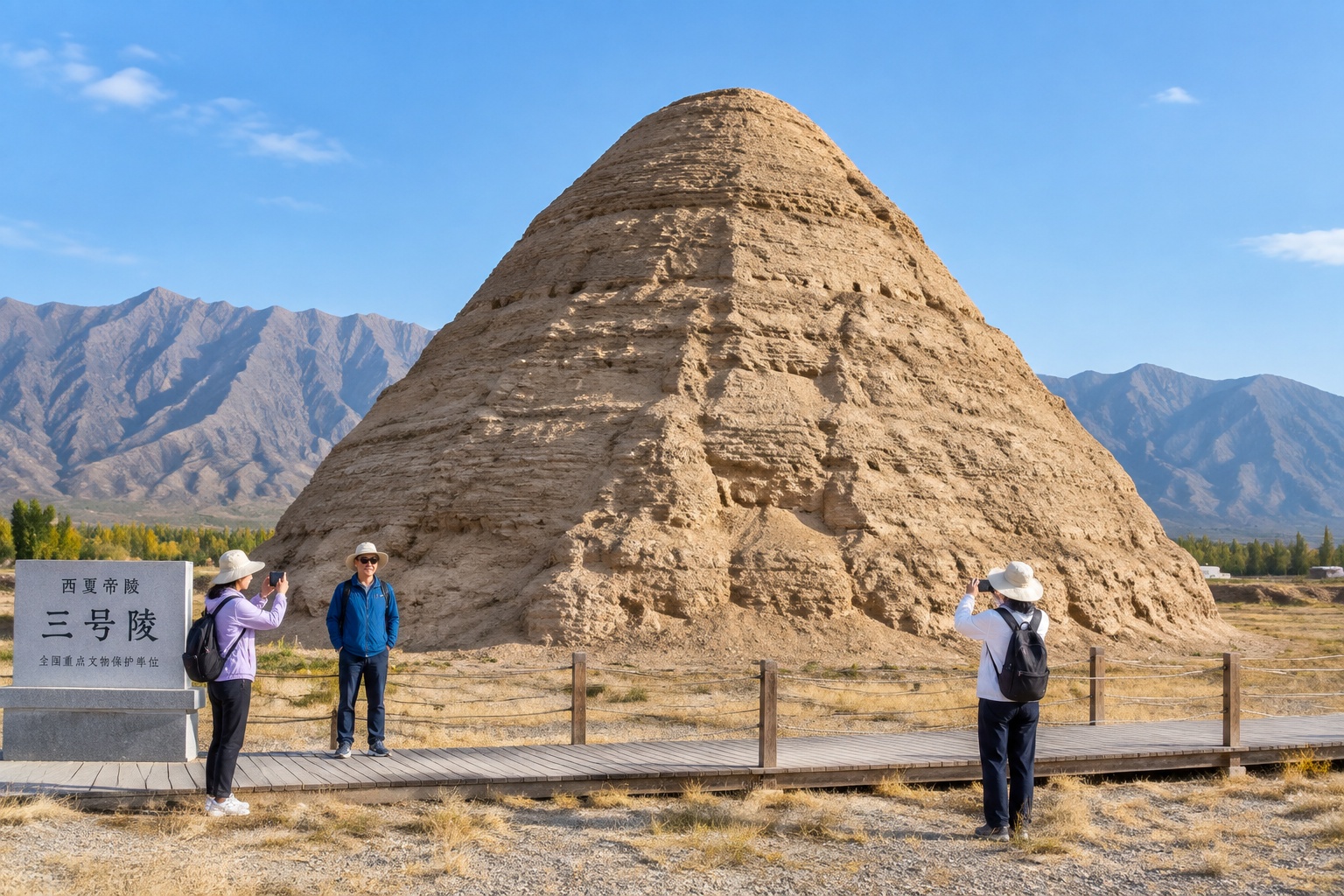
They are not pyramids. They are mausoleum towers — ling ta, tomb pagodas — built by ramming earth layer by layer, the way you would raise a wall out of wet soil and muscle. Each one was originally wrapped in timber, tiled roofs and painted beams, and set inside a walled complex with gate towers, stele pavilions and a buried chamber for the coffin. The wood is long gone: burned, rotted or stolen. What survived is the compressed earth core, which is why they look so abstract, like an architectural model with everything else peeled off.
The cemetery covers about 50 square kilometers along the eastern foot of the Helan Mountains. Archaeologists have counted nine imperial tombs and more than 250 satellite graves belonging to princes, generals and officials. Tomb No. 3 is the largest and best preserved, and it is the one on every postcard.
Who Built Them: An Empire You Have Probably Never Heard Of
The builders were the Tangut, a nomadic people who moved down from the highlands of what is now Qinghai and Gansu into the Yellow River plains. In 1038 their leader, Li Yuanhao, declared himself emperor of a state he called Great Xia. Chinese histories call it Western Xia (西夏).
At its height the empire covered today’s Ningxia, most of Gansu, eastern Qinghai, northern Shaanxi and part of Inner Mongolia. It fought the Song, the Liao and the Jin to a standstill, and it ran a real state: a civil service, an examination system, a mint, a postal network, a Buddhist canon printed with woodblocks. Its territory sat across the eastern corridor of the Silk Road, and it taxed everything that moved.
A State That Decided It Needed Its Own Alphabet
In 1036, Li Yuanhao ordered a scholar named Yeli Renrong to create a writing system for the Tangut language. The result ran to about 6,000 characters. They borrow the idea of Chinese characters — square blocks, strokes, a logic of composition — but they were never Chinese characters. You cannot guess the sound or the meaning of one by laying it next to a Chinese character. The language underneath is not Chinese either; it is Tibeto-Burman, structurally closer to Tibetan than to Mandarin.
For nearly two centuries Tangut was used for law codes, land contracts, poems, sutras, coins and seals. Visitors to the Mogao Caves at Dunhuang scratched Tangut graffiti onto the walls, the medieval equivalent of signing a guestbook. Then, in 1227, it stopped.
Why the Writing Died
Genghis Khan’s Mongol armies destroyed Western Xia in a campaign that stretched over more than 20 years. Genghis himself died during it, in August 1227, and the capital — Zhongxing, today’s Yinchuan — was taken and sacked. The imperial tombs were broken open and burned. It was one of the most complete destructions of a state in Chinese history.
Here is the part that surprises people: the script did not die with the empire. Tangut officials kept working for the Mongol Yuan court. Tangut monks kept printing Buddhist texts. The last known Tangut inscription was carved in 1502, on Buddhist pillars in Baoding, Hebei — nearly three centuries after the state that invented the writing had ceased to exist.
What finally killed it was not a war. It was something quieter. Tangut writing had only ever had one job, and that job was gone.
The script served a state and its Buddhist institutions. No neighboring people ever adopted it. It was never a trade language. Once Western Xia’s bureaucracy, schools and monasteries disappeared, nobody had a reason to teach it to their children. The Tangut themselves dispersed, marrying into Han Chinese, Mongol, Tibetan and Hui communities. By the middle of the Ming dynasty the writing was unreadable even to scholars who had the stones in front of them.
Compare that with Chinese, which outlived every dynasty that fell, because hundreds of millions of people used it daily for taxes, contracts, letters and poems. A script lives exactly as long as the community that needs it.
How Anyone Learned to Read It Again
In 1804, a Chinese scholar named Zhang Shu was visiting a temple in Wuwei, Gansu, when he noticed a pavilion that had been bricked shut. He had it opened and found a stele dated 1094, carved in two scripts: Chinese on one face, and the same text in characters nobody could read. He identified them, correctly, as Tangut. That stele is still the single most important key to the language.
A second, much bigger key arrived in 1909, when the Russian explorer Pyotr Kozlov stumbled on the ruined city of Khara-Khoto in the Gobi desert of western Inner Mongolia. He carried off tens of thousands of Tangut manuscripts, prints and paintings; most are still in St. Petersburg. Among them was a 1190 textbook called Pearl in the Palm, essentially a Tangut–Chinese phrasebook. With that, plus bilingual inscriptions, scholars in Russia, Japan, China and Europe spent the 20th century reassembling the language piece by piece.
Western Xia studies is now a real academic field — Ningxia University has an institute dedicated to it — and most surviving Tangut texts can be read. Just not spoken. Nobody alive learned Tangut as a first language.
What Visiting Feels Like Now
The site is a national archaeological park, about 35 kilometers from downtown Yinchuan and 40 to 60 minutes away by taxi or ride-hailing app. Tickets, including the shuttle bus that links the tombs, run roughly 75–100 yuan (about $10–14). There are boardwalks and English signage at the main stops, though not everywhere.
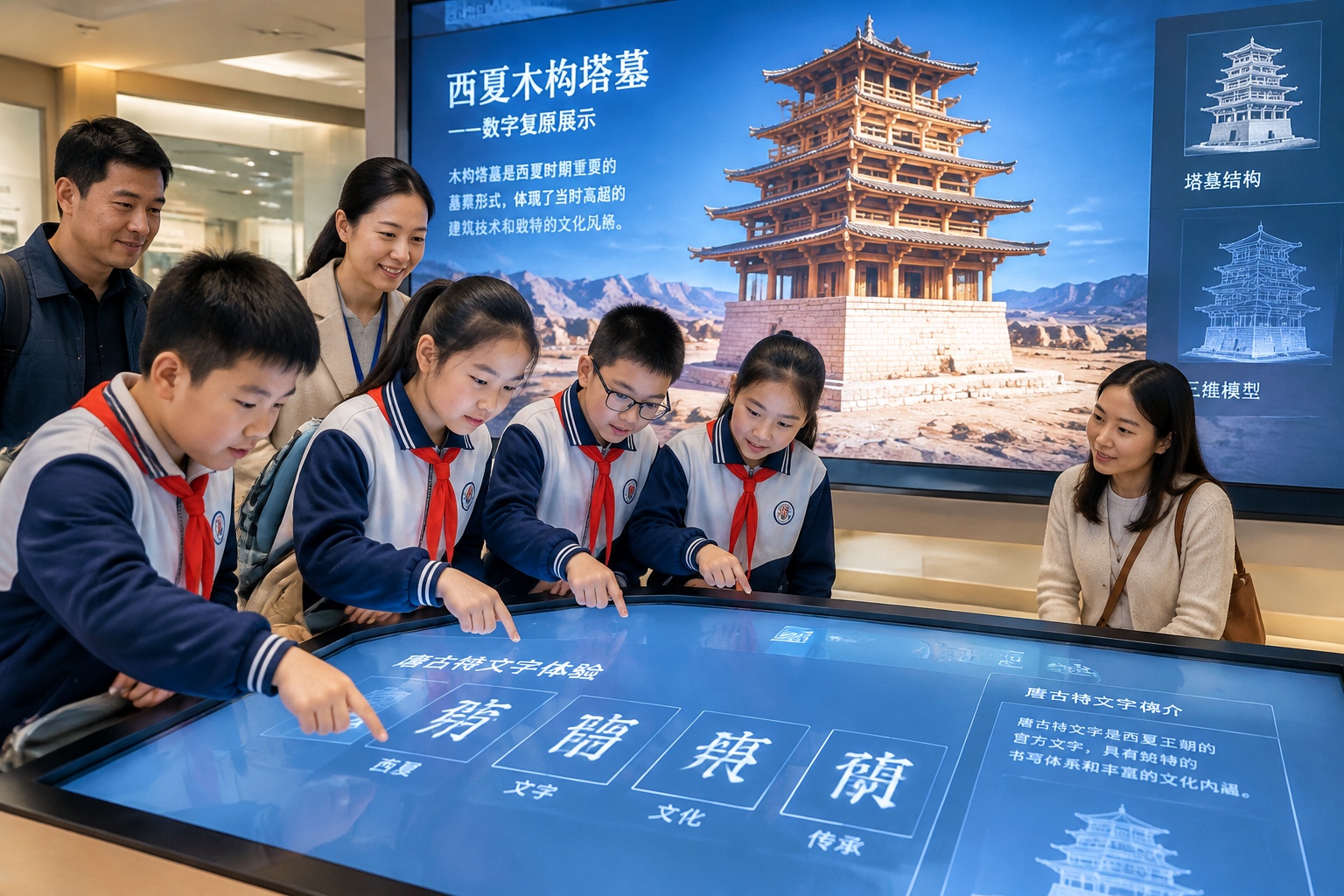
The museum is the part most foreign visitors do not expect. It moved into a large new building in 2019 and leans heavily on digital reconstruction: you can see each tomb as it looked with its wooden pagoda intact, walk a virtual version of the cemetery, and tap Tangut characters onto a touchscreen. School groups from Yinchuan come here on field trips. Guides will cheerfully tell you that scholars still argue over which emperor lies in which tomb — Tomb No. 3 is usually linked to Li Yuanhao, but it is not settled.
Two practical notes. Go between May and October, and bring water and something to cover your face: the site sits on a gravel slope with almost no shade and a constant wind. If you have a car, pair the tombs with two very different stops nearby — the Helan Mountain rock engravings, and the wine region on the mountain’s eastern slopes, where dozens of wineries have been collecting international awards for the past decade. Desert tombs in the morning; a glass of Cabernet at three in the afternoon.
Then drive back into Yinchuan for the evening. The Huaiyuan night market near Ningxia University runs late, and it is where the city actually eats: lamb skewers, cold noodles, yogurt, and goji berries, which Ningxia grows more of than anywhere else in China. Teenagers film their skewers for social media while grandparents argue over the price of apricots. It is a good reminder that the empire whose writing vanished was, for two centuries, just people doing this.

Why the Desert Kept Them
Rammed earth is fragile. It survived here for two reasons. Ningxia receives less than 200 millimeters of rain a year, so the towers erode slowly. And the cemetery sits on a dry gravel apron above the irrigated farmland of the Yellow River plain, so it escaped both flooding and centuries of farmers digging the earth out for fertilizer.
Keeping it standing is now a full-time job: drainage channels, monitoring for cracks and salt damage, controlled vegetation, limits on where visitors can walk. Rain is the real enemy. One heavy storm does more damage than a hundred years of wind.
What Remains
There is an easy version of this story — lost civilization, mysterious script, curse. The true version is quieter and more interesting. An emperor decided his people needed their own letters. They used them for two centuries. A war ended the state, and then ordinary economics ended the writing: no schools, no offices, no reason.
Traces of the Tangut still turn up in the present tense. Historians and genealogists have documented families in Anhui, Henan and elsewhere who trace their ancestry to Tangut officials who served the Mongol court. Nobody in those families speaks the language. But in the museum in Yinchuan, kids on a school trip tap Tangut characters onto a screen with their fingers, just to feel the shapes.
Eight hundred years is a long time for a writing system to wait for readers. It finally got some.
Start the discussion at forum.chinacomes.com