

Running on Stilts: A Sport That Turns Heads
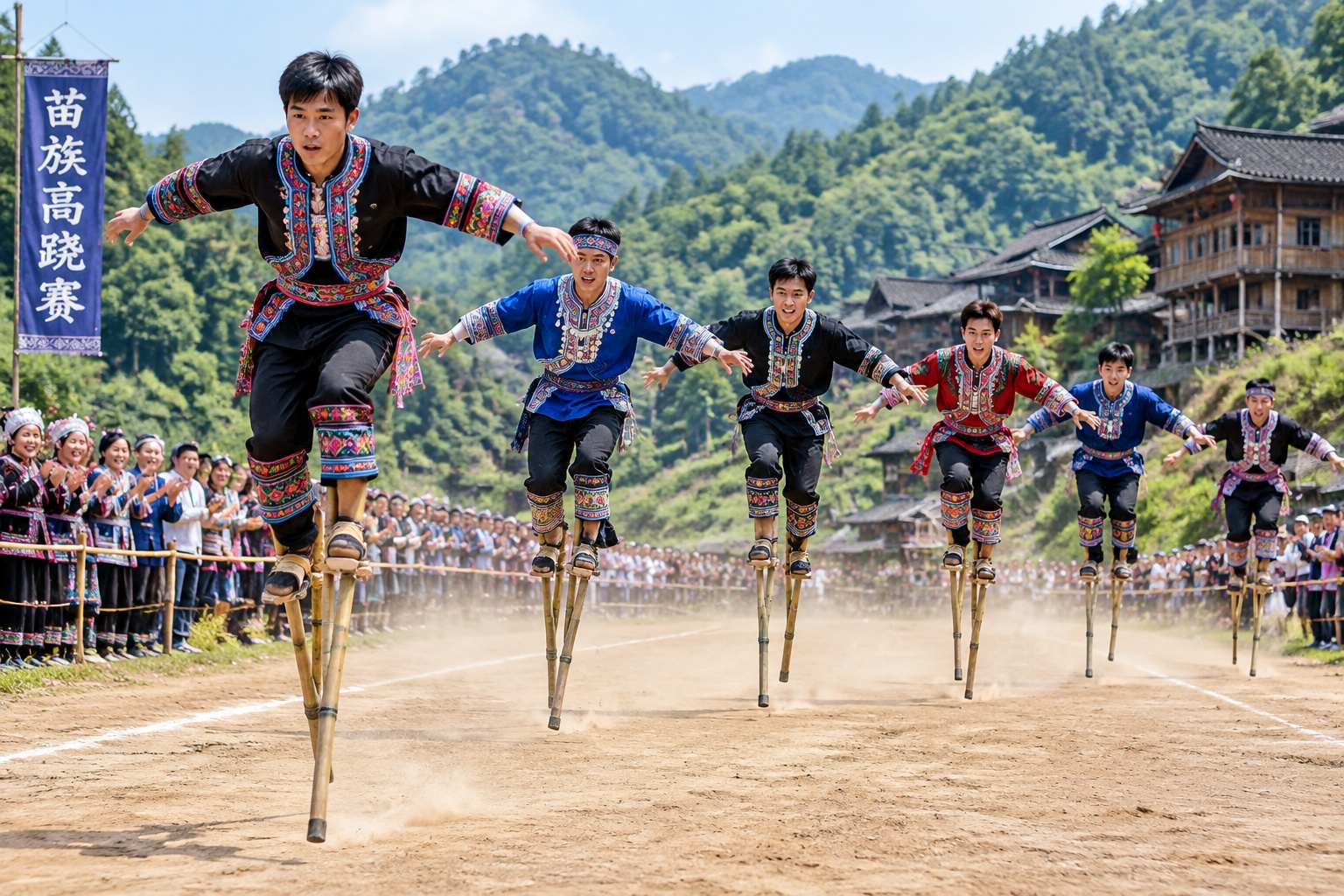
It’s race day in a small Miao village in Guizhou, southern China. There’s no electronic starting gun. Instead, a referee blows a whistle, and six racers shoot forward on what look like tall bamboo staffs. But they aren’t just carrying them—they’re standing on them, riding each stride with a smooth rhythm that makes them seem more like centaurs than sprinters. Their feet are strapped to wooden pegs a foot above the ground. This is gaojiao ma, or “high-legged horse,” a traditional sport that blends balance, strength, and pure adrenaline.
I came to the village to see how this unusual pastime fits into modern Chinese life, and I left with a bit of dust on my shoes and a deep respect for anyone who can run like that without touching the ground.
What Exactly Is a High-Legged Horse?
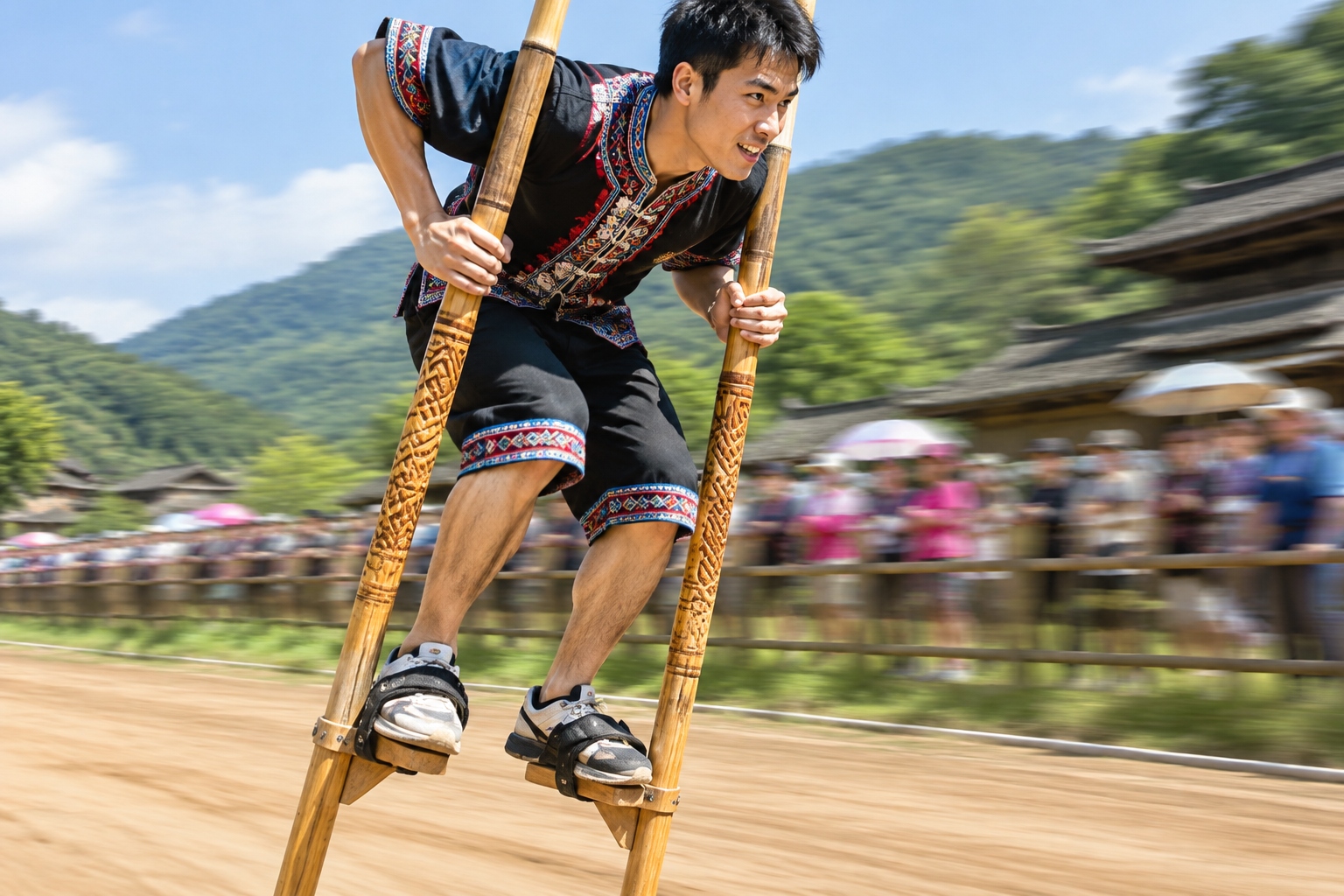
The name is quite literal. Participants hold the tops of two long wooden or bamboo poles, step onto small footrests tied or carved into the poles, and then walk or run as if on temporary extensions of their own legs. In sport settings, the footrest is usually placed around 40 to 60 centimeters above the ground, forcing racers to take long, sweeping steps. The higher the footrest, the more difficult the trick.
Historically, farmers in the mountain regions used stilts to walk through wet rice paddies and to pick fruits from taller trees. The skill gradually became a recreational competition. In the 1980s, stilt racing was formally categorized as one of China’s traditional ethnic minority sports, alongside dragon boat racing and pearl ball.
Today, the gear is often store-bought, but many villagers still make their own from local wood, adding decorative touches like carved patterns or colorful paint. The simple design means that almost anyone can participate, though running well is another story.
How a Stilt Race Works
At local festivals, stilt races are usually held on a straight dirt or gravel road. Distances vary from 30 to 100 meters. In more formal competitions, there are also slalom events, where racers weave through a line of flags, turn around a pole, and sometimes even exchange a small object with a teammate. One popular relay format involves two racers per team: one runs forward, passes a baton to the other, who then has to reach the finish line while carrying an egg on a spoon—a test of both speed and steadiness.
The rules seem simple: if both feet touch the ground, you’re out. But in practice, that rule creates constant tension. Racers lean forward, swinging their arms in big circles to maintain balance. Every stride is a controlled fall. The fastest runners complete 100 meters in around 17 or 18 seconds, which is impressive given the stilts.
One of the most exciting moments is the mid-race wobble. A racer’s stilt catches a rock, the body lurches sideways, and for a second the crowd gasps. The good ones recover with a hop and keep going; the less lucky ones hit the ground with a laugh. That mix of seriousness and playfulness is what makes the sport so charming. In some regions, there’s even a “king of the stilts” title awarded to the person who can stay balanced on one stilt the longest. It’s less about speed and more about pure core strength.
More Than a Game in Miao and Tujia Communities
For the Miao and Tujia ethnic groups, stilt racing is an integral part of festivals and coming-of-age events. During the Miao New Year, or the Lusheng Festival, races are held after the music and dancing, bringing together entire villages. Teenagers compete to prove their maturity and agility. Even older villagers sometimes join, showing off moves that have been polished over decades.
According to local tradition, the stilts were originally used by shepherds to cross rushing streams during the rainy season. Later, young men used them to impress prospective partners during festivals. If that sounds like a daredevil move, it was—and some villages still have a custom where a successful racer can win a chorus of praise from the unmarried women. In Tujia culture, the stilts are sometimes called “gaojiao ma” as well, but they are often decorated with tassels and bells. During the Tujia New Year, stilt racers join the traditional Baishou Dance after the race, blending sport with festive ritual.
The sport is also a way to teach children resilience. In many rural schools near the mountainous regions, physical education teachers include stilt walking in their classes. Kids start with low stilts and gradually work their way up. It’s a hands-on lesson in coordination and persistence, wrapped in fun.
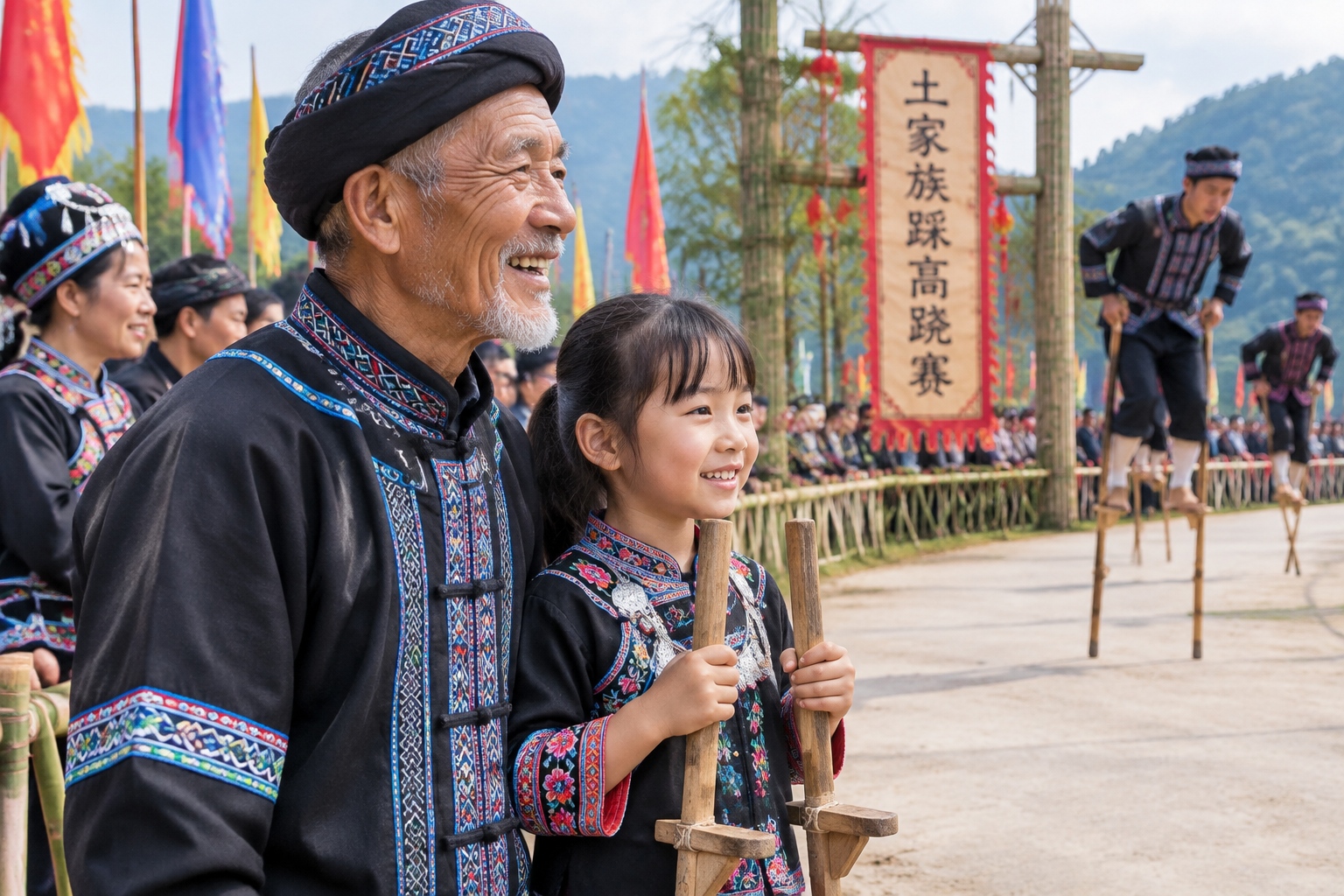
“When I was little, I used my father’s stilts and fell a hundred times,” said Yang Chen, a 26-year-old Miao racer from a village near Kaili. “But by the time I was 12, I could beat most adults. That feeling of flying on wooden legs never leaves you.”
From Village Track to National Stage
Stilt racing has grown beyond local celebrations. Since the first National Traditional Ethnic Minority Sports Games in 1953, it has been a key event. The games, held every four years, draw athletes from all over China, and stilt racing is consistently one of the crowd-pleasers.
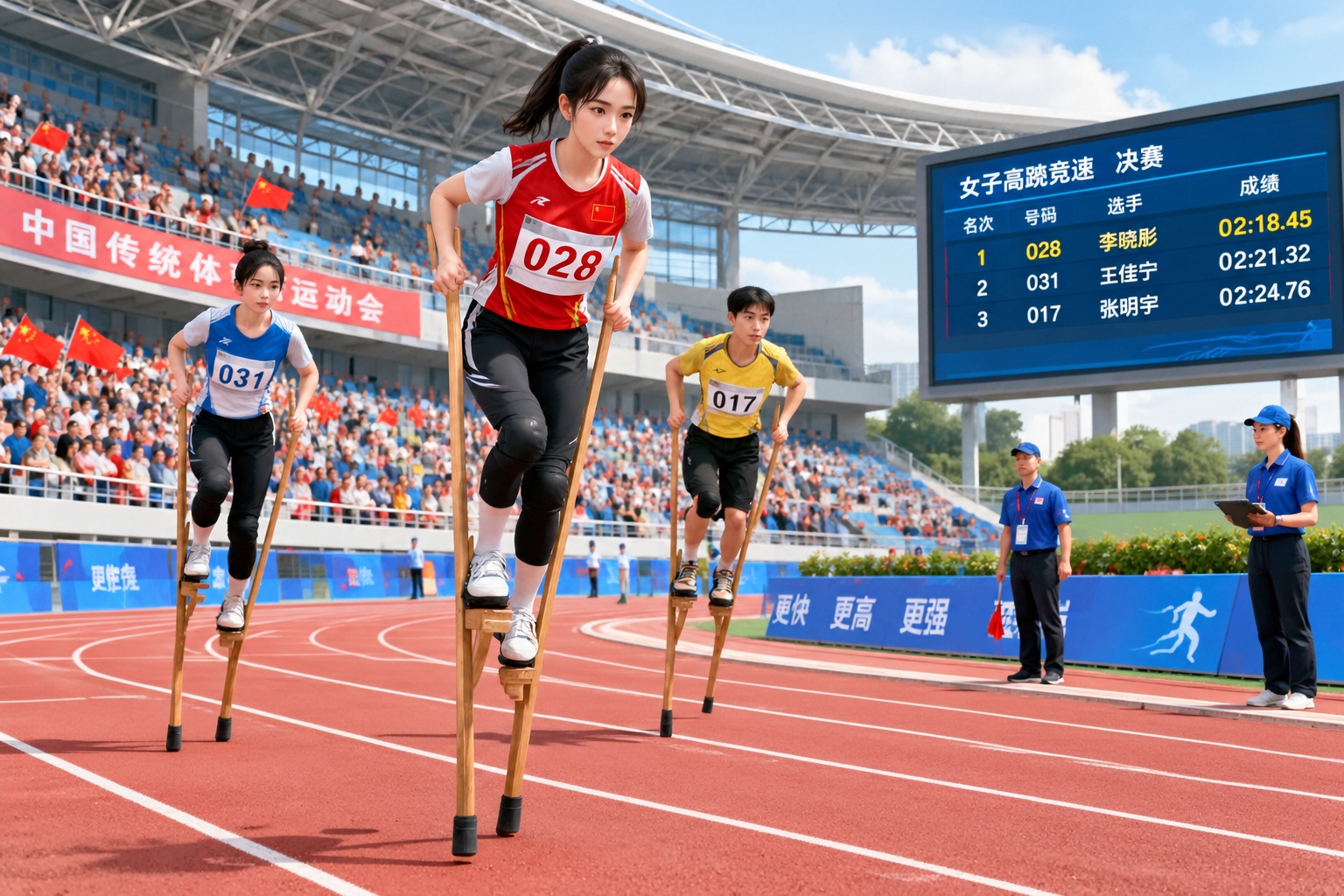
In 2019, at the 11th National Games, stilt racing included men’s and women’s 50m and 100m sprints, as well as a 200m relay. The rules were standardized: stilts must be between 1.6 and 2.0 meters long, and the footrest cannot be higher than 35 centimeters from the ground (this helps prevent dangerous falls). Athletes now train with sports coaches, using techniques borrowed from running and balance training.
The national exposure has also sparked tourism opportunities. In areas like Xijiang Miao Village in Guizhou, visitors can watch open-air exhibitions where local kids race on stilts. Some village tourist programs let guests try low stilts under supervision. The experience is often captured on video and shared on social media, introducing the sport to a global audience. Even outside ethnic areas, stilt racing has made its way into school sports days and corporate team-building activities. In cities like Chengdu and Changsha, companies occasionally book a stilt-racing session as a fun way to build trust among employees. The sport has also entered physical education textbooks in more than a dozen provinces, and training programs for coaches have been established at several universities in Hunan and Guizhou.
Tips for Trying the High-Legged Horse
If you’re curious enough to step on a stilt, be prepared for a real leg workout. Your first attempts will feel clumsy. Your arms will flail, your knees will shake, and you’ll wonder how anyone manages to run this way. But once you find your balance and get used to the rhythm, the world looks different from up there.
Guided stilt lessons are now available at cultural parks and festivals in provinces like Guizhou, Hunan, Hubei, and Guangxi. Instructors usually start with the basics: how to grip the poles, how to place your feet, and how to push forward without twisting an ankle. The correct way to start is to grip the top of the poles firmly, step up with your dominant foot first, then push off with the other while keeping your weight forward. Most instructors suggest practicing against a wall for the first ten minutes. Don’t expect to be sprinting in the first hour. Give yourself a couple days, and you might be able to walk a few meters without holding onto anyone’s hand. That in itself is a small victory.
Why Watching Stilt Racing Is Worth Your Time
Stilt racing may not be as well-known as martial arts or kung fu, but it’s just as entertaining. It reveals a side of China that is playful, competitive, and deeply rooted in ethnic traditions. Behind the laughter and the spills is a network of communities who are proud of their heritage and eager to share it with outsiders.
The next time you see a video of someone running on tall wooden legs, you’ll know it’s not a circus act. It’s a sport called gaojiao ma, and it’s still alive in fields, streets, and stadiums across China. If you ever get the chance, take a seat on the sidelines, cheer for the racers, and maybe even try the stilts yourself. You’ll come away with a new appreciation for a tradition that deserves more attention.
Start the discussion at forum.chinacomes.com