
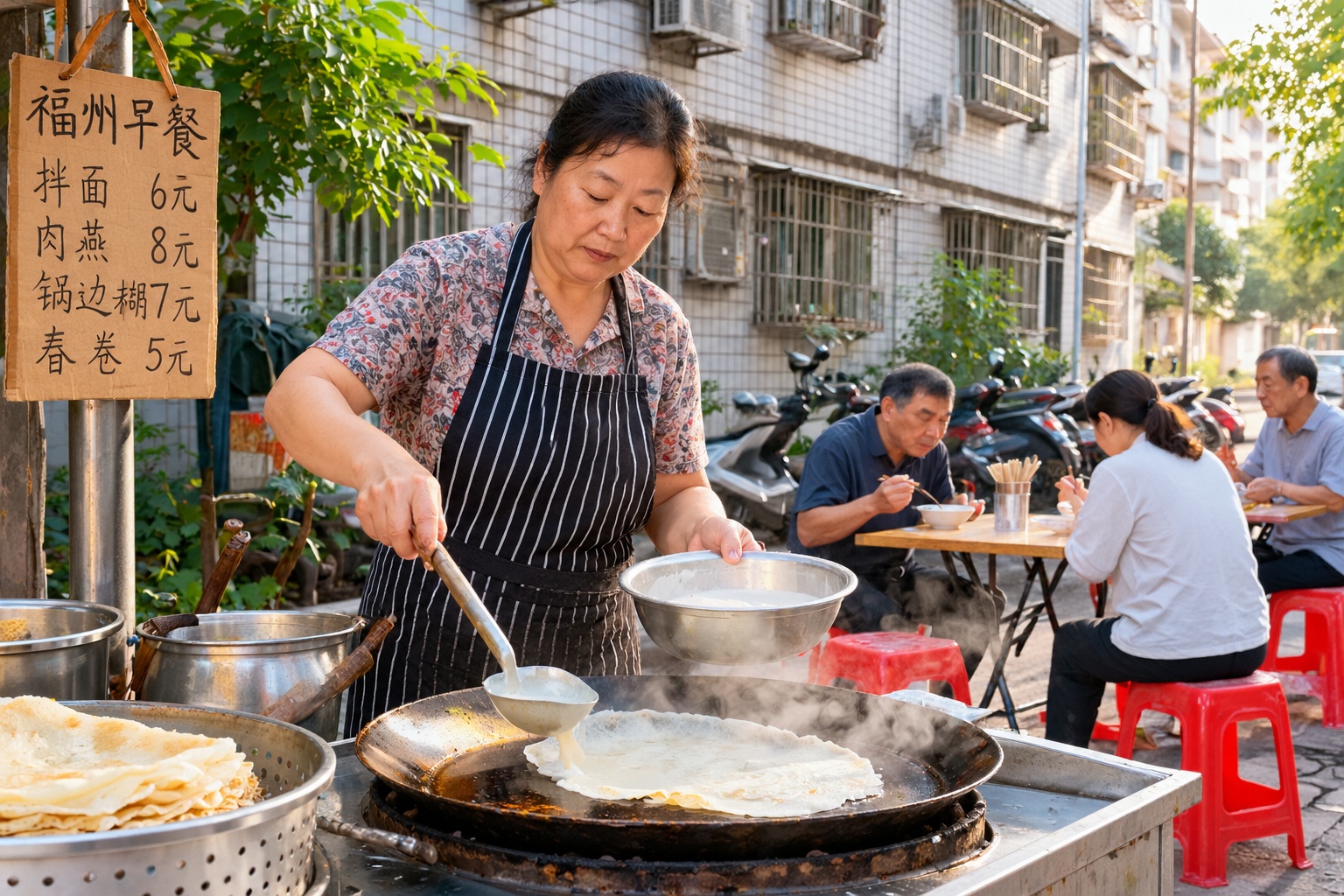

6:40 a.m. on a Fuzhou Sidewalk
At 6:40 on a Tuesday morning, Chen Xiuying has already poured her third ladle of rice batter around the rim of a smoking wok. The batter slides down the hot iron, sets into a thin sheet, and she scrapes it into the broth below with one flick of the spatula. Steam fogs the plastic awning. A man in a delivery-company jacket sits down at a table without asking anyone, pulls a bowl toward himself and says good morning to the woman across from him. They have never met.
The dish is 鼎边糊 (ding bian hu), the rice-batter soup Fuzhou has eaten for breakfast for generations. It arrives in ninety seconds. The man will sit over it for twenty minutes.
That gap — between how fast Fujian breakfast is made and how slowly it is eaten — is the whole story. Breakfast here is not a meal you grab. It is the hour when a city checks in on itself.

Fujian Breakfast Is a Map, Not a Dish
Chinese breakfast is often reduced, abroad, to congee or a steamed bun. In Fujian it is a set of local systems, and the menu changes every hundred kilometers.
- Fuzhou — 鼎边糊. Rice batter poured around the inside of a hot wok, peeled off into a light broth with clams and dried shrimp. Five to eight yuan, usually with a 海蛎饼 oyster fritter fried in the next doorway. The same city runs on 捞化: thin rice noodles blanched in pork or seafood stock, with toppings you choose yourself — pig liver, squid, tripe, a boiled egg.
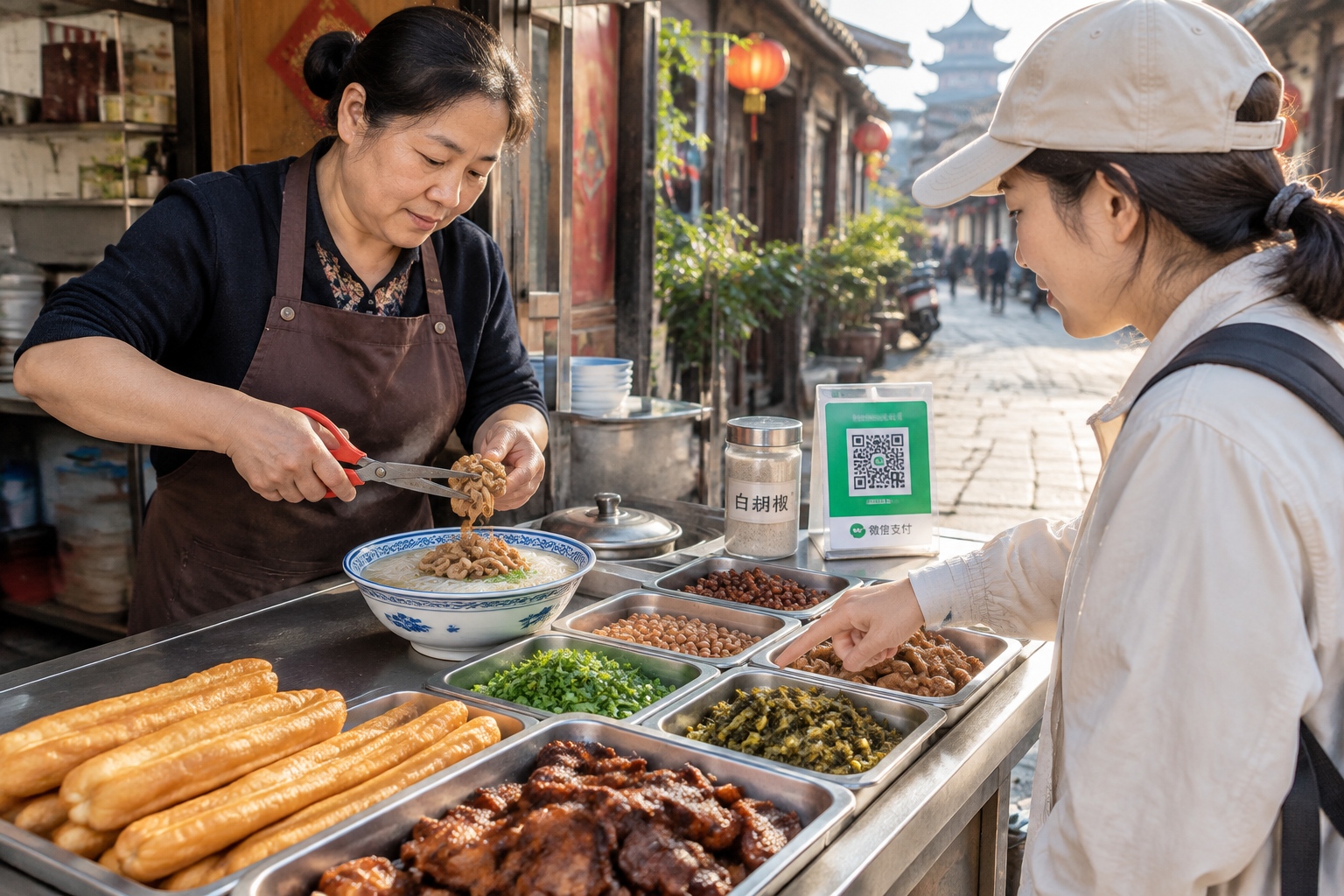
- Quanzhou — 面线糊. Wheat vermicelli cooked down until it is closer to soup than noodle, thickened slightly, finished with white pepper. You build the bowl: braised pork intestine snipped in with scissors, 醋肉 (vinegar-marinated fried pork), a fried egg, a length of youtiao. Eight to fifteen yuan.
- Xiamen — 沙茶面. Noodles in a peanut-satay broth, sweet underneath the heat, topped with shrimp, squid, pork liver or tofu. Afterwards, 花生汤: peanuts boiled until they collapse, eaten with youtiao.
- Zhangzhou — 豆花粉丝. Silky tofu and thin noodles in the same savory bowl, with braised pork and bamboo shoots on top. It sounds like a mistake and tastes like breakfast.
- Shaxian, inland — 拌面 and 扁肉. Noodles tossed in peanut sauce beside wontons with wrappers thin enough to read through. Five to eight yuan each. The Shaxian Snack brand now counts tens of thousands of outlets worldwide — official figures put it above 88,000 — but the original is a plain bowl eaten quickly at a plastic table.
Two things surprise first-time visitors. The price: a full breakfast — soup, something fried, tea — usually costs five to fifteen yuan, about one to two US dollars. And the pace: the bowl is in front of you within two minutes, and almost nobody leaves straight away.
The Table Is the Point
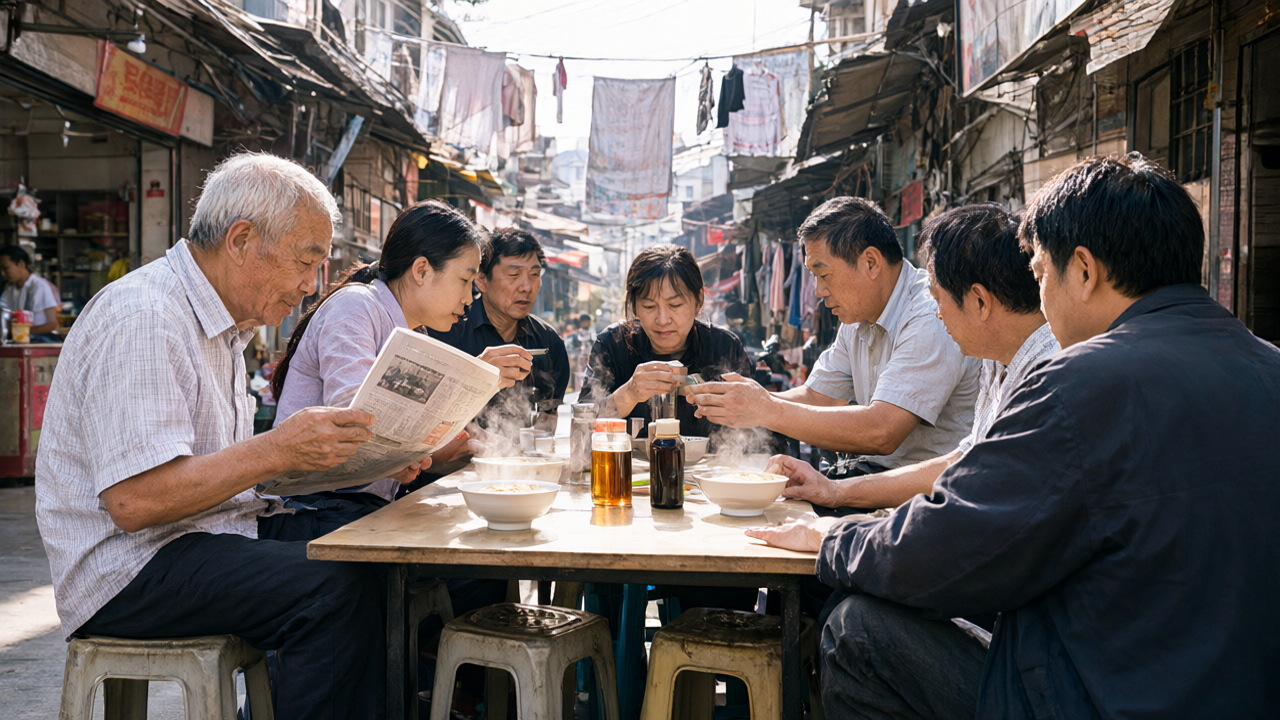
Fujian breakfast stalls use small tables and too many stools. Six or eight people share a table built for four. You ask 有人吗 — “is anyone sitting here?” — and if nobody answers, you sit down.
Then the talking starts. The woman on your left is discussing pomelo prices at the wholesale market. The man opposite is complaining about a bus route. Two retirees are re-arguing a football match from the 1990s.
In older neighborhoods, the stall works as an information node. The vendor knows which regular has not appeared for a week, whose son passed the civil service exam, which building has its water cut off on Thursday. In Fuzhou and Quanzhou it is also where small deals get aired: a fruit seller haggling with a landlord’s nephew, a factory worker asking about a job two blocks away, an insurance agent leaving a card under a bowl.
Three Mornings in Fujian
7:15 a.m., Xiamen. Lin Yating, 27, works at an e-commerce company near the software park. She orders shacha mian, thirteen yuan, scans the QR code taped to the side of the cart, and eats the first three bites standing. By 7:30 she is on a call with a supplier. Breakfast, she says, is the one meal she does not eat at her desk.
6:00 a.m., Fuzhou. Zheng Guoming, 68, swims at the park, then walks to the same stall he has used for eleven years. Ding bian hu, an oyster fritter, seven yuan. He stays forty minutes, reads a folded newspaper and joins whichever argument is already running. He could eat at home for less. He does not want to eat at home.
3:30 a.m., Quanzhou. Chen Xiuying is up before the buses, at her spot by five, and sells roughly 300 bowls before she closes at 10:30 — most of them between six and eight. Then she goes home and sleeps through the afternoon.
Put that beside the Western grab-and-go morning: a paper cup and a pastry, six to twelve dollars, eaten while walking to the train. Both are fast. Only one of them is a place to sit.

When the City Changes, Breakfast Changes
None of this is frozen. The morning meal is being reorganized by the same forces reshaping the rest of urban China.
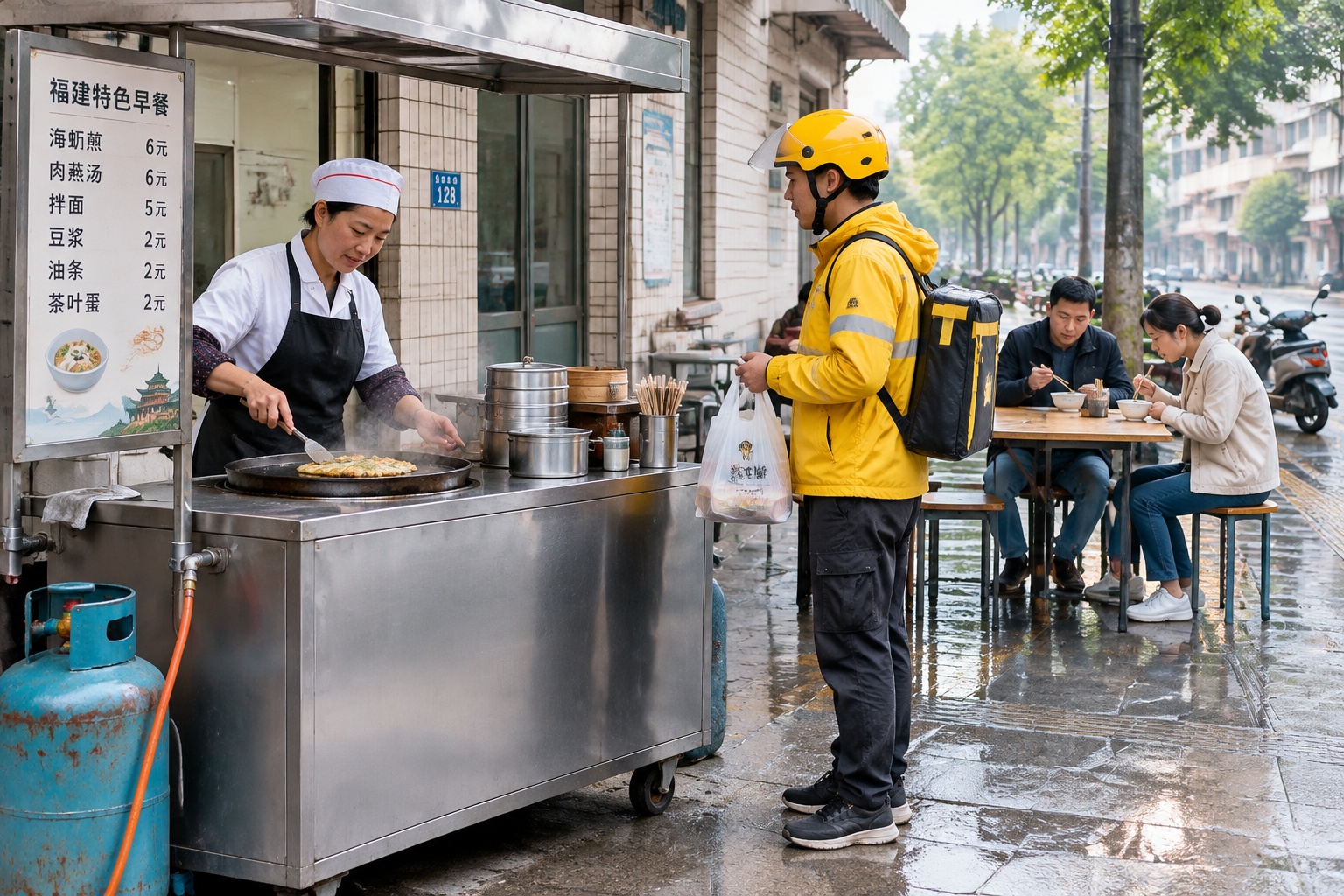
Delivery. Meituan and Ele.me both push breakfast hard. Some stalls run WeChat groups where regulars pre-order the night before. But soup travels badly — vermicelli softens, fritters go limp — so delivery stays a small share of sales, mostly serving office workers who would otherwise skip breakfast altogether.
Chains and standardization. Many Shaxian snack shops have become air-conditioned outlets with laminated menus and QR-code ordering. They are more predictable and often cheaper than a Western brunch, and considerably quieter than a sidewalk stall.
Regulation and hygiene. Cities across Fujian have moved vendors into formal breakfast programs: stainless-steel carts, uniforms, gas burners instead of coal. The frying oil is cleaner than it used to be. Some older vendors relocated to back alleys; a few stopped.
Rent. A corner pitch in a redeveloped Fuzhou block can cost several times what it did a decade ago. When a stall moves 400 meters, most regulars follow. When it moves across the river, they find a new stall — and the social circle reassembles around a different wok.
The ritual is not disappearing. It is changing address.
Why This Matters Outside China
In a country where most people live in apartment towers and work long hours, the breakfast stall is one of the few places where a 68-year-old retiree and a 27-year-old logistics manager sit at the same table before eight in the morning. That kind of unplanned mixing is getting harder to find in cities everywhere.
It also costs one or two dollars. Not a treat, not a special occasion — just Tuesday.
Fujian people have a way of putting it: 吃得饱是底线,见个面是习惯. Filling your stomach is the minimum. Seeing each other is the habit.
How to Eat Breakfast Like a Local
- Go to an old residential neighborhood, not a tourist street, between 6:30 and 8:30.
- Ignore the longest line if it is mostly phones and selfie sticks. The best stall often has a handwritten price list and no English menu.
- Order a combination, not one dish: ding bian hu with an oyster fritter; mian xian hu with youtiao and vinegar pork; shacha mian followed by peanut soup.
- Point at what you want. 加这个 (“add this”) works everywhere.
- Take the empty seat when someone nods. Ask 有人吗 first; it is the password.
- Pay by phone — WeChat Pay or Alipay. Cash is accepted, but few stalls can break a 100-yuan note before 8 a.m.
- Go early. Many stalls close by 10:30, and the fritters tend to run out before nine.
- Carry tissues. Napkins are not always provided.
By 10:45 the awning comes down, the stools stack, and the wok goes cold. The same fire is lit again at five the next morning, in the same place, for the same people — and for whoever happens to sit down.
Start the discussion at forum.chinacomes.com