
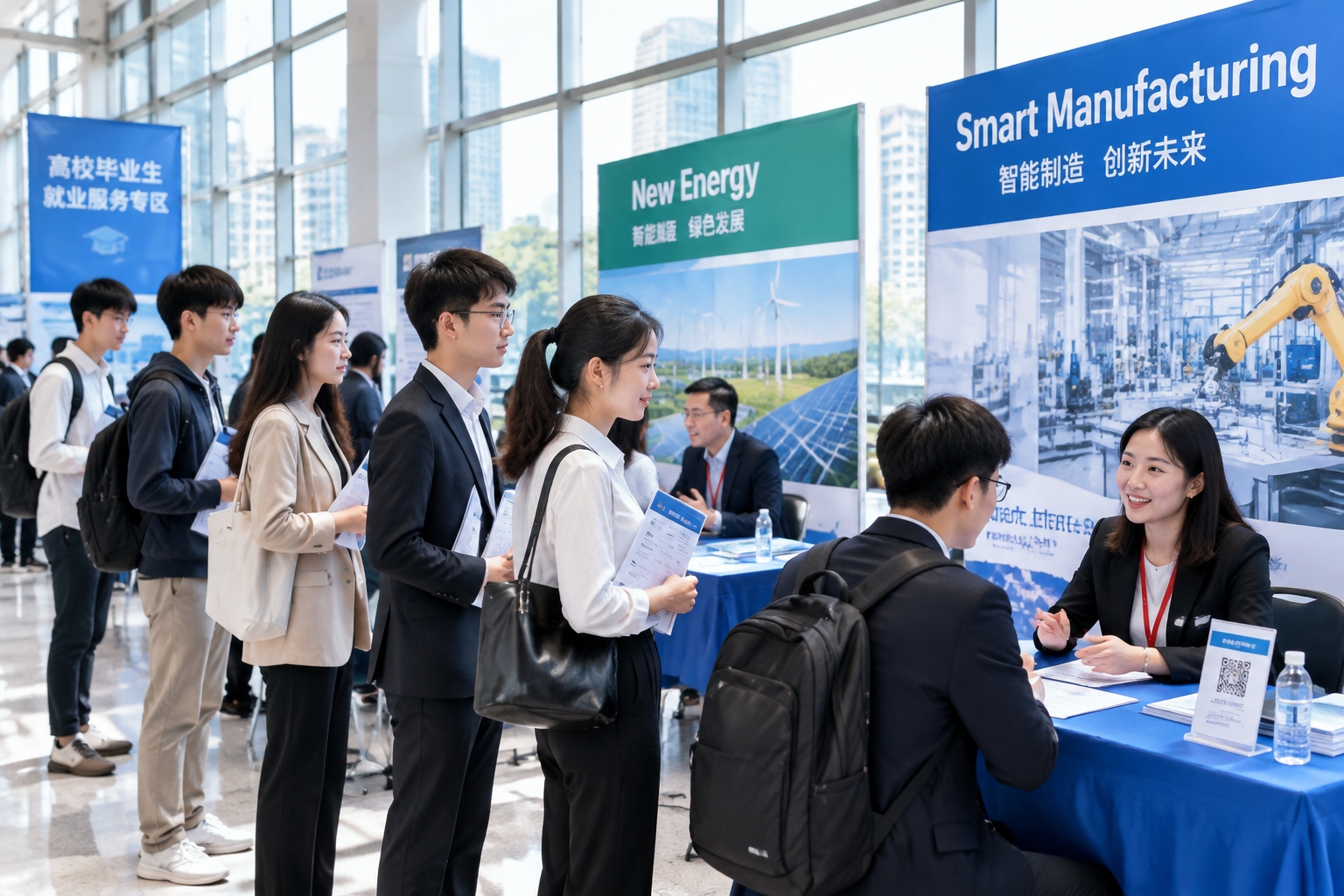

On a damp November morning in Hangzhou, 22-year-old Lin Wu gripped a folder of résumés and pushed through the crowd at the city’s annual graduate job fair. A journalism major from a mid-tier university in Anhui province, Lin had spent three months sending out nearly 80 online applications to newspapers, magazines, TV stations, and marketing agencies. He had received only four interview calls and no offers. At the fair, the liveliest booths were stacked with brochures for “livestream operations assistant,” “logistics planner,” and “AI data trainer.” By 2 p.m., he had handed over two copies of his résumé and registered for an interview with a local e-commerce group that wanted an “operations specialist”—a job that involved writing short-video scripts and analyzing viewer data. It wasn’t the newsroom he’d dreamed of, but he took it. “Anything to get a start,” he said afterward. His father, retired from a factory in Wuhu, still doesn’t understand how a degree can end up as an online retail job.
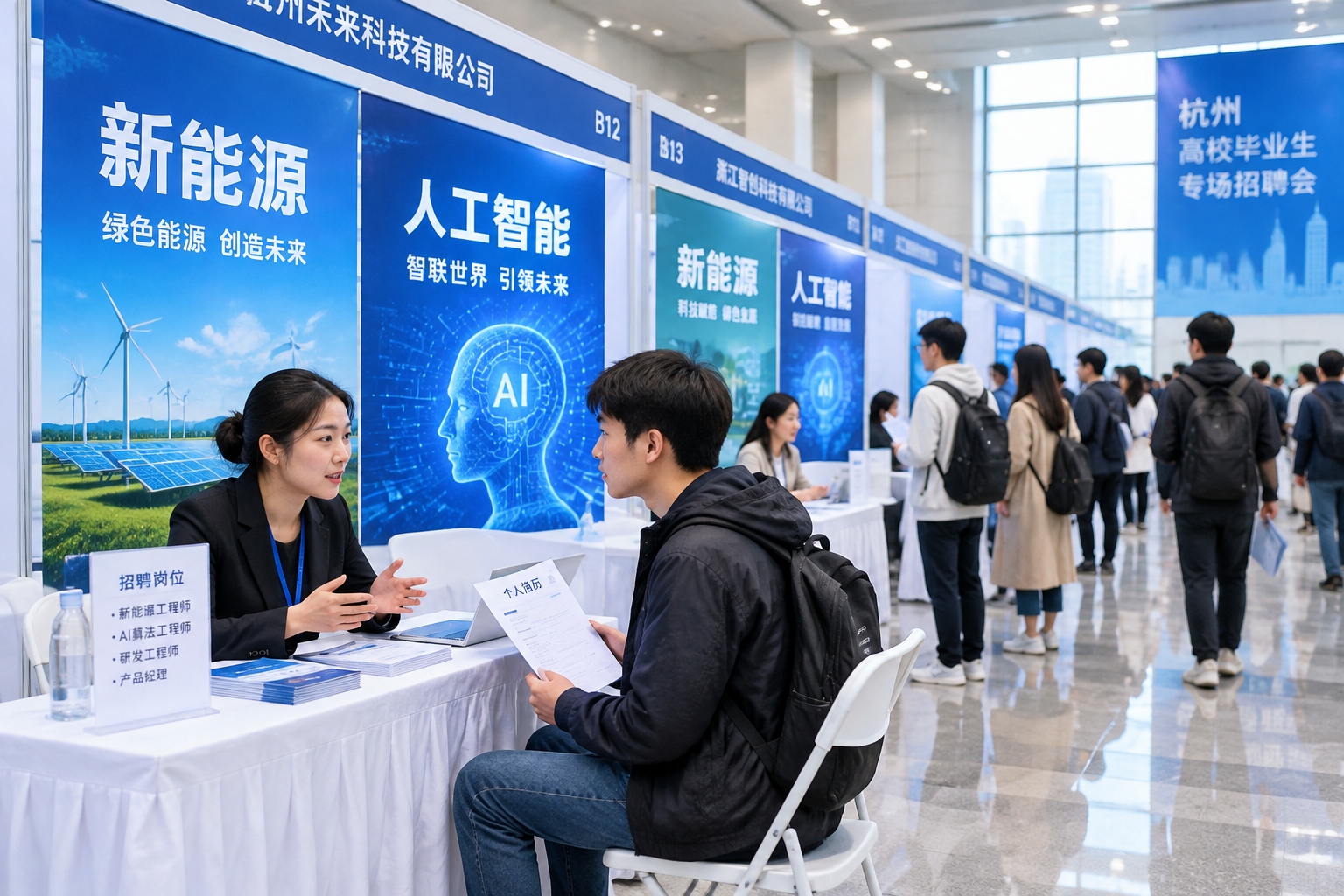
That scene, repeated in dozens of Chinese cities every winter, fuels a familiar cliché: China has too many university graduates, and not enough jobs for them. Yet the reality is far more complex. In 2024, a record 11.8 million young Chinese entered the job market, and the figure is expected to approach 12.2 million in 2025. Headlines in the global media talk of “mass unemployment” and “a lost generation.” But a close look at the labor market reveals an odd anomaly: while many graduates struggle, a large number of employers in advanced manufacturing, new-energy vehicles, artificial intelligence, and green technology say they can’t find enough qualified people. That contrast is the heart of the story.
A record number of graduates, a record number of mismatches
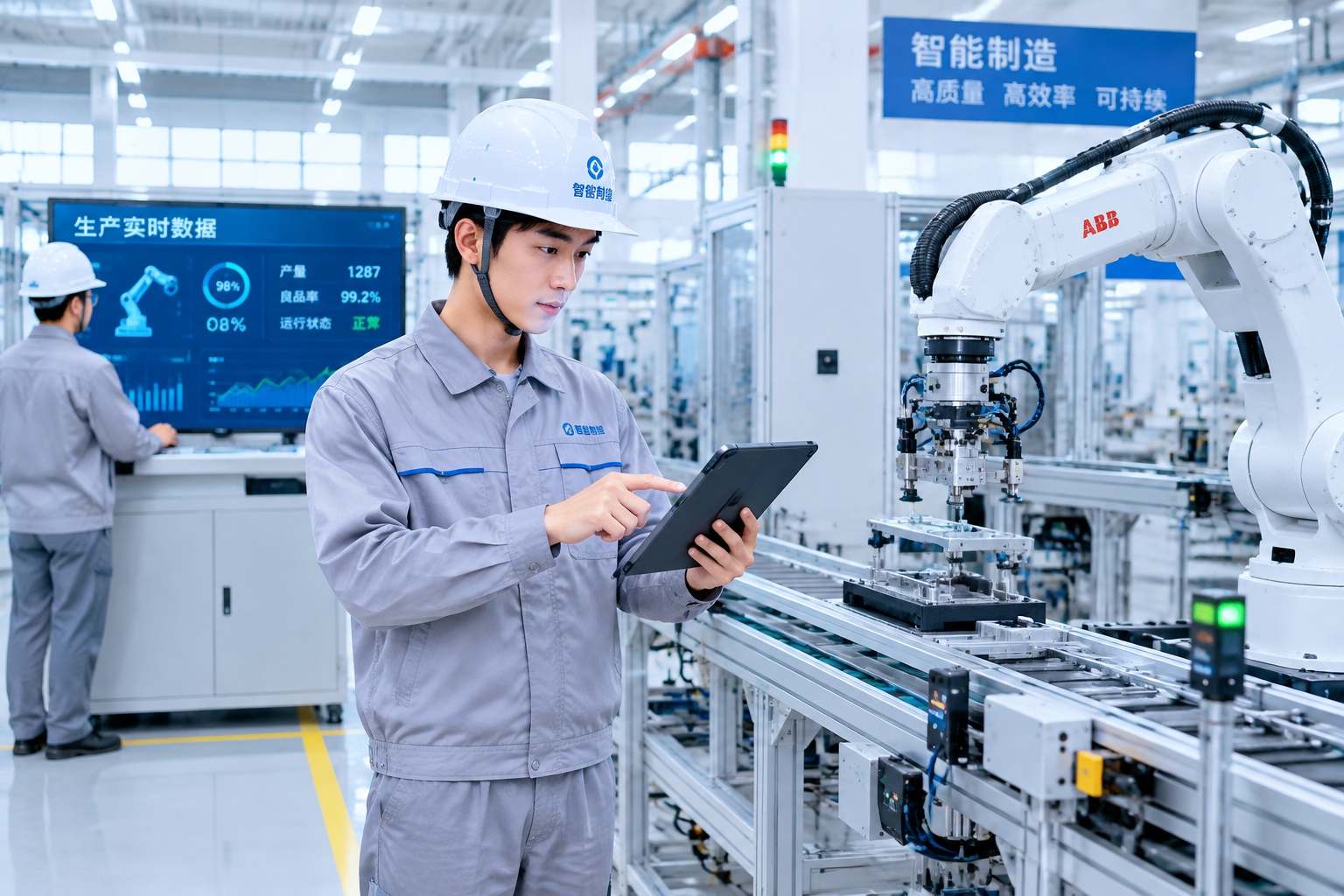
The sheer numbers are not the whole story. According to the latest data from the Ministry of Education, today’s graduates are overwhelmingly clustered in fields that expanded rapidly over the past two decades: journalism, law, accounting, public administration, business management, and the visual arts. The number of engineering graduates is large in absolute terms, but many are trained in traditional fields like civil engineering, while the fastest-growing demand is for interdisciplinary skills—software engineers who understand industrial hardware, data analysts who can work with sensor data, and automation specialists who can update a factory’s production line.
At the same time, the Chinese labor market is undergoing a deep change. The easy days of real estate and financial services are fading, and new opportunities are being created in areas such as smart manufacturing, battery technology, electric vehicles, and renewable energy. This shift explains why a finance graduate can feel left behind while a chemical engineering graduate from a provincial college is recruited a month before graduation. The mismatch is not about “too many students” as such; it is about an education system that hasn’t caught up with a changing economy.
Three mismatches explain the real story
Let’s break it down.
Major mismatch: the crash of humanities vs. the boom in engineering
The most visible imbalance is academic. Over the last 20 years, Chinese universities expanded humanities and social science programs, which are cheap to operate and popular with students. In 2020, enrollment in humanities and social sciences at the undergraduate level reached 45% of the total, according to the Ministry of Education. Meanwhile, technical and engineering programs connected to the country’s “new infrastructure” agenda grew more slowly. As a result, many cities have an oversupply of graduates in lower-demand disciplines. Consider the 2023 edition of the MyCOS annual employment report, a widely cited industry survey: computer science graduates earned an average starting salary of over 7,000 yuan per month, whereas journalism graduates averaged just over 5,000 yuan, and those in law, music, and fine arts hovered around 4,500. In a 2022 report, the government listed law, painting, environmental design, and a few other majors as “red flag” programs, calling for cuts in their enrollment.
Regional mismatch: a crowded coast, a hungry interior
The second gap is geographic. Since the late 1990s, the majority of China’s best jobs have clustered in the four first-tier cities—Beijing, Shanghai, Guangzhou, and Shenzhen—with a second tier of strong hubs such as Hangzhou and Chengdu. That’s still true for white-collar jobs. But in 2024, a Zhaopin report noted that just over half of active graduate resumes were aimed at those cities, while only about 20% of the available job openings were there. In contrast, central and western cities are struggling to attract the engineering, IT, and management talent that they need. The city of Hefei, home to memory-chip maker CXMT and NIO’s main factory, offered 60,000 new technical jobs last year, according to local officials, but local universities could fill only a fraction. Rather than moving inland, many graduates prefer to stay near the coast, even if it means taking a lower-paid job. The result is a strange paradox: job adverts in Chengdu and Changsha go unanswered, while the parks and malls of Shanghai overflow with underemployed white-collar workers.
Expectation mismatch: high hopes vs. entry-level reality
The third imbalance lies in what students and their families believe when they enter university. Grand expectations are fed by a culture that prizes stable, white-collar jobs, especially within government—the “iron rice bowl.” This preference exploded in the 2025 civil service exam, which registered 3.4 million applicants for just 39,700 positions, a ratio of 86:1. Many graduates apply for those jobs not because they have a passion for bureaucracy but because it offers security, a pension, and respect. At the same time, 2024 surveys from recruitment platform BOSS Zhipin found that fresh graduates expected a starting salary of roughly 8,000 yuan per month, while the actual average offer was close to 5,500. The gap is especially stark in lower-tier cities, where starting salaries of 4,000 yuan are not unusual. A bachelor’s degree no longer guarantees a middle-class income, and that realization is painful for many families who have invested heavily in their children’s education.
How universities, companies, and the state are adjusting
The good news is that the system is starting to react, although slowly. The Ministry of Education has begun to cut enrollment in some majors it considers surplus—for example, several universities have dropped undergraduate programs in public administration, environmental design, or journalism. Meanwhile, dozens of new cross-disciplinary majors have emerged: artificial intelligence, energy storage science, health data science, intelligent manufacturing, and robotics engineering are now among the fastest-growing majors at the undergraduate level. The state has also expanded vocational schools and strongly promoted the idea that “vocational education is equivalent to academic education.” In 2022, the revised Vocational Education Law aimed to elevate the status of vocational diplomas, allowing them to enter university admission pathways. This was a quiet but fundamental shift.
Companies too are adapting. Many no longer require a specific degree list; instead, they run their own training academies. Foxconn, for instance, created its own college that turns vocational school graduates into mechatronics technicians in eight months. Midea, the appliance maker, launched a program to hire humanities graduates and train them in electrical engineering. Even in finance, big banks now put new hires through a six-month “digital bootcamp” to learn Python and data analysis. These moves show that the market is not waiting for the universities to change; it is recalibrating around them.

A new equilibrium in the making
What does this mean for the new wave of graduates? In the short run, careers are less stable and more stressful. Many will hop between jobs, take pay below their expectations, or move to places they never considered. But this is part of a repetitive historical pattern. Countries that rapidly industrialize often pass through a phase where the educational system lags behind the economy. The mismatch is temporary—the question is how fast the adjustment happens.
It may be tempting to see the struggle of Chinese graduates as proof that China’s growth model has failed, or that “over-education” has gone too far. But a more honest reading is that China is in the middle of a major reallocation—one in which degrees in the humanities and social sciences have become less valuable to employers, while practical technical skills have gained in importance. That is not a waste of education; it is a shift in what kind of education is useful. For Lin Wu, who now writes short-video scripts and checks analytics at an e-commerce company, the shift means lower pay than his parents hoped for, but it also means a foothold in China’s largest industry—one that did not even exist a decade ago. In the long run, the students who adapt early will be the ones who benefit most.
Start the discussion at forum.chinacomes.com