
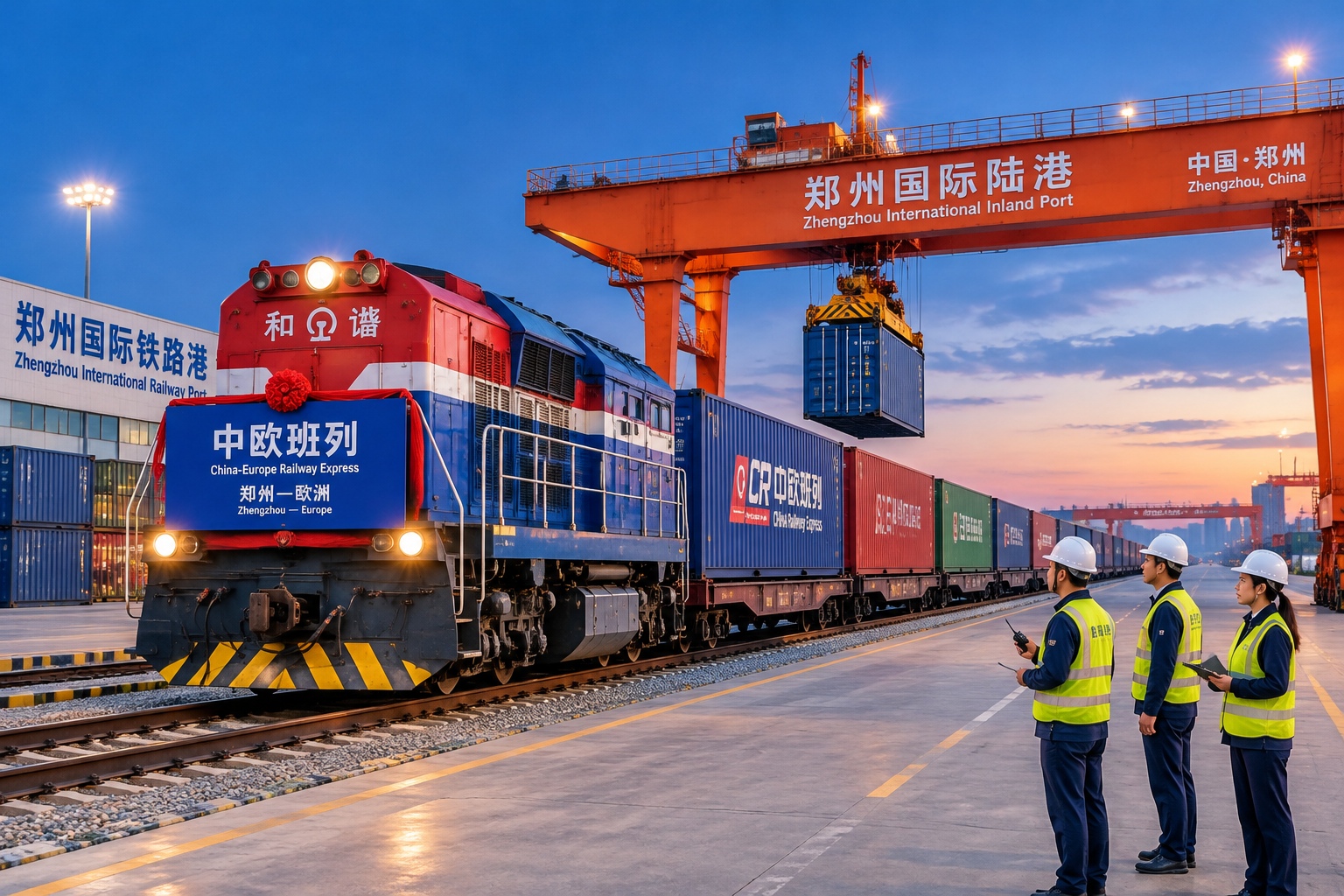

A Train Leaves Zhengzhou
It’s 9 p.m. at the China Railway Container Terminal in Zhengzhou, a city of ten million people in central China. Workers in yellow vests are lifting containers marked with a blue China-Europe Railway Express logo onto a train that stretches nearly a kilometer. The cargo includes car parts made in Henan, smartphones assembled in Shenzhen, and boxes of dried wild mushrooms from the province’s mountain villages.
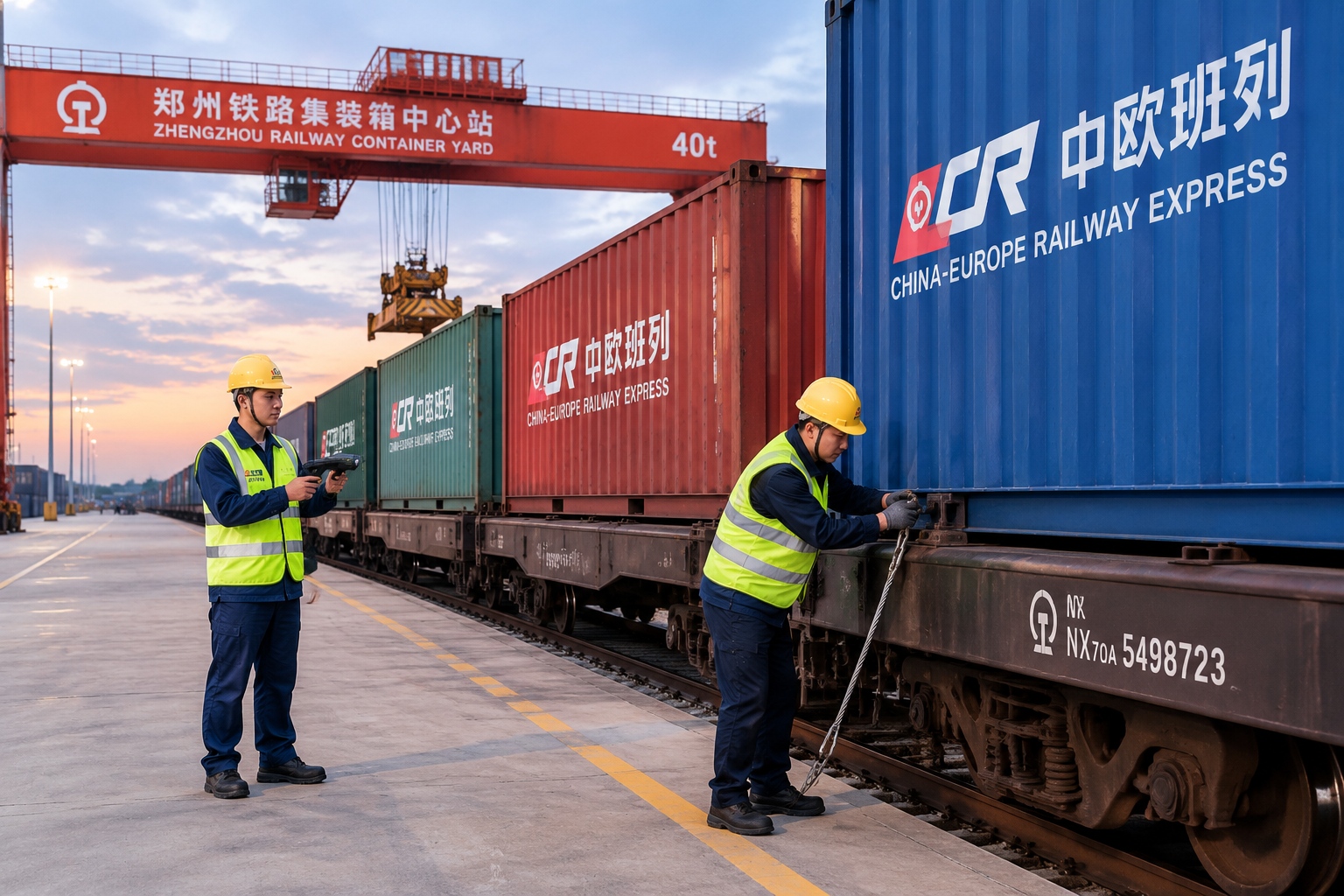
By midnight, the train will cross the Qinling mountains and head west to Kazakhstan. Eighteen days later, the same containers will be unloaded in Hamburg, Germany. This is not a special trip. Every day, dozens of trains depart from Chinese cities for Europe.
What Is the China-Europe Railway Express?
The China-Europe Railway Express is a network of regular freight train routes between Chinese cities and more than 20 European cities. It started in 2011 with a single line from Chongqing to Duisburg. By late 2023, it had made over 78,000 trips, connecting 219 cities across 25 countries.
The trains are not speed records. They roll for days across deserts and mountains. But they fill a gap that used to be impossible to fill.
A third way between air and sea
Before the railway, Chinese exporters to Europe had two options. Ship by sea: cheap, reliable, but slow—35 to 45 days. Or fly: about five days, but very expensive, so only worthwhile for small, high-value items. Train takes 16 to 20 days, with costs somewhere in between. It turns out this is a sweet spot for many goods, especially those that would lose freshness or market edge if shipped by sea.
It also provides a hedge when ocean shipping is disrupted, like during the Suez Canal blockages or port congestion.
Why Henan? The Rise of an Inland Hub
Henan is one of China’s most populous provinces, with close to 100 million people. It’s known for flat farmland, spicy food, and for being ‘the granary of China.’ It sits inland, far from the coast. For a long time, that meant manufacturing had a harder time participating in global trade.
Zhengzhou, its capital, is a railway city. It grew around the intersection of two major national rail lines. When the China-Europe Railway Express started expanding around 2013, Zhengzhou saw an opportunity. It built a modern container station, digitized customs paperwork, and created a bonded logistics zone.
Today, the Zhengzhou corridor is among the busiest in the network. Trains run to Hamburg, Munich, Rennes, Helsinki, and Warsaw. The city now handles regular freight traffic worth more than 100 billion yuan each year.
‘We are not a port city,’ said a local trade official. ‘But now we act like one.’
The Long Ride Across Eurasia
From Zhengzhou to Hamburg, the route passes through two rail gauge changes. At Alashankou, on the Chinese-Kazakh border, cranes move containers from Chinese Standard Gauge wagons to Russian Broad Gauge wagons. The process used to cause multi-day queues. Now a dedicated terminal clears a full train in hours.
The train passes through places where temperatures reach minus thirty degrees in winter. Some containers carry heating units. Others have GPS tracking and real-time monitoring for temperature, humidity, and door openings.
Digital tools have made the process smoother than you might expect. Customs seals are now electronic. Shipper documents are uploaded once and shared across the route. In Kazakhstan, customs officers inspect containers without making trains wait for days.
A typical train runs at about 60-80 km/h, not fast by passenger standards, but it’s moving almost non-stop. It crosses two continents, seven time zones, and multiple customs territories.
How This Feels for a Factory Owner
Yuan Li runs a small factory near Zhengzhou that makes bicycle trailers for families. For years, he exported only to Southeast Asia, where goods could go by truck and ship in a shorter time. European buyers were interested in his innovative design, but they wanted delivery in three weeks, which sea freight couldn’t guarantee, and air freight would cost more than the product was worth.
‘The train changed everything,’ he said. ‘Now, when I load a container on Thursday, my customer in Eindhoven can have it by the second Monday after.’
He can also ship smaller, more frequent orders. Instead of waiting for a full container to be economical by sea, he can send a 20-foot container whenever a buyer needs it.
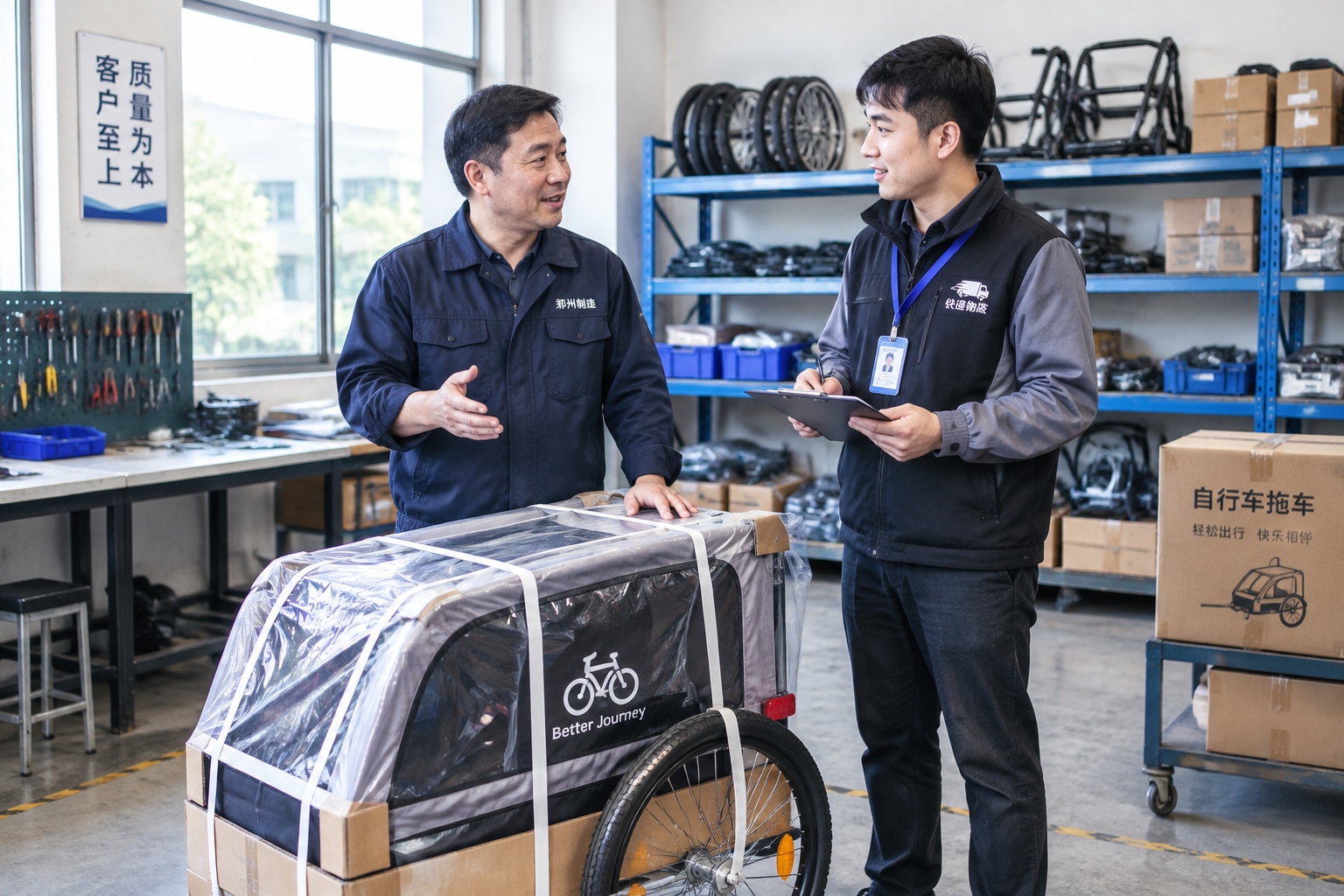
Other small exporters echo that experience. A local plastics company ships molds to Turin. A dried-fruit processor sends packages to Poland. They all talk about the same shift: supply chains are no longer limited by coastlines.
The Other Direction: What Trains Bring Back
The railway isn’t one-way. Empty containers are expensive to drag back. So operators actively look for cargo in Europe. In return, trains come back with wine from Bordeaux, milk powder from Germany, cars made in Leipzig, and luxury goods from Milan.
These products often arrive faster and fresher than they used to. A bottle of Spanish olive oil can reach a Wuhan supermarket just a week after bottling. European brands use the train for time-sensitive goods.
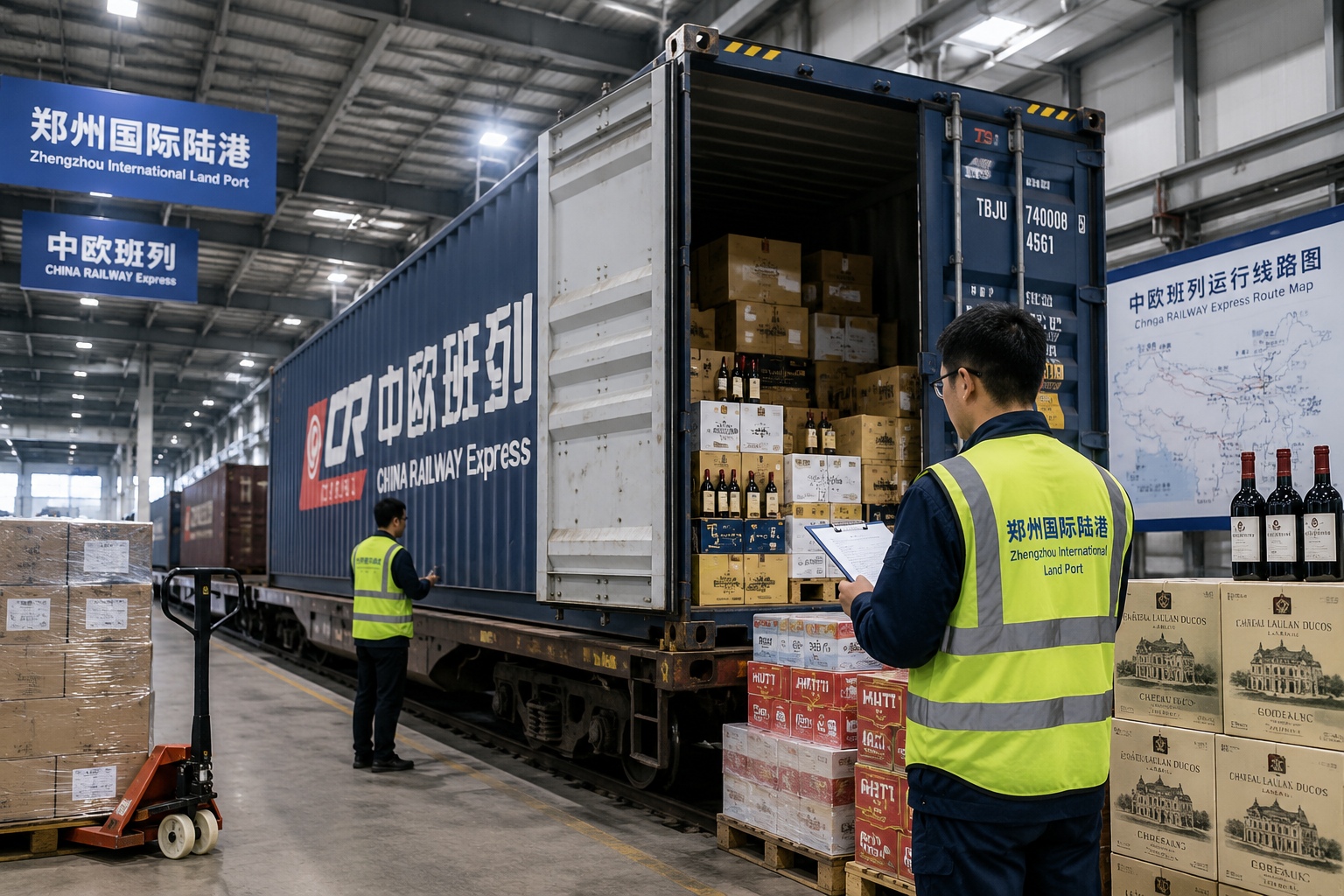
For ordinary Chinese consumers, the effect is visible on supermarket shelves and online shops. Parmesan cheese, French yogurt, Belgian beer, and even fresh flowers from the Netherlands now show up in mid-tier cities like Zhengzhou or Changsha much sooner than before.
Where Does the Railway Fit in Big-Picture Trade?
Here’s a useful perspective: In total China-EU trade, the railway still carries only a small share. The vast majority of goods go by sea. In 2022, rail accounted for about 8% of China–EU trade by value, up from almost nothing a decade earlier. That’s a big deal for a single form of transport, but it’s not replacing boats anytime soon.
The most important effect is the opening of a new corridor. Businesses that cannot fill a ship or pay for cargo planes now have a middle path. This helps make trade more resilient and gives inland regions like Henan a tangible link to global markets.
Real Challenges, Real Adaptations
The system has real problems. There is a major imbalance: far more goods travel west than east, often making return trips unprofitable. Rail operators rely on subsidies from China’s central and local governments to keep prices competitive.
Geopolitics is a wildcard. After Russia invaded Ukraine, many operators refused to use the Russian corridor, so they created routes through the Caspian Sea and Turkey. These are longer and more expensive, but they reduce dependence on any single territory.
In Europe, infrastructure bottlenecks remain. The tracks that feed ports like Duisburg get congested. The ‘last mile’ is still often a truck, so the doorstep-to-doorstep time can be longer than the rail segment suggests.
And yet, the trains keep running. In early 2024, data showed that the number of trips was still growing. The railway is not a one-hit wonder; it’s becoming a fixture of Eurasian trade.
A Quiet Transformation
The China-Europe Railway Express doesn’t have the glamour of passenger high-speed rail. It moves slow, heavy containers through harsh landscapes. But quietly, it changes what is possible.
For a worker in Zhengzhou, it means a stable job in a warehouse or factory. For an engineer in Duisburg, it means a shipment of components arrives sooner than expected. For a mother in Warsaw, it means the toy she ordered from a Chinese app costs less because it didn’t have to fly.
That’s how a railway changes trade. Not with headlines, but with thousands of small, practical decisions made by ordinary people.
Start the discussion at forum.chinacomes.com