

A Half-Metre Dam That Behaves Like a Hundred-Metre One
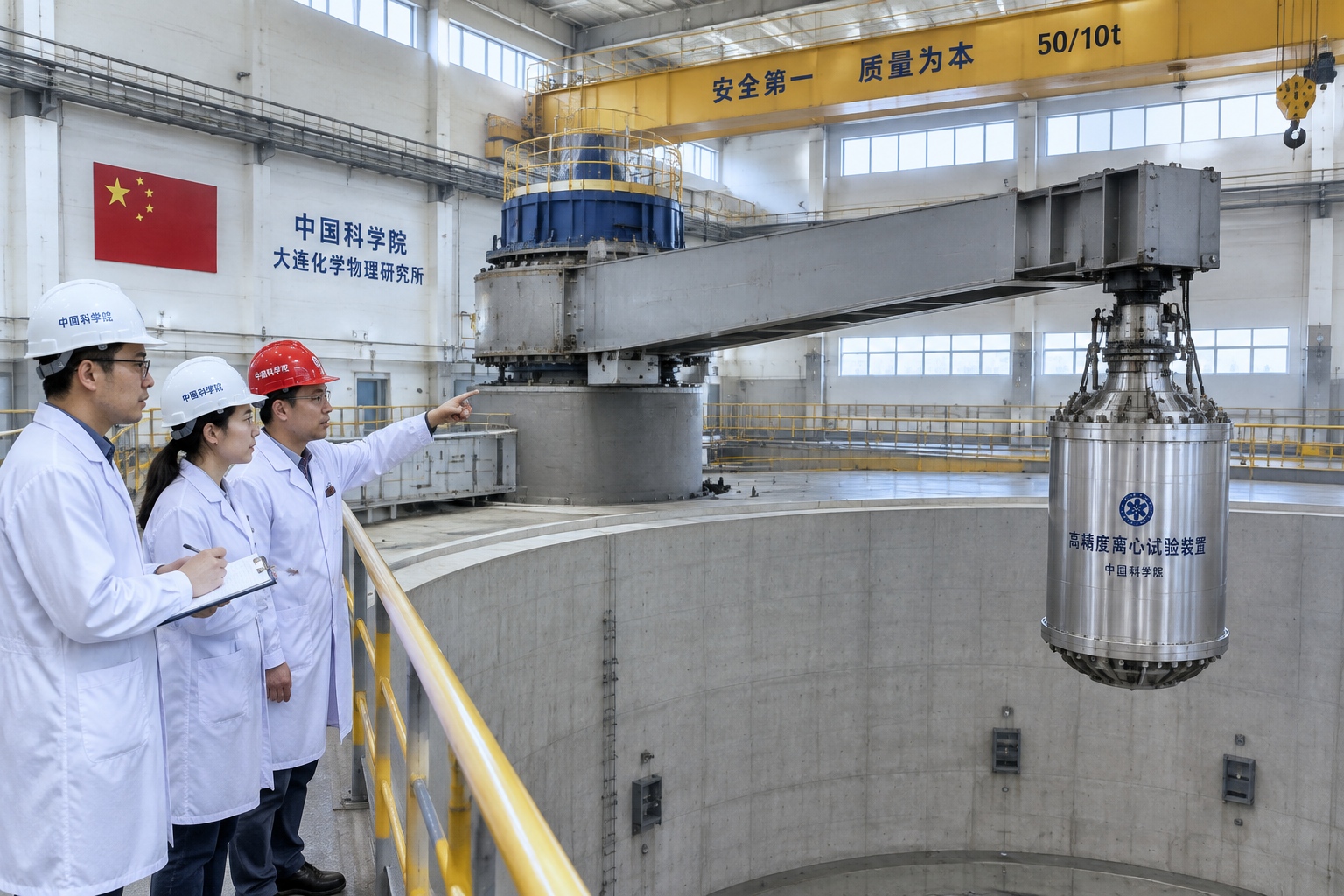
In a hangar-sized hall in Hangzhou’s Yuhang district, a steel arm longer than a city bus swings a sealed container in a wide circle. Inside the container sits a model earth dam about half a metre tall, built from carefully graded sand and clay, wired with tiny sensors. As the arm spins up, the material at the bottom of the model begins to feel 200 times its own weight. A half-metre embankment starts to behave like a 100-metre dam filling for the first time.
Water moves through the model soil at a speed no bench test could produce. In roughly a quarter of an hour, the model lives through a year of groundwater seepage. The operator can stop the machine, open the container, and cut the model open to see where the failure started.
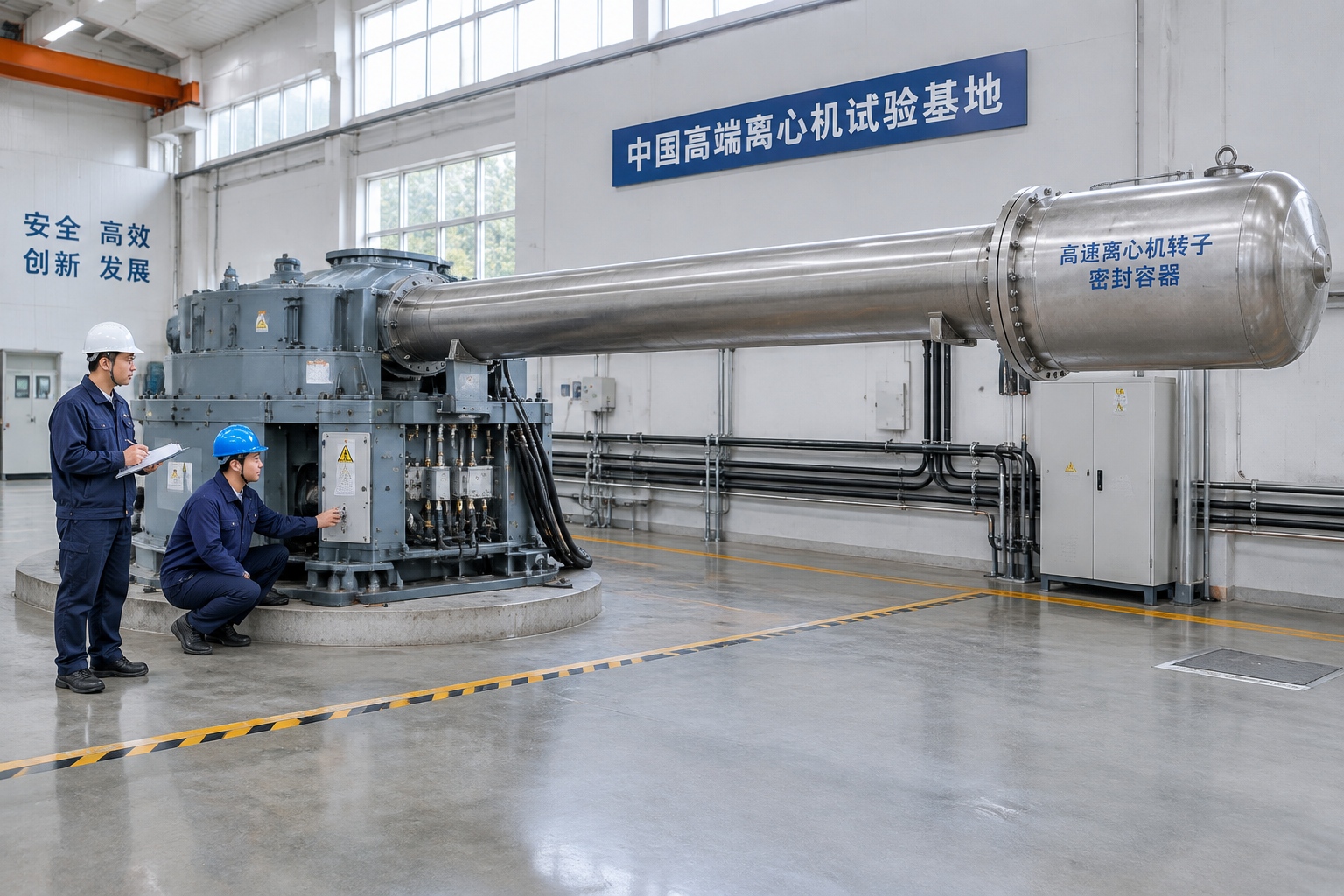
This is one of three centrifuges at the Centrifugal Hypergravity and Interdisciplinary Experiment Facility, known by its English acronym CHIEF, built on the campus of Zhejiang University. It is a national major science and technology infrastructure project — the category of large public research facility that China has been adding at a steady pace. Construction began in 2019, and the site includes six experiment chambers, each fitted out for a different class of test: slopes and high dams, earthquake engineering, deep underground works, geological processes, resource extraction and materials preparation. Project descriptions give the largest machine a capacity of 1,900 g·t, which the team describes as the highest of any geotechnical centrifuge in the world.
What “Supergravity” Actually Means
The phrase sounds like science fiction. It is not. Gravity at the Earth’s surface is 1 g. A centrifuge produces additional acceleration by rotating a payload around an axis; at the outer edge of the arm, the effective gravity can be 50, 100 or 200 times normal. Nothing about the physics changes. The soil simply gets heavier.
That matters because soil is not a material you can scale down in the way an aircraft designer scales a wing. Sand and clay get their strength from friction and from the pressure between grains. Shrink a slope by a factor of 100 for a table-top model, and the grains at the bottom are under 100 times less pressure than in the real hillside — so the model stands up while the real slope fails. The centrifuge fixes that. Spin the 1/100-scale model at 100 g and the stresses inside it match the stresses inside the prototype, point for point. The model becomes a physically honest miniature.
Geotechnical engineers have used this trick since the 1970s, when Cambridge built one of the first modern machines for soil. Until recently, though, most centrifuges were small: a few hundred kilograms of model, a handful of sensors, an arm a few metres long. The engineering questions China now faces — 300-metre dams, tunnels under 1,000 metres of rock, offshore wind farms in soft seabed — pushed the equipment toward a different scale.
Buying Time: Fitting Decades Into an Afternoon
The second thing a centrifuge buys is speed. In a centrifuged model, processes controlled by the flow of water through soil — seepage, consolidation, the slow settling of a foundation — run about N² times faster, where N is the g-level. At 100 g, one year of prototype behaviour takes roughly 50 minutes. At 200 g, about 13 minutes.
That is the real product. A coastal city sinking by a few centimetres a year, a landfill liner that must hold for decades, a mine tailings dam that will be judged over a century: these are processes nobody can afford to simply watch in real time and get wrong. Landslides triggered by rainfall, the creep of a soft clay slope under a new highway, the long-term leakage path under a reservoir — all of them become repeatable experiments.
What Actually Gets Tested
Dams, slopes and the first filling of a reservoir
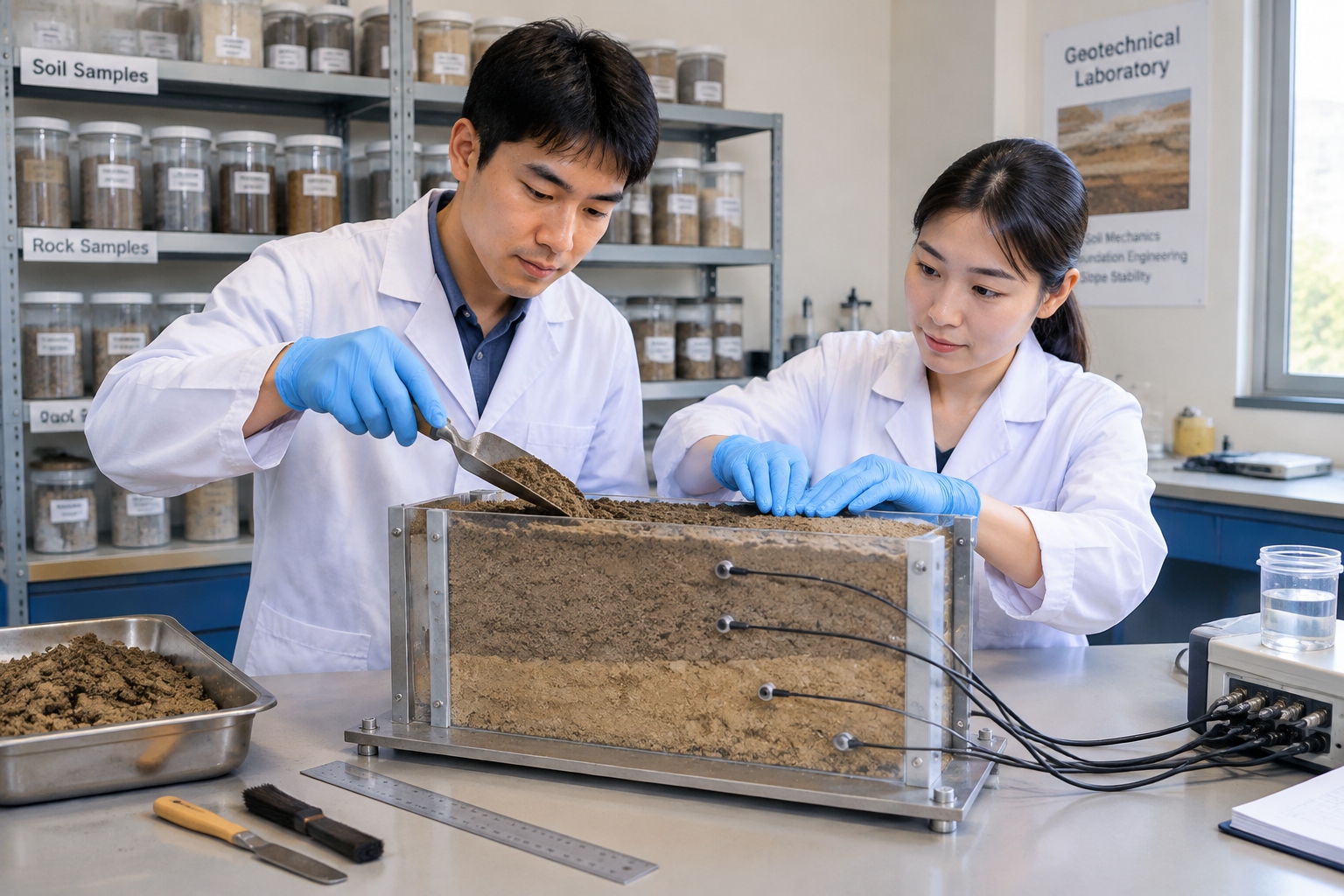
The most dangerous moment in a large dam’s life is often not an earthquake but the first filling of the reservoir, when water pressure builds inside the slope for the first time. Southwest China holds a concentration of 300-metre-class dams, plus thousands of kilometres of reservoir shoreline. A centrifuge model of a valley wall can be brought to failure under controlled water rise and controlled rainfall, with the failure surface recorded rather than guessed at.
Earthquakes and liquefaction
Many centrifuges carry a small shaking table on the arm, so a model can be hit with a recorded earthquake while it is under high gravity. The same earthquake can then be replayed with one variable changed — denser sand, a different foundation, a drainage layer — which is almost impossible after a real event. Liquefaction, the process where saturated sand temporarily behaves like a liquid, is a classic target. It decides whether a building tips, whether a subway station floods with mud, whether a buried gas line breaks. Chinese cities have built a great deal of underground infrastructure in exactly the soft, water-saturated ground where this matters.
Deep underground and under the sea
Rock at 1,000 metres behaves differently from rock at 10 metres: it squeezes, it creeps, it can burst. Mountain tunnels on new rail lines in the southwest, deep metal mines, and underground caverns for energy storage all raise questions that are expensive to answer at full size. Offshore, the questions move to the seabed: suction-bucket foundations for wind turbines, pipeline stability on soft clay, the safety of carbon dioxide stored beneath the sea floor. The facility’s deep-underground and resource chambers are designed around such problems.
Materials and other fields
Supergravity is also a processing tool. When the effective gravity is strong enough, density differences drive separation fast: molten alloys separate more cleanly, functionally graded materials form with sharper boundaries, fine particles settle in ways they never do at 1 g. Materials scientists use centrifuges to study casting, crystal growth and mineral processing; environmental engineers use them to watch how contaminants migrate through clay liners.
The Machine Is Its Own Engineering Problem
Capacity is written as g·t: acceleration multiplied by the mass being carried. At 1,900 g·t and 100 g, the largest machine swings about 19 tonnes of model, container and instrumentation. At 200 g, roughly 9.5 tonnes. That is a small truck, plus a steel bucket, plus hundreds of cables and sensors, held at 200 times its weight by a rotating arm.
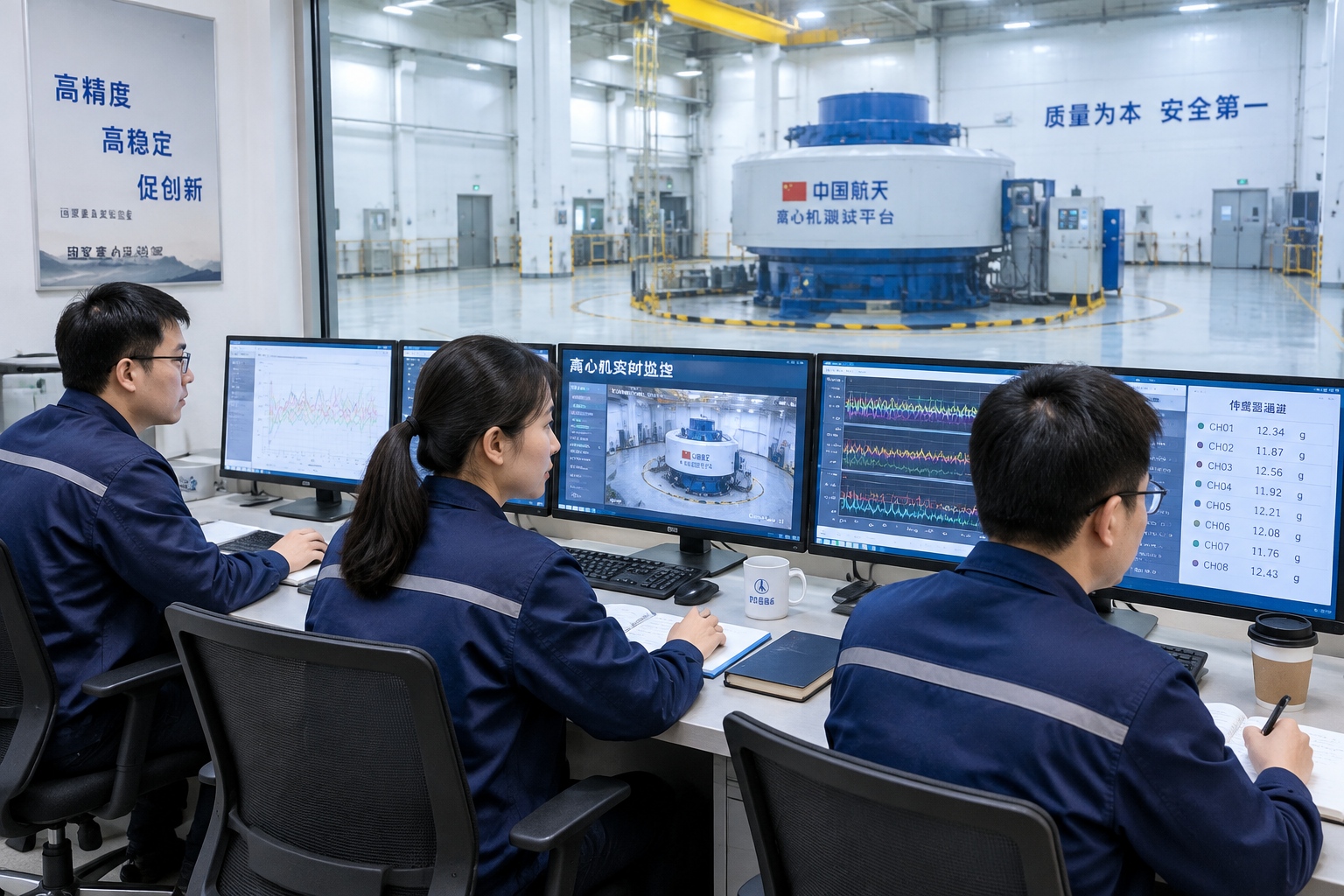
The forces are unforgiving. The rotor must be balanced to a fine tolerance, because imbalance grows with the square of speed. The chamber is evacuated so the arm does not heat up from air friction, which means the model has to be serviced through sealed ports. Power, water, compressed air and hundreds of data channels have to reach a spinning frame — through slip rings, rotary joints or onboard wireless links. Nothing can be adjusted by hand while it runs, so experiments are scripted in advance and monitored from a control room. And because a failure at speed is catastrophic, the whole hall functions as a containment structure.
What a Centrifuge Cannot Do
The honest version of this story has to include the limits. Scaling is never perfect. A 1/100 model of a sandy slope needs grains 1/100 the size, and those grains behave more like silt or clay. Modellers work around this with carefully chosen substitute soils, but the substitution is an approximation with its own assumptions. Container walls distort the stress field near the edges. Different processes obey different time laws — seepage runs at 1/N², dynamic events roughly at 1/N — so an experiment that mixes both has to choose which one to keep faithful.
Instruments are another constraint. Sensors must be small enough not to change the model’s behaviour and robust enough to survive 100 g, and their readings have to be untangled from noise and from the machine itself. A centrifuge produces data that is rich and indirect; interpretation is where much of the scientific value — and much of the risk of error — sits.
Above all, a centrifuge is a model, not the world. It cannot replace field monitoring, long-term observation or the awkward evidence that comes from a real site with real geology. Its best use is to test ideas cheaply and quickly before they are trusted at full scale, and to explain failures after they happen.
Why It Is Called a Multi-Discipline Platform
The phrase “extreme-condition platform” is bureaucratic, but it points at something real. A machine like this is too expensive and too slow to build for one department. It works like a shared instrument — a synchrotron for soil, rock and materials — with research groups from civil engineering, geology, hydraulic engineering, marine science and materials science booking time on the same rotor.
That sharing changes what gets studied. A hydrologist interested in how water moves through a dam core, a materials scientist interested in how alloys separate, and an engineer interested in a tunnel collapse are all asking the same underlying question: what happens to a mixture of solids and fluids when the forces on it are far larger than anything in a normal laboratory? Having one very large answer machine in one place makes those questions cheaper to ask.
What the Machine Is Really For
The impressive number is 1,900 g·t. The useful number is smaller: how many experiments a year, how many research groups, how many engineering decisions that would otherwise be made on judgement and simulation alone. Those figures will only become clear over the next decade, and they will be the real measure of whether a very large, very expensive centrifuge in Hangzhou changed how Chinese engineers think about risk underground.
For a young researcher, the appeal is simpler. An experiment that would take ten years of field observation can be run on a Tuesday afternoon, and if the model collapses in an unexpected way, the cost is a ruined soil sample and a week of preparation. That is a rare thing to be able to say about the behaviour of a mountain.
Start the discussion at forum.chinacomes.com