
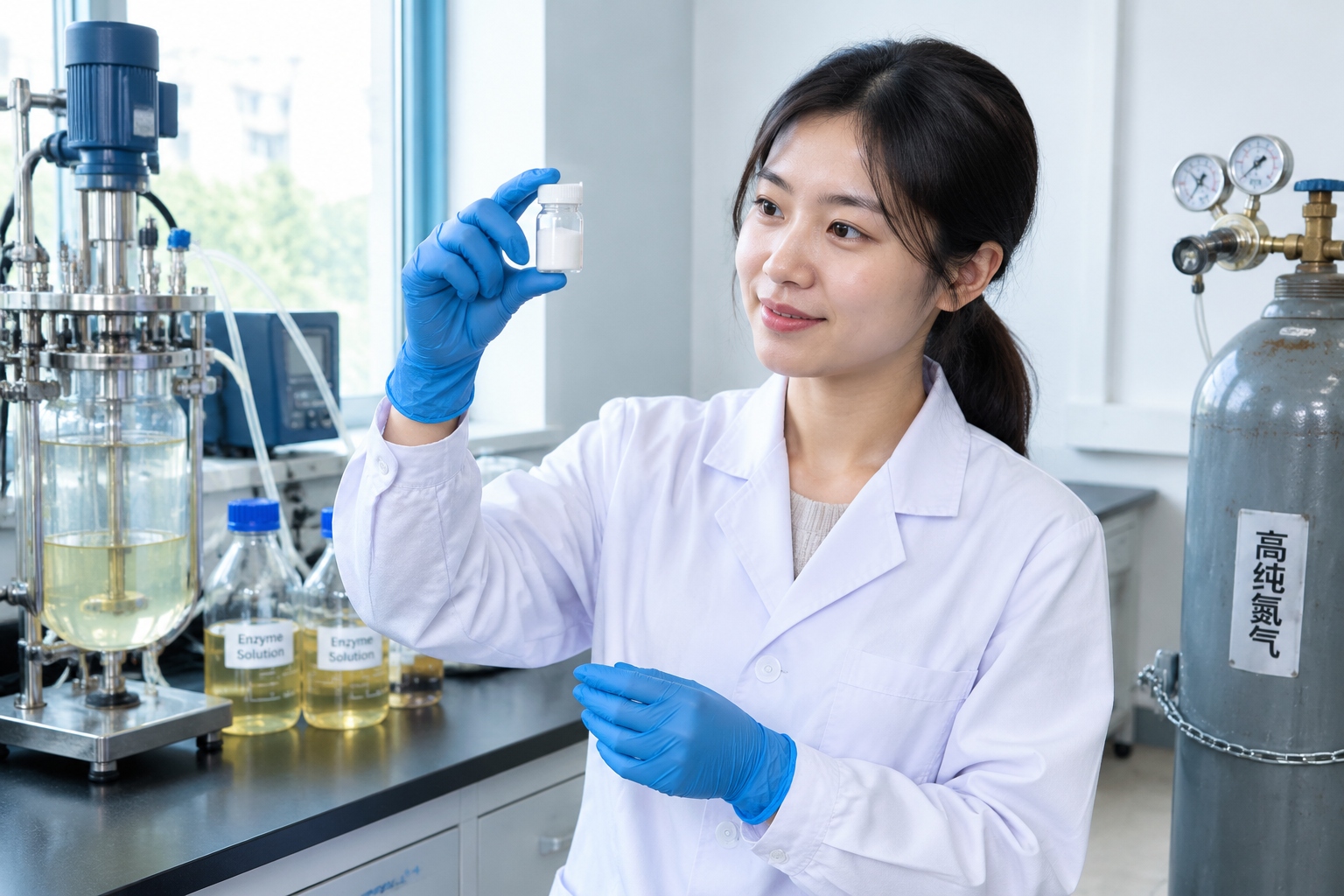

A Bottle of Gas, a Vial of Powder
In a laboratory at the Tianjin Institute of Industrial Biotechnology, part of the Chinese Academy of Sciences, the raw material arrives in a steel cylinder. It is carbon dioxide — the same gas that leaves a power station chimney or rises off a fermenting vat of beer. At the far end of the process sits a small quantity of white powder that looks, feels and tests like the starch in a bag of cornflour.
The route between those two points was published in Science in September 2021 by a team led by Ma Yanhe. It was the first complete artificial pathway from CO2 to starch, and it squeezed a process that occupies a maize plant for an entire season into a bench-scale reaction system. The team reported a starch synthesis rate about 8.5 times that of corn.
That is a genuine result. It is also a laboratory result. The most important phrase in the paper is not “breakthrough”; it is “cell-free chemoenzymatic system” — an apparatus that runs for hours under carefully controlled conditions and produces grams, not tonnes.
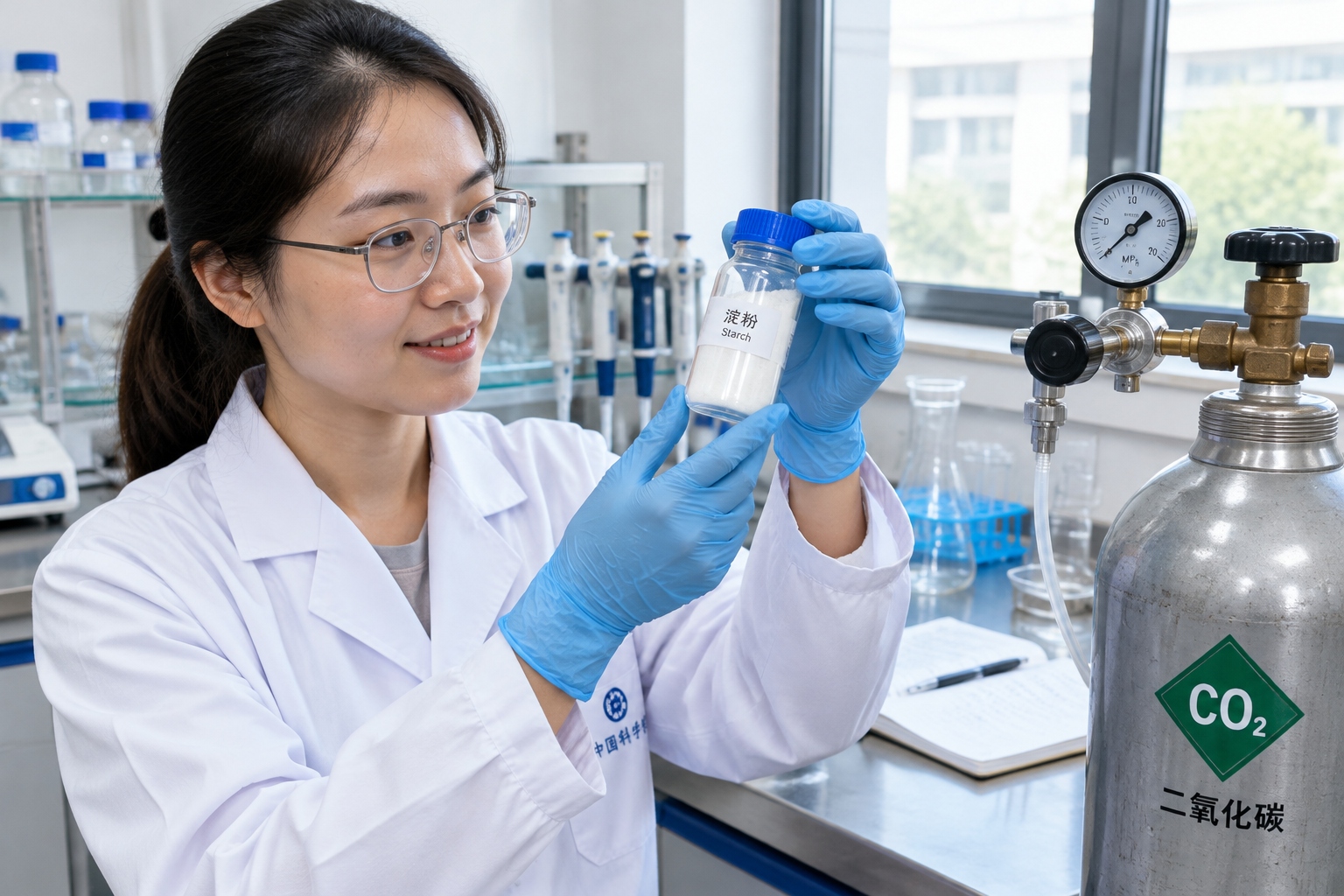
What Actually Happens Inside the Apparatus
Nature’s version of this process is photosynthesis. A corn plant pulls CO2 from the air, uses sunlight to split water, and through roughly 60 enzymatic steps builds glucose and links those glucose units into starch. It also grows roots, leaves, stems and husks, defends itself against insects, and waits for weather.
The Tianjin route splits the job into two halves.
The first half is ordinary industrial chemistry. CO2 is combined with hydrogen over a catalyst at high temperature and pressure to make methanol. Nobody invented that step for this project; methanol synthesis is a century-old business.
The second half is the new part. Methanol is fed into a broth of engineered enzymes held in a reactor. The enzymes — borrowed from plants, bacteria and fungi, then modified and optimised — first turn methanol into glucose and then stitch the glucose into amylose and amylopectin, the two molecules that make up starch. The team called the system ASAP, for artificial starch anabolic pathway.
Counted end to end, the core route runs through 11 reactions. The plant uses about 60.
The useful way to picture it is an assembly line replacing a farm. Everything a living organism does that is not strictly needed to assemble starch — growing a stem, storing water, repairing tissue — has been removed from the critical path. What remains is a chemical sequence that does one job.
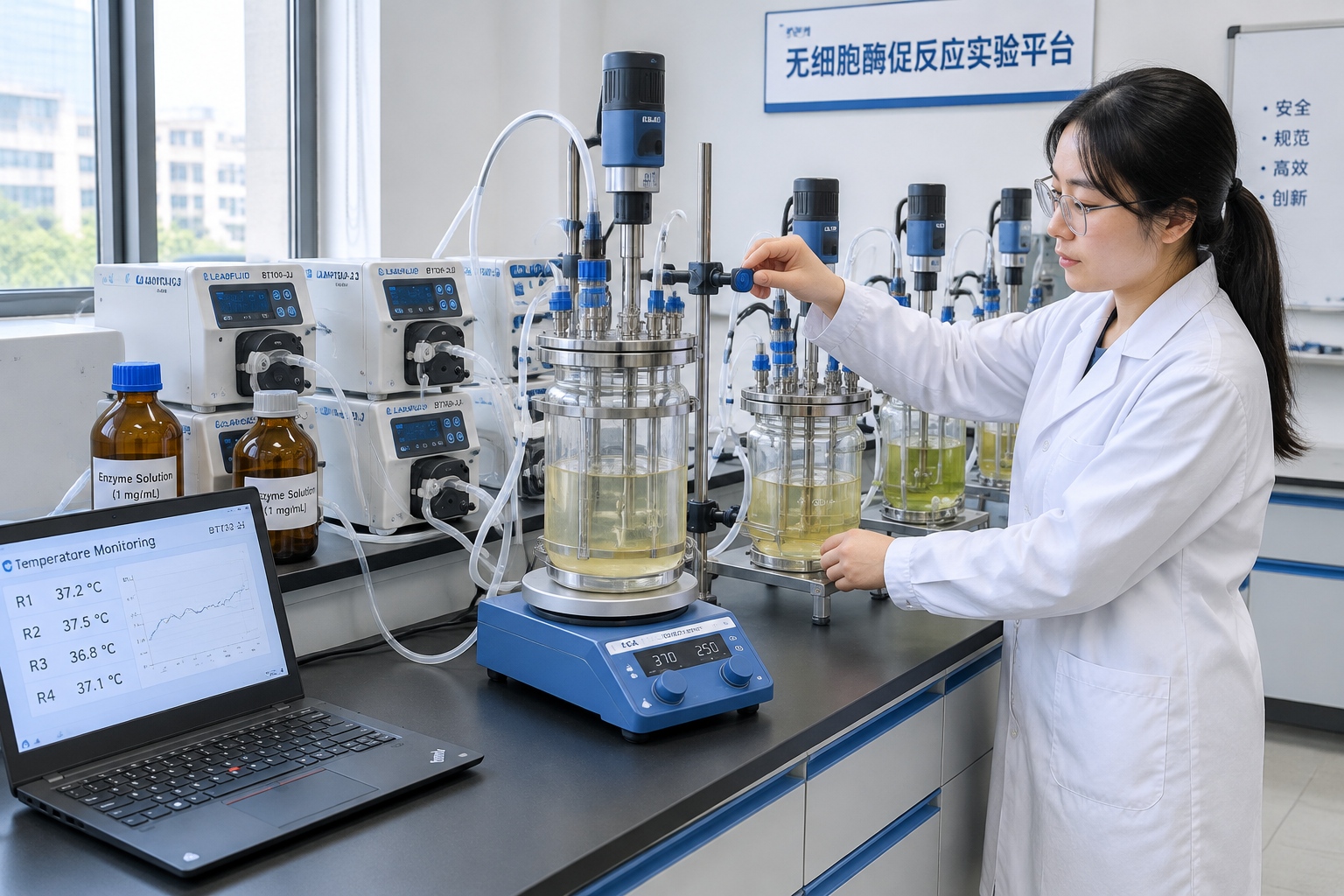
The Numbers Behind the Headlines
Three figures explain both the promise and the limits, and each comes with a caveat that the original paper states plainly.
8.5 times
The starch synthesis rate of the artificial system was reported at roughly 8.5 times that of corn. This is a comparison of how fast starch is assembled per unit of catalytic machinery, not of output per hectare. A cornfield still wins on total volume by an enormous margin, because a cornfield is measured in square kilometres and the reactor is measured in litres.
About 7% versus roughly 2%
The team calculated the overall energy efficiency of its route — the energy stored in the starch divided by the energy fed in — at around 7%, assuming the hydrogen were produced with renewable electricity. Field crops typically convert something like 1–2% of incoming solar energy into biomass. That gap is the real argument for the technology: it is a way of using electricity to make food molecules, rather than using land.
Grams
The 2021 experiments produced laboratory quantities. That is normal for a first paper, and it sets the honest scale of the achievement: a pathway was proven, not a production line.
One more number is worth keeping in mind, because it is simple chemistry rather than a claim. Starch is about 44% carbon by mass, and CO2 is about 27% carbon. So a tonne of starch, made this way, needs roughly 1.6 tonnes of CO2. That is the conversion ratio the whole idea rests on.
The Gap Between a Vial and a Silo
The distance from that vial to anything resembling a factory is set by three stubborn problems.
The first is enzymes. They are the expensive component, they lose activity over time, and a working plant would need a stable, cheap, continuously replenished supply. Much of the work since 2021 has gone into exactly this: finding more robust enzymes, cutting the number of steps, improving the reaction environment.
The second is hydrogen. The process needs H2, and where that hydrogen comes from decides whether the whole thing is a climate benefit or a climate cost. China produces most of its hydrogen from coal; green hydrogen made with renewable electricity exists but costs several times more. A starch plant running on coal-derived hydrogen would be an interesting piece of chemistry with a poor carbon story.
The third is price. Starch is one of the cheapest manufactured commodities on earth. Corn starch trades at a few hundred dollars a tonne on world markets. A lab route built on engineered enzymes and purified hydrogen does not compete with that today, and it will not for a while.
Where does the project actually stand? The team has continued to publish on improving the enzyme system and the reaction design, and has said it is working toward pilot-scale verification — the intermediate step between a bench reactor and an industrial plant. As of its most recent public updates, no commercial plant exists, and no independent cost figure for production at scale has been published.
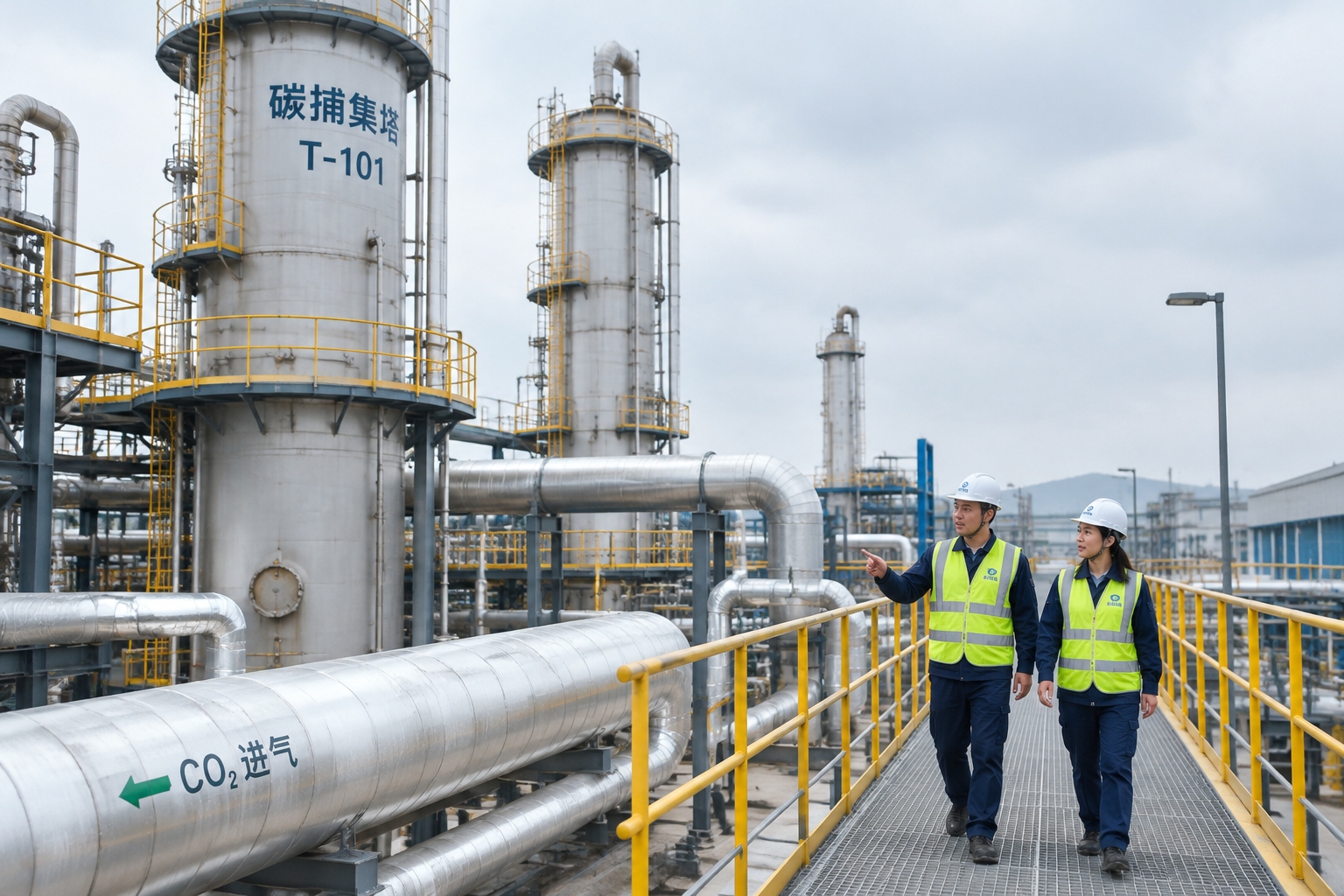
Why This Reaches Beyond the Beaker
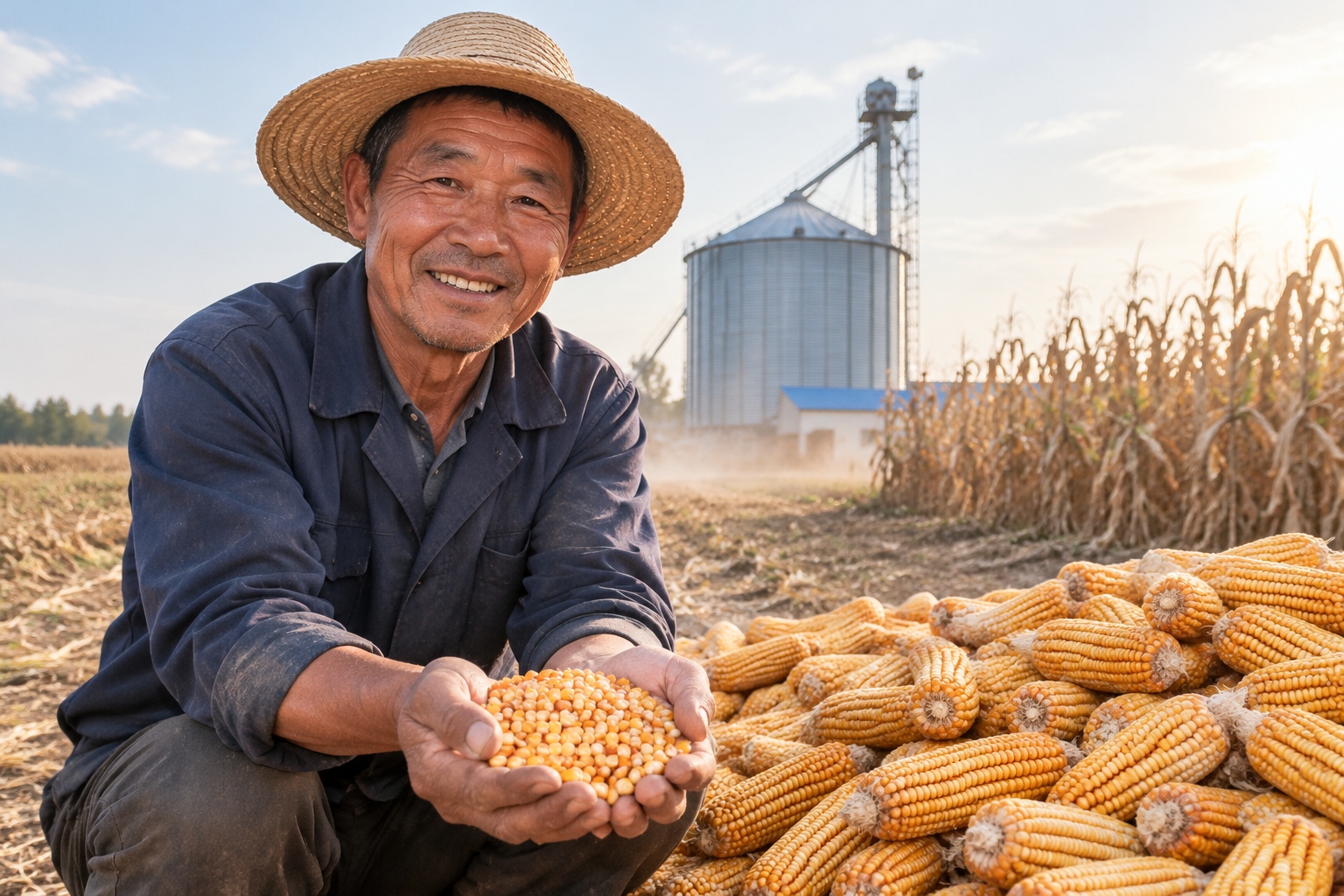
Starch is not a niche chemical. It is most of the calories in most human diets, and it is also an industrial input for paper, textiles, sweeteners and bioplastics. China devotes tens of millions of hectares to corn and still imports corn and, far more heavily, soybeans. Every tonne of starch made in a reactor is a tonne that does not need farmland, fresh water and a harvest window.
Then there is the carbon side. Heavy industry — steel, cement, coal power, chemicals — produces CO2 in concentrated streams that are expensive to eliminate at the source. Most plans for those emissions involve burying the gas. Turning a fraction of it into a solid product that can be sold is a more attractive proposition, provided the energy comes from somewhere clean.
Seen this way, artificial starch is one entry in a broader category that has been quietly expanding: converting CO2 into things people buy. Synthetic protein made by fermenting CO2 and hydrogen is already sold as animal feed. CO2-to-methanol plants operate in Iceland and in China. None of these replace the incumbent industries. All of them make the price of emitting a little more negotiable, and the technology of capture a little more familiar.
There is also a scientific payoff that has nothing to do with food. A cell-free enzyme cascade is a platform. The same logic — take the useful part of a biological pathway, discard the organism, drive it with electricity — applies to other molecules. The starch work is a demonstration that the approach can run all the way to a finished product.
A New Option, Not a Verdict
It would be easy, and wrong, to say this technology will feed the world or end food imports. It will not, certainly not on any timeline a reader of this article needs to plan around. The honest description is narrower and more interesting: a route from CO2 to starch now exists, it works at lab scale, and it is being pushed toward the next stage.
The number that will decide its future is not 8.5 and not 7%. It is cost per tonne, and nobody has published a credible one yet. Until then, this sits where most serious technology sits in its early years — a proof that a wall can be moved, with the hard engineering still ahead.
Back in Tianjin, the vial of white powder and the cornfield it might one day compete with exist in the same country, on the same grid, under the same sky. For now, the vial is a few grams of evidence that the boundary between what a plant does and what a factory can do is not fixed.
Start the discussion at forum.chinacomes.com