
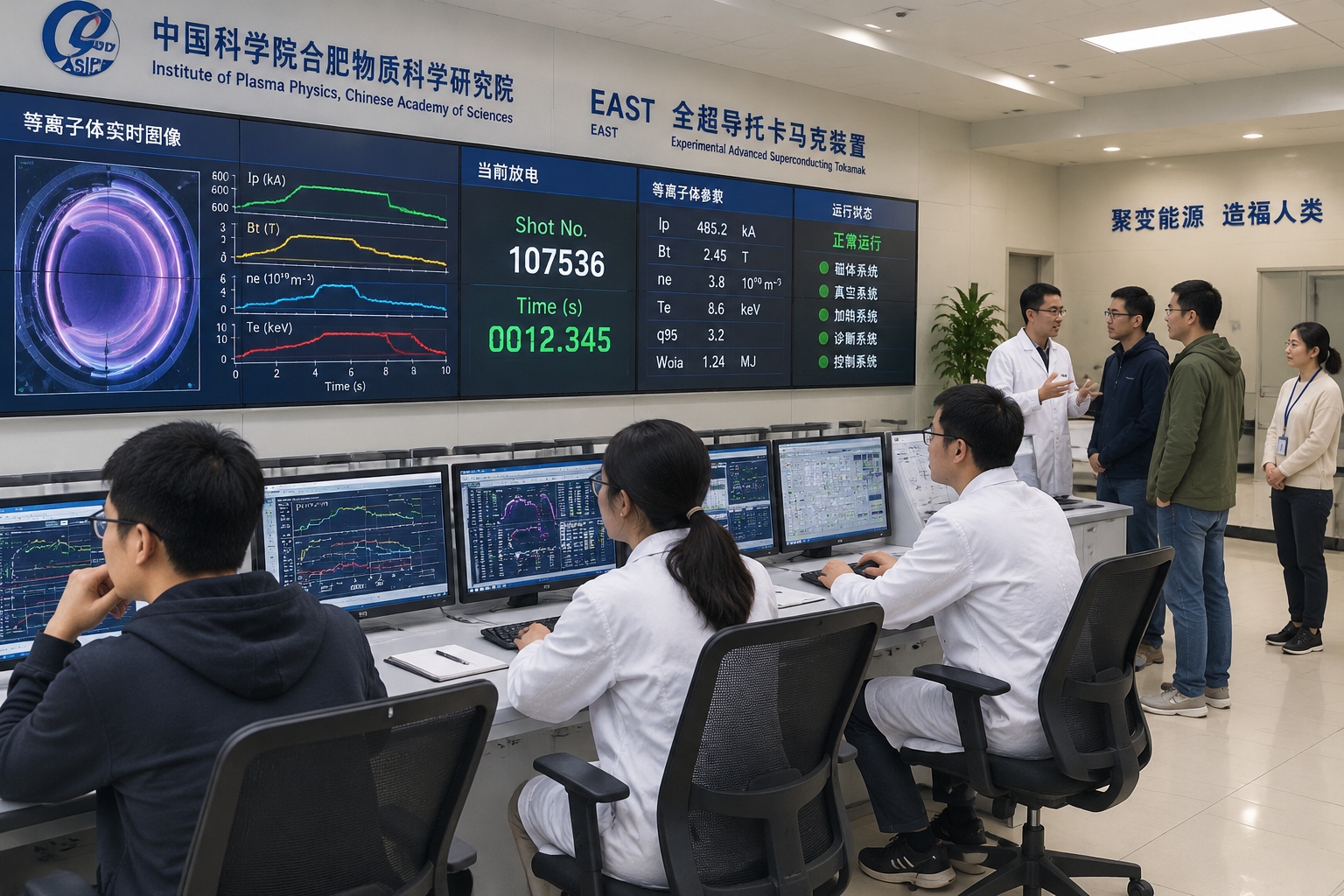

A Clock That Ran for 17 Minutes
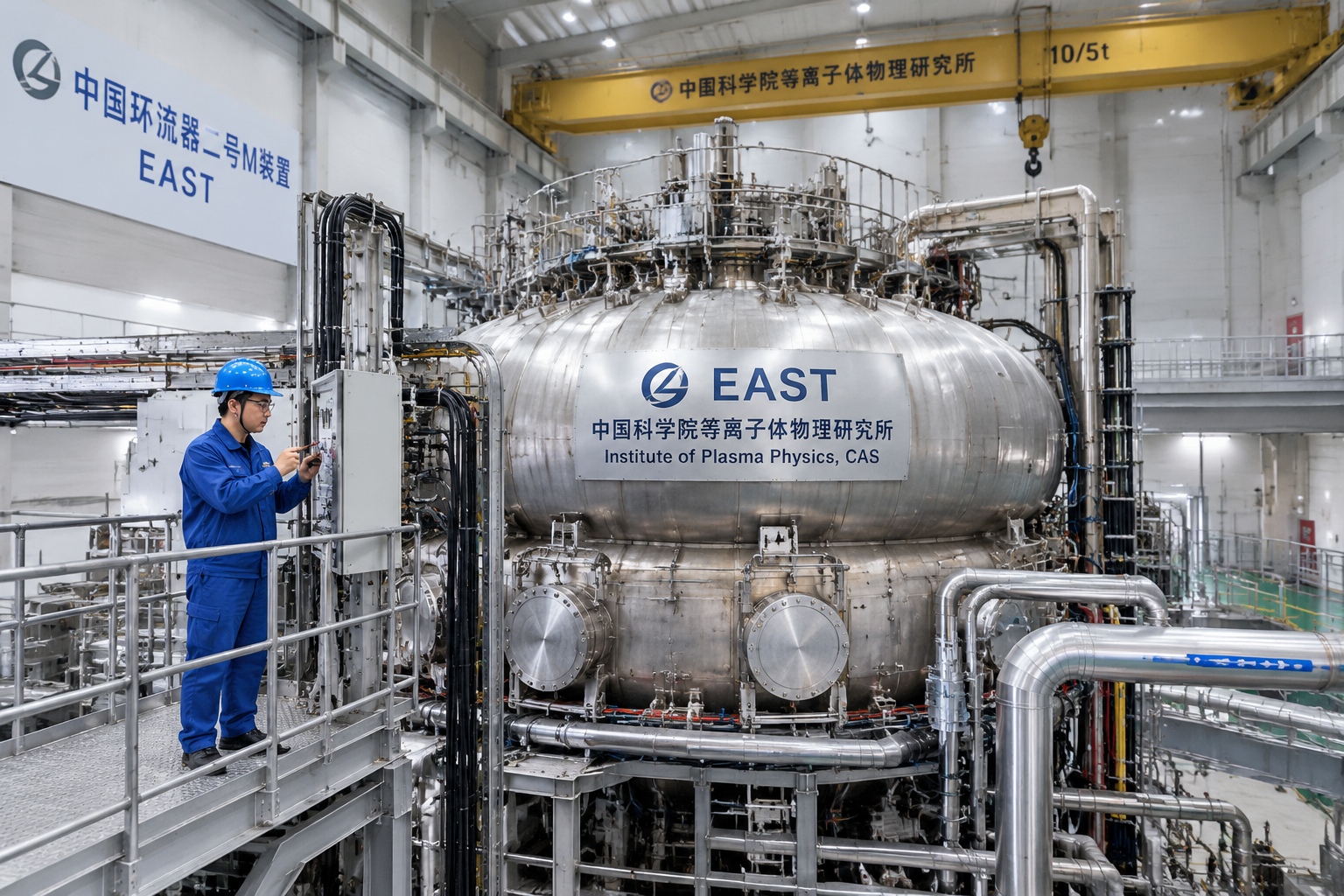
On 20 January 2025, in a control room on Science Island in Hefei, eastern China, a counter on the main display kept climbing. Behind the wall sat a steel doughnut about 11 metres tall and 400 tonnes in weight, holding a ring of gas hotter than the core of the Sun. When the run ended, the counter stopped at 1,066 seconds — 17 minutes and 46 seconds.
The Institute of Plasma Physics, part of the Chinese Academy of Sciences, described the result as a world record for steady-state, high-confinement plasma at a core temperature above 100 million degrees Celsius. The same machine had held a comparable plasma for 101 seconds in 2021 and 403 seconds in 2023.
What is a tokamak? Why does 17 minutes count as news? And if we can bottle a piece of the Sun for a quarter of an hour, why is the electricity in your kitchen still coming from coal, gas, wind and sunlight?
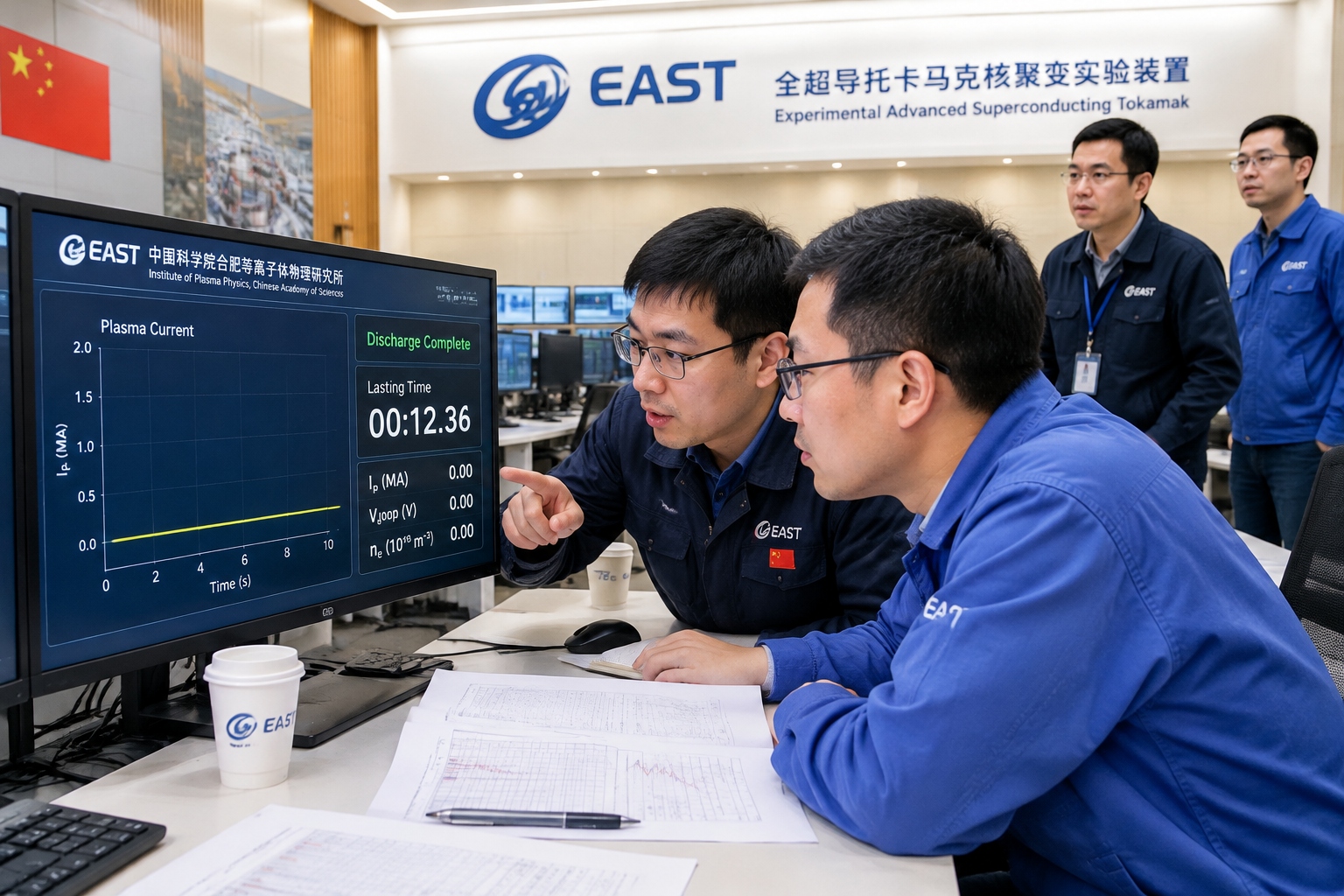
What a Tokamak Actually Does
Fusion is the reaction that powers the Sun: light atomic nuclei are pushed together until they merge, and the sliver of mass that disappears returns as energy. The easiest fuel on Earth is a mix of deuterium and tritium, two heavy forms of hydrogen. Making them fuse requires enormous temperature — over 100 million degrees Celsius — plus enough density and enough time.
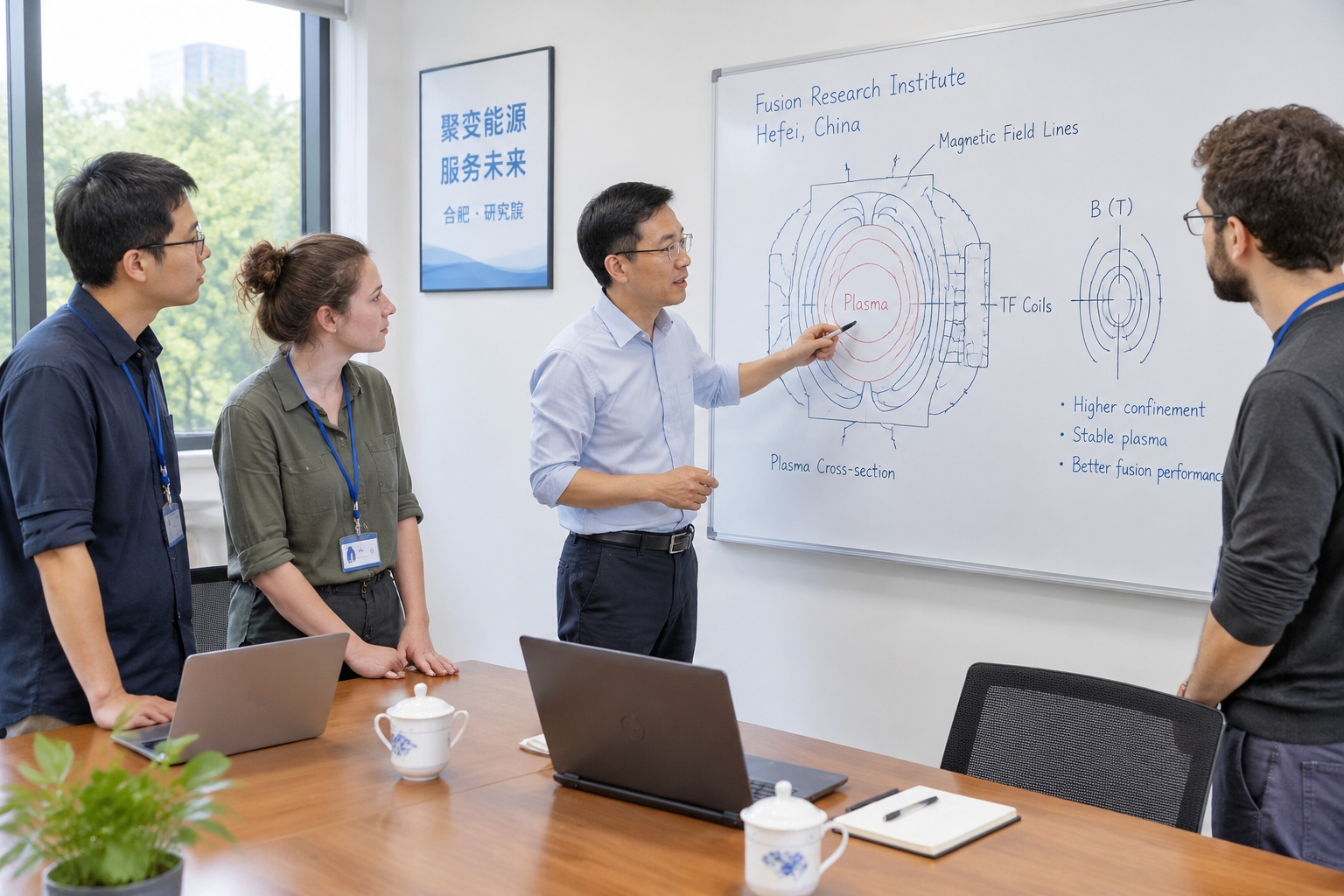
Nothing solid can touch that. So a tokamak suspends the fuel in a magnetic cage: coils around a doughnut-shaped vacuum vessel create fields that keep the ionised gas, the plasma, spinning in the middle, clear of the walls. EAST — Experimental Advanced Superconducting Tokamak, in Chinese Dongfang Chaohuan — is one of roughly a dozen comparable machines worldwide. Its main coils are superconducting: cooled with liquid helium to near absolute zero, they carry current with almost no resistance, which is what makes a run measured in minutes, rather than seconds, possible.
Three Numbers, and What Each One Means
100 million degrees Celsius
That is about seven times the temperature at the centre of the Sun, which is roughly 15 million degrees. The Sun gets away with less heat because gravity does its squeezing; in a laboratory, temperature has to compensate for much lower density. One detail worth knowing: in official accounts, the 100-million-degree figure refers to the electron temperature in the plasma core. Ion temperature — the number that matters most for fusion yield in a future reactor — is measured separately, and press reports often blur the two.
1,066 seconds
Fusion experiments report two things: how hot, and how long. Reaching 100 million degrees for a fraction of a second is now routine in several machines. Holding it for 17 minutes while the plasma stays stable is not. Europe’s JET, the largest tokamak for decades and retired in 2023, produced its record 69 megajoules of fusion energy in a pulse lasting about five seconds.
Steady state, high confinement
“High confinement”, or H-mode, is a regime discovered in Germany in 1982: above a threshold heating power, the plasma forms a thin insulating layer at its edge and roughly doubles its heat retention. It is the operating mode ITER, the international reactor under construction in France, is designed around. “Steady state” means the plasma is sustained by continuous current drive rather than being a brief burst — closer to how a power plant would have to run. Getting both at once, for more than a thousand seconds, is the specific achievement here.
Why Holding It Is Harder Than Lighting It
A short, violent pulse is a physics experiment. A long, controlled one is an engineering problem that keeps changing shape.
Heat. The plasma’s exhaust has to go somewhere. In EAST, as in ITER, it is steered onto a divertor — tungsten-armoured tiles built to take around 10 megawatts per square metre, a heat load comparable to a rocket nozzle. Tiles survive seconds easily; over 17 minutes, small asymmetries and transient bursts begin to matter.
Control. Plasma is unstable in dozens of ways, and instabilities grow in milliseconds. Long runs mean hundreds of diagnostic systems feeding real-time corrections into the coils — steering a ring of 100-million-degree gas so that it never touches a wall, for a quarter of an hour. Researchers liken it to driving at speed through a narrow tunnel that is itself moving.
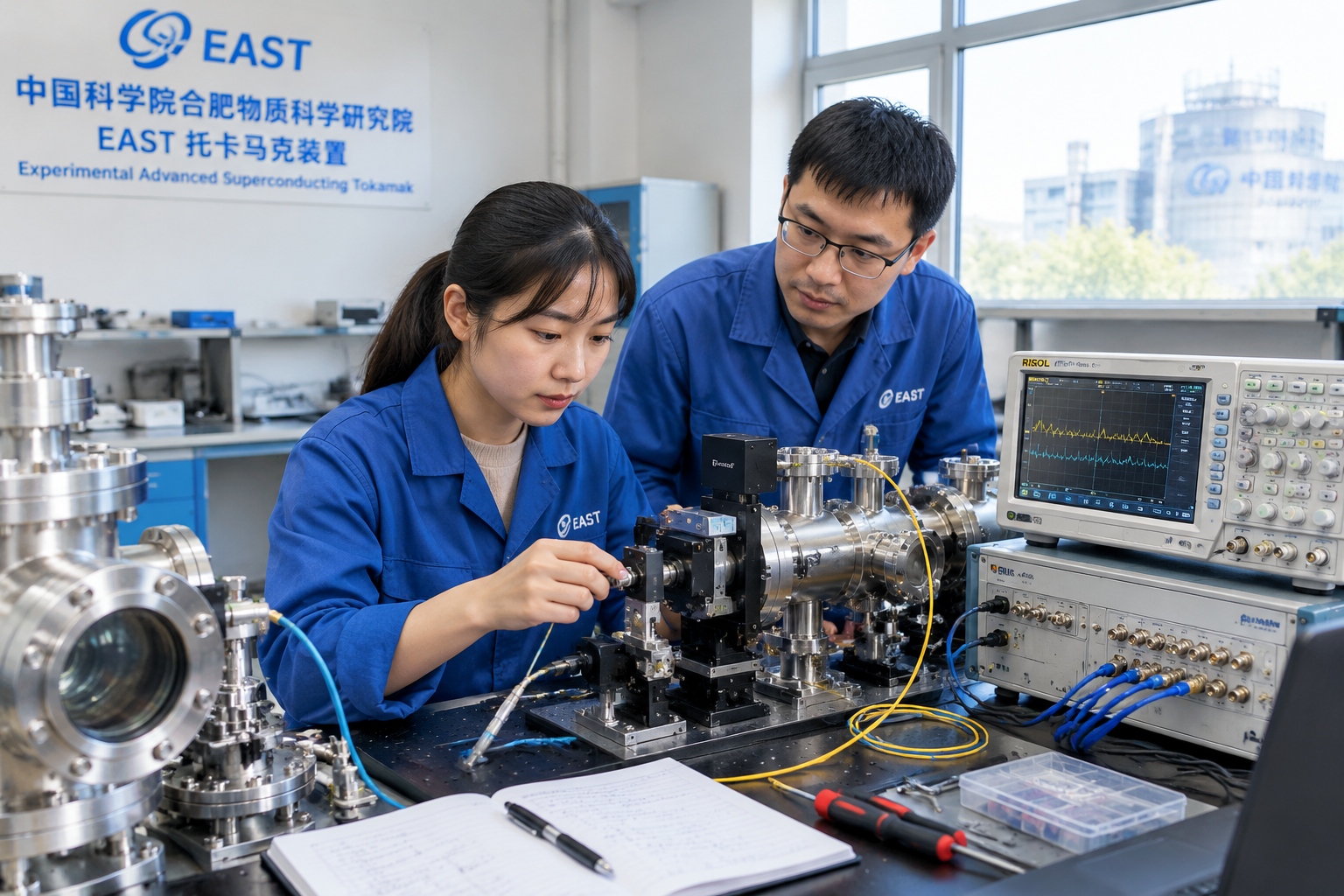
The wall. Over long pulses, impurities sputtered off the vessel accumulate in the plasma and radiate energy away. The wall has to be conditioned between shots, and fuel replenished continuously, often by firing frozen hydrogen pellets into the plasma. The magnets. Superconducting coils must stay cold and stable throughout, with quench protection on standby; one normal-conducting spot can end the experiment.
None of this is exotic physics. It is the unglamorous work of making a violent system behave for longer and longer — and it is where the EAST team has spent its time.
A Laboratory, Not a Power Plant
This is the part most easily lost in headlines. EAST generates no electricity. It draws several megawatts from the grid to heat the plasma and run its magnets, and it has no turbine, no generator, no breeding blanket. It runs hydrogen and deuterium, not the deuterium-tritium mix a reactor would use, so it produces very few of the high-energy neutrons that make fusion both powerful and hard.
Between a 1,066-second plasma and a commercial plant sit several unsolved problems. A reactor must breed its own tritium, which requires a lithium blanket never yet operated at scale. Structural materials must survive years of neutron bombardment. The machine must run for months between maintenance windows, at a reliability a grid operator would accept, at a cost per megawatt-hour someone will pay.
China’s next steps are visible. The same institute is building BEST, a compact tokamak intended to demonstrate fusion power generation around 2027, plus CRAFT, a large facility for testing reactor components. In Shanghai, the startup Energy Singularity completed a small all-high-temperature-superconducting tokamak in 2024 and is now building a larger one.
Where China Sits in a Shared Race
Fusion has never been a single-country project. China joined ITER in 2006 and supplies superconducting strand, magnet supports and correction coils, among other components. EAST itself works as a testbed for ITER-relevant physics, and its experimental campaigns include visiting researchers from abroad.
The field is moving faster than it did a decade ago. ITER is in assembly in southern France, aiming for first plasma in the 2030s and 500 megawatts from 50 megawatts of heating. South Korea’s KSTAR has held 100-million-degree plasmas for tens of seconds. In the United States, the National Ignition Facility achieved laser-driven ignition in 2022, and private firms such as Commonwealth Fusion Systems are building compact machines using high-temperature superconductors. The 1,066 seconds belongs to that landscape: not a finish line, but a marker of how long a laboratory plasma can now be kept in the regime a reactor will need.
Why It Still Matters
Fusion will not replace coal or solar this decade, and probably not next. Grid planners working on 2035 are not waiting for it. What fusion offers is different: firm, high-density power whose fuel is abundant in seawater and whose waste is short-lived compared with today’s fission plants. That is insurance against a future in which renewables, storage, fission and grids alone prove harder or slower than hoped.
The work also leaves capabilities behind — superconducting magnets, high-power heating, vacuum and materials engineering — that surface in medical imaging, accelerators and industrial processing. And there is a quieter point: 17 minutes means a machine, a team and a supply chain all behaved as designed, for 1,066 seconds in a row. That is what progress in this field actually looks like.
Start the discussion at forum.chinacomes.com