

3:47 a.m. at the Nanshan ground station
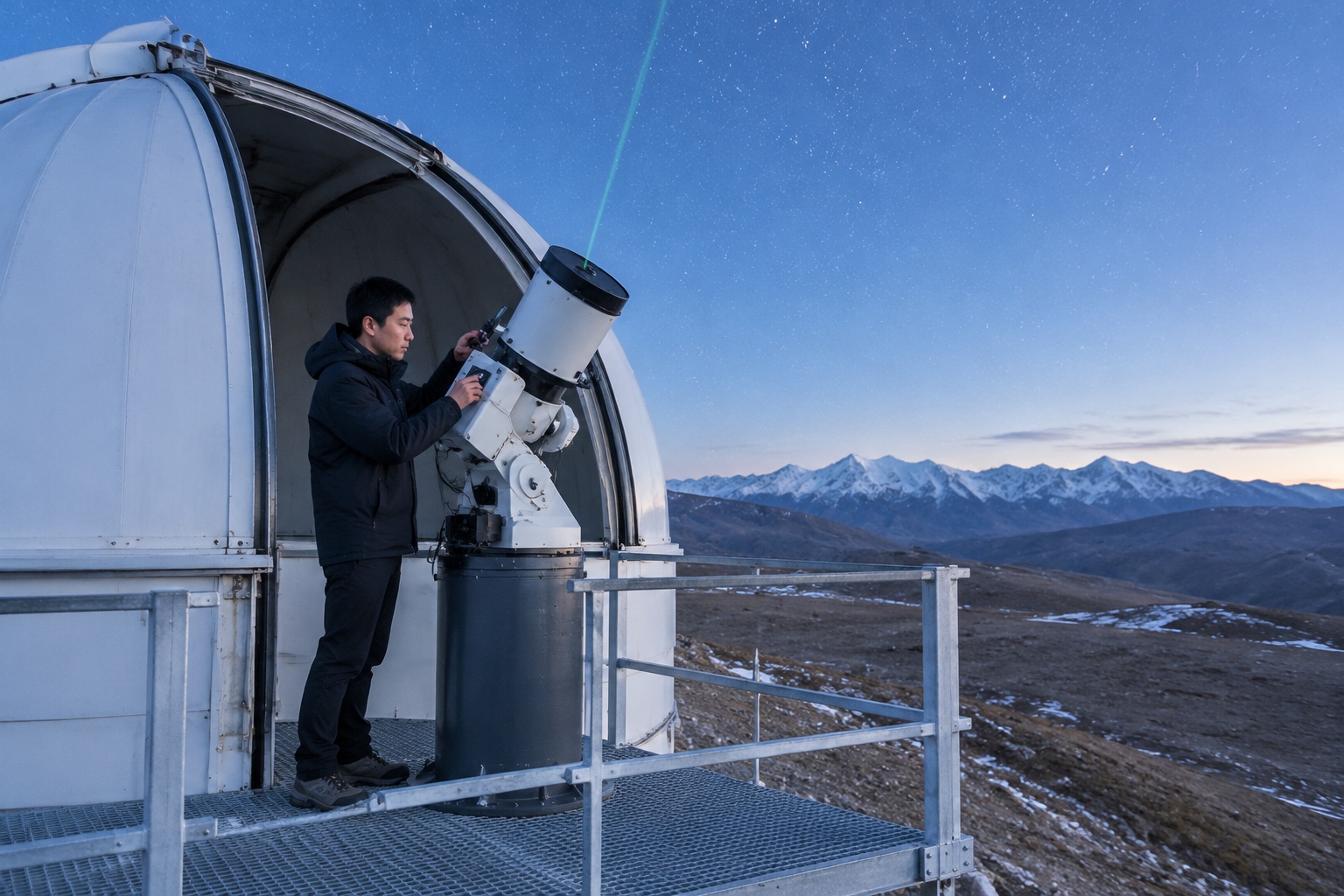
At 3:47 a.m. the cloud over Nanshan finally thinned enough to work with. A technician pulled on a jacket and climbed the steel stairs to the observatory dome. The shutter rolled back and cold air came in — Xinjiang in early spring, a few degrees below zero. In the control room, a screen listed the satellite passes for the night, each one timed to the second. Micius would be in view for a few minutes. If the sky held, the station would fire a guide laser upward, catch the satellite’s faint beam with the telescope, and exchange a key.
Nobody was launching anything that night. That is what working with Micius looks like now: weather checks, sleeping in shifts, and short windows of time.
The morning it left the ground
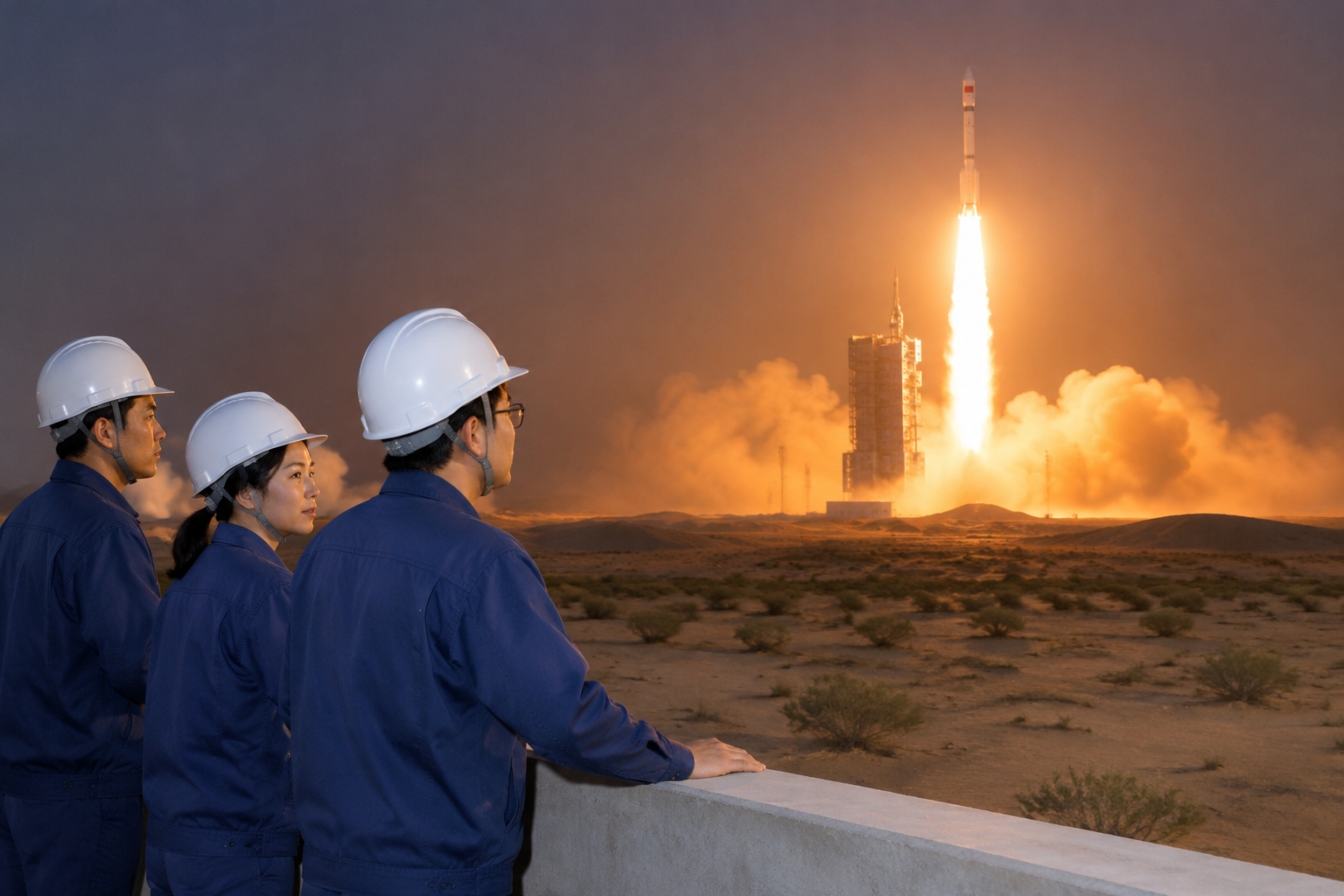
Micius — Mozihao in Chinese, named after the classical philosopher who wrote about optics in the fifth century BC — lifted off from the Jiuquan Satellite Launch Center in the Gobi Desert at 1:40 a.m. on 16 August 2016, riding a Long March 2D rocket. The satellite weighed about 640 kilograms. Its payload was built around a laser system, a source of entangled photon pairs, and a telescope designed to stare down at Earth.
The international reaction was curious rather than alarmed. Science and Nature both covered the launch. The questions were practical: could a satellite really survive the vibration of launch, the vacuum, and the temperature swings, and still keep a laser aligned well enough to talk to a station in a telescope mirror? A single photon has to survive a journey of 500 kilometres down through the atmosphere and be caught.
The answer arrived within a year.
A key that cannot be copied without showing it
Quantum key distribution is a simple idea dressed in difficult physics. Two sides need the same random string of bits to encrypt a message. They could send that string over the internet, but anyone listening in could copy it. Quantum mechanics offers a different route.
Individual photons are sent, each prepared in one of several states — often their polarization. The receiving station measures them. Because of the no-cloning principle, an eavesdropper cannot make a perfect copy of an unknown quantum state. Any attempt to measure it disturbs it. When the two sides later compare a small sample of their results over an ordinary channel, those disturbances show up as errors. If the error rate is low enough, the key is safe. If it is not, the key is thrown away.
The physics was not new. Quantum key distribution was proposed in the 1980s and demonstrated over laboratory benches and then short fibre links. The problem was distance. Photons fade inside optical fibre — after a few hundred kilometres the signal drowns in noise, and repeaters have to be trusted, which defeats the point. Free space, above most of the atmosphere, is cleaner.
From 1,200 kilometres to 7,600
In 2017, the team reported satellite-to-ground key distribution between Micius and the Xinglong station in Hebei, roughly 1,200 kilometres apart. The key rate was modest — a few hundred bits per second, good enough to prove the link worked, not good enough to stream a film.
A second set of results was stranger. Two ground stations, Nanshan in Xinjiang and Delingha in Qinghai, were separated by 1,200 kilometres on the ground. Micius sent pairs of entangled photons to each station simultaneously, and the measurements at both ends stayed correlated. Doing this across 1,200 kilometres, in open air, was the farthest test of entanglement to date.
Then came the demonstration most people remember. On 29 September 2017, a video call was made between Beijing and Vienna, encrypted with a key generated through Micius and relayed via the Xinglong and Graz stations — about 7,600 kilometres. The conversation lasted only about 75 minutes, and the people on the call did not have much to say. Still, the key was not carried by a courier or a cable.
What the experiment actually demands
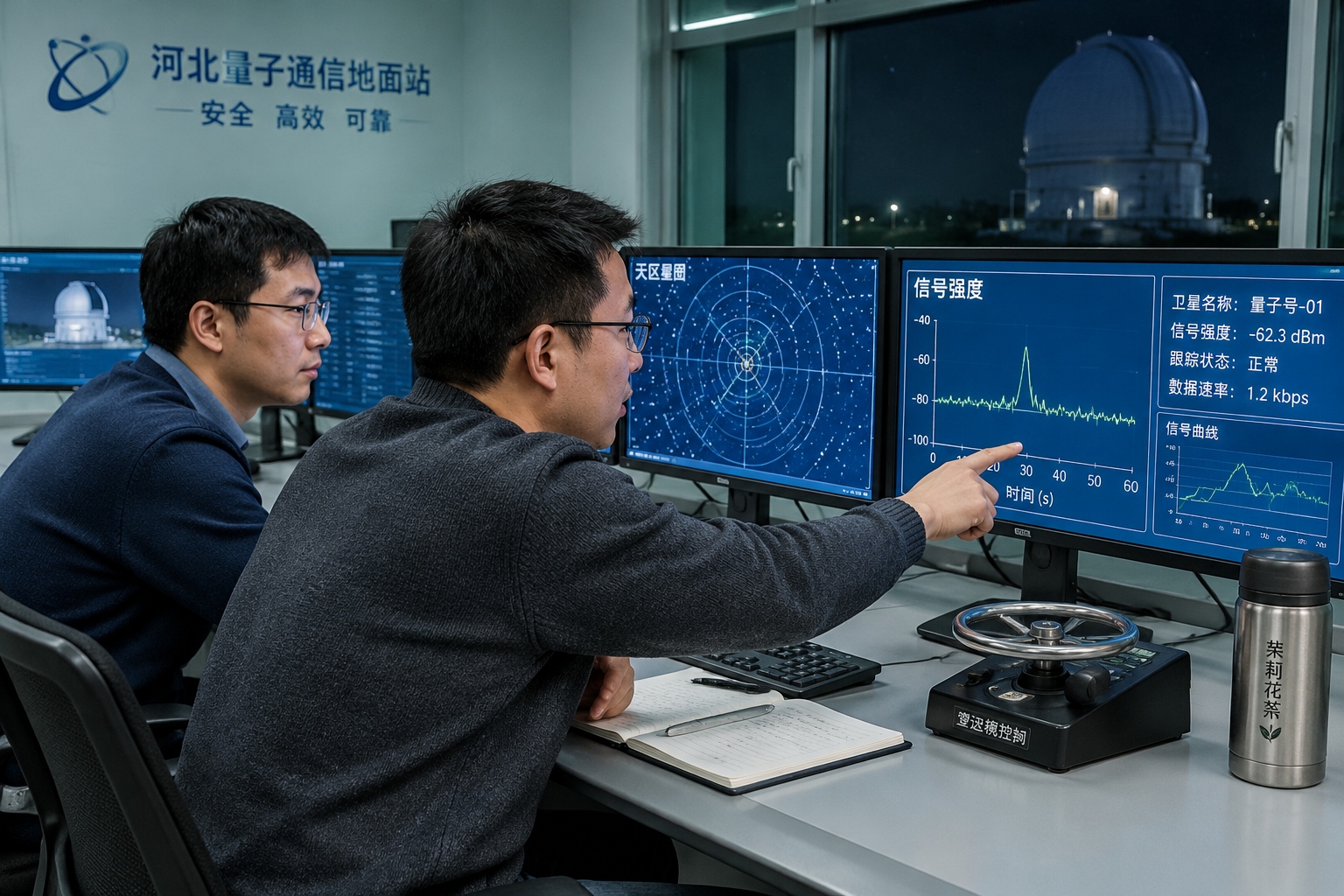
It is worth being precise here about the barriers that remain. The technology is real, but the logistics are demanding. A ground station for free-space quantum communication is not a router in a basement; it is a building with a large aperture telescope, precision tracking, and a dedicated team. China built a small network of them: Xinglong in Hebei, Nanshan in Xinjiang, Delingha in Qinghai, Lijiang in Yunnan, and Ali in Tibet, above 5,000 metres, used for ground-to-satellite entanglement experiments.
Weather is the constant obstacle. The link is optical, so cloud ends the pass. The ground station must be in darkness while the satellite is illuminated, which rules out much of the day, and the satellite must be above the horizon for both ends at once. A usable pass lasts only a few minutes. The keys generated are short, and each one has to be replenished.
None of this is a failure. It is what an experimental infrastructure looks like in its early years, comparable to the state of fibre-optic communication in the 1970s. But it is a long way from a service anyone can subscribe to.
The line that continues after Micius
Micius was designed as a two-year mission and has long outlived that schedule. The work moved on. In 2017, China opened a 2,000-kilometre fibre backbone between Beijing and Shanghai for quantum key distribution, with dozens of trusted nodes along the route — a different approach, useful for banks and government networks, but limited by distance and by the trust placed in each node.
In July 2022, a much smaller satellite called Jinan-1 was launched, built by a commercial spin-off and weighing roughly 100 kilograms, or about a sixth of Micius. In 2024, researchers reported a real-time quantum key link between stations in China and South Africa, spanning about 12,900 kilometres, using a compact ground station that weighed far less than Micius’s telescopes. The trend is clear: smaller, cheaper, more numerous. Several groups in China and elsewhere are discussing constellations of quantum satellites, though no one has announced a commercial service.
What ‘quantum’ means to people in China
Ask someone on a city bus in Hefei, where much of the research base sits, and they will recognise the word. The launch was on the evening news. School textbooks and science museums mention the satellite. Pan Jianwei, the physicist who led the project, is a public figure in the way few scientists are.
That visibility has an odd side. In 2019, a company marketed “quantum wave speed reading” classes for children, claiming that flipping through a book quickly would let the brain absorb it. Regulators shut it down. Shops sold quantum water bottles, quantum underwear, quantum pendants. None of it had anything to do with physics. The gap between what a satellite does and what the public hears is real, and China’s science communicators know it.
The honest version is less exciting than either the official story or the frauds. Quantum key distribution does not make communication unbreakable. It makes eavesdropping detectable, which is a narrower and more useful claim. It does not encrypt anything itself; it produces keys, and those keys are only as secure as the hardware at each end.
The dome closes
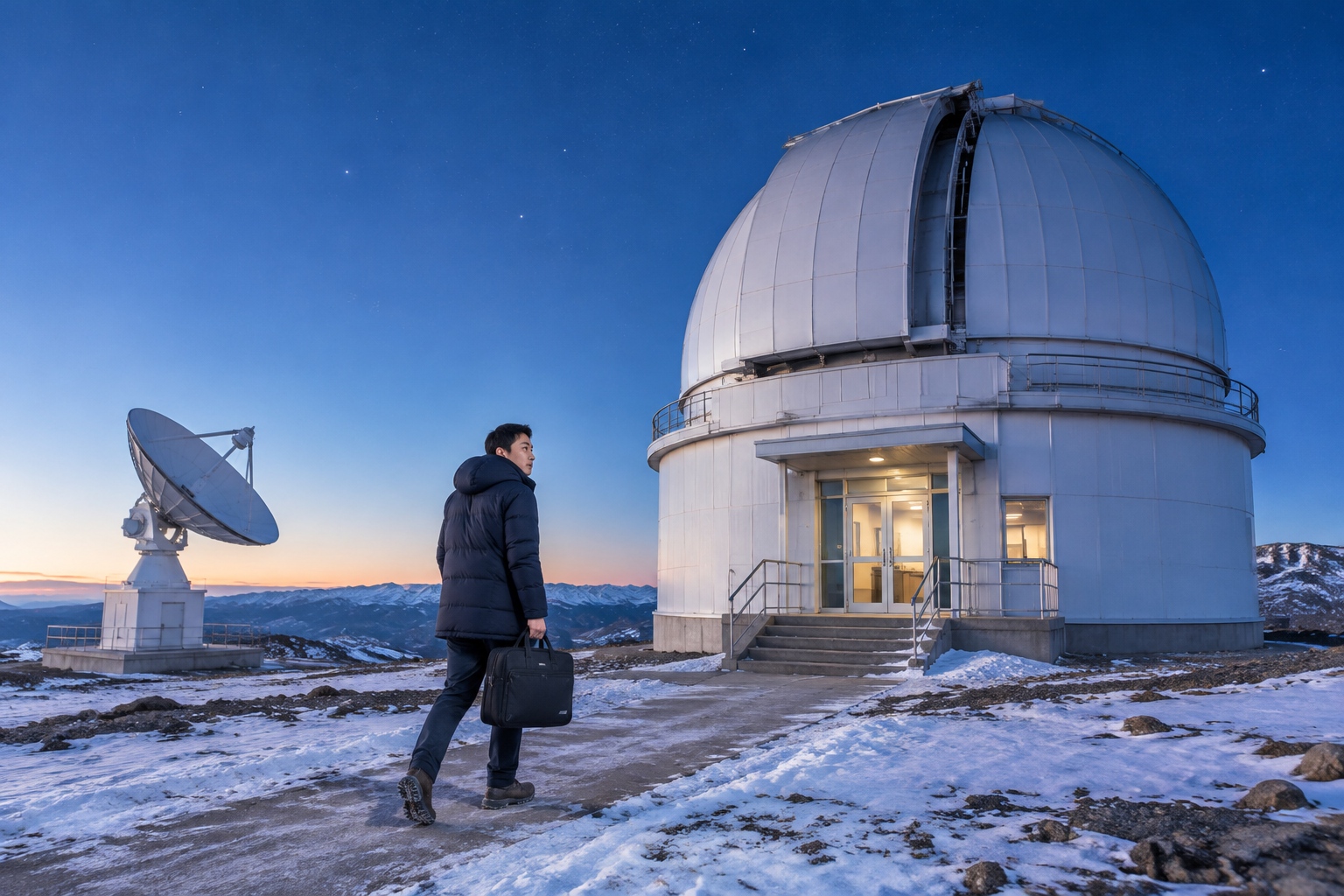
By seven, the sky over Nanshan was pale and the pass list was empty until evening. The technician shut the dome and went to bed. Two or three times a week, depending on the season and the clouds, the station repeats the routine: open, track, exchange, close. The satellite has been up there for nearly a decade, older than its designers expected, its orbit slowly decaying. The work has moved on to smaller machines and longer distances.
Somewhere in a textbook, a student is reading about the photon that cannot be copied. Somewhere else, a vendor is selling a quantum pendant. Both are part of the same story about a technology that has already changed what is possible, without yet changing what most people do with their phones.
Start the discussion at forum.chinacomes.com