

Thursday afternoon, Jing’an District, Shanghai
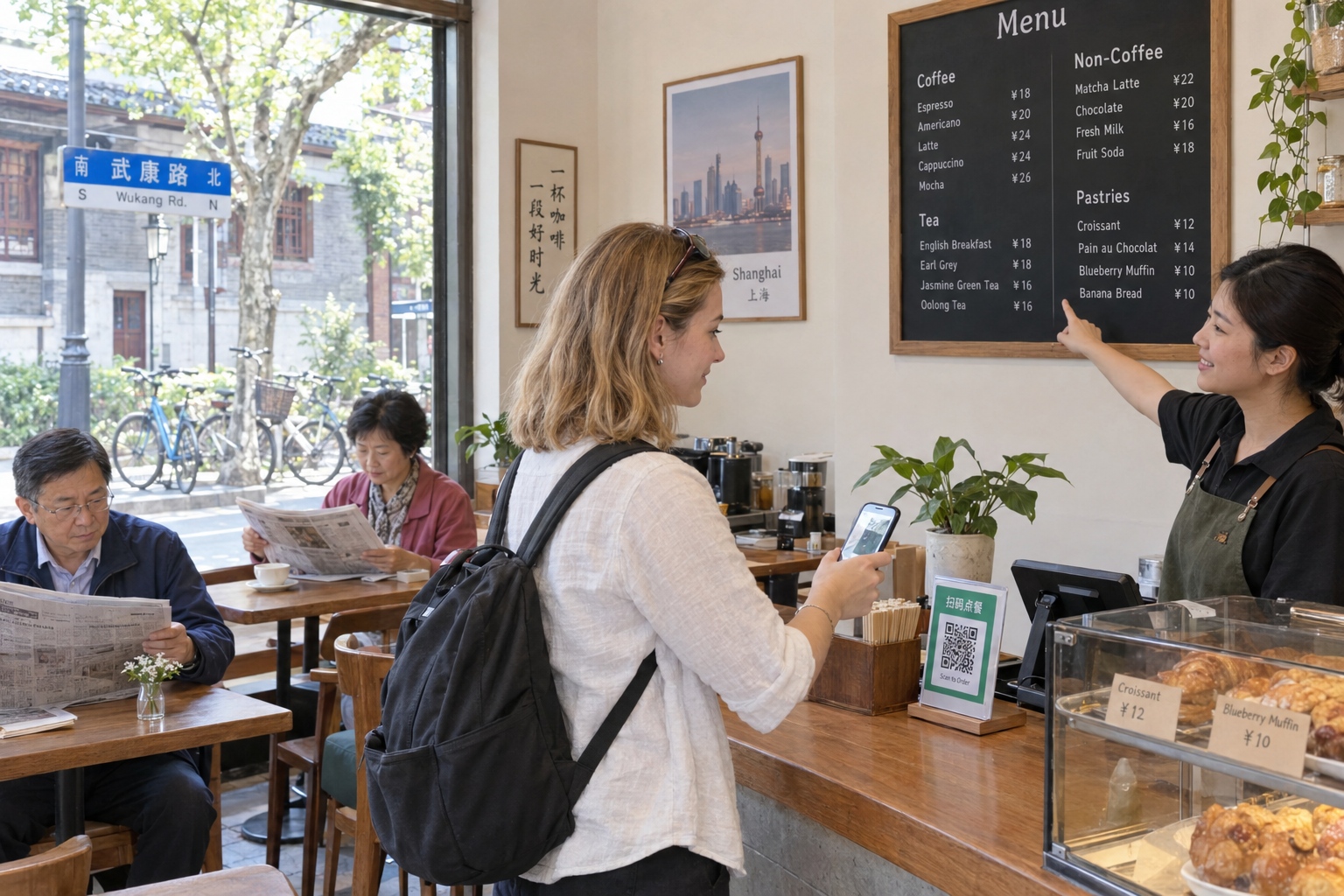
It is three o’clock on a Thursday afternoon at a neighborhood café in Jing’an, Shanghai. A German tourist holds her phone up to a QR code on the counter. The screen jumps to a payment page. She uses a translation app to ask the barista, “How much is this?” The barista points to an English menu on the wall. Thirty seconds later, the transaction is done.
Three years ago, this scene would have been nearly impossible. For foreign visitors, the biggest headache in China was cash and cards — most small shops didn’t take Visa, vending machines rejected coins, and taxi drivers rarely had change for a 100-yuan note. Now Alipay and WeChat Pay accept foreign bank cards, and many street-level shops tape their QR codes in plain sight.
This small detail sits on top of a year of policy shifts. In December 2023, China began a unilateral visa-free trial for citizens of France, Germany, Italy, the Netherlands, Spain, and Malaysia. By the end of 2024, the unilateral visa-free list had expanded to about 40 countries, with another 50-plus countries covered by a 240-hour transit visa exemption. In November 2024, the maximum visa-free stay was extended from 15 days to 30 days.
So what did “one year of visa-free entry” actually change? The numbers tell part of the story. The rest is tucked into ordinary daily life.
What the numbers show — and what they hide
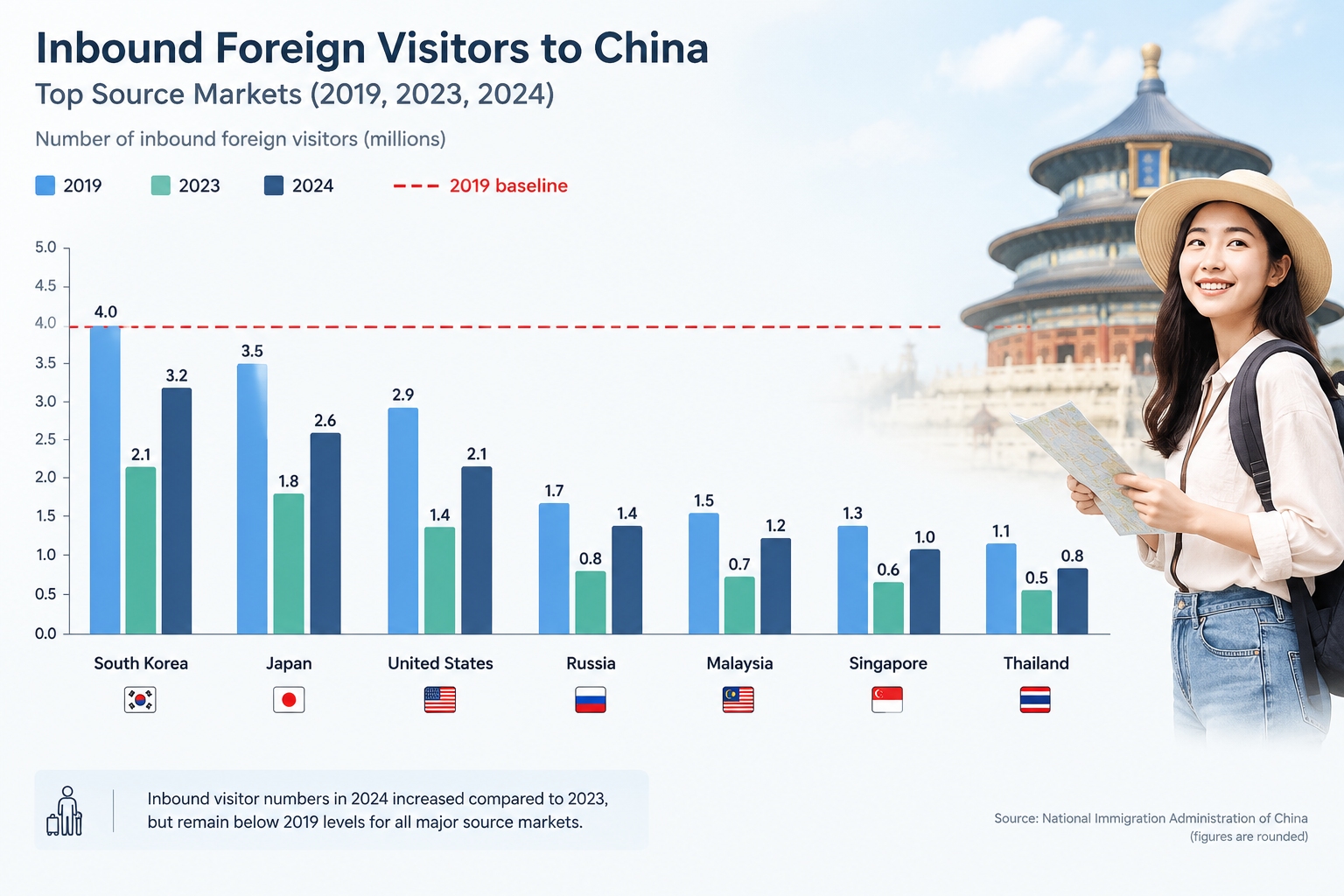
Start with the ledger. In 2024, about 27 million foreign nationals entered China, up roughly 95% year-on-year (National Immigration Administration, January 2025). Of those, about 20 million entered visa-free, up around 112%. The top source countries included South Korea, Japan, the United States, Russia, Vietnam, Malaysia, Singapore, and Thailand.
Compare that with 2019, when about 32 million foreigners entered China. In other words, 2024 recovered to roughly 84% of the pre-pandemic level. The more accurate description is “recovery,” not “boom.”
It also helps to separate correlation from causation. The rebound in inbound tourism is shaped by at least four variables: exchange rates (a weaker yuan against the dollar, euro, and yen makes China cheaper to visit), international flight capacity (about 70% of 2019 levels in 2024, according to OAG data, with some routes recovering more slowly), geopolitical atmosphere (travel advisories in some countries), and the visa-free policy itself. Visa-free is one variable, not the only switch.
From landmark spotting to city living
The old foreign tourist route was predictable: the Forbidden City in Beijing, the Terracotta Warriors in Xi’an, the Bund in Shanghai, the karst hills of Guilin. In 2024, the routes visibly scattered.
On Wukang Road in Shanghai, in Beijing’s hutongs, at the Yulin wet market in Chengdu, and at small dessert shops in Guangzhou’s old quarters, you now run into foreign faces pulling small suitcases. A guesthouse owner in Chengdu said that a few years ago foreign guests would ask where to buy panda souvenirs. Now they ask where locals go for tea on weekends.
Visa-free is not the only reason. “City walk” content on social platforms, younger travelers’ interest in ordinary daily life, and the habits of low-cost short-haul travel all push routes outward. But visa-free lowers the threshold for spontaneous trips — a three-to-five-day weekend visit becomes feasible. A Shanghai tour guide said that in the second half of 2024, about half of her European clients were “Friday arrival, Monday departure” types. They skip the landmarks and spend their time in neighborhoods, wet markets, and independent bookstores.
Digital life: easier, but not frictionless
Mobile payment is the change foreign visitors feel most directly. In 2024, both Alipay and WeChat Pay allowed foreign bank cards (Visa, Mastercard, JCB, and others) to be linked, with single-transaction limits raised to several thousand yuan. Many scenic spots, convenience stores, and chain restaurants also accept foreign cards directly. Beijing Capital and Shanghai Pudong airports set up payment service centers for international arrivals, walking people through the card-linking process.
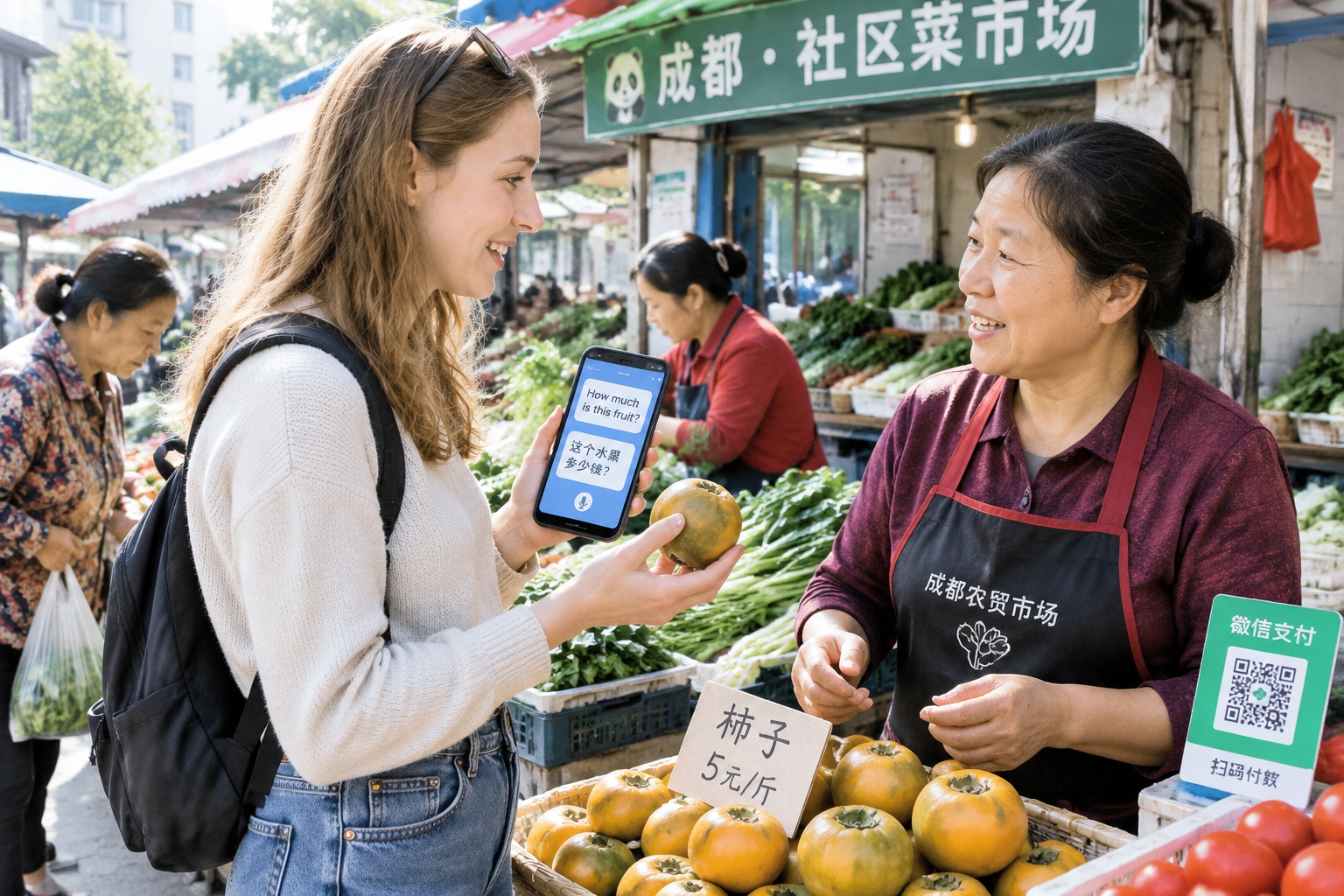
Friction remains. Opening a Chinese bank account requires a Chinese phone number (some banks accept foreign numbers, but the process is longer). Some restaurant ordering systems require real-name verification. Ride-hailing apps have Chinese-language interfaces. Translation tools often stumble on local dialects. A French tourist put it plainly: “Paying is easy now. Ordering food still involves guessing.”
What small businesses actually feel
The first to feel the visa-free flow are small businesses.
A guesthouse owner in Jing’an said that in 2024 the average stay for foreign guests dropped from four or five days to two or three, and bookings became more last-minute — “a week ahead feels early now.” Average spending per guest didn’t rise much, but guests became more willing to try neighborhood breakfast stalls and local eateries. A taxi driver said the questions from foreign passengers have changed: “They used to ask where to find good food. Now they ask where we buy groceries.”
Not every business is better off. An English-speaking guide in Guilin said that in 2024 the number of European and American tour groups recovered more slowly than expected, partly because of fewer flights and longer layovers. His income has not returned to 2019 levels.
The “quiet flow” that tourism data misses
A significant share of 2024’s inbound numbers were not tourists at all: business delegations, trade fair attendees (Canton Fair, China International Import Expo), factory visits, family visits, and short-term students. These people don’t appear in “tourism” statistics, but they show up in hotels, industrial parks, and airport lounges.
A translator at the Suzhou Industrial Park said that in the second half of 2024, delegations from small and medium-sized European companies became noticeably more frequent. Many were following a simple logic: “Visa-free means we can come take a look first, without signing anything, and decide later.” This quiet flow has concrete effects on city services: longer stays in business hotels, multilingual reception at industrial parks, temporary interpreters at exhibition halls.
How much have public services caught up?
The improvements are specific. Pudong and Capital airports added multilingual signage. Arrival halls now have foreign-card ATMs and SIM card counters. Some Shanghai Metro lines added English-language announcements. Tourist information centers in Hangzhou and Chengdu stock maps in Chinese, English, Japanese, and Korean. In 2024, China also rolled out “inbound tourism facilitation” measures, including simplified booking processes at scenic spots for foreign visitors.
The gaps are also specific. Smaller city airports have very little English signage. Some ticket windows only accept WeChat or Alipay, and foreign cards don’t work. Community clinics require ID cards for registration, which is awkward for short-term visitors. Some hotels still decline foreign guests, even though regulations allow them. An Italian tourist said: “Shanghai is smooth. In smaller cities nearby, translation apps and hand gestures become the main tools again.”
One data point that runs against expectations
Japanese citizens have long enjoyed visa-free entry to China. Yet in 2024, about 2 million Japanese visited China — only around 40% of the 2019 level of roughly 5 million (Japan National Tourism Organization, 2024). The visa is not the issue. The reasons include the broader diplomatic atmosphere, travel safety advisories, the tone of Japanese media coverage of China, and the weak yen. This data point makes the point clearly: visa-free is one variable, not the deciding variable.
Similarly, visitors from the United States, United Kingdom, and Canada — none of which are on the unilateral visa-free list — recovered more slowly than visitors from visa-free countries, partly because of flight capacity, travel advisories, and bilateral relations. Visa-free countries (France, Germany, Italy, Spain, Malaysia) recovered faster, but their absolute numbers still sit below 2019.
Favorability data offers another check. A 2024 Pew Research survey found that the median share of negative views toward China in high-income countries remained above 50%, with some countries higher than the year before. There is no simple positive correlation between traveler numbers and favorability.
So what changed, and what didn’t
If you only look at the numbers: inbound visitors recovered to just over 80% of pre-pandemic levels, the visa-free list grew from six countries to about 40, and the maximum stay extended from 15 days to 30.
If you look at the details: foreign visitors now appear in more ordinary places — wet markets, neighborhood cafés, parks, subway cars. The threshold for mobile payment is a bit lower than three years ago. Small business owners are getting used to hearing different languages again. Airports and metro stations have a few more English signs.
What hasn’t changed: visa-free is not a master key. It lowers the barrier, but it doesn’t erase the effects of flights, exchange rates, geopolitics, and media narratives. It makes “come and take a look” easier. It doesn’t guarantee “you’ll like what you see.”
Back at the café in Jing’an. The German tourist asks the barista, “Is there a market here on weekends?” The barista pauses, taps a translation app, and replies: “Next-door park. Saturday morning.” The tourist nods, sets down her cup, and walks out. It is a small moment. But it is closer to what one year of visa-free entry actually changed than any macro number — not the relationship between states, but whether one person is willing to walk two extra blocks to see how others live.
Start the discussion at forum.chinacomes.com