

6:20 a.m., and there are already three people in line
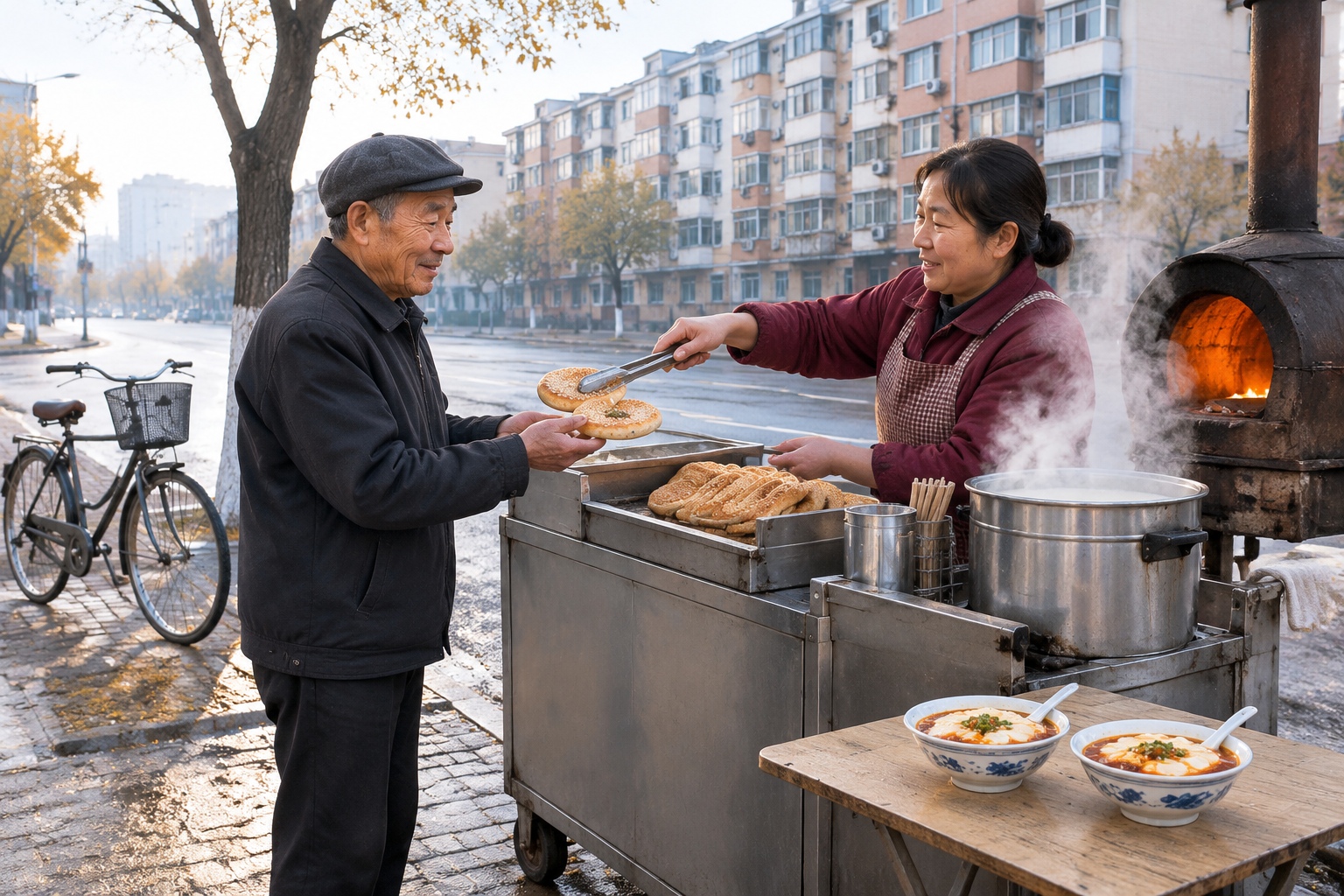
The sky over Kuiwen District is still grey-blue, but the oven on the corner is already roaring. Mrs. Liu has run this shaobing cart for eleven years. She pulls a flatbread out of the barrel-shaped clay oven with a pair of long tongs, taps it once to knock off the ash, and drops it into a wooden box lined with newspaper. Sesame seeds scatter across the wet pavement.
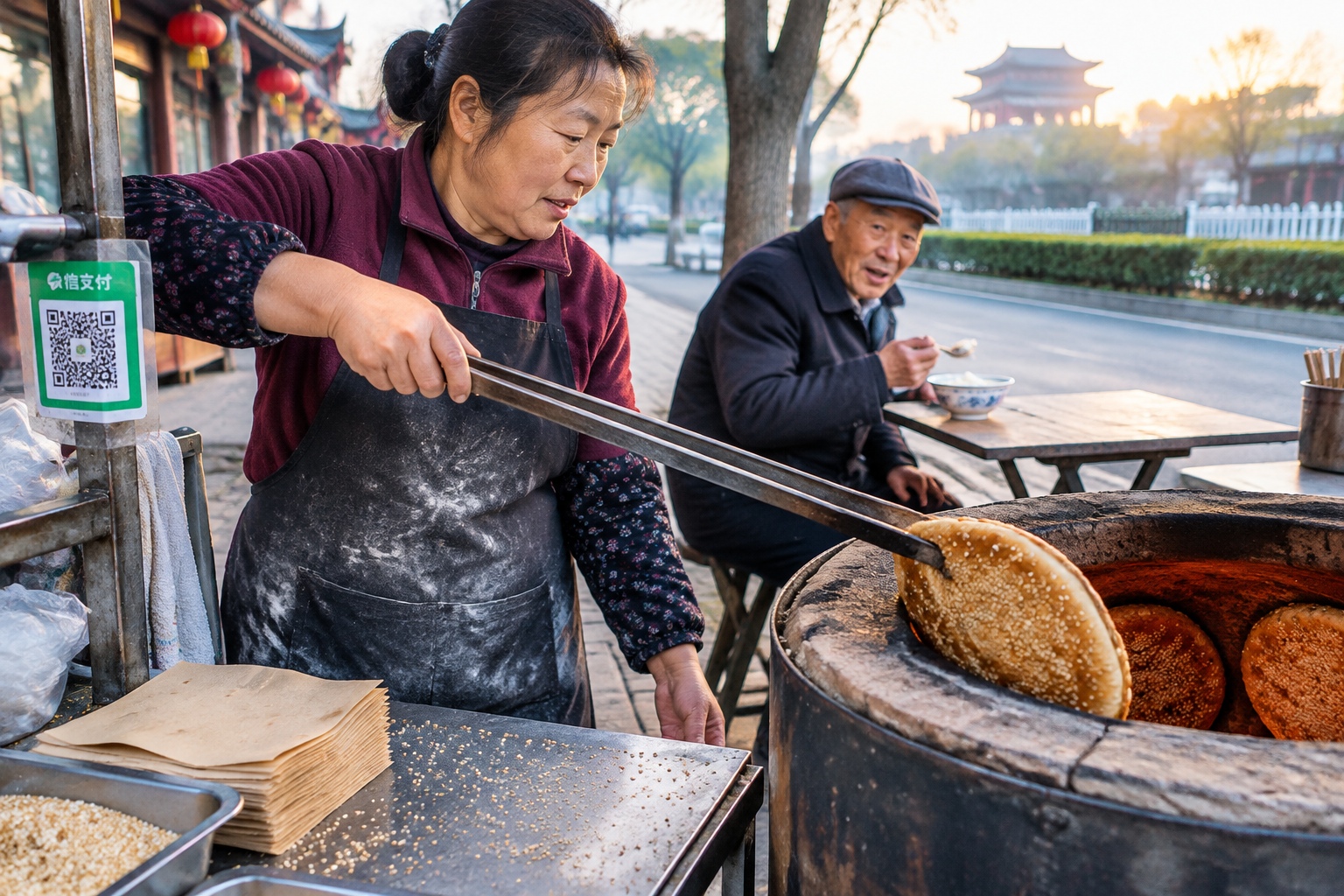
Wang Jianmin, 68, is third in line. He does not order. Mrs. Liu sets two shaobing and a bowl of doufunao on the folding table beside the cart, and he holds his phone up to the QR code taped to the handle. Eight and a half yuan, roughly $1.20.
“Same thing every day,” she says, not looking up from the oven. “If he’s late, I assume his knee is bothering him.”
Two flatbreads, one bowl of tofu, and a street that knows him
Shaobing in Shandong is not the flaky pastry you find in a Shanghai bakery. It is dense and chewy, salted, layered with a little oil, pressed with sesame, and slapped against the inside wall of the oven until the surface blisters and browns. Two of them cost five yuan. The doufunao is the northern kind: soft silken tofu under a spoon of dark gravy, pickles, chili oil and a scatter of coriander. It is savoury. Ask for sugar in Weifang and you will get a look.
Breakfast here is a five-to-ten-yuan habit, and the cart runs on a rhythm that everyone in the block has memorised. Mrs. Liu opens at 5:30 and closes around 9:30, selling somewhere near 300 flatbreads in that window. Her husband does the dough at three in the morning so she can start the oven at five. A dozen people pass through in the ten minutes I stand there: a security guard from the compound next door, a woman in a hospital uniform, two schoolboys who split one shaobing because they only have five yuan between them.
What stands out is not the food. It is that nobody is anonymous. Mrs. Liu asks about a customer’s daughter’s exams. An older woman stops to complain about the price of pork, and stays to complain about her son-in-law. Wang Jianmin eats standing up, in about six minutes, and says maybe thirty words. But he says them to people who have seen him every morning for a decade.
Who is Uncle Wang?
He is nobody special, which is the point. Wang spent 38 years at a diesel engine plant on the west side of the city, most of it on the shop floor machining parts to tolerances he can still quote from memory. He retired eight years ago. His pension is a little over 3,000 yuan a month, about $420 — not generous, but steady, and it lands on the same date every month.
He and his wife, Zhang Xiulan, 66, live in a six-storey walk-up built in 1996: no elevator, five flights, a stairwell that smells faintly of soy sauce and someone else’s cooking. Their son is an engineer in Qingdao, two and a half hours away by high-speed train, and comes home for Spring Festival and his daughter’s summer holiday. The granddaughter is nine and calls Wang on video roughly every second evening, usually to show him a drawing.
His wife handles dinner and the evening square dancing on the plaza. He handles the morning. This division of labour has held for eight years.
The fifteen minutes between the cart and the river
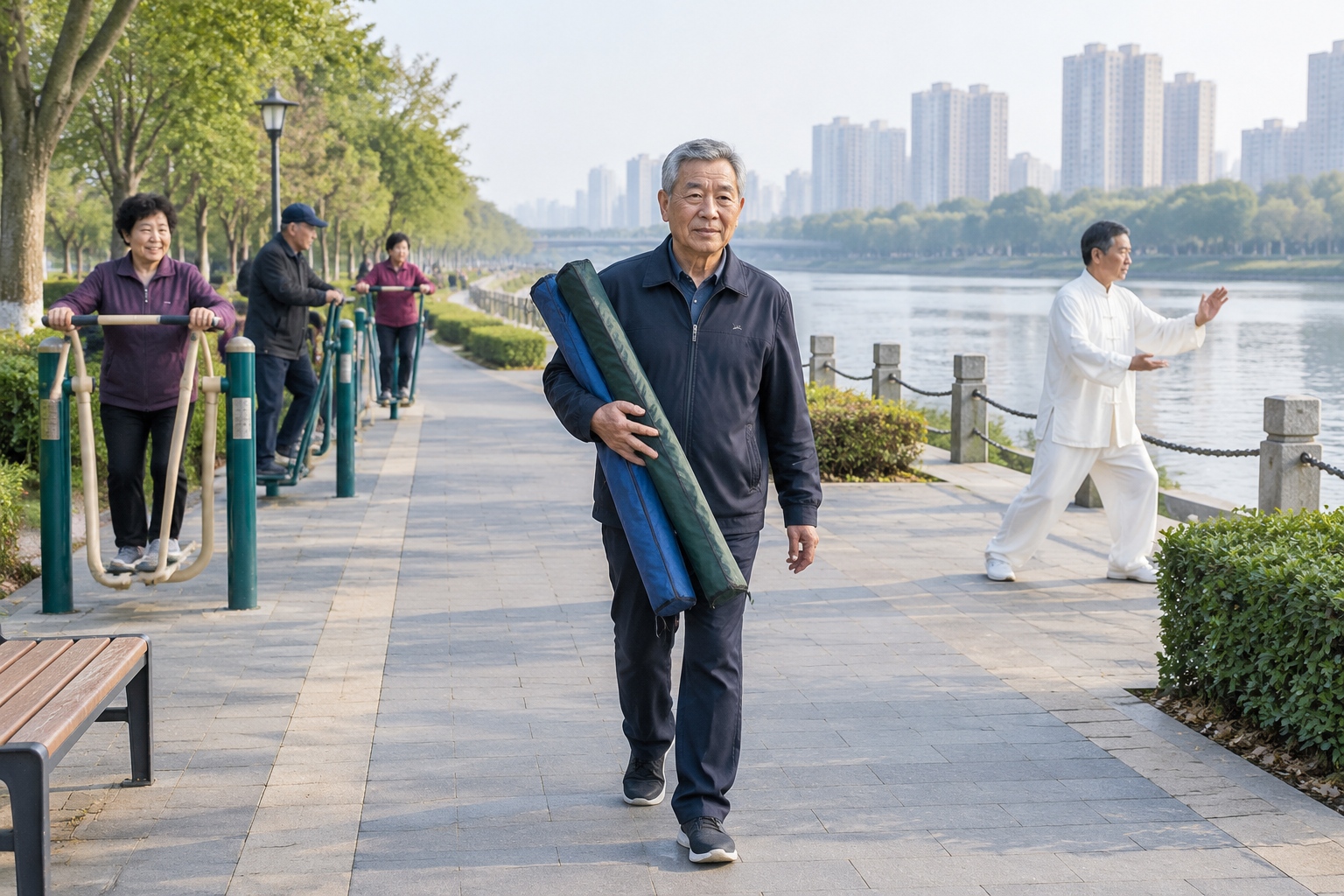
From the breakfast cart, Wang walks. He could take the bus — since 2021, Weifang’s city buses have been free for anyone 60 or older, and he has the card — but the walk takes fifteen minutes and he counts it as part of the exercise.
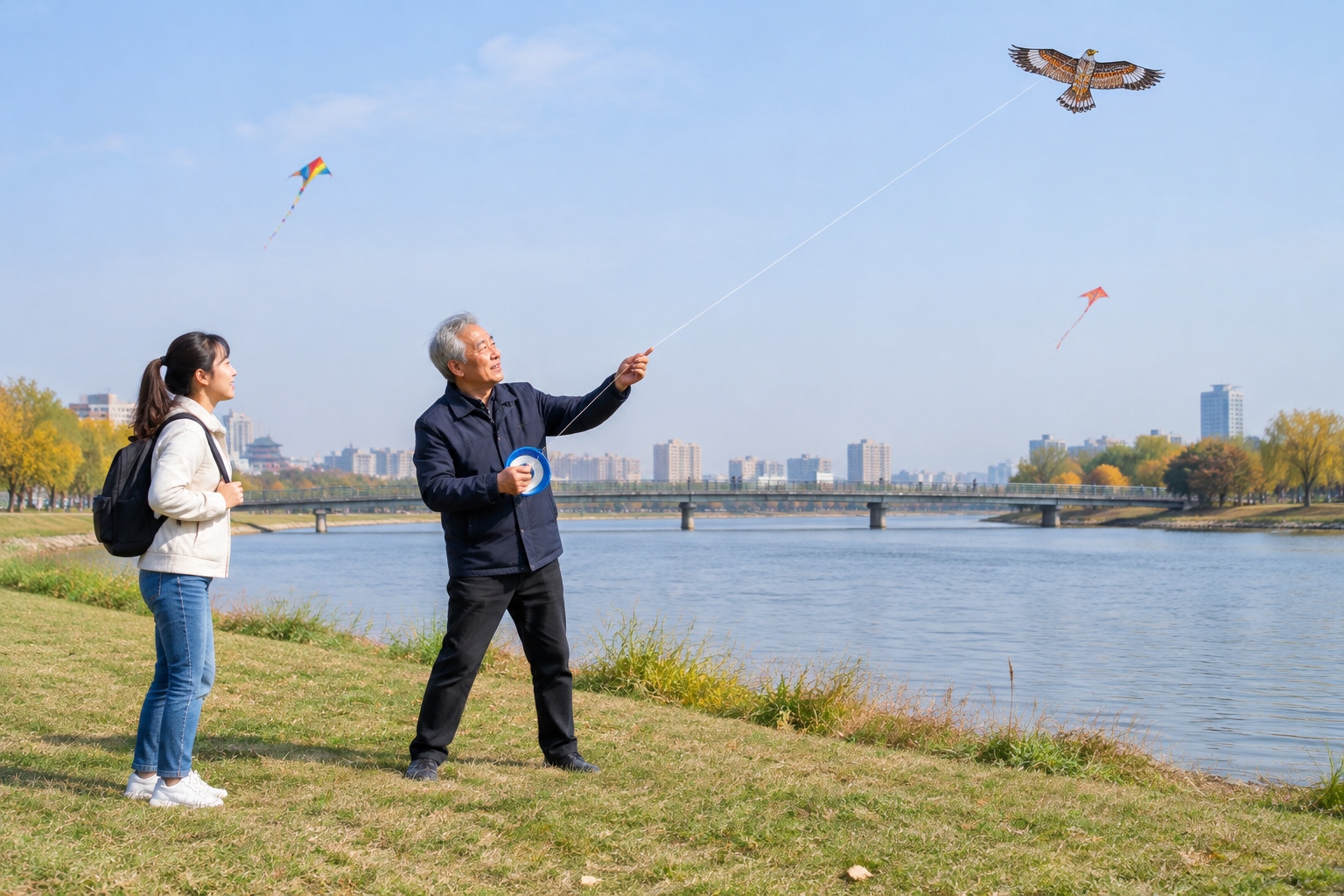
The route is unremarkable and completely specific: past a wet market where a man sells eggs out of the back of a three-wheeler, past a row of barbershops with prices painted on the glass, across a footbridge, down a ramp onto the riverside greenway along the Bailang River. On the way he passes four or five men his age doing the same thing with different kites under their arms.
A kite is bamboo, paper, and forty years of habit
Weifang calls itself the world kite capital, and every April it fills with tour groups for the international kite festival, which has run since 1984. That is the version foreigners see. The version Wang lives is quieter: a Tuesday in October, a stretch of grass, seven old men and a light north wind.
He flies a pan ying — a “circling eagle” kite. It is small, maybe 180 grams, with a bamboo frame covered in printed fabric, and it is built to imitate a hawk riding a thermal. It is also difficult. A pan ying needs a pilot who can feel the line, and Wang spends most of his first ten minutes just moving his wrist a centimetre at a time until the kite stops arguing with him.
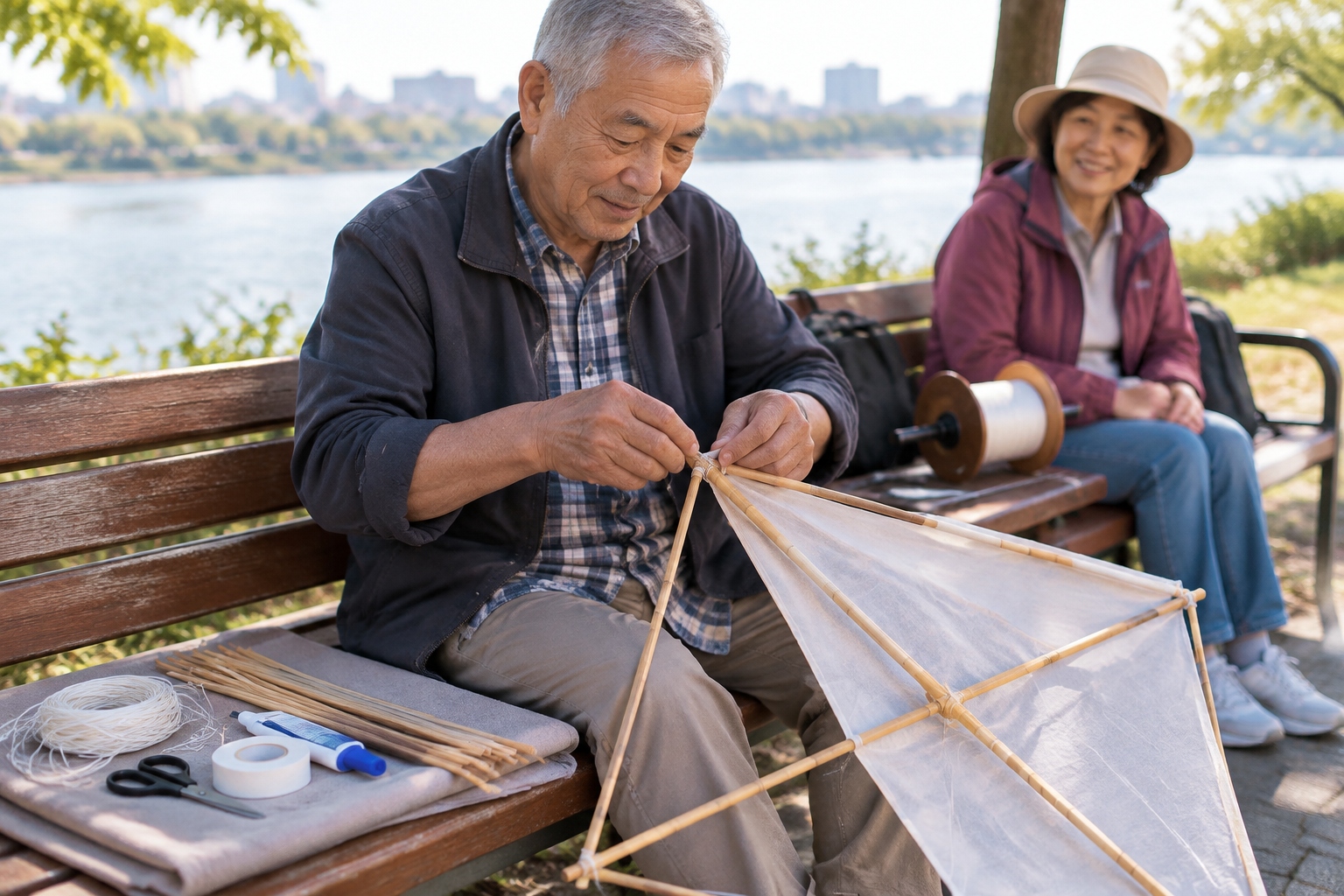
He repairs his own kites. Bamboo strips come from an old shop near the wet market that still sells them by the bundle; he splits them by hand, sands them with a scrap of sandpaper kept in his jacket pocket, and glues the joints with 502 — the fast-setting cyanoacrylate you can buy anywhere — instead of the wheat paste his father used. The line is wound on a plastic reel that has been repaired twice with electrical tape. In his bag there is a spare spine, a roll of light fabric tape, and a small pair of scissors.
This is where the tradition actually lives: not in the museum near the railway station, but in a man’s hands on a riverbank, fixing a joint so the kite will fly for another season.
Young people stop sometimes. A university student asked him last month how the eagle turns without a tail. He explained it for fifteen minutes, using his hands. He likes this part more than the flying, I suspect.
The city has quietly rearranged his morning
None of this is only about Wang. The greenway he walks has been extended and re-paved over the past decade, with benches, drinking fountains, public toilets and outdoor exercise machines every few hundred metres. There is a small canteen for elderly residents two streets from his home that opened in 2023 and serves lunch for around 12 yuan. Once a year, the neighbourhood health centre calls him in for a free check-up — blood pressure, blood sugar, an ECG — under a national programme for people over 65.
Other things have not changed, and the gap matters. The elevator retrofit programme for old walk-ups like his has moved slowly on his street, partly because everyone on the ground floor has to agree, and they have nothing to gain. His knees are the reason he is careful about the weather. In January, when the air over the city turns thick and grey, he skips the river and stays home, and the kite stays in its bag for weeks.
What one morning says about being old in China
At the end of 2023, about 297 million people in China were 60 or older — just over one in five. That number is rising fast, and it is the thing most outside coverage of China gets either apocalyptic or sentimental about. Both readings miss the texture.
The texture is this: a state pension of a few thousand yuan, basic medical insurance that covers a decent share of the bills, a community clinic that knows his name, a free bus pass, and a riverside with a bench in the shade. Add a wife who has her own friends, a son who lives far away but calls, and a hobby that requires both hands and some skill. It is not abundance. It is not loneliness either.
The real divide in China is not between generations but between the urban retired and the rural ones, whose monthly allowance can be a fraction of Wang’s pension and whose greenway is a field. Wang is on the luckier side of that line, and he knows it. His own parents, he says, never had a single morning like this.
10:40, time to reel in
By half past ten the wind has dropped and the thermals are gone. Wang winds the line back onto the reel, slowly, hand over hand, and the eagle comes down in a long shallow spiral until he catches it. He folds the frame flat, puts it in a cloth bag, and walks back the way he came — past the barbershops, across the footbridge, past the egg seller.
At the corner, the oven is still hot. Mrs. Liu is scraping down the counter. He buys one more shaobing, plain, for lunch, and she wraps it in paper without being asked.
“Tomorrow,” she says.
He nods and walks up the five flights of stairs, and that is the whole story: an eight-yuan breakfast, a bamboo kite, and a street where somebody notices when you are late.
Start the discussion at forum.chinacomes.com