

A table, a bill, and one question
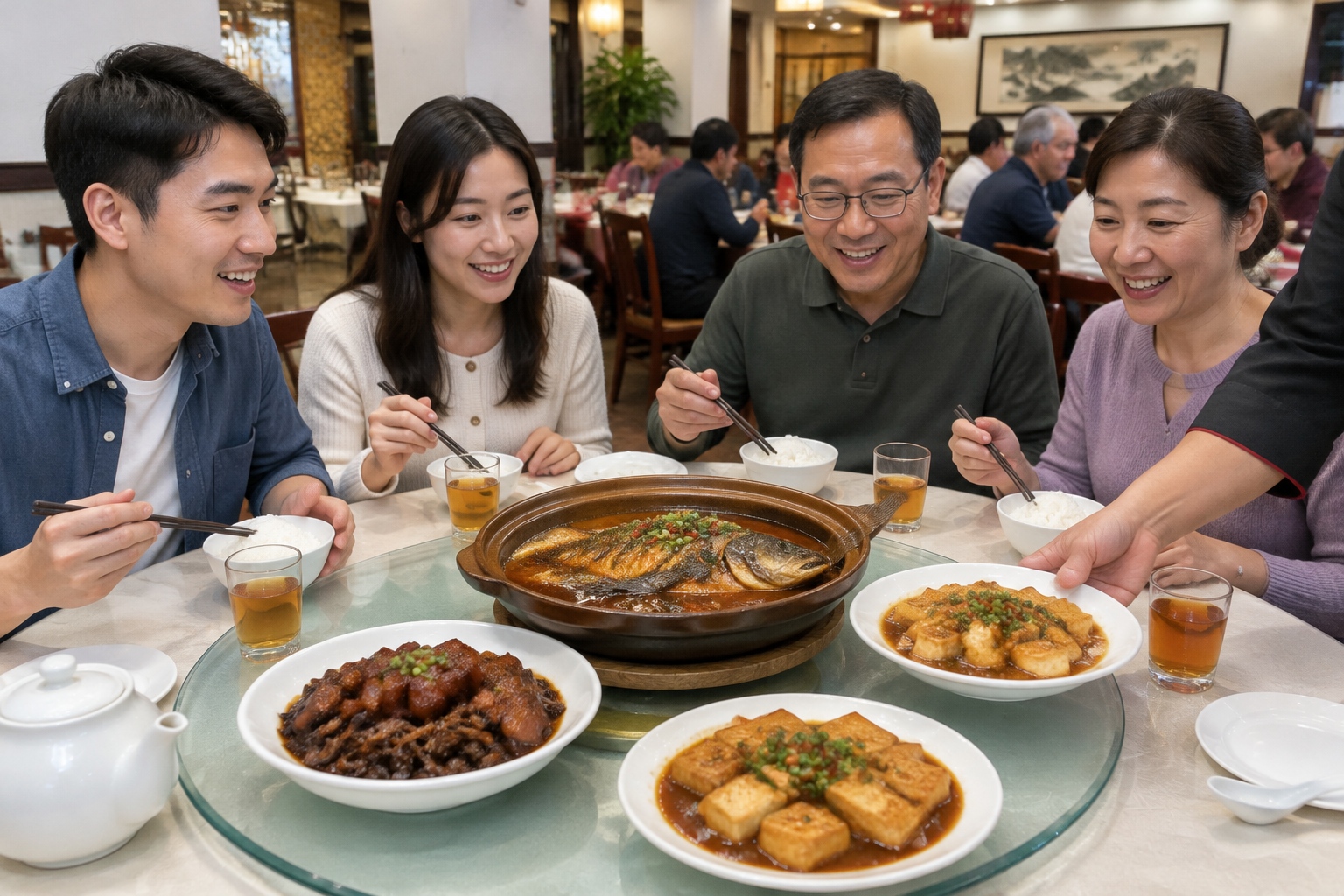
At 7:20 on a Friday evening, a Huizhou restaurant on the fourth floor of a mall in Hangzhou is full. A clay pot of stinky mandarin fish — chou gui yu, salted and fermented before cooking — lands on table 12, and the smell arrives a second before the dish does. Four people: a young couple, her parents visiting from Hefei. The bill comes to 486 yuan (about $68): the fish at 158, braised pork with dried bamboo shoots at 78, fried hairy tofu at 58, a stone-ear chicken soup at 168, plus tea and rice.
The father pokes at the fish with his chopsticks and says what a lot of people say in this situation: in the village, this would cost a third of that.
He is roughly right, and also missing most of the story. The question worth answering is not whether city restaurants mark food up — of course they do — but where, exactly, the money goes between a bamboo forest in southern Anhui and a mall in Hangzhou. Follow one dish through that chain and Chinese food pricing stops looking like greed and starts looking like logistics.
First, what Huizhou is, and why its food tastes like preservation
Huizhou is a historical region, not a current administrative one. Its core sits in today’s Huangshan City in southern Anhui province — the same mountains that gave China inkstones and merchants — plus Jixi and Shexian counties, and Wuyuan, which now belongs to Jiangxi. It is 80 percent hillside. Flat farmland is scarce; the growing season is short; villages sit in narrow valleys connected by stone paths.
That geography produced a cuisine built on storage. Huizhou cooking (徽菜, one of China’s eight recognized regional traditions) leans on salt-curing, fermentation, drying and smoking, and it uses little water — the opposite of the light, soupy cooking of the nearby Yangtze delta. The signature ingredients are all preserved things: bamboo shoots dried until they weigh a tenth of what they did, pork legs salted and hung for most of a year, freshwater fish packed in wooden barrels with salt and turned daily until the flesh firms up, tofu left to grow a white fur of mold.
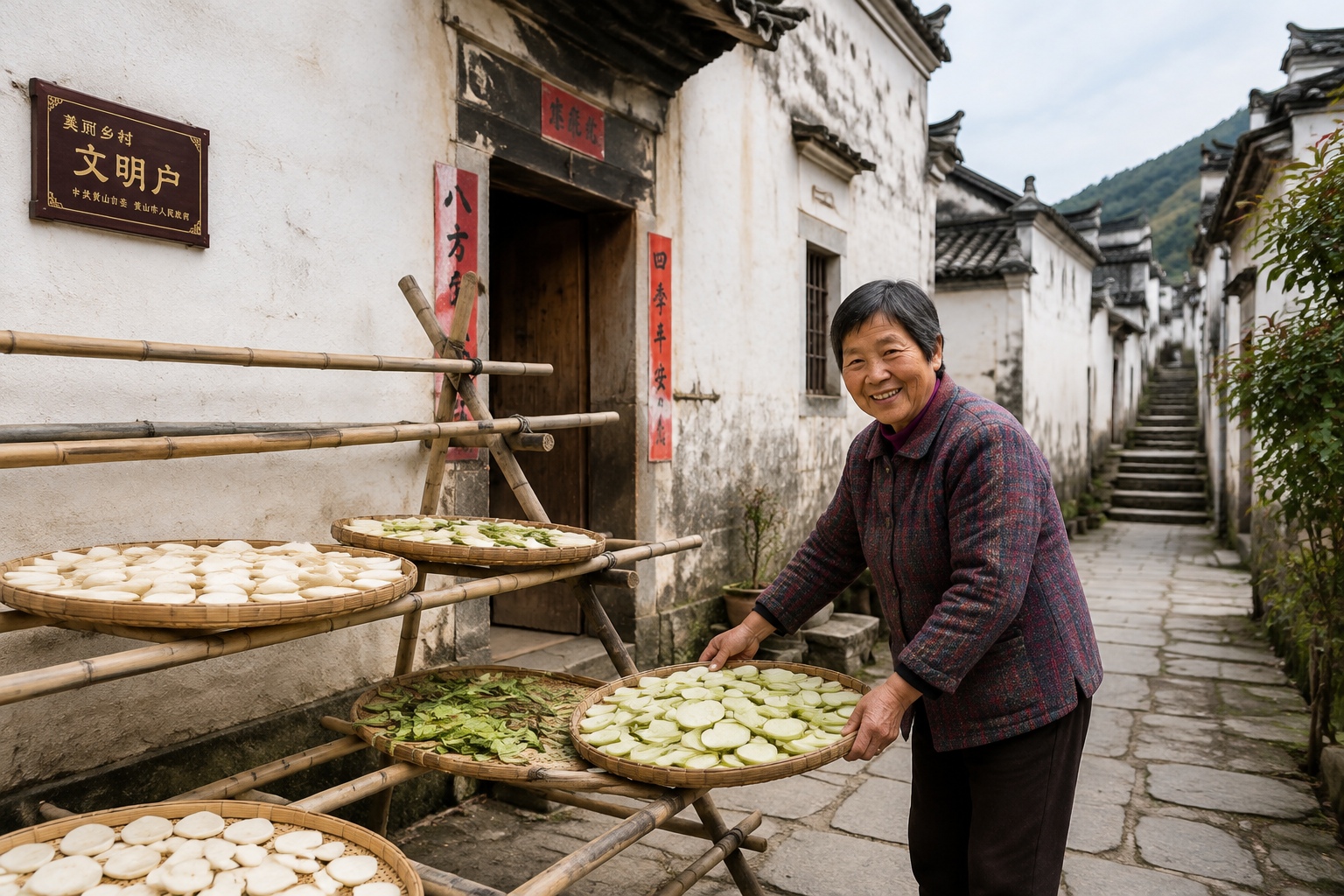
None of this was originally a delicacy strategy. It was how a mountainous household got protein and vegetables through a winter and how a merchant carried food on a two-week walk. The flavor came second. Today the flavor is the product.
At the source: what the farmer actually gets
In early April, in a village about 40 minutes outside Shexian, a farmer named Wang and his brother dig spring shoots — mao sun, the fat, dark-tipped bamboo shoots that push up through the leaf litter for about six weeks a year. They are on the slope by 6:30 a.m. A good day is 150 to 200 kilograms between two people, carried down in baskets because no vehicle reaches the stand.
Wholesale price at the roadside collection point in peak season: 3 to 6 yuan per kilogram. In a bad year, when every valley harvests at once and the two local canneries are already full, it drops to 2. A household managing 20 mu of bamboo forest — about 1.3 hectares — might gross 15,000 to 25,000 yuan in the season, before labor.

Drying changes the arithmetic. Roughly ten kilograms of fresh shoots yield one kilogram of dried — sun gan — so the raw material in a single kilo of dried shoots is worth 30 to 60 yuan before anyone has lit a fire. Add fuel, a drying shed, hand-turning, grading and a vacuum bag, and wholesale dried shoots leave the county at 70 to 110 yuan per kilogram depending on grade and thickness. In a city supermarket or on an e-commerce platform, the same bag retails at 120 to 200.
The same pattern holds elsewhere. Cured ham from Jixi leaves the village at 50 to 80 yuan per kilogram and sells in Shanghai for 120 to 180. Farmed mandarin fish, the base of the famous fermented dish, goes for 26 to 40 yuan per kilogram live at the pond gate, depending on size and season. Dried stone ear — the black rock fungus scraped off cliff faces, still largely wild-harvested — is a different order of thing: several hundred yuan per 500 grams, and top grades pass 1,000. It is the reason that chicken soup on table 12 costs 168.
So the father at the table is right that mountain ingredients are cheap in the mountains. What he is comparing, though, is an unprocessed shoot against a plated dish.
The middle: fermentation, drying and the cost of waiting
Stinky mandarin fish is the clearest example of how time becomes money. The fish is scaled and gutted, rubbed with salt and a little花椒, layered in wooden barrels under weights and kept at 15 to 20°C for six to eight days. Someone turns and inspects them daily. Get the salt wrong and the batch spoils; get the temperature wrong and it turns ammoniac rather than savory. A small workshop loses 5 to 10 percent of a batch in summer.
The fish also loses weight — 10 to 20 percent — and that loss is paid for by someone. Vacuum-packed and chilled, the semi-finished fish leaves a Jixi processor at 55 to 70 yuan per kilogram. Frozen, it can travel anywhere and last six months; chilled, it has three to four weeks.
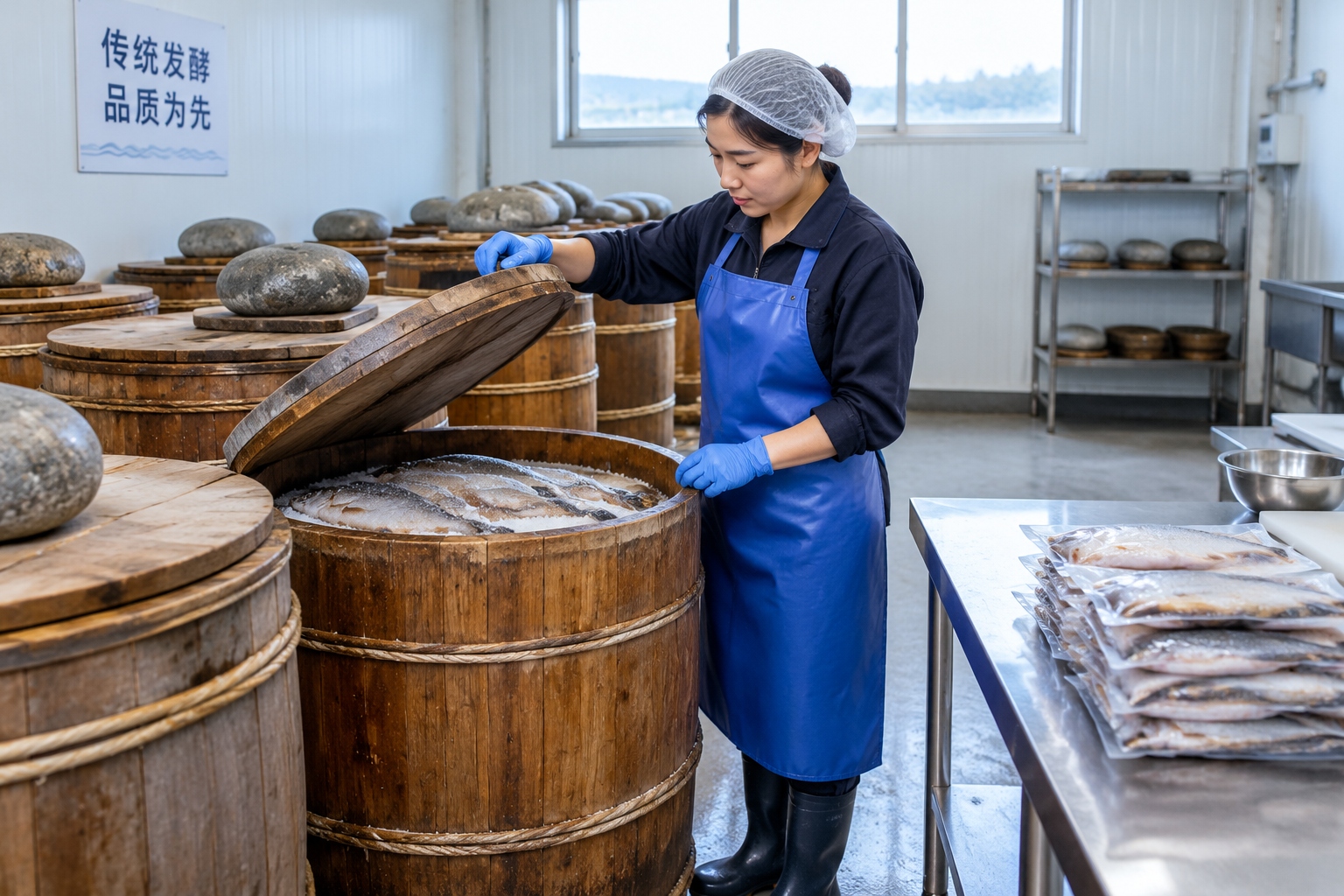
This is the part overseas readers often misread. The premium for “traditional” is not nostalgia — it is the cost of controlled decay. Factory production has made the process more reliable (inoculated cultures, temperature logs, standard salt ratios) and cheaper per unit, but it has also flattened variation: two barrels from two villages used to taste noticeably different, and now a chain restaurant’s fish tastes the same in Hangzhou, Nanjing and Shenzhen. That consistency is what lets a regional cuisine scale. It is also what the father at the table was complaining about without saying so.
The road out: cold chain, transfer and the last kilometre
Huangshan to Hangzhou is about 240 kilometres; the high-speed rail takes roughly 90 minutes, but food does not travel by rail. A 4.2-metre refrigerated truck chartered for the run costs 1,800 to 2,500 yuan. Most small processors cannot fill a truck, so they ship less-than-truckload: roughly 1.2 to 2 yuan per kilogram for chilled consolidated freight, plus 0.3 to 0.6 yuan per kilogram for handling at a transfer warehouse.
Dried goods — shoots, ham, stone ear — are the easy cargo. They travel ambient, stacked on pallets, and the freight is a rounding error against their value. Chilled fermented fish is the hard cargo: it needs a cold chain the whole way, cannot be stacked high, and any break in the chain at a transfer dock means a rejected pallet. Frozen fish trades freshness for certainty.
Then the last kilometre, which is where city money starts: a warehouse slot in Hangzhou’s Xiaoshan district, a leased cold room, a delivery van, a driver. Distribution from a city warehouse to a restaurant door typically adds 1 to 2 yuan per kilogram. On a 0.9-kilogram fish, that is small. On a 20-kilogram box of vegetables, it is not.
The restaurant’s ledger
Back to table 12. The restaurant seats 60, occupies about 180 square metres on the fourth floor, and pays monthly rent in the low 50,000s. Twelve staff, from dishwasher to manager, average around 6,500 yuan a month with meals and dormitory; the head chef, who came from Huangshan and has been doing this for 18 years, costs considerably more than that, and a second chef is being trained at 9,000.
Monthly revenue runs 600,000 to 800,000 yuan, and the owner, who asked not to be named, puts food cost at 36 to 40 percent, labor at 22, rent at 8 to 9, utilities and gas at 3 to 4, and delivery-platform commission at 15 to 20 percent on the roughly one-fifth of orders that come through apps. Packaging for takeaway adds 2 to 3 yuan an order. Net margin, after depreciation on the fit-out, lands in the mid-to-high single digits in a good month. In January, it can be zero.
“People see 158 yuan for a fish and assume the fish costs 30 and we keep 128,” he says. “The fish costs me 60. The rest pays for the room.”
One dish, line by line
The stinky mandarin fish at 158 yuan, as the restaurant’s own rounded numbers show:
Fish: 0.9 kg of semi-finished fermented fish at about 65 yuan/kg — 58 yuan. Pork belly for the braise, oil, ginger, garlic, dried chili, soy, a little sugar: 9 yuan. Gas for a 12-minute braise: 3 yuan. Share of kitchen labor allocated to this dish: 22 yuan. Share of rent, utilities and front-of-house service: 26 yuan. Wastage allowance — one fish in twenty is sent back or dropped: 5 yuan. Total cost before tax and platform fees: about 123 yuan.
That leaves 35 yuan, or 22 percent, which covers the fit-out, the marketing, the owner’s margin and the discount coupons that brought the couple in. If the order had come through a delivery app, 15 to 20 percent of 158 would have gone to the platform, and the dish would have been loss-making at full portion size — which is why the delivery version is smaller.
The dried-bamboo-shoot pork is a different shape. Shoots: 0.15 kg dried, rehydrated to 0.5 kg, at 90 yuan/kg dried — 13.5 yuan. Pork belly, 0.35 kg at 26 yuan/kg — 9 yuan. Seasoning, gas, labor, rent share: 28 yuan. Cost around 51 yuan against a 78 yuan price. Cheaper ingredients, thinner margin, and the dish most likely to be ordered twice.
What diners see, and what they argue about
The couple at table 12 are the target customer: urban, mid-20s to 40s, willing to pay for a regional cuisine they did not grow up with, price-sensitive enough to check the bill. Her parents are the other customer: people who grew up with this food and measure the restaurant against a memory.
The live argument in China right now is yuzhicai — pre-prepared dishes. A restaurant that reheats a factory-sealed braise and one that cooks from raw ingredients can look identical on the plate, and diners have become sharply attentive to which is which; several chains were publicly criticized in 2024 for serving pre-made dishes without saying so. For Huizhou food the split is practical rather than moral. Fermentation is inherently a prepared process — nobody ferments a fish to order. The question is where the line sits between a workshop in Jixi and a factory in Jiangsu, and whether the menu says so.
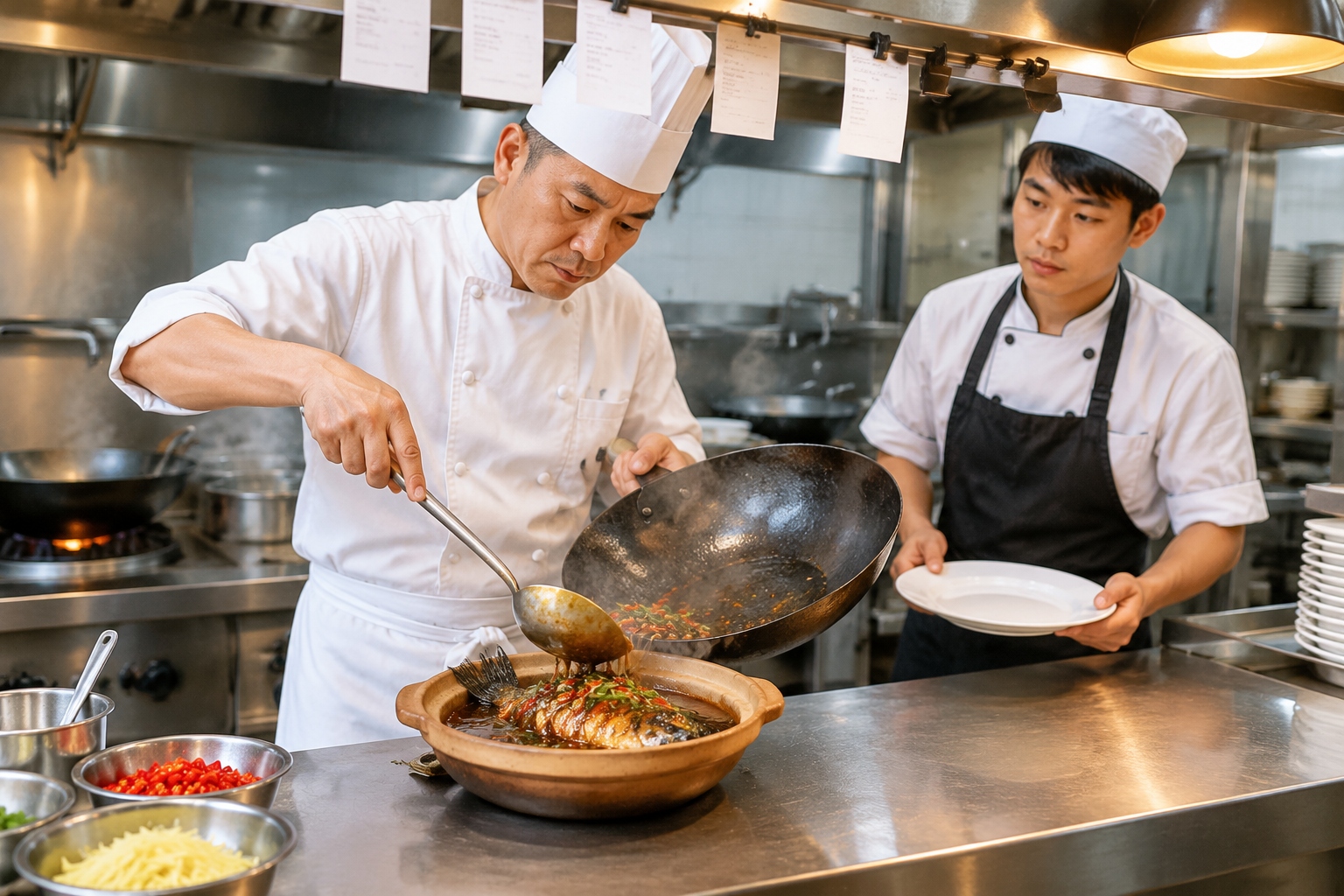
Diners judge value on three things: whether the fish is firm rather than mushy, whether the shoots still have bite, and whether the bill matches the room. A 158-yuan fish in a mall with tablecloths reads differently from a 158-yuan fish in a bare concrete shopfront. Both can be correct pricing; only one will feel like it.
What is changing
Cold chain coverage is the quiet revolution here. Anhui’s chilled-logistics network has expanded fast since the high-speed rail link opened in late 2018, and small Jixi processors now ship vacuum-packed fermented fish to Guangzhou and Chengdu in 48 hours. E-commerce has done the rest: dried shoots, cured ham and hairy tofu kits sell direct from county-level cooperatives, cutting two layers of wholesale and putting 30 to 50 percent more of the retail price back in the county.
The cost is standardization. A young chef in Huangshan, 29, trained in Shanghai and back home running a 30-seat place, puts it plainly: cold chain rewards products that travel well, and the things that travel well are the things that taste the same everywhere. He keeps a small barrel room for fish he ferments himself and charges 40 percent more for it, and he says customers can tell.
Back to one dish
The fish at table 12 is finished. The father has stopped comparing it to the village, mostly because the version in front of him is better than he remembered — the restaurant’s barrel room is temperature-controlled and the fish is not over-salted. He orders rice and pours the sauce over it.
What the 486 yuan bought was not just ingredients. It bought six weeks of a bamboo season, eight days of someone turning fish in a barrel, a cold-chain truck, a warehouse slot, a chef with 18 years behind him, and a room on the fourth floor of a mall where a family could sit for two hours. Some of that money stayed in a village in Anhui. Most of it did not. That is not a scandal; it is a supply chain — and it is the reason a mountain cuisine can now be ordered in a city 400 kilometres away on a Friday night.
Start the discussion at forum.chinacomes.com