


Sunrise, Java, and Ocean Breeze
At 10 a.m. on a weekday, the café near Xiamen’s Software Park is half full. A young man in a faded T-shirt stares at a screen full of Java code. He sips a latte. Outside, a group of tourists in bright sun hats walks past, heading to the beach. Nobody finds this strange.
This is Xiamen, a city of 5 million people on the southeastern coast of China. Tourists know it for subtropical islands, old colonial villas, and the famous pedestrian street of Zhongshan Road. But in the past two decades, a quieter economy has taken root: software development. And the people building it have a nickname for themselves: mánóng — “code farmers.”
What Is Xiamen Software Park?
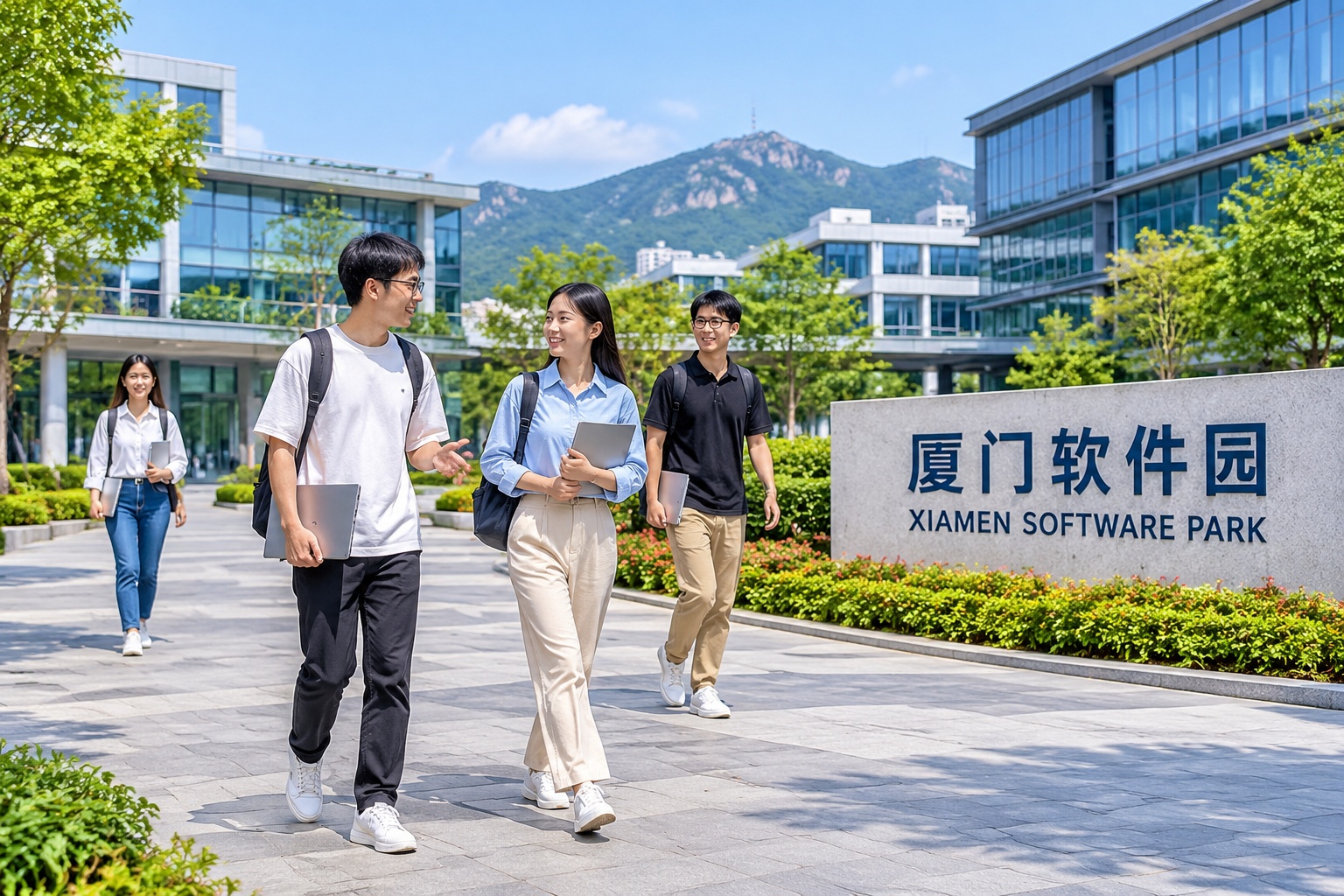
Xiamen Software Park is not a single building. It is a cluster of zones across the city, with the newest one in Jimei District stretching over several square kilometers. The park hosts more than 10,000 companies. These range from gaming studios to cloud-service providers. Some are global-facing, like Meitu, the photo-editing app used worldwide. Others are local stars, such as 4399, a web-games pioneer. Together, they have helped make software and information services a pillar of Xiamen’s economy, generating tens of billions of yuan in revenue every year.
Why a Vacation City Became a Code Hub
The standard recipe for a Chinese tech city goes like this: government subsidies, huge housing blocks, and pressure. Shenzhen and Hangzhou are famous examples. Xiamen does it differently. It uses its natural beauty as a recruitment tool. The planners noticed early that many young Chinese developers were tired of Beijing’s traffic and Shanghai’s rental prices. So they built offices near the sea, and they waited.
It worked. Today, the Software Park is one of the fastest-growing employment centers in Fujian Province. The local government offers tax breaks, low-rent offices, and a straightforward path for startup licenses. But the lifestyle is the real magnet. Xiamen ranks consistently high in Chinese surveys of “most livable cities.” The air is clean. There is a running track along the coast. The cold-brew coffee is excellent.
The Unexpected Economics: “Code Farmer” Math
So how does a developer in Xiamen actually live on a coder’s salary? It helps to understand the numbers. A junior engineer earns about 10,000 to 15,000 RMB per month. That is roughly USD 1,400 to 2,100 before tax. In Beijing, a similar job might pay 15,000 to 25,000 RMB, but rent, commuting, and general stress eat up a lot of the difference.
Xiamen has its own problem: housing prices are surprisingly high, ranking among the top five cities in China. A small apartment in the city center can cost more than a similar flat in some provincial capitals. Many young code farmers choose to live on the outskirts and accept the long commute. Others make a different calculation: they trade a lower salary for a better daily life.
A Day in the Life: Code, Coast, and Curry
The morning starts maybe not at 9 sharp but closer to 9:30. Developers walk into office buildings with the sea just a few blocks away. Lunch often means a quick meal at one of the local eateries in the area: spicy noodles, or rice with a sizzling plate of seafood. In the afternoon, cafés fill with people typing on laptops. Some companies even allow employees to work from these beachside spots.
When the workday ends—and not always, because deadlines matter—some people head to the promenade. They skate, jog, or just watch the sunset. It’s a scene you do not often see in Shenzhen’s bustling science parks or in the steel-and-glass canyons of Beijing’s Zhongguancun.

The Catch: Not All Palm Trees
But let’s be honest. The “code farmer” life in Xiamen has thorns. Housing prices mean that many young workers will never own an apartment in the island’s core. The city is smaller than the big hubs, so senior opportunities are fewer. And the “relaxed” culture does not mean people work less. During product launches, teams can stay late, order takeout, and sleep under their desks. The ocean is not a cure for a buggy release.
There is also a constant pull toward the bigger cities. Xiamen trains talent, and sometimes it loses it to higher salaries elsewhere. The city tries to counter this by improving the quality of life. New schools are being built. Metro lines are expanding. But the math is still tense: lower income, higher housing cost, peace of mind.
What This Says About Modern China
For an outsider, Xiamen’s software economy is a useful reminder: China’s tech scene is not one giant beehive. Yes, there are super-competitive hubs like Hangzhou and Shenzhen. But there are also softer, greener places where the same kind of work happens with a different rhythm. Xiamen shows that China’s technology industry can be both productive and pleasant. It is not Silicon Valley—it is Silicon Coast.
As the afternoon tide recedes, the café by the sea grows quiet again. The tourist groups are gone. A lone coder closes his laptop and walks down to the shore, shoes in his hand. He is done for the day. He will be back tomorrow, but for now, there is only the sound of waves.
Start the discussion at forum.chinacomes.com