

Where Every Third Toy Is Born
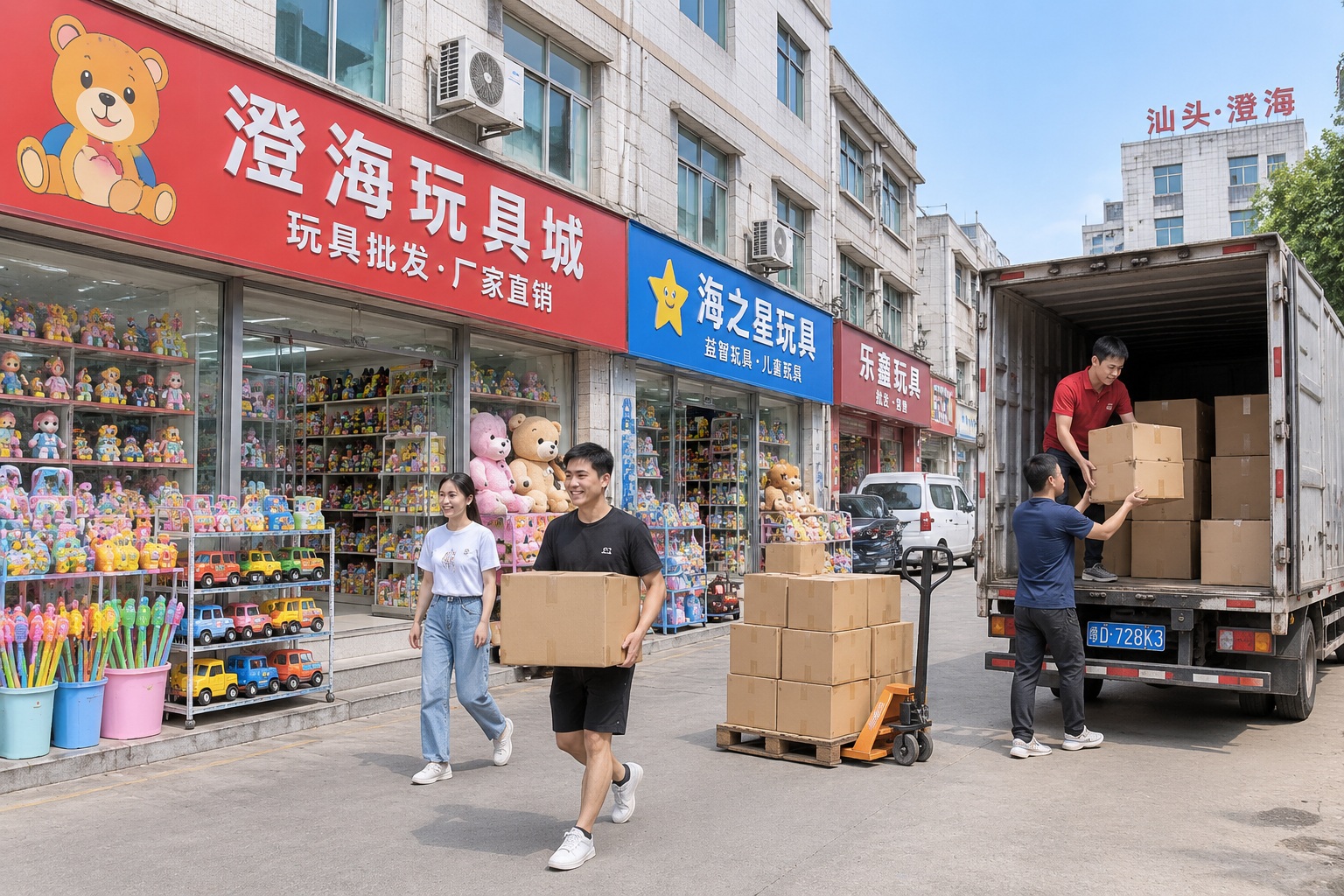
Just a two-hour drive northeast from the high-tech hub of Shenzhen, the town of Chenghai doesn’t look like a place that shapes childhoods. The streets are lined with low-rise buildings and motorcycle repair shops. But as soon as you get closer to the main commercial blocks, something odd appears: nearly every single storefront is dedicated to toys. Big bins of plastic blasters spill onto the sidewalks; stacks of doll houses lean against doorways; tricycle frames hang from overhead racks. In the alleys, hand-pulled carts squeeze past, piled high with cardboard boxes full of teddy bears, building blocks, and battery-operated cars.
Chenghai is not a tourist destination. It’s a working factory town. And according to industry estimates, about one out of every three toys sold anywhere on the planet — from a plastic dinosaur in a Paris supermarket to a mini drone in a Tokyo electronics store — starts its life within this small district of Shantou, a prefecture-level city in China’s Guangdong Province. If you’re reading this while squeezing a stress ball, there’s a solid chance that ball was formed here.
The Numbers Behind the Toy Story
The scale is almost impossible to grasp. Chenghai is home to more than 50,000 registered toy-related businesses. While many are small family workshops, quite a few employ thousands of workers. Each year, these businesses pump out over 50 billion yuan (roughly $7 billion) of toys. That’s about a quarter of China’s total toy output and well over half of its toy exports. The district also produces around 25% of the world’s toys by volume, according to local government reports.
If you walked into a dollar store anywhere in the United States, you’d find products with labels saying “Made in China” — and a large share of those toys, especially plastic ones, were made right here. Chenghai’s factories also produce for well-known global brands. A toy car you buy from a big-box retailer in Germany might have been designed in California, but its injection-molded body and wheels almost certainly came from Chenghai.
From Fishing Town to Global Workshop
How did a poor fishing and farming town become the toy capital of the world? It’s a classic story of grit and opportunity. In the late 1970s, when China began its economic reforms, a few enterprising locals bought old injection-molding machines and started making simple items like plastic combs and buttons. These machines, imported from Hong Kong or scavenged from closing factories, were often operated by hand in family homes.
By the mid-1980s, people realized there was more money in making things for kids. At first, they copied simple Western toys — rubber ducks, rattles, and race cars. The products weren’t high quality, but they were cheap, and demand from Hong Kong buyers was endless. As word spread, family workshops multiplied. Grandparents, parents, and children all worked around the clock from their living rooms, smelting and assembling plastic pieces.
Over the next few decades, those home workshops upgraded into modern factories. The government built an industrial park, improved roads, and linked the area to the port of Shantou. Today, Chenghai has a complete toy supply chain within a 30-kilometer radius: raw plastic pellets, molds, printing, injection molding, painting, assembly, and even quality testing. Need a specific gear for a new train set? It’s a five-minute scooter ride to a specialist factory. Want 10,000 custom boxes with your logo? A printing shop down the road will deliver them the next day.
A Day in the Life of Toy Makers
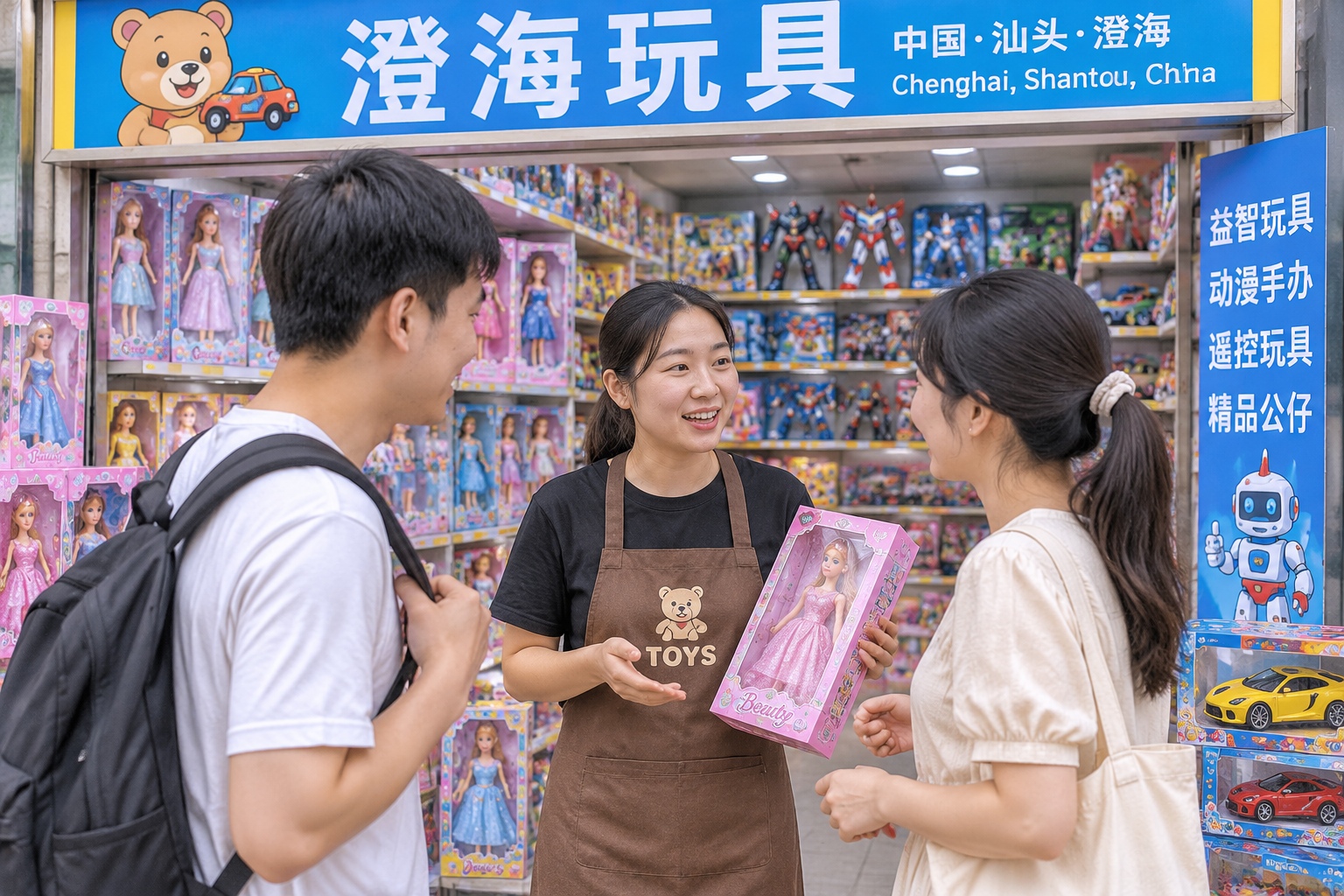
Walking through Chenghai is an assault on the senses. The main drag, Wenguan Road, is packed with showrooms that look like small warehouses stuffed to the ceiling with dolls, drones, action figures, and educational games. Salespeople sit behind laptops, taking orders from buyers in 80 countries via WhatsApp, WeChat, and email. They can quote prices within minutes, because the factory is usually just behind the showroom.
Behind these storefronts, factory floors are buzzing. In one building, a worker carefully paints eyes on plush animals — a task that machines still can’t do as naturally. In another, an automated press stamps out 15,000 toy wheels per hour, with only two workers supervising. Many employees are migrants from poorer provinces, like Guizhou and Hunan, who earn between 3,000 and 5,000 yuan a month ($420–$700). It’s not a great salary by Chinese standards, but it’s stable, and some can remit money home. The work is repetitive, but factories often provide dormitories and canteens.
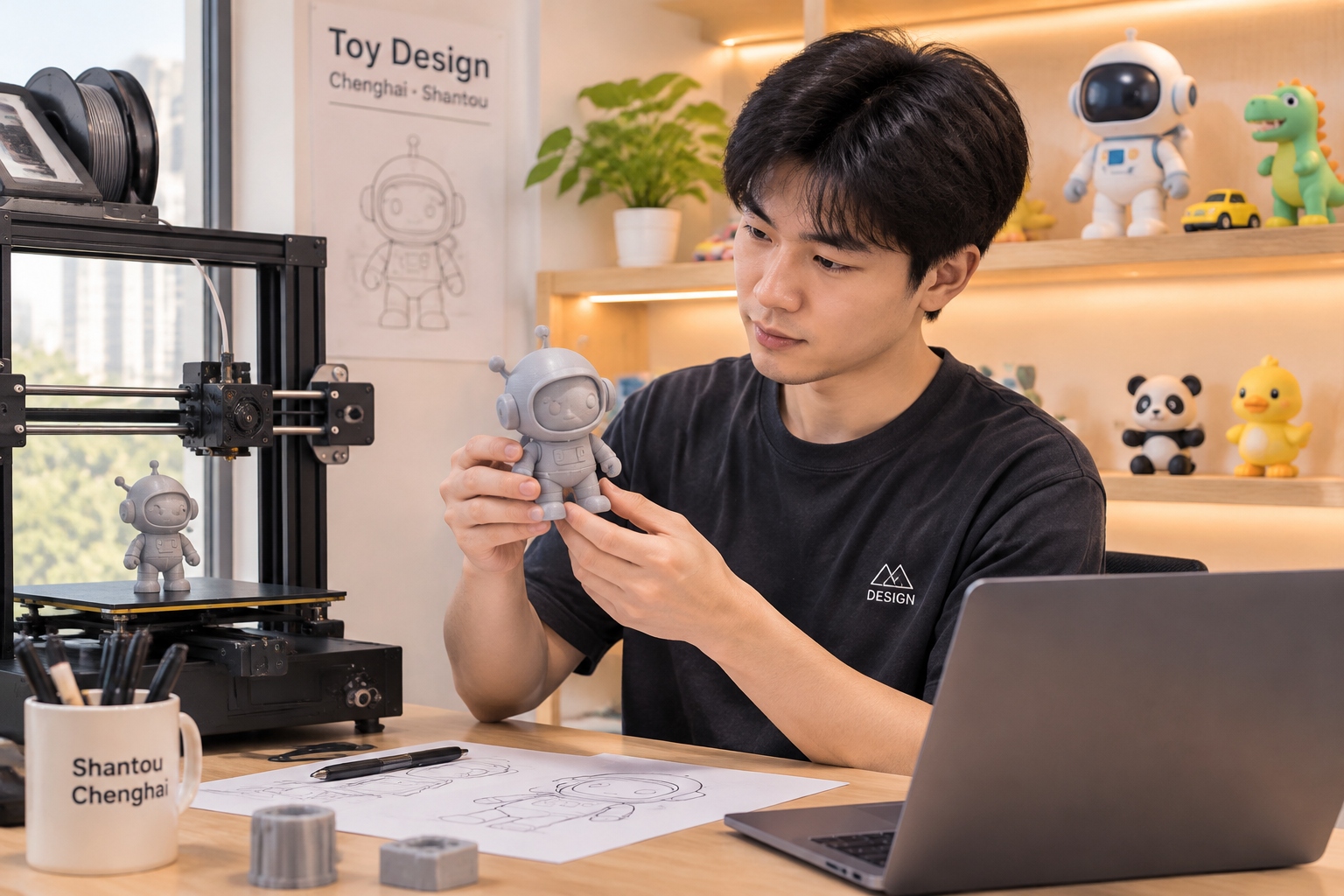
Then there are the younger people who are redefining what it means to make a toy. At an industrial park on the edge of town, I met 26-year-old Li Wei, who runs a tiny design studio out of a former warehouse. He showed me his workspace: two 3D printers, a laptop, and shelves of his own creations — magnetic blocks that assemble into tiny cityscapes. His first product was crowdfunded on the Chinese platform Dimiao, and it now sells in 20 countries. “My parents see this as just making toys,” he says. “But for me, it’s about combining hardware, software, and story design. It’s like creating a world, not a gadget.”
Selling to the World from a Small Screen
A visit to Chenghai isn’t complete without seeing its live-streaming operation. In a nondescript building near the center of town, rows of young women and men sit in front of phones, holding up toys and shouting into their microphones. These livestreamers, many in their early 20s, are the new sales force of the toy industry. They can sell thousands of units in a single night.
One of them, Chen Yuting, used to work at a factory assembly line. Now she earns three times as much by selling toys for several different companies. “I don’t have a script,” she told me between streams. “I just pick up a toy, show how it works, and tell people why it’s fun. The key is to be real—if you don’t like the toy, they’ll know.”
Her studio is a small room with a ring light and a roller background. A phone is mounted on a tripod, and a pile of unopened product sits behind her. She streams for four hours every afternoon, then spends another hour packaging and shipping the orders. Last year, her team sold over $1 million worth of toys, most of it to customers in Southeast Asia and the Middle East.
This is a new layer in Chenghai’s economy. While traditional buyers still come to trade shows, an increasing share of sales is driven by social media and short videos. A toy that becomes a viral hit in one country can generate massive orders overnight. Chenghai’s factories are agile enough to churn out new designs within days, which gives them an edge over more rigid competitors.
The Complicated Path from Knockoffs to Originality
Chenghai has not always been proud of its reputation. For decades, it was infamous for copying popular toys. Western and Japanese companies regularly sued local factories for producing counterfeit Lego blocks, Barbie dolls, and Transformers. The courts ruled in their favor, but enforcement was weak, and the copies continued. In the early 2000s, many importers refused to work with Chenghai because they feared IP lawsuits.
But that’s changing. A growing number of local companies now invest heavily in design and patents. In 2021, Chenghai granted more than 8,000 toy-related patents, making it one of China’s most active IP holders. Some factories are still “copycats” in the eyes of foreign competitors, but the best firms have moved up the value chain. They create their own brands and collaborate with international license holders for legitimate production.
Take the case of One Toy, a company that started in the 1990s making knockoff action figures. Today, it owns several original brands and jointly designs toys with a well-known Japanese entertainment company. Their factory uses robots for precision assembly and has its own quality-control lab. “The pressure to be original is huge,” says a manager. “But if you’re just copying, you’ll never survive the next crackdown.”
Still, the road is bumpy. Many small workshops struggle to shift from cheap knockoffs to distinctive design. Raw material costs have gone up, and the Chinese government has introduced stricter environmental rules on plastic waste, forcing factories to invest in waste-treatment equipment. Labor costs have risen 15% year on year in some areas. Some companies have responded by automating, while others are experimenting with biodegradable plastics.
How a Toy Gets from Chenghai to Your Home
So how does a toy made in this small town end up in the hands of kids in Nairobi, Lima, or Vancouver? It’s a smooth, high-speed chain. Truckloads of toys leave Chenghai every day for the nearby Shantou port, one of the busiest in southern China. Container ships then carry them to ports all over the world. In recent years, e-commerce has opened a direct route to consumers: the Alibaba platform, for example, hosts thousands of Chenghai toy stores that sell directly to overseas buyers. Many small factories now have dedicated staff to manage online orders from as far away as Brazil and Poland.
Every year, at the China International Toy Fair in Shanghai, a huge section is reserved for Chenghai companies. International buyers walk through the aisles, checking out new products and negotiating deals. “You can’t plan a toy season without visiting Chenghai,” says Maria, a Brazilian buyer who comes to the fair every year. “They set the price and the quality for the whole industry.”
The Toy Town’s Lasting Grip on the World’s Playrooms
Chenghai isn’t pretty, and it isn’t romantic. But it is a true industrial marvel. It turns plastic pellets into the stuff of childhood memories, and it does so at a scale that no other city on Earth can match. For decades, this cluster of family firms and factories has proven that a small place can adapt, survive, and lead.
Next time you pick up a toy, glance at the label. If it says “Made in China,” there is a high chance it came from these streets. When you see a pile of colorful plastic in a discount store, think not just of a product but of the people — the grandfather who saved up for an injection machine, the migrant who paints eyes on plush animals, and the young designer sketching a brand-new world. Chenghai’s toys are passed down to children everywhere; the town itself remains unassuming, busy, and quietly proud.
Start the discussion at forum.chinacomes.com