

A Morning on the Same Narrow Lane
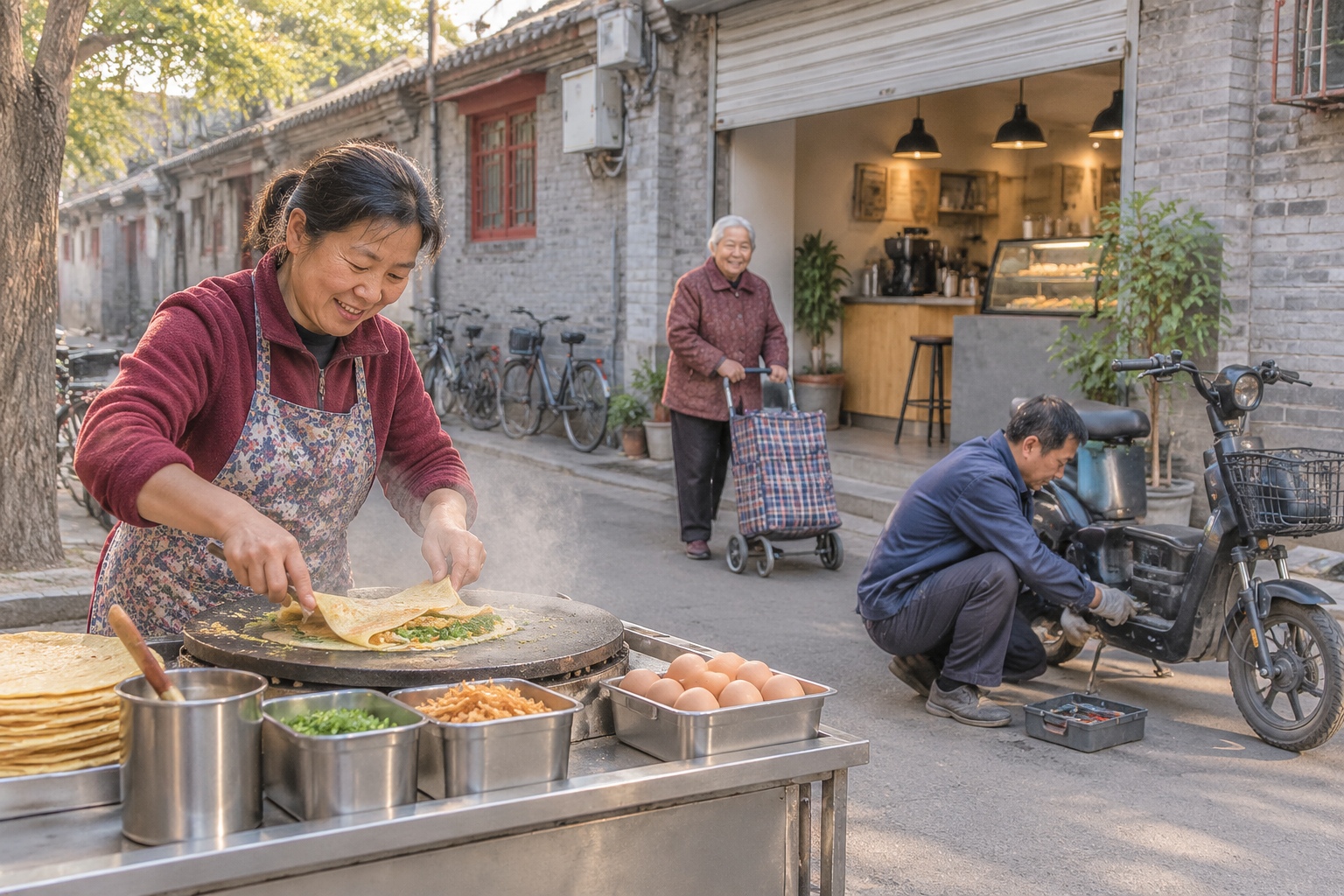
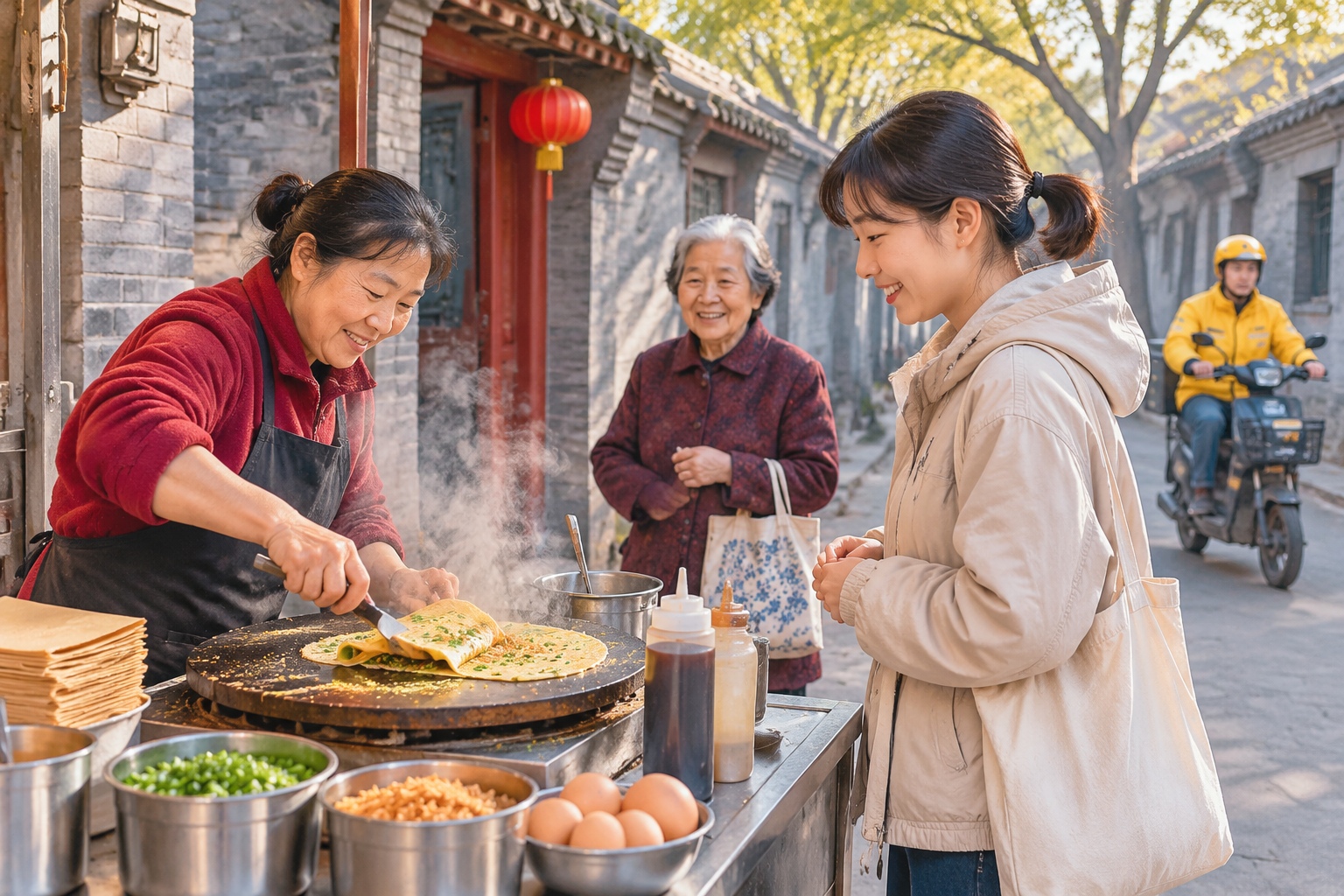
At 7:40 on a weekday morning, a lane off Gulou East Street is already doing three kinds of business at once. A woman is folding a jianbing on a round griddle, the steam fogging the glass case where she keeps her eggs. Ten meters on, a man in a blue apron is squatting beside an electric delivery bike, testing the brake with one hand. Next door, a coffee shop has just raised its metal shutter, and two young women are already photographing the doorway — the old brick, the new wooden frame, a plant in a tin bucket.
An auntie pulls a shopping trolley past all of them. A courier threads through on a scooter. Nobody looks surprised. This is not a heritage street dressed up for visitors. It is a place where people buy breakfast, fix a bike, get a haircut, collect a parcel and, increasingly, pay 32 yuan for a flat white.
What “Community Commerce” Means in a Beijing Hutong
Hutongs are the narrow lanes lined with courtyard houses that still make up much of central Beijing. Many were built centuries ago; few have private bathrooms or wide doorways. Life spills into the lane because the lane is where there is space: vegetables laid out on a board, laundry on a line, a stool for the barber, a table for mahjong.
Community commerce here is not a planning slogan. It means the shops within a five-minute walk that people use without thinking: the small grocery that sells eggs singly, the key cutter, the noodle shop that knows who wants extra vinegar, the repair stall that will tighten a wheel for a few yuan.
That mix has shifted. Over the past decade, Beijing has cleaned up many hutong storefronts, sealed illegal openings in courtyard walls and pushed back on unlicensed stalls. Rents have risen. Tourism has spread beyond the famous lanes around Nanluoguxiang. At the same time, a new generation of small businesses has moved in — coffee shops, bakeries, ceramics studios, tiny restaurants with six seats and a waiting list on a phone app.
The result is not a simple takeover. It is a street-level negotiation over noise, rent, queues and who the lane is for.
The Repair Shed That Knows Everyone’s Bicycle
Uncle Liu has repaired bicycles in this lane for more than twenty years. His workshop is barely two meters wide, with tires hanging from the ceiling and a tin of screws sorted by size. A brake adjustment costs ten yuan. A punctured inner tube, fifteen. He does not advertise. His customers are the people who live within a few streets, plus the delivery riders who now depend on him.
“Before, it was school kids and old people,” he told me, wiping his hands. “Now it’s e-bikes. The young people don’t know how to fix anything, so they come here.” He has learned to replace lithium battery connectors and diagnose a controller fault by sound. The work is dirtier and the parts cost more, but the queue is longer.
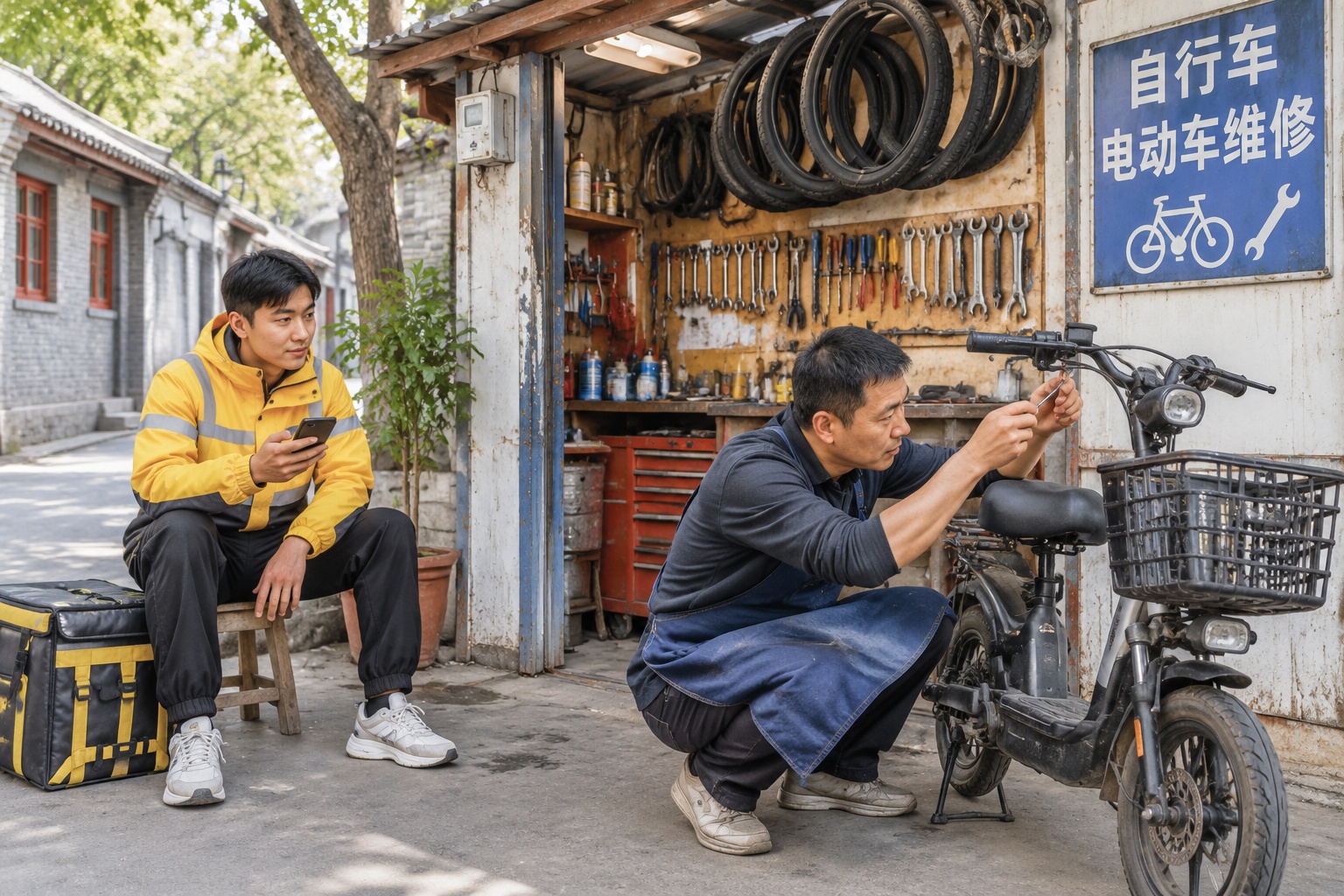
His business shows the quiet resilience of old shops: low overheads, deep local knowledge, prices that survive because they are small. It also shows the pressure. The courtyard landlord has changed. The lease is renewed year by year. His daughter works in an office in Chaoyang and has no interest in taking over a repair shed. “When I stop, it stops,” he said, without drama.
Why a Coffee Shop Chooses a Hutong
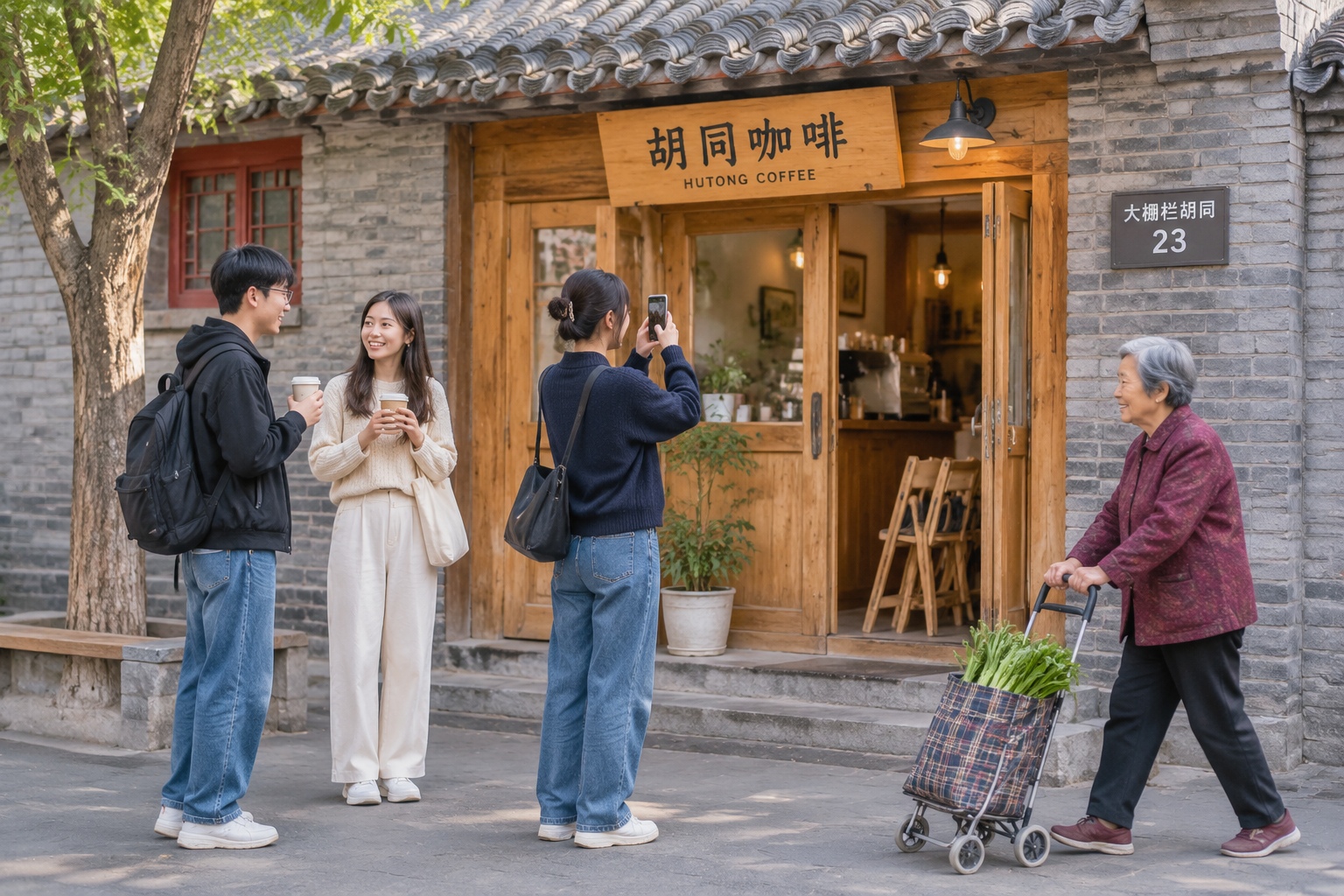
Two lanes over, a coffee shop called (let’s say) “Small Court” opened last spring. It is run by two women in their late twenties who left jobs in marketing and design. They looked at spaces in Sanlitun and Gulou’s main streets and chose a 22-square-meter room in a hutong side lane. The rent was lower, the light was better, and the doorway had what they called “a face.”
“People come for the coffee, but they photograph the window,” one of them said. “The hutong is the product as much as the espresso.”
That is the honest logic of the internet-famous shop. Social media rewards places that look like they could not exist anywhere else. A hutong doorway, a tiled roof, a bicycle leaning against a wall — these are cheap sets with high recognition. For a young entrepreneur, the hutong offers character at a price that a shopping mall cannot match.
The shop brings foot traffic that the lane did not have five years ago. It also brings queues, tripods, delivery scooters and paper cups. On weekends, the narrow pavement outside can hold twenty people waiting.
When the Queue Blocks the Door
The friction is ordinary and specific. An elderly neighbor complained that customers stood outside her window at 8 a.m. on Saturdays, talking loudly. Another said people were photographing her courtyard gate as if it were a stage set. The cafe’s rubbish bin overflowed on the first warm weekend. A noodle shop owner down the lane worried that the crowd would block his regulars.
None of this is unique to Beijing. It is the same story in Lisbon, Brooklyn or Seoul: a cool business arrives, rents rise, daily life gets squeezed. What matters is what happens next.
In this lane, the cafe owner went to the neighborhood committee and then to the neighbors themselves. They agreed on a few things: no outside seating before 9 a.m.; a staff member sweeps the pavement twice a day; queues are asked to wait on the wider corner, not under residential windows; the shop closes by 9 p.m. The owner also put a small sign inside asking customers not to photograph people’s doorways without asking.
“Some of it is just being a good neighbor,” she said. “Some of it is survival. If the neighbors hate us, we can’t stay.”
Rules Made at the Table
Coexistence is not a poster. It is a set of small, unglamorous arrangements. The breakfast stall starts at 6 and is gone by 10, so it never competes for the lunch crowd. The repairman lets the cafe use his electricity when their meter trips. The cafe sends customers to the noodle shop when its kitchen closes at 2:30. The fruit seller keeps a spare key for the woman who runs the stationery shop.
Community committees, property managers and shopkeepers’ WeChat groups do more of this work than any policy document. They negotiate delivery hours, bin placement and who cleans the drain. Sometimes they fail. Shops close. Arguments stay unresolved. A lane can lose its balance when one landlord raises rent by 40 percent or when a popular shop starts acting like a destination rather than a neighbor.
Who Gets to Stay
Residents make their own calculations. Many buy breakfast from the stall and vegetables from the cart, but rarely spend 32 yuan on coffee. Some see the cafes as a sign that the lane is alive and safe at night. Others see higher prices and more strangers. Younger residents who moved in for the old architecture are often the loudest defenders of quiet.
The same tension runs through urban renewal debates across Beijing. Preserving a facade is not the same as preserving a community. A hutong can look unchanged in photographs while the people who made it a neighborhood move to the fifth ring road. The more interesting question is whether the new businesses can be useful to the people already there — a place to sit, a toilet for a delivery rider, a job for a local teenager, a reason for a landlord to keep a low-rent tenant.
Evening, and the Lane Goes Back to Itself
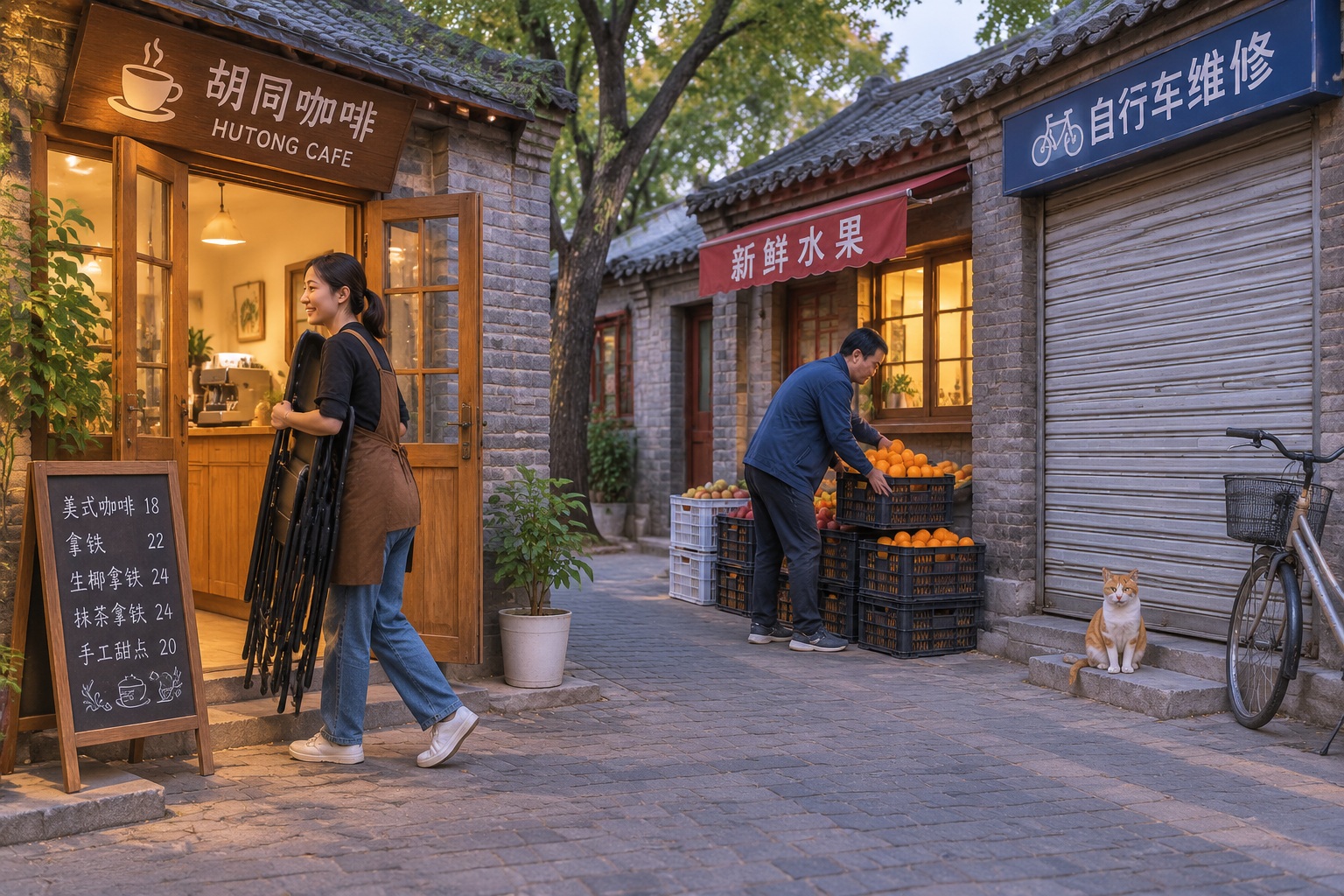
By 9 p.m., the light has gone soft. The fruit seller is stacking crates. The cafe staff are folding chairs and carrying them inside, as agreed. Uncle Liu has pulled down his metal door; a cat sits on the step where he keeps his pump. A delivery rider checks his phone, then disappears toward the main road.
The lane does not resolve the argument between old and new. It simply gets ready for tomorrow. The coexistence of old shops and internet-famous newcomers is not a natural state and not a finished story. It is held together by rent, rules, small favors and the willingness of people who share a few meters of pavement to keep talking. When that stops, the street may still look charming in photographs. It just won’t be a neighborhood anymore.
Start the discussion at forum.chinacomes.com