

A fence, a hum, and 350 kilometres from Beijing
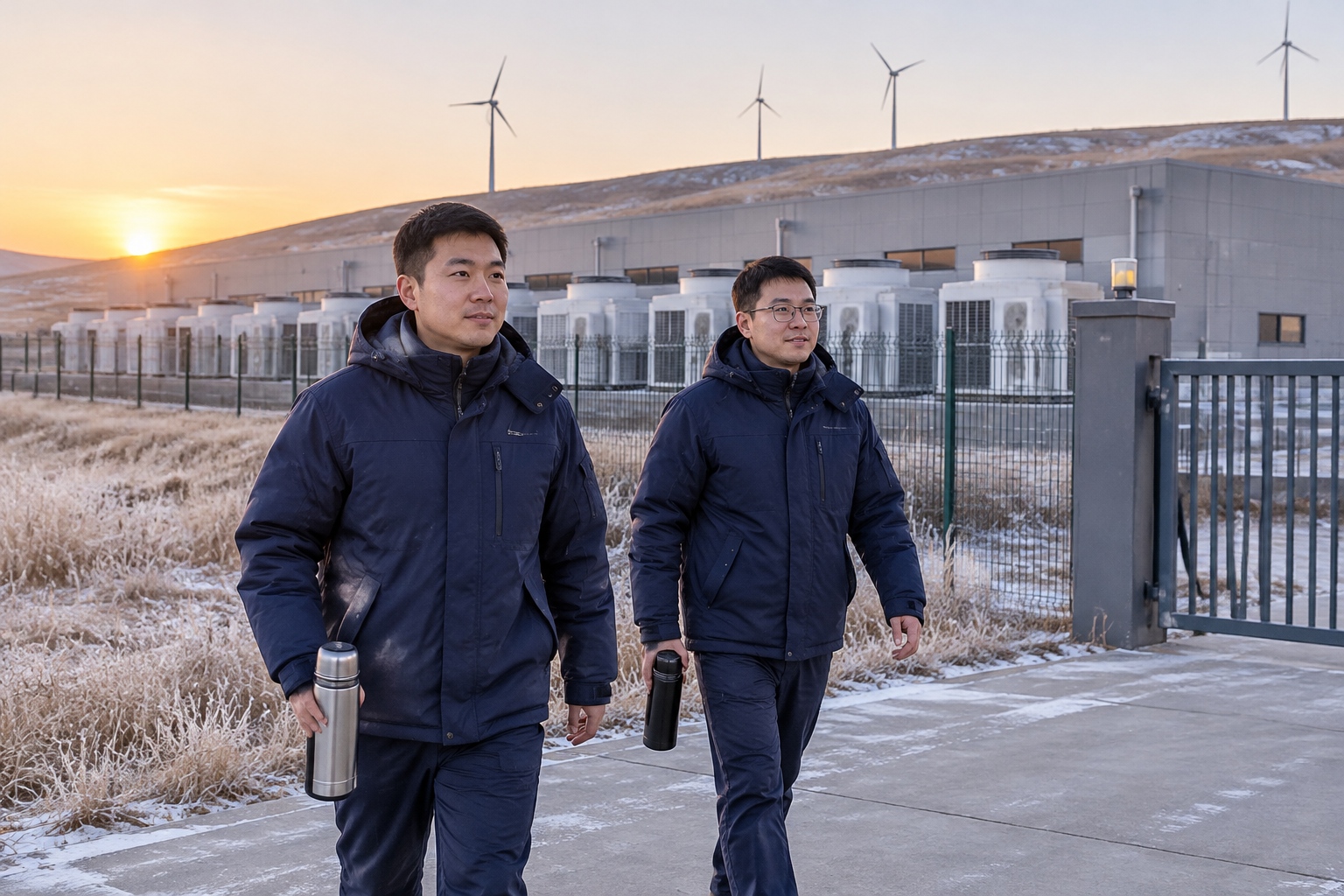
At seven-thirty on a September morning, the grassland outside Ulanqab is already white with frost. A line of wind turbines turns slowly on the ridge behind the industrial zone. A grey shuttle bus stops at a security gate, and a dozen workers in padded jackets file through with thermoses in their hands.
Behind the fence stand long, low buildings with rows of white cooling units along their flanks. Nothing comes out of a chimney. There is no smell. Stand close to the wall and you hear a hum you can feel in your back teeth. A road sign on the access road gives the distance to Beijing: 350 kilometres.
If you live outside China, Ulanqab is probably not a word you have met. If you use Chinese AI products, though, some of your requests have almost certainly passed through these buildings — through racks of servers running the training and inference that large models need.
Ten years ago, most of this land grew potatoes.
The city whose business card was the potato
Ulanqab is a prefecture in central Inner Mongolia, spread over an area roughly the size of Croatia, with fewer than two million people. Ask a Chinese person about it and, until recently, you would hear about potatoes. The city’s planting area is among the largest of any prefecture in the country, and it is one of China’s biggest processing bases for french fries and potato starch. Local officials liked to call it the country’s potato capital. Oats, grassland yogurt and wind power were the other calling cards. Not one of them had anything to do with computing.
There is a saying in the city about its own geography: no grass above ground, no minerals below it. In plain terms, poor. Before 2013, Ulanqab was poor in a very stable way.
What unsettled that stability was not a document from Beijing. It was a neighbour.

The provincial plan that didn’t have their name on it
In 2021 the Inner Mongolia regional government published a ten-year plan for cloud computing. It named four node cities: Hohhot, Baotou, Ordos and Chifeng. Ulanqab, one of the region’s twelve divisions, was not among them.
This was less a snub than a sorting. Being named a node brings power quotas, land, provincial money and a place in the queue for national projects. Hohhot had the stronger claim. Its cloud hub sits in Horinger county, 150 kilometres from Ulanqab — barely a county’s width in a region this size — and Horinger ticks the same boxes. Altitude around 1,400 metres. Average annual temperatures near 4°C, which means months of free cooling for machines that throw off enormous heat. Industrial electricity far cheaper than on the coast. Wind and solar farms feeding the same grid. And power from this plateau, like power from Horinger, runs to Beijing on dedicated lines.
For a reader outside China, the thing to hold on to is that a data centre is essentially a machine for turning electricity into computation. Power is the largest operating cost by a wide margin. A cold, windy, coal-rich plateau with transmission lines pointing at the capital is close to an ideal site — which is exactly why the official nodes ended up there too.
Ulanqab had the same natural gifts and no official title. So it went looking for companies on its own, one meeting at a time.
A delegation, a contract, and a very large bet
Huawei was the obvious first call. In 2012 the company had opened its first cloud data centre in Karamay, in Xinjiang, and was signing sites in Suzhou, Xiangyang and Yuxi — east, centre, southwest. North China was still a gap in the map. The requirements for that missing node were specific: cold weather, cheap power, and a short distance to Beijing.
City officials flew to Huawei’s headquarters in Shenzhen to make the case in person. In September 2013 the two sides signed a strategic cooperation agreement. Huawei would build; Ulanqab would make it worth Huawei’s while.
The terms were blunt. The city government bought Huawei’s government cloud service and moved the data and systems of more than thirty municipal departments onto it, on a contract worth roughly 200 million yuan per five-year term, renewable twice — around 600 million yuan across fifteen years. At the time, the whole prefecture’s annual fiscal revenue was about 7 billion yuan. There were also discounts on land, power and bandwidth.
Huawei, for its part, promised to bring its server and hardware suppliers to the city, develop a local talent pipeline, and run training aimed at the whole region. In effect, the company was expected to do part of the recruiting for Ulanqab’s industrial park.
Construction started in May 2014: 1.6 billion yuan for phase one, 1,600 racks, room for 20,000 servers — at the time the largest node Huawei had built itself. When it opened in July 2016, a vice-chairman of the regional government came for the ceremony. Ulanqab had bought a seat at the table.

Seven years of being called an empty city
The seat did not come with a cushion. From 2016 until roughly 2023, the project was a standing target for criticism at home. The streets of the new zone were quiet. Most of the promised investment was still under construction or on paper. Commentators called it an empty city, a land grab, a vehicle for subsidies. One common argument was simple arithmetic: data centres employ very few people relative to the money invested, so what does a city actually get?
That argument is not wrong. A hyperscale facility that cost billions may employ a few hundred people once it is running, and the construction jobs disappear when the cranes come down. The tax revenue is real but modest against the capital sunk. What such a site produces is capacity, and capacity only pays if somebody rents it.
In 2020, a local official put the city’s position to a reporter from China City News with a proverb: we have only planted the plane tree; when the golden phoenix arrives, the returns will follow. Read between the lines and the city was talking itself into patience. Nobody there could point to a signed contract that proved the bet would pay.
Then the arithmetic changed
What arrived was not a phoenix but a boom. The generative AI race that started in 2023 turned computing capacity from a commodity into a bottleneck. Ulanqab’s half-empty halls suddenly had a waiting list.
Apple runs two data centres in mainland China. One is in Guizhou; the other is here, in Inner Mongolia. Alibaba expanded on the same plateau. Kuaishou built its first hyperscale campus in Ulanqab, an investment reported in the tens of billions of yuan. More recently, reports have described plans for a one-gigawatt AI data centre in the city, with chip purchases alone estimated at more than 40 billion yuan — a project that would have sounded like a joke in 2017.
Official recognition caught up. In 2018 the State Council’s general office publicly commended the city’s approach to the big data industry. In 2022, when Beijing launched the “East Data, West Computing” framework — eight national hubs, ten clusters, an explicit attempt to shift compute-heavy work inland to where land and power are cheaper — Ulanqab was folded into the very Inner Mongolia hub it had been left out of a few years earlier.
By the local government’s own count, the city now hosts about 9% of China’s national computing capacity, and more than 90% of that capacity is built for AI rather than general-purpose work. On a plateau that grows potatoes, that is an unusual sentence to write.

From landlord to shareholder
The next move is more ambitious and much harder. City officials have started describing Ulanqab as a “token factory.”
The distinction matters. Selling computing power is a landlord business: you rent out racks and GPUs by the hour, and your income is set by the price of electricity and the going rate for a card-hour. Selling tokens is different. A token is the basic unit of text a model reads and writes, and API customers are billed per million of them. If a city’s data centres are paid per token of model output, they are no longer collecting rent — they are taking a slice of what the AI produces.
Whether that works is an open question. Token prices in China fell sharply through 2024 and 2025 as model providers undercut one another, and margins on inference are thin. The value in AI still pools with the companies that own the models and the applications, not with the buildings. A city owns concrete, land, power contracts and cooling systems; it does not own a frontier model. And what gets installed depends on chip supply, the most constrained variable in the entire Chinese AI stack.
There is an environmental footnote, and it deserves honesty. Inner Mongolia is China’s largest coal-producing region, and the grid that carries the wind farms also carries coal plants. The green-power pitch is real — the plateau’s wind and solar resources are excellent, and for much of the year cooling here is mostly fresh air — but calling the local computing industry “clean” needs qualifiers. Water is another constraint on dry grassland, even with air cooling.
What the plateau actually shows
The tidy version of China’s tech map says Beijing picks the winners and the rest follow. Ulanqab complicates that story. In 2013 the city had no national designation, no obvious advantage beyond cold air and cheap electricity, and no guarantee that the companies it courted would stay. It flew south, wrote a cheque that was large relative to its own budget, and then waited through seven years of being told it had wasted the money.
The gamble paid because of foresight, a willingness to bend the usual rules, and something officials will never put in a report: luck. Had the AI boom arrived five years later, or not at all, the critics would still have the better argument.
Late in the afternoon the light turns orange and the frost comes back to the grass. A shift bus pulls out of the gate and heads for the city. A few kilometres away, a harvester is still working a potato field that has not yet been built over — the old economy and the new one within sight of each other, sharing the same grid.
Start the discussion at forum.chinacomes.com