

A key that crosses a continent, then an ocean
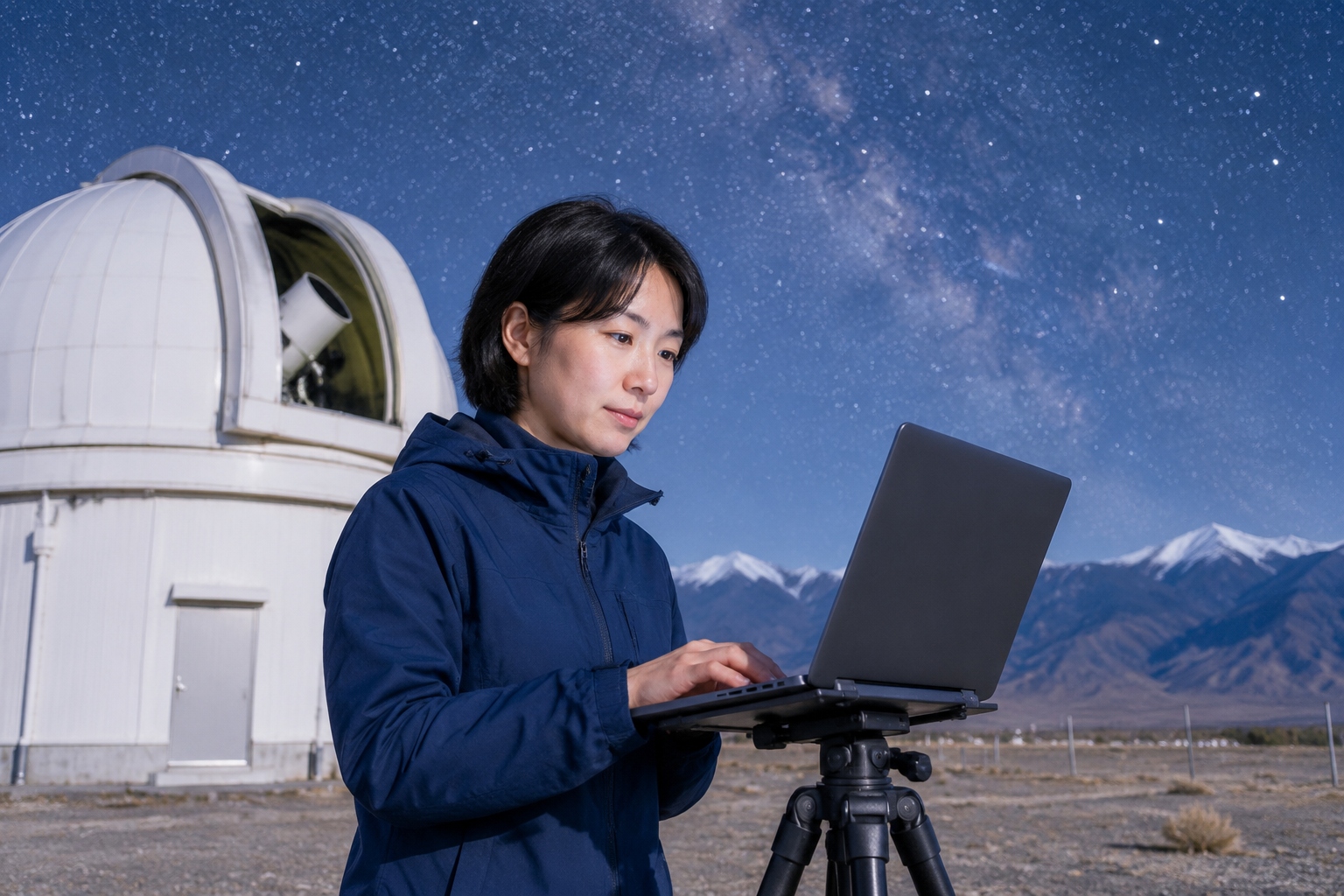
The most important part of the experiment may have lasted less time than it takes to boil an egg. A small satellite passed over a ground station; a telescope locked onto it; detectors began counting single particles of light. If the sky was clear and the tracking was good, the two ends began to agree on a string of random numbers. That string is the key.
In a recent experiment, researchers in China and South Africa shared a quantum key across about 12,900 kilometers. The number is striking. The process is more interesting: it required a satellite relay, two ground stations, careful timing, and a very particular definition of “secure.”
Quantum key distribution, or QKD, is often described as “unhackable encryption.” That shorthand causes confusion. QKD does not encrypt your messages. It distributes a key—a random string of bits—that two parties can use to encrypt and authenticate data. The physics guarantees one narrow thing: if someone tries to eavesdrop on the key distribution, the disturbance shows up in the data. The key is then thrown away. It does not guarantee that the laptop at either end is safe.
Why 12,900 kilometers is a different problem
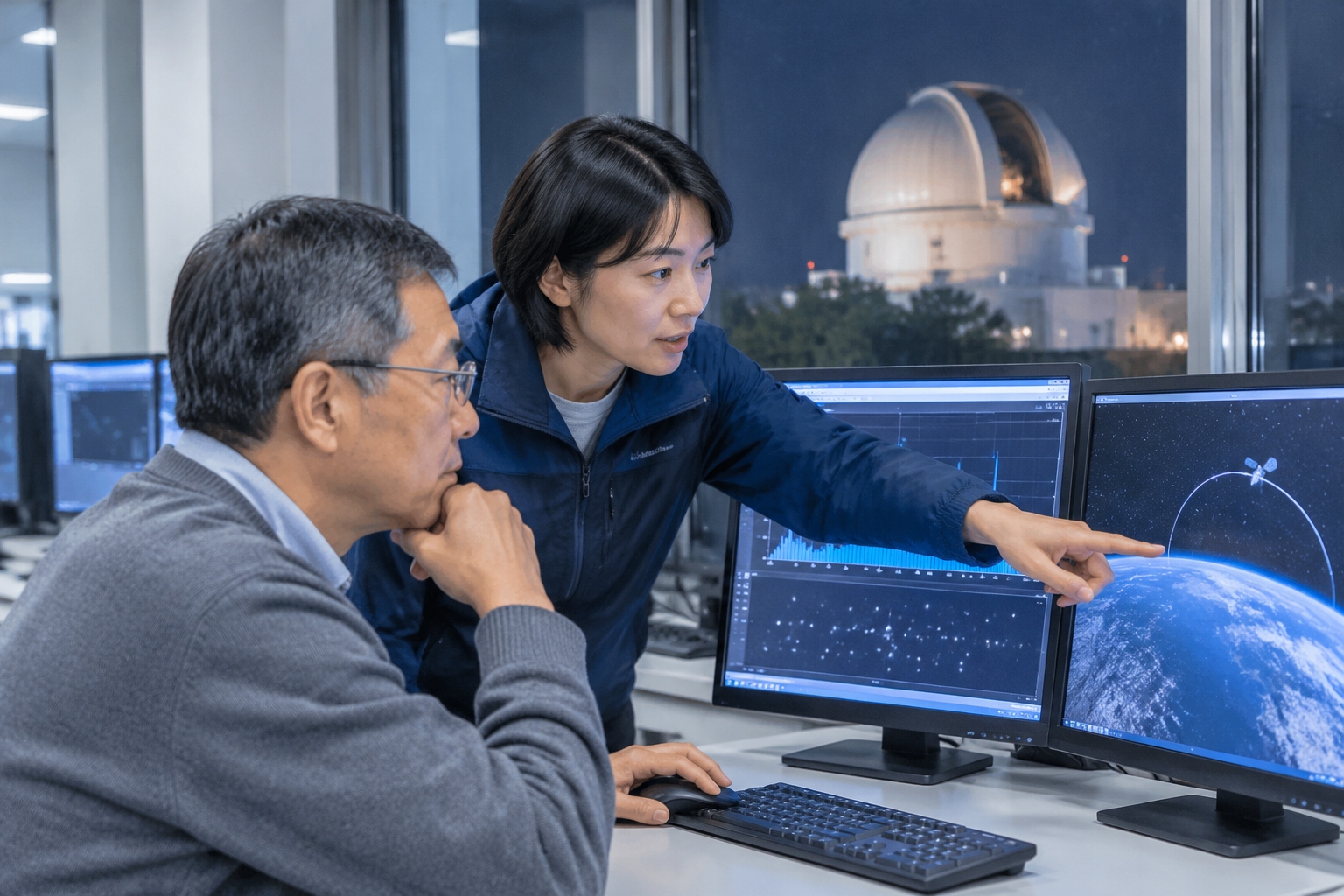
Over a city, QKD can run through optical fiber. Over 12,900 kilometers, fiber is not an option. Light in glass fades; amplifiers cannot copy an unknown quantum state; and there is no continuous fiber route from China to South Africa that could carry a fragile single-photon signal across Asia and the Indian Ocean. Even if you built one, the loss would be enormous.
So the experiment went through space. A satellite in low Earth orbit can see a ground station in China on one pass and a station in South Africa on another. It can establish separate quantum keys with each. Then it can combine them. The satellite is not a passive mirror reflecting a photon from one continent to the other. It is an active relay.
The satellite is a relay, not a giant quantum wire
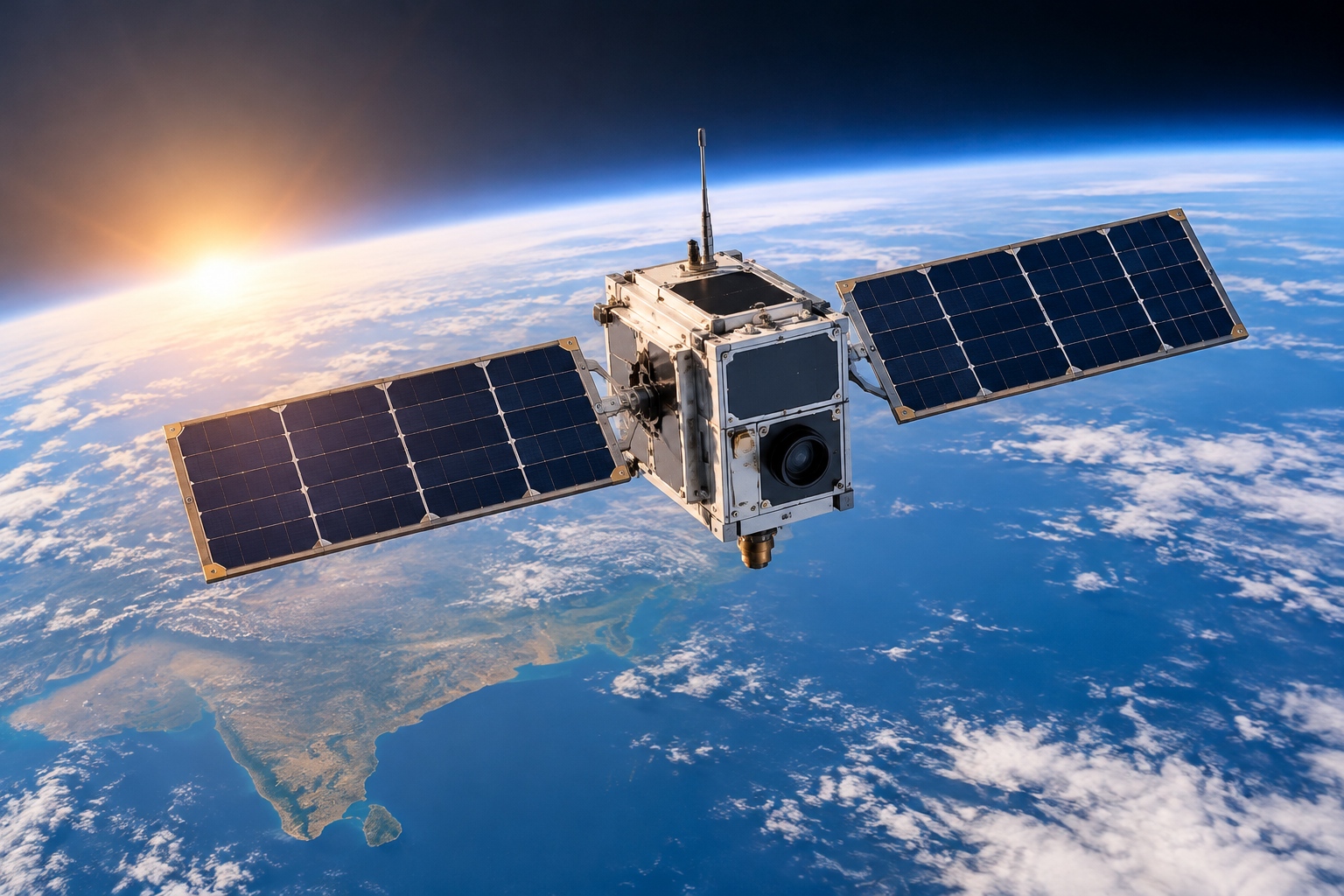
The satellite used in this work was Jinan-1, a compact Chinese quantum satellite. It follows in the path of Micius, the earlier Chinese satellite that demonstrated satellite-based QKD and, in 2017, a China–Austria link of about 7,600 kilometers. Jinan-1 is smaller and was designed to test a more practical, lower-cost approach.
Here is the basic choreography. Station A and the satellite run QKD and end up with a shared key, call it K_A. Station B and the same satellite run QKD later and end up with K_B. The satellite can then combine K_A and K_B—usually with a simple XOR operation—so that A and B can derive a common key. This is called a trusted-node relay. It works, but it has a catch: the satellite briefly knows both keys. If the satellite is compromised, the relay is compromised.
The minutes that matter
A low-orbit satellite is not parked above one spot. It moves across the sky at roughly 7 kilometers per second. A usable pass may last only a few minutes. In that window, the ground station must track the satellite precisely, point a telescope at it, send a beacon laser, synchronize clocks, and detect returning single photons against background light. A cloud can end the attempt. So can a tracking error, a timing drift, or a detector artifact.
The two ends do not need to be in the same pass. The satellite can hold key material between passes, which is exactly why the relay model matters. But that also means the operation is a schedule, not a phone call. Teams must coordinate weather, orbit predictions, ground-station availability, and security procedures. The South African station and the Chinese station may be in different time zones, under different skies, and on different operational rhythms. The experiment only succeeds when all of that lines up.
What “unhackable” means—and what it doesn’t
The security claim behind QKD rests on quantum mechanics. An eavesdropper cannot perfectly copy an unknown quantum state. If someone measures the photons in transit, the measurement disturbs them. The two parties compare a sample of their data and estimate the error rate. If the rate is too high, they discard the key. In principle, the eavesdropper learns less than the parties’ own uncertainty allows.
That is powerful, but narrow. QKD protects the key-distribution step. It does not protect the endpoint. It does not stop malware, phishing, a bribed administrator, or a flawed random-number generator. It does not automatically make the satellite trustworthy. In a trusted-node relay, the satellite is a point of trust; if an adversary can access it, the security model changes. Real systems also face implementation attacks—detector blinding, side channels, and other engineering flaws—that are not covered by the clean textbook proof.
So “unhackable” is the wrong word for the whole system. A better sentence is: QKD makes eavesdropping on the key distribution detectable, under stated assumptions. That is already valuable for high-value links. It is not a force field around the internet.
What it costs to move a secret 12,900 kilometers
Satellite QKD is not cheap or simple. You need a satellite, a payload, ground stations with telescopes and single-photon detectors, precise clocks, trained staff, and a lot of scheduling. The key rate is modest, and the pass windows are short. This is not a technology for streaming video or everyday web browsing. It is a tool for high-assurance key exchange: government links, financial infrastructure, critical networks, or research backbones.
The cost is also why the Jinan-1 class of satellite matters. A smaller, cheaper satellite can make experiments more frequent and more flexible. But the ground segment remains heavy. A quantum network is not just spacecraft; it is domes, detectors, weather logs, and people on night shifts.
What the record actually changes
The 12,900-kilometer result shows that intercontinental QKD can be organized with a small satellite and a relay model. It does not yet mean a global quantum internet is here. A real network would need many satellites, many ground stations, standards for interoperability, and clear rules for trust. It would need to work when the sky is cloudy, when a satellite fails, and when different countries do not want to trust the same relay.
For most people, the near-term effect will be indirect. Banks, governments, and infrastructure operators may use QKD for specific high-value links while the rest of us keep using classical cryptography, which is not standing still. The interesting part of this experiment is not that a number got bigger. It is that a key was moved across a continent and an ocean by making physics, logistics, and trust line up for a few minutes. The key itself may have been a meaningless string of bits. Getting it there was the hard part.
Start the discussion at forum.chinacomes.com