


What Wukong actually is
The first thing to know about Wukong is what it has not done: it has not found dark matter. That sounds like an odd way to start a story about a satellite often called a dark matter hunter. But it is the most honest way to understand the mission.
Wukong is the nickname of the Dark Matter Particle Explorer, or DAMPE. It is a Chinese space science satellite launched on December 17, 2015, from Jiuquan. It circles Earth in a sun-synchronous orbit about 500 kilometers up and weighs around 1.9 tonnes. The name comes from the Monkey King in Chinese folklore, a figure with sharp eyes who can see through disguises. The comparison is playful, not scientific.
DAMPE is not a telescope that takes pretty pictures. It is a particle detector. It catches high-energy particles and gamma rays arriving from space, measures their energy and direction, and sends the data back. Its job is to look for subtle patterns that might, or might not, come from dark matter.
This distinction matters. A telescope collects light. DAMPE collects events: a particle enters, interacts, and leaves a signature. The signature is translated into energy, direction, and charge. That is the raw material of the science.
Why send a satellite after something invisible?
Dark matter is the name for mass we infer but cannot see. It does not absorb, reflect, or emit light in any way we have detected. It passes through planets, people, and detectors. We know it is there only through gravity.
Galaxies rotate as if they contain far more matter than the stars and gas we observe. Clusters of galaxies bend light in ways that visible matter cannot fully explain. The cosmic microwave background, the afterglow of the early universe, carries imprints of a substance that does not glow.
Current cosmology suggests ordinary matter is only about 5 percent of the universe. Dark matter is roughly 27 percent. The rest is dark energy. Nobody has identified the dark matter particle. It might be a weakly interacting massive particle, an axion, or something not yet imagined.
If dark matter particles exist, they might collide with each other or decay. Those processes could produce ordinary high-energy particles, including electrons, positrons, and gamma rays. A satellite like Wukong can look for an excess or a sharp feature in those particles. It does not see dark matter directly. It sifts the debris that dark matter might leave behind.
High-energy electrons are especially useful for this kind of search because they lose energy as they travel through the Milky Way. Those reaching Earth at tera-electron-volt energies cannot have come from very far away. A local excess could point to a nearby pulsar, a supernova remnant, or dark matter. That ambiguity is the heart of the problem.
How the detector works
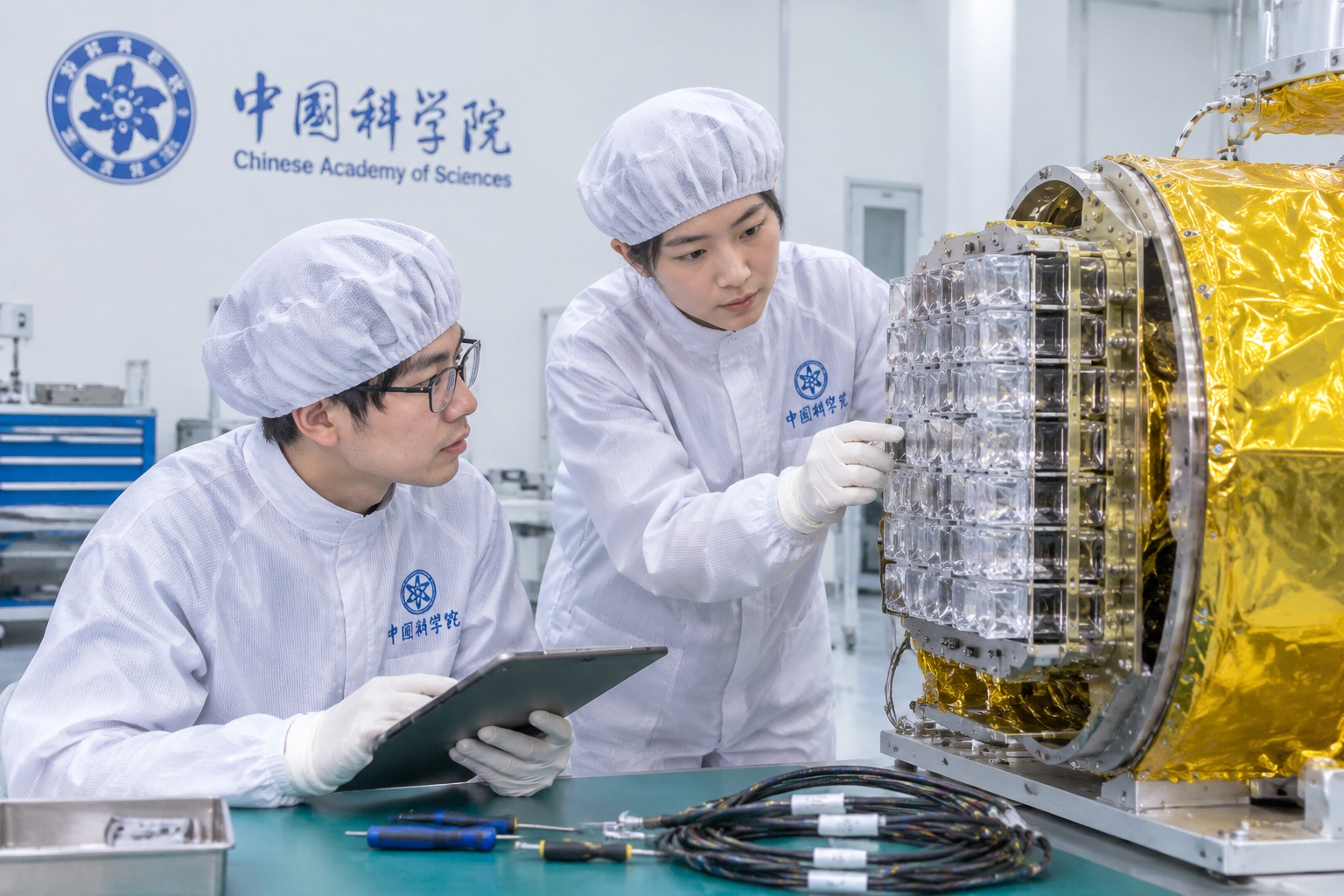
The instrument is built in layers, a bit like a very sensitive stack of detectors. The main calorimeter uses dense bismuth germanate crystals, often called BGO. When a high-energy electron or gamma ray enters, it creates a shower of secondary particles. The crystal stack measures how much energy is deposited. A silicon tracker maps the path of charged particles. Plastic scintillators and a neutron detector help separate electrons and gamma rays from the much more common protons and heavier nuclei.
Think of it as a security scanner for particles. Each layer asks a different question. Did something pass through? How much energy did it leave? Where did it bend or scatter? Was it likely an electron, a gamma ray, or a proton? The answers come together event by event.
This matters because cosmic rays are not clean signals. A satellite in orbit is hit by a constant rain of particles. The detector has to reject most of them and keep the rare events that matter. The data are not a photograph of the sky. They are a list of particle events, each with energy, direction, and quality flags.
Space is essential for this work. Earth’s atmosphere absorbs most high-energy cosmic rays and gamma rays before they reach the ground. A detector above the atmosphere can sample them directly. Wukong also has a wide field of view, so it can scan much of the sky while it orbits.
What it has found, and what it has not
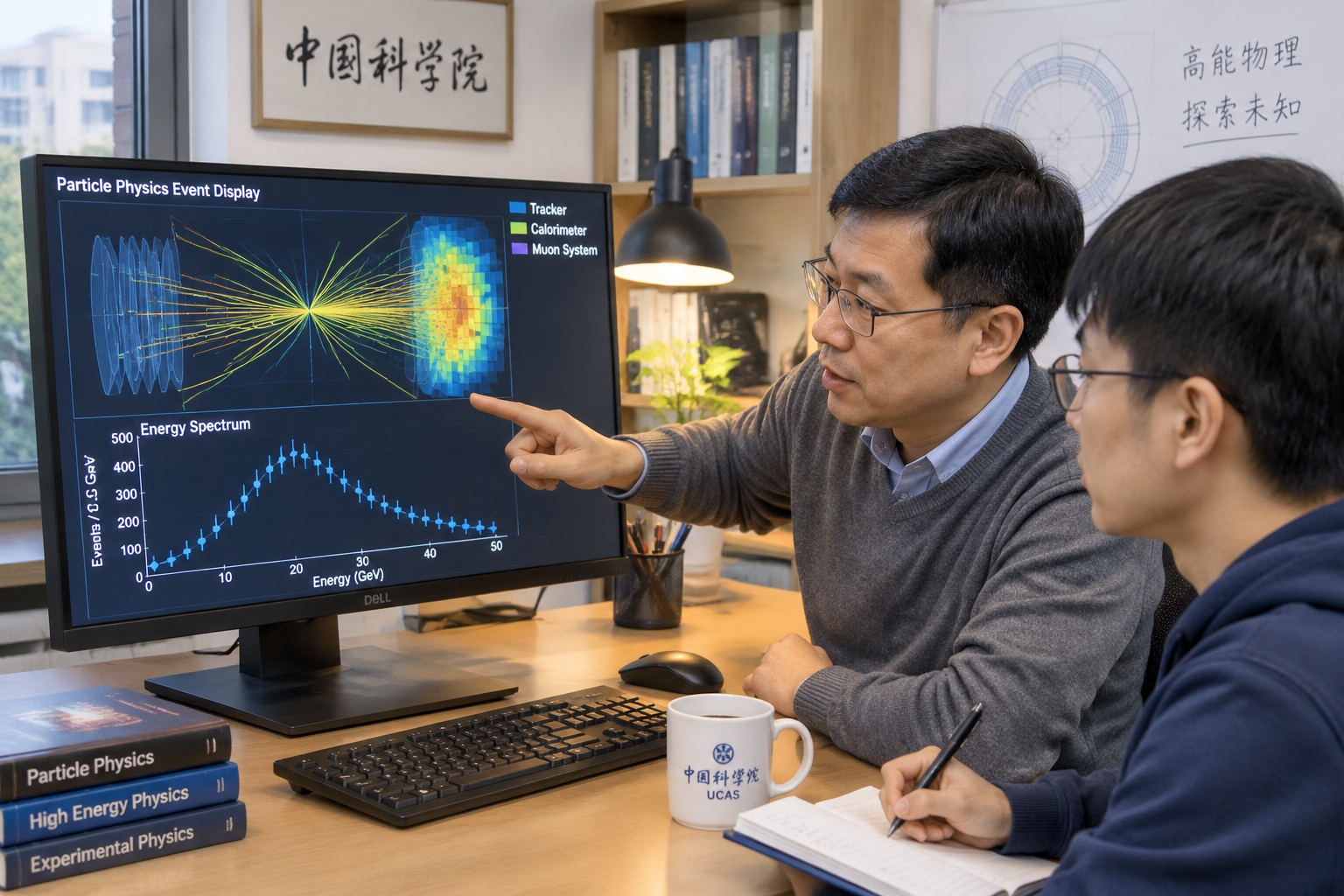
In 2017, the DAMPE team published a measurement of the combined electron and positron spectrum from 25 GeV to 4.6 TeV. The spectrum showed a break around 0.9 TeV. A break is a change in slope, like a road that stops climbing and starts to flatten. It is interesting because the spectrum was expected to follow a smoother curve. The measurement was precise enough to make the feature hard to dismiss.
But a break is not a discovery of dark matter. The feature could come from nearby pulsars, supernova remnants, or some other astrophysical source. It could also be a hint of dark matter, but the data cannot settle that on their own. This is the line that often gets lost in headlines: Wukong is a dark matter detector, not a dark matter discovery machine.
The mission has also measured the spectra of protons and helium nuclei, the bulk of cosmic rays. These measurements help physicists understand how cosmic rays travel through the Milky Way and how they are accelerated. The satellite has contributed gamma-ray observations as well. As of the mid-2020s, it has been operating for nearly a decade, well beyond its original three-year design life.

The limits are part of the science
At the highest energies, the number of events is tiny. A few particles can shape a data point. Separating electrons from protons is difficult, and every detector has backgrounds. A result that looks exciting in one energy range may fade with more data. This is normal in particle astrophysics, but it makes cautious language necessary.
No single experiment can identify dark matter. Wukong works alongside other approaches: underground detectors that wait for rare nuclear recoils, the Large Hadron Collider, gamma-ray observatories, and other space missions. China also hosts the PandaX experiment in the Jinping underground laboratory in Sichuan, which searches for dark matter in a very different way. The comparison is useful. Wukong looks up at the sky. PandaX looks down into the rock.
The most responsible sentence about Wukong is this: it is looking for indirect evidence of dark matter, and it has found interesting features in cosmic-ray data that require more work. That is less dramatic than a headline saying dark matter has been found. It is also closer to how the science actually works.
Why it matters beyond the hunt
For most people, Wukong will never be part of daily life. There is no app, no consumer product, no visible change on the street. Its value is different. It shows whether a country can build, launch, operate, and interpret a frontier particle physics instrument. It trains engineers, software developers, and young researchers. It keeps Chinese scientists inside a global conversation about the universe.
That conversation is slow. A satellite like this is a long bet on knowledge. It produces papers, data pipelines, and skills. It may also produce nothing that settles the dark matter question. That is not failure. It is how science works when the target is invisible and the evidence is rare.
So the next time you see Wukong described as a dark matter hunter, keep the useful correction in mind. It is hunting. It has not caught anything yet. The hunt itself is the story.
Start the discussion at forum.chinacomes.com