

A Supercharger Beside the Bamboo Forest
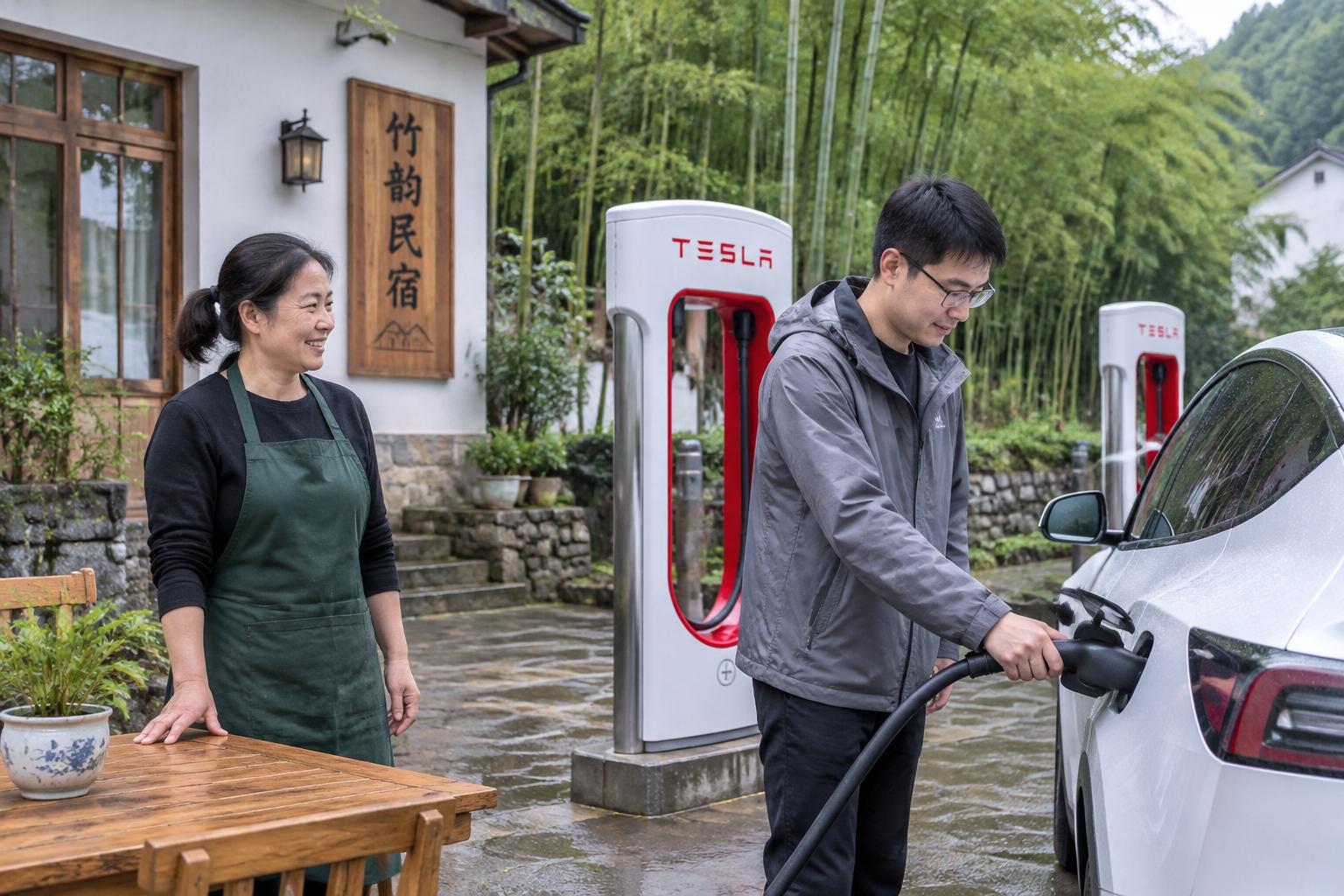
On a Saturday morning in late spring, a white Tesla Model Y rolled into the courtyard of a guesthouse in Anji County, Zhejiang, without making much noise. The driver, a 34-year-old software salesman from Hangzhou, plugged the car into one of two charging stalls beside a bamboo grove, then ordered coffee and a bowl of bamboo-shoot noodles. The owner, Chen Meihua, 48, wiped a table and watched. Five years ago, she said, almost no one arrived in an electric car. Now, on weekends, the courtyard has a new rhythm: park, plug in, eat, walk into the village, come back an hour later.
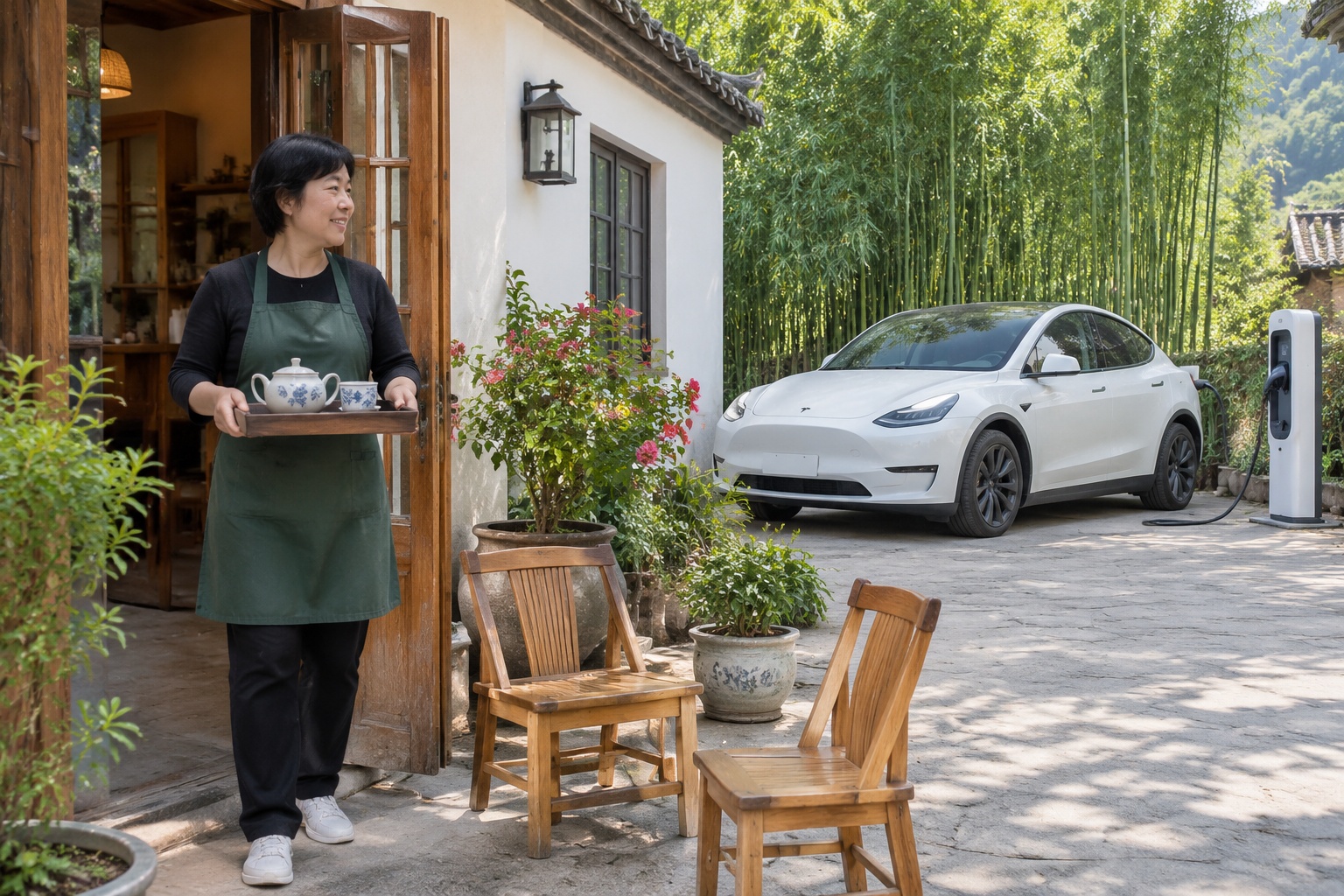
Anji is a mountainous county in northern Zhejiang, a couple of hours from Hangzhou and within easy weekend range of Shanghai. It is known for bamboo forests, hiking trails, and guesthouses that fill up when city people want quiet. The charger in Chen’s courtyard is not a Tesla showroom. It is a small test of what happens when electric-vehicle charging reaches the last mile of rural tourism.
Why EV Drivers Used to Skip Villages Like This
Range anxiety used to make places like Anji a hard sell for electric car owners. A driver from Shanghai could reach the county seat with plenty of battery left, but the last 30 kilometers of mountain road were the problem. Would there be a charger near the trailhead? Could the car sit overnight at a guesthouse and be charged by morning? If not, many drivers took a gasoline car or joined a tour bus.
That pattern is familiar in rural parts of the United States and Europe, where charging gaps can make a weekend trip feel like a logistics exercise. China has its own gaps, especially in the west and in remote mountain areas. But the density of public charging is changing quickly. China now has millions of public and private charging piles, and Tesla alone says it has more than 11,000 Superchargers in mainland China. The numbers do not mean every village is ready for an EV. They do mean that a rural guesthouse owner can now put a charger on the list of things that bring guests in.
The Deal: Local Government, the Grid, and Tesla
The charger did not appear by magic. In the village I visited, the site was put together by the county tourism platform, the local power company, and Tesla. The fast chargers went at the visitor center, not deep inside the old lanes, because the lanes are narrow and the grid connection is stronger there. The power company upgraded a transformer. Tesla supplied the equipment and trained a local technician to handle basic checks. Several guesthouses added slower destination chargers for overnight guests.
Local officials saw charging as tourism infrastructure, not as a favor to a car brand. That is an important difference from how many rural charging projects are framed elsewhere. In parts of the US and Europe, a single charger can wait months for permitting, utility studies, and a business case. In China, local governments often bundle charging with rural revitalization, road upgrades, and tourism promotion. The coordination is not always smooth, and not every project works. But when it does, a small village can get a transformer, a paved spot, and a sign faster than many foreign visitors expect.
What the Guesthouse Owner and the Taxi Driver Notice
Chen does not talk about the energy transition. She talks about parking. Before the chargers arrived, she said, weekend guests were mostly families in gasoline cars. They stayed one night, hiked, and left. Now she sees more electric cars from Shanghai, Hangzhou, and Suzhou. Some guests book because they saw a charging point on a map. They arrive earlier, stay longer, and order more coffee. Her biggest complaint is not the technology. It is that two stalls are not enough on a holiday weekend.
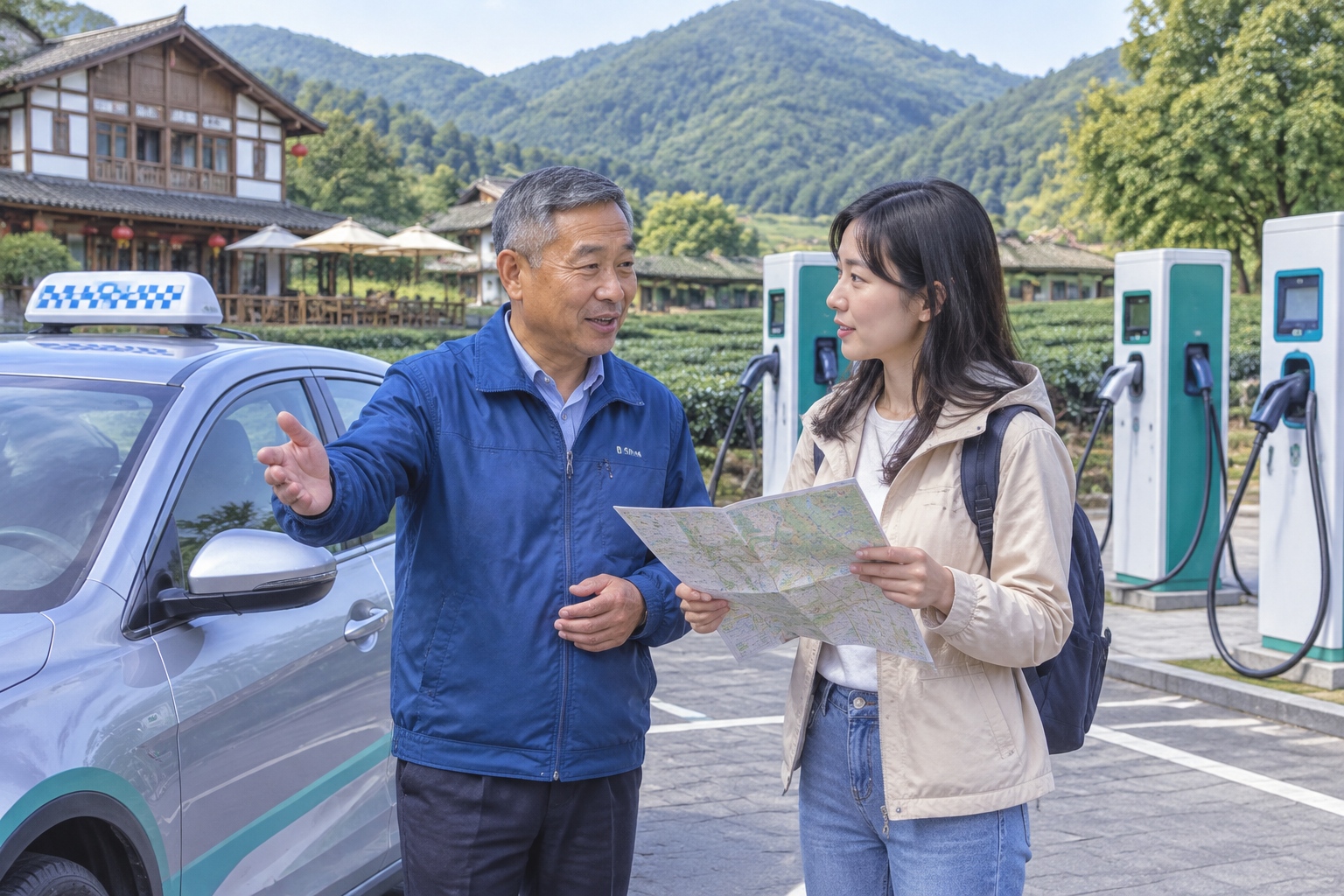
A local taxi driver, Wang Jian, 52, has a different view. He drives an electric taxi and used to avoid long trips to the scenic villages because he worried about charging. Now he knows there are piles at the visitor center and at two farm stays. “I can take a passenger to the village, charge while I wait, and take another trip to a nearby trail,” he said. His trips have become longer, not shorter. The charger has changed his mental map of the county.
The Numbers Behind the Quiet Change
The village tourism cooperative’s rough tally is modest but telling. In the first full year after the chargers opened, tourism revenue rose about 40 percent from the previous year. The Tesla stalls averaged around 15 charging sessions a day, with peaks on weekends and public holidays. These are not audited figures from a controlled study. A new road and a few viral social-media posts also helped. But the charger changed the mix of visitors. More young couples and small families arrived in EVs. They spent money on coffee, local bamboo shoots, and short guided walks. The guesthouse association says the average weekend stay lengthened, though the exact number is disputed.
That caveat matters. A charging station is not a magic economic switch. It works when a village already has something people want to visit, when the road is decent, and when the charger is maintained. In places where those conditions are missing, a charger can sit unused and become a photo of good intentions.
The Real Constraints: Maintenance, Grid Load, and Holiday Queues
Rural charging in China is not solved. Dust, insects, voltage spikes, and holiday demand all put pressure on equipment. A fast charger can cost hundreds of thousands of yuan to install, and maintenance is not free. On summer evenings, air conditioners and chargers compete for grid capacity. During the May Day holiday, drivers in some scenic areas have queued for charging, just as they queue for parking.
The team behind the Anji site is trying to manage this with remote monitoring, a local electrician on call, and a booking app that shows real-time availability. But the harder problem is scale. In western China, distances are much longer, and a charger every 100 kilometers may not be enough. Some villages install chargers but do not maintain them. A dead charger teaches drivers to avoid the area, and that reputation is hard to undo. The difference between a photo opportunity and useful infrastructure is often maintenance.
From Charging Stop to a Rural Tourism Ecosystem
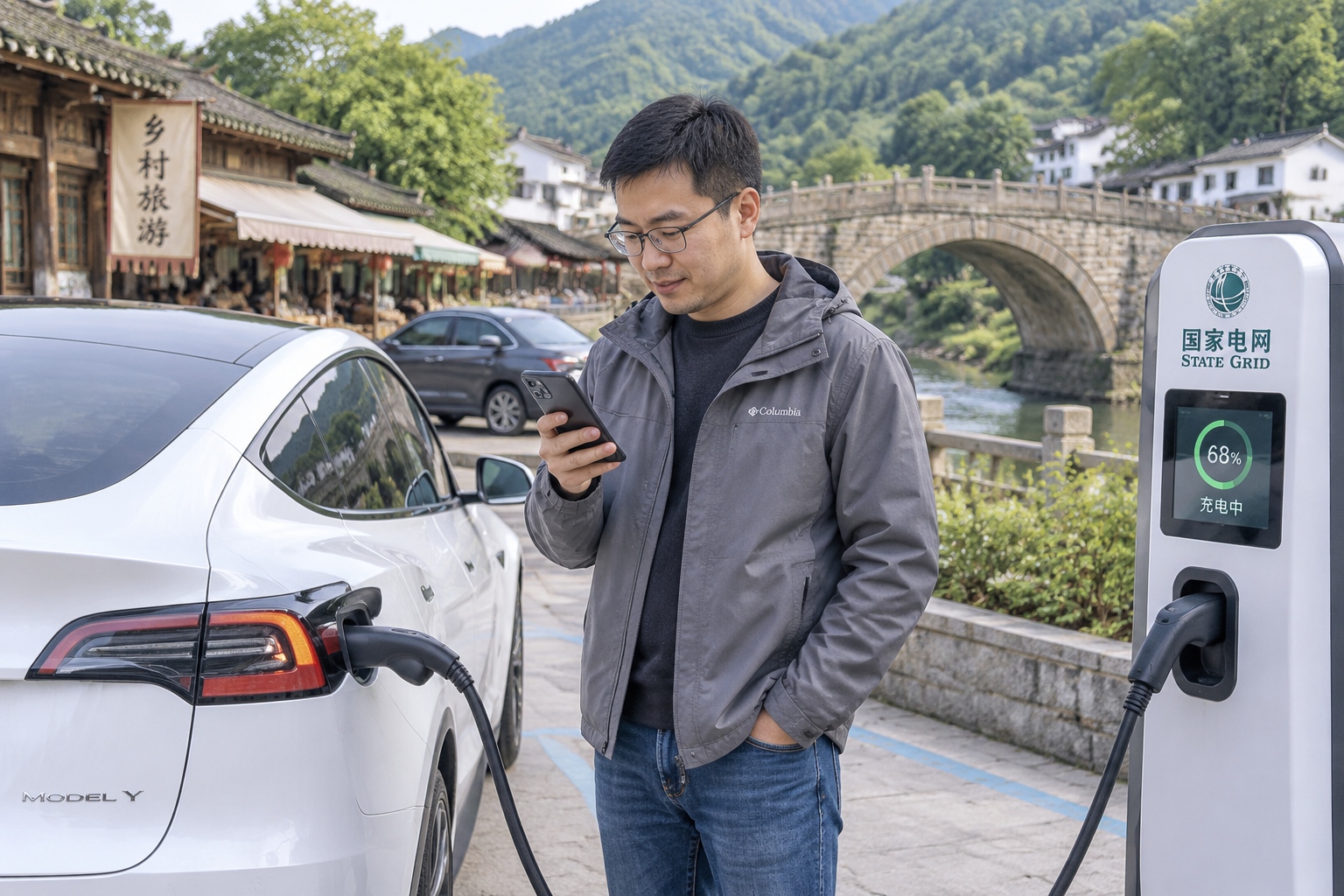
The next step is not simply more plugs. Several villages in Zhejiang and Anhui are testing a “charging plus tourism” model: solar canopies over parking areas, battery storage to shave peak demand, electric car rental at high-speed rail stations, and apps that combine charging, maps, and guesthouse booking. Tesla is one brand in this story, not the whole story. BYD, NIO, Xpeng, State Grid, and private charging operators are building rural networks too. Drivers do not care much about the logo on the plug. They care whether the charger works, whether the price is clear, and whether there is something to eat while the car charges.
For visitors from abroad, the surprise may be the speed of coordination. In many countries, a rural charger means permits, utility studies, and a business case. In China, local governments often treat charging as part of public infrastructure, alongside roads and toilets. That does not mean every village succeeds. It does mean that the same problem—how to make a remote place reachable without gasoline—can get a different answer.
Conclusion: A Small Window
Back at Chen’s guesthouse, the white Tesla is still there at noon. The driver has finished his noodles, walked through the bamboo forest, and bought two bags of dried bamboo shoots. Chen writes the order in a paper notebook, then checks her phone for the next booking. She does not describe the charger as a window to the world. She describes it as a reason for people to stop. In a village like this, that is already a lot. The charger is a piece of technology, but its real effect is smaller and more human: it lets a car stay an hour longer, and lets a village earn a little more from the road that passes through it.