
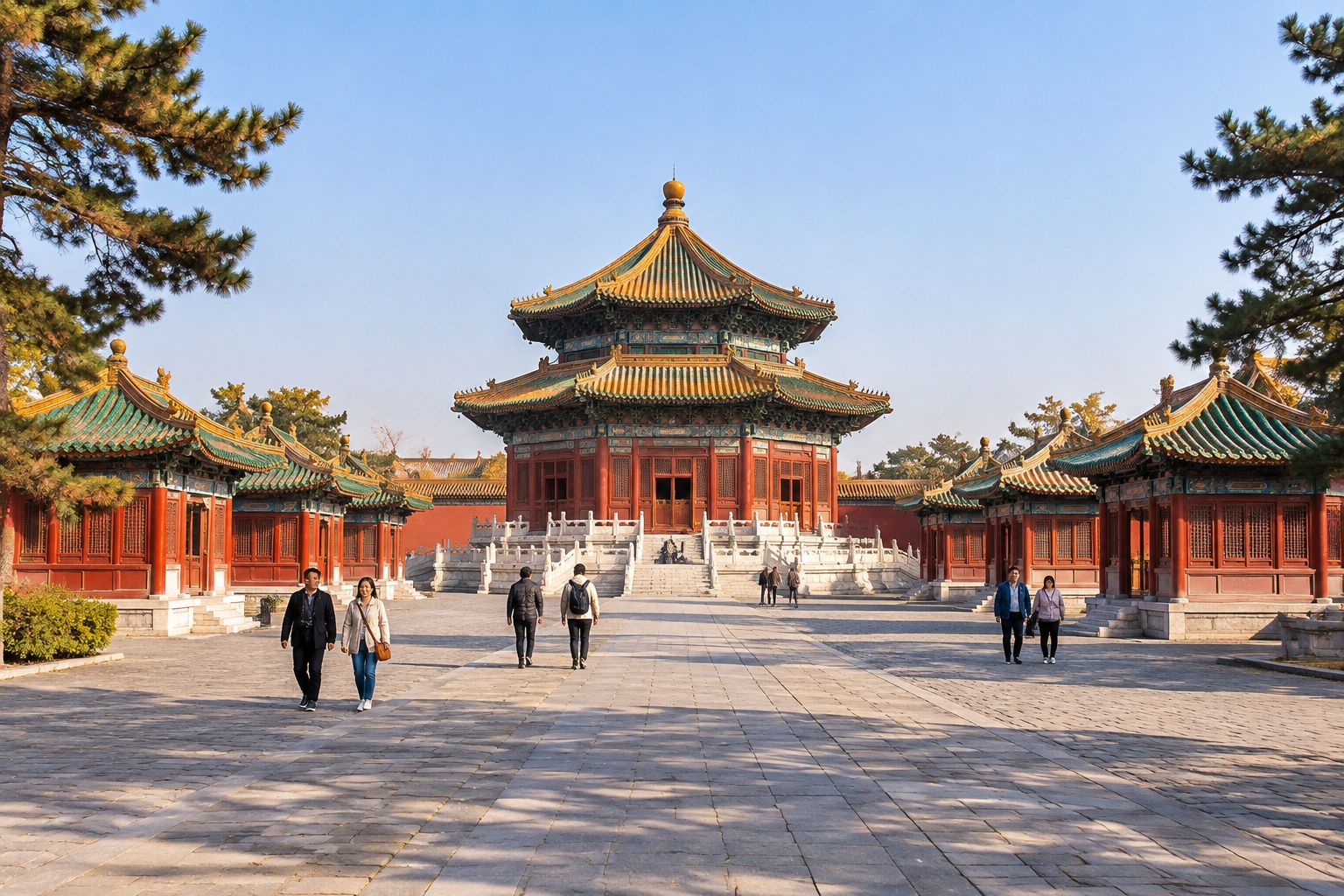

A palace you can walk into on a Tuesday
On a Tuesday morning in late October, a man in a padded jacket was flying a swallow-shaped kite in the square outside the Shenyang Imperial Palace. Behind him, four retirees moved through a slow dance routine beside a portable speaker. A school group in red scarves lined up for a photo. Nobody was hurrying.
This is the entrance to one of only two imperial palace complexes still standing in China.
At the Forbidden City in Beijing, the same Tuesday begins with a QR code, a timed entry slot booked days ahead, and a queue along the moat. In Shenyang you buy a ticket at the window for 50 yuan — about seven dollars — and walk in.
The Mukden Palace sits in the middle of Shenyang, an industrial city of roughly nine million people in northeast China. In 2004 UNESCO added it to the World Heritage List as an extension of the Beijing listing: officially, the Imperial Palaces of the Ming and Qing Dynasties in Beijing and Shenyang. Same listing. Very different building.
Two palaces, one dynasty
The Forbidden City was finished in 1420 by the Ming. It covers 72 hectares and about 8,700 rooms.
Shenyang’s palace was begun in 1625 by Nurhaci, the Manchu leader who had just moved his capital here, and completed by his son Hong Taiji. It covers about six hectares — roughly one twelfth of Beijing’s — and around 300 rooms in more than 100 buildings.
The difference in scale is not about budget. When this palace went up, the Manchus had not yet conquered China. They ruled a frontier state, first called the Later Jin and renamed Qing in 1636, still fighting for control of the northeast. The palace was a working headquarters: part court, part fortress, part office.
In 1644 Qing armies took Beijing and the emperor moved into the Ming palace. Shenyang became the dynasty’s secondary capital, and this smaller palace turned into something closer to an ancestral shrine. Kangxi, Qianlong, Jiaqing and Daoguang all travelled back on “eastern inspection tours” to sleep in their ancestors’ rooms. Qianlong expanded the complex in the 1780s, adding an east and a west section.
Which is why the place feels like a prequel. You are looking at the architecture of a government on the way up.
Built by a khanate, not an empire
The Dazheng Hall, or Hall of Great Governance, is the building most visitors photograph first: octagonal, double-eaved, eight sloping roofs, standing at the head of a courtyard flanked by ten smaller pavilions arranged in a V.
Those ten pavilions were the offices of the Eight Banners and two senior princes — the military and social organisation that made Manchu conquest possible. Stand at the front of the courtyard and you are looking at a chain of command built in timber.
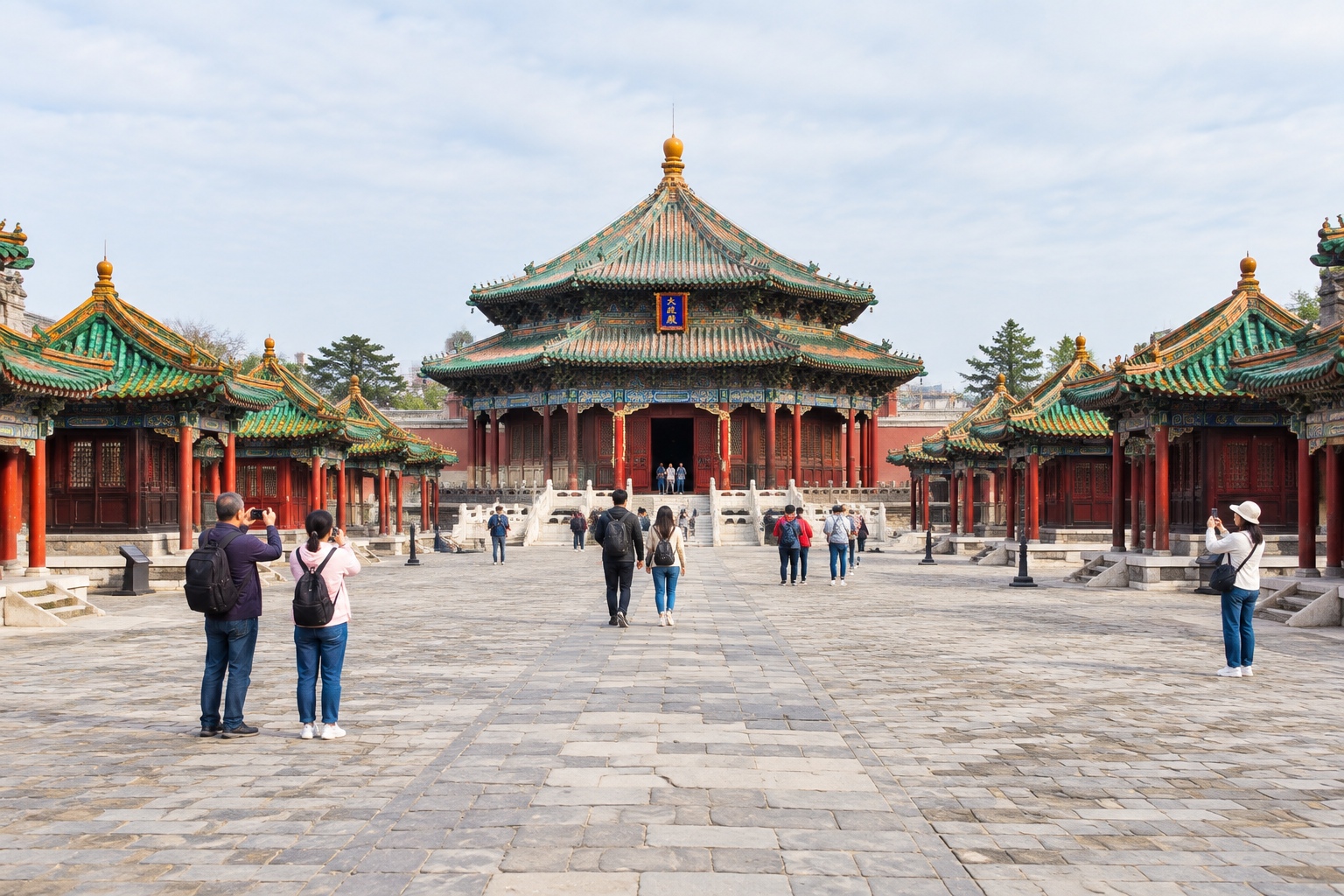
Chinese imperial halls are usually rectangular, symmetrical and oriented strictly north-south. The octagon, the pointed roofs and the Mongol and Tibetan detailing on the Dazheng Hall read differently. Guides here usually describe it as a military tent made permanent — a nod to the Manchu nomadic past, and possibly a deliberate signal that this was not a conventional Chinese court.
There is a rough parallel in Ottoman Istanbul, where sultans built in a mix of Byzantine, Persian and Balkan idioms because their empire was itself a mix. The Qing did something similar here, on a much smaller footprint, drawing on Manchu, Han, Mongol and Tibetan traditions in a single courtyard.
The door is on the wrong side
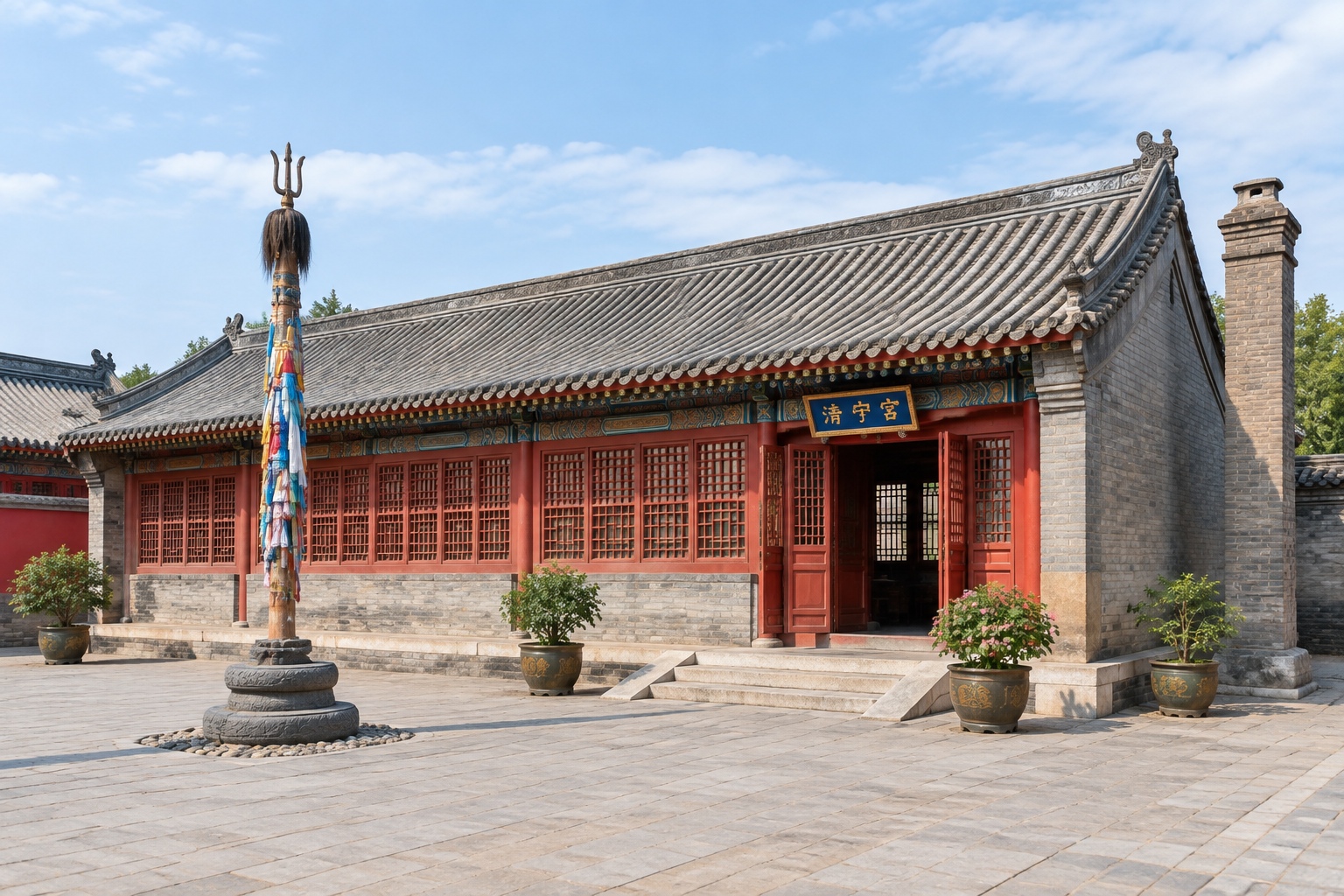
Qingning Palace, Hong Taiji’s residence, breaks a rule that Han architecture almost never breaks: the entrance is not centred. It sits at the eastern end of the front wall.
Inside, a heated brick platform called a kang wraps around three walls of the main room. Outside, the chimney does not rise from the roof ridge the way it would on a Han building. It stands on the ground, attached to the side of the house.
Both choices come from the cold. Manchu homes in the northeast were built this way to survive winter, and the palace kept the vernacular even after it adopted imperial scale. A courtyard pole used for shamanic offerings is a further reminder that Manchu ritual, Buddhism and Daoism coexisted here rather than one replacing the others.
A library with a black roof
In the western section, Qianlong built the Wensu Pavilion to hold one of seven copies of the Siku Quanshu, the huge imperial manuscript collection assembled in the 1780s. Its roof tiles are black. Every other imperial roof here is yellow.
The reason is cosmology: black corresponds to water, and water defeats fire — the obvious nightmare for a building full of paper. Yellow belonged to the emperor, but fire safety won.
What you actually see on the ground
Inside the gates the crowd divides. Local residents move quickly toward the courtyards where magnolias bloom in May, or sit on the steps while their children run. They have been here many times; the ticket is cheap and the palace is a twenty-minute walk from the main shopping street.
Visitors from other provinces, and a growing number of foreigners, cluster around the Dazheng Hall and the Chongzheng Hall with phone cameras out, following a flag or an audio guide.
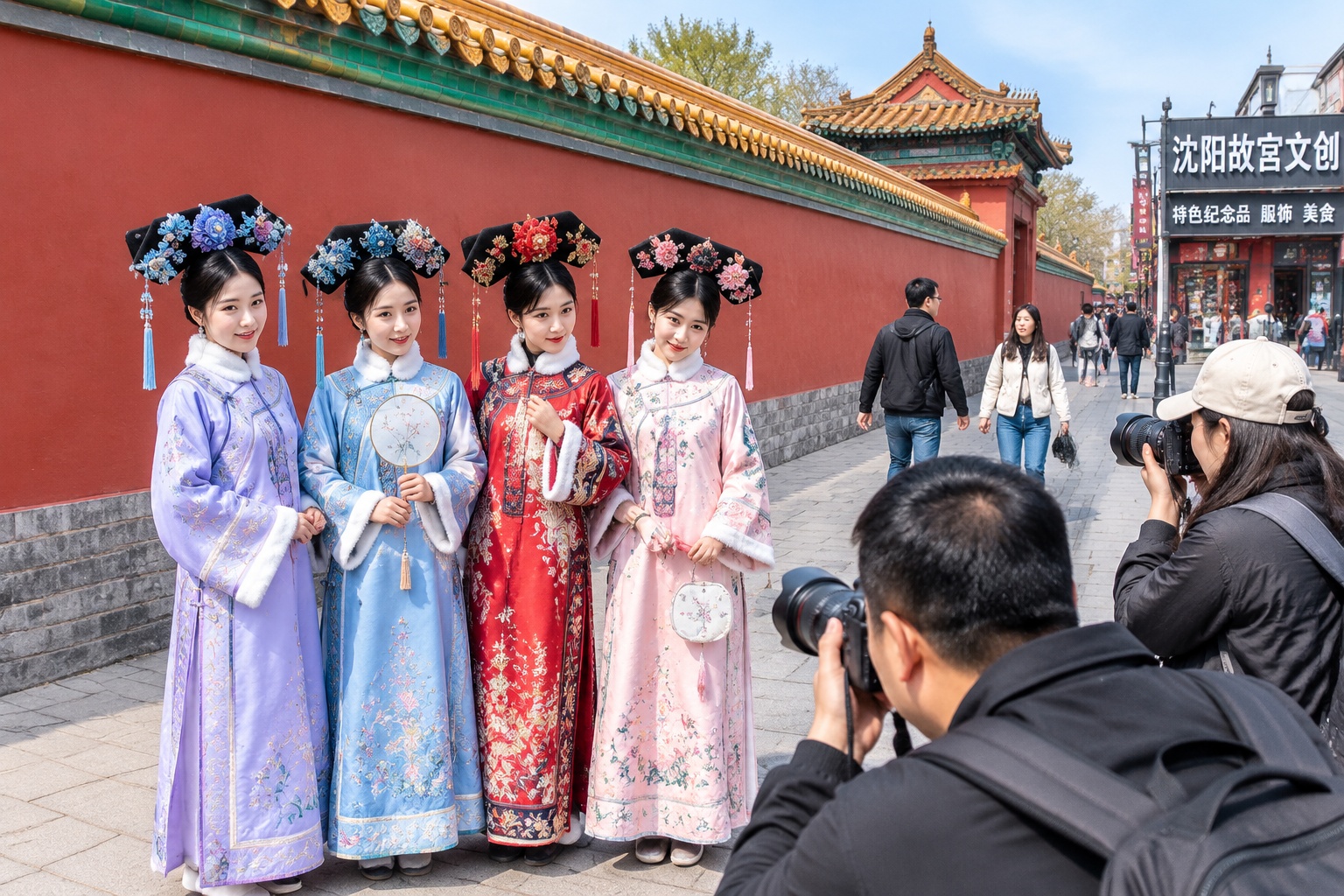
Then there is the third group: young women in rented Manchu robes and elaborate headdresses, posing for professional photographers. Costume shoots have become a small industry at heritage sites across China, and Shenyang is one of the most popular places to do the Manchu look. Hair, makeup and a photographer run a few hundred yuan. On a good weekend morning a dozen of them will be lined up against the red walls.
Step outside and the century changes
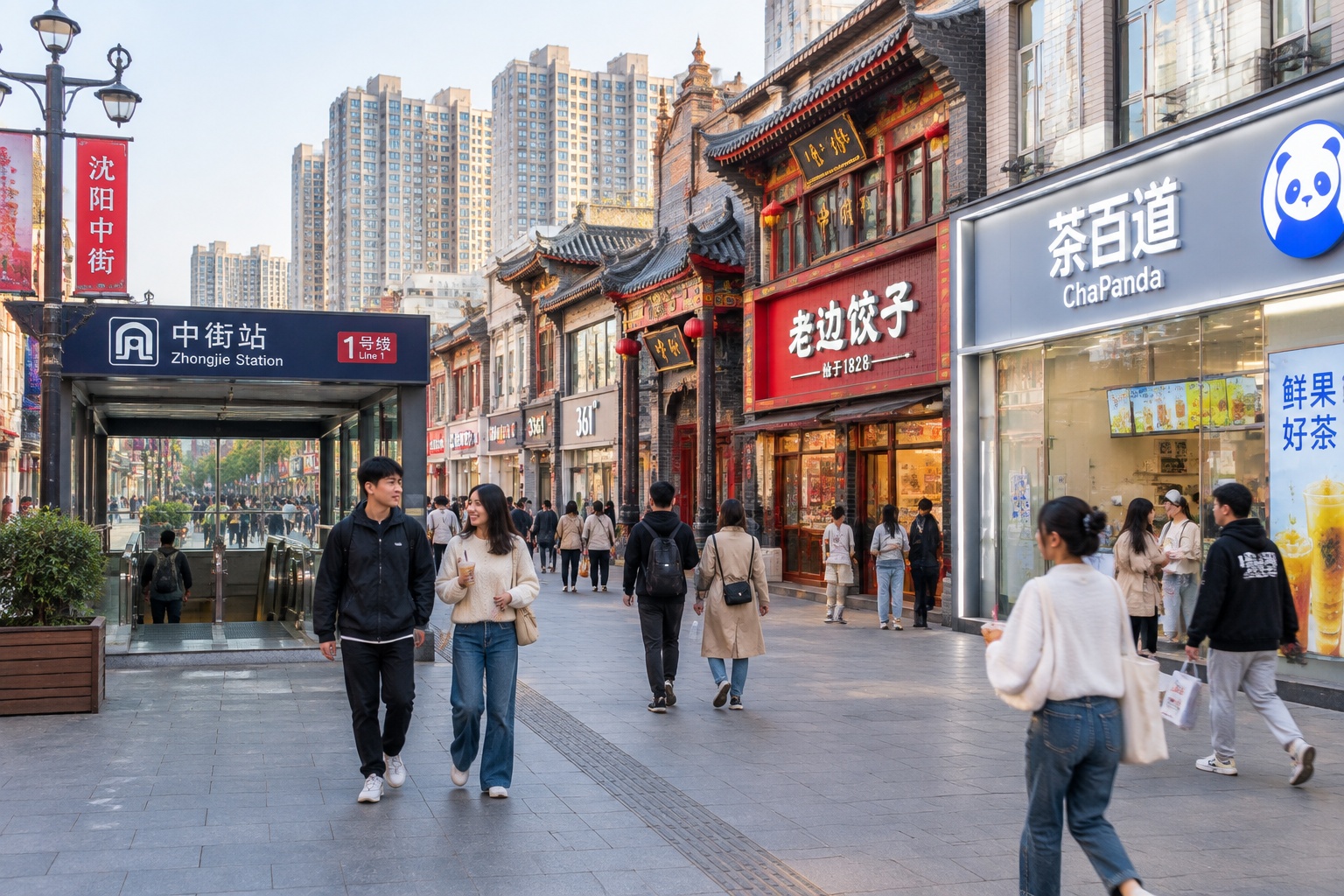
Walk out of the main gate and you are on Zhongjie, one of China’s oldest continuously operating commercial streets, now a pedestrian mall of milk tea shops, sportswear stores and a sweet shop that has sold ice cream since 1946. Metro Line 1 stops a few minutes away. Thirty-storey apartment towers stand a few blocks further on.
This is where the Shenyang experience differs most from a European one. Versailles sits inside a park; Schönbrunn has its own grounds. The Mukden Palace shares a city block with retail.
Some visitors find that jarring. Conservation in Chinese cities has not always been gentle — parts of the old city around the palace were demolished and rebuilt in mock-antique style during the 2000s and 2010s, and not everyone thinks the result was an improvement. But it also means the palace has not become a sealed museum object. People live beside it, argue about it, and buy bubble tea in front of it.
If you are coming from Europe or North America
Four things tend to stand out.
It is small. You can see the whole complex in ninety minutes without rushing. That is the point, not a flaw: this is what an imperial palace looks like before the empire arrives.
English is present but thin. Signage is bilingual, the explanations are brief. An audio guide, a translation app or a Chinese-speaking companion changes what you get out of it considerably. The architecture also carries a lot of the story on its own, once you know to look for the octagon, the side door and the black roof.
Tickets work differently. Chinese heritage sites run on WeChat and Alipay mini-programs with timed slots. Foreign passports can be registered on most of these platforms now, but when that fails, on-site ticket windows still exist here — which is not true at the Forbidden City. Bring your passport.
History is not fenced off. European palaces are usually separated from daily commerce by gates, ticket halls and parkland. Here the boundary is one wall and one street.
Practical notes
Shenyang is two and a half to three and a half hours from Beijing by high-speed rail, with frequent departures. Taoxian International Airport has flights from Shanghai, Guangzhou and Seoul. From the centre, Metro Line 1 stops at Zhongjie, a short walk from the gate.
Tickets are around 50 yuan. Hours change with the season, and the palace has periodically closed on Mondays in the low season, so check the official WeChat account before you go. Pair it with a walk down Zhongjie and lunch at one of the old noodle shops. January here is genuinely cold — which, given that this palace was designed around heating, is not the worst time to understand it.
Why it stays unseen
The Forbidden City draws visitors in the millions and sells out days ahead in summer. Shenyang’s palace receives a fraction of that. It is missing from most first-time China itineraries, which usually run Beijing–Xi’an–Shanghai.
That is a loss, because the two palaces only make full sense together. Beijing shows you what the Qing became. Shenyang shows you where they started: a frontier court in a cold city, borrowing from four traditions at once, building a palace one-twelfth the size of the one it would eventually inherit.
Back in the square, the kite was still up. The dance group had moved on to a second song. The palace behind them had been standing there for four hundred years, and on a Tuesday morning it was mostly just part of the neighbourhood.
Start the discussion at forum.chinacomes.com