


A Foreign Founder’s View of China in 2027
Picture this: it is a sunny morning in March 2027. A German hardware designer named Katrin is testing a prototype at a shared lab in Shenzhen’s Nanshan district. Three days earlier, she landed at Bao’an airport without a local partner. Today, she has already met a contract manufacturer that can make her IoT sensor board in two weeks, and a local venture fund has offered a seed check if she moves her pilot line to a nearby government-backed maker park.
This scene is not a futuristic fantasy. Every element of it exists in China today; what is changing is how easy, fast and normal it has become for an outsider to connect with the Chinese innovation ecosystem. As we look toward 2027, the question is no longer where to find cheap manufacturing or copyable apps. The real opportunity lies in finding innovation partners who can help you iterate, integrate and scale.
This article treats 2027 as a planning horizon. We combine observable trends from 2024 and 2025 – such as the growth of local-currency venture funds, the increasing role of government-backed capital, and the expansion of international hard-tech accelerators – with clearly labelled projections. Nothing here should be read as a guarantee; rather, it is a map to the places where change is most likely to happen.
The Cities That Are Shaping Innovation in 2027
China has long been called a single market, but the startup landscape is really a network of specialised hubs. Each city has its own industry logic and institutional context. If you are looking for a partner in 2027, you are better off starting from one of these four nodes than trying to cover the whole country.
Beijing: Where Deep Research Meets Policy
Beijing remains the country’s brain centre. With dozens of universities, state laboratories and AI institutes, the capital gets first access to foundational research. In 2027, this will translate into a concentration of foundation-model companies, autonomous-driving startups and frontier biotech. Foreign firms in regulated sectors may find Beijing harder to navigate legally, but they should be there for licensing talks and joint research. The Zhongguancun area already hosts over 100 university-linked business incubators; by 2027 we expect the number of international co-cultivation zones to grow, especially around Changping and the Chinese Academy of Sciences campuses.
Shanghai: The Gateway for Capital and Global Talent
If Beijing is the brain, Shanghai is the capital market. The Shanghai Stock Exchange’s Sci-Tech Innovation Board, or STAR Market, has become a reliable IPO route for many hard-tech firms. By 2027, Shanghai will be the easiest place in China for an English-speaking founder to register, hire and raise money without untangling a web of intermediaries. Zhangjiang Science City, plus the Lingang area near the new free-trade zone, will offer dedicated facilities for biomedicine, AI and integrated circuits. A 2024 policy in Lingang already simplified visa procedures and started cross-border data pilots; we see these expanding further over the next two years.
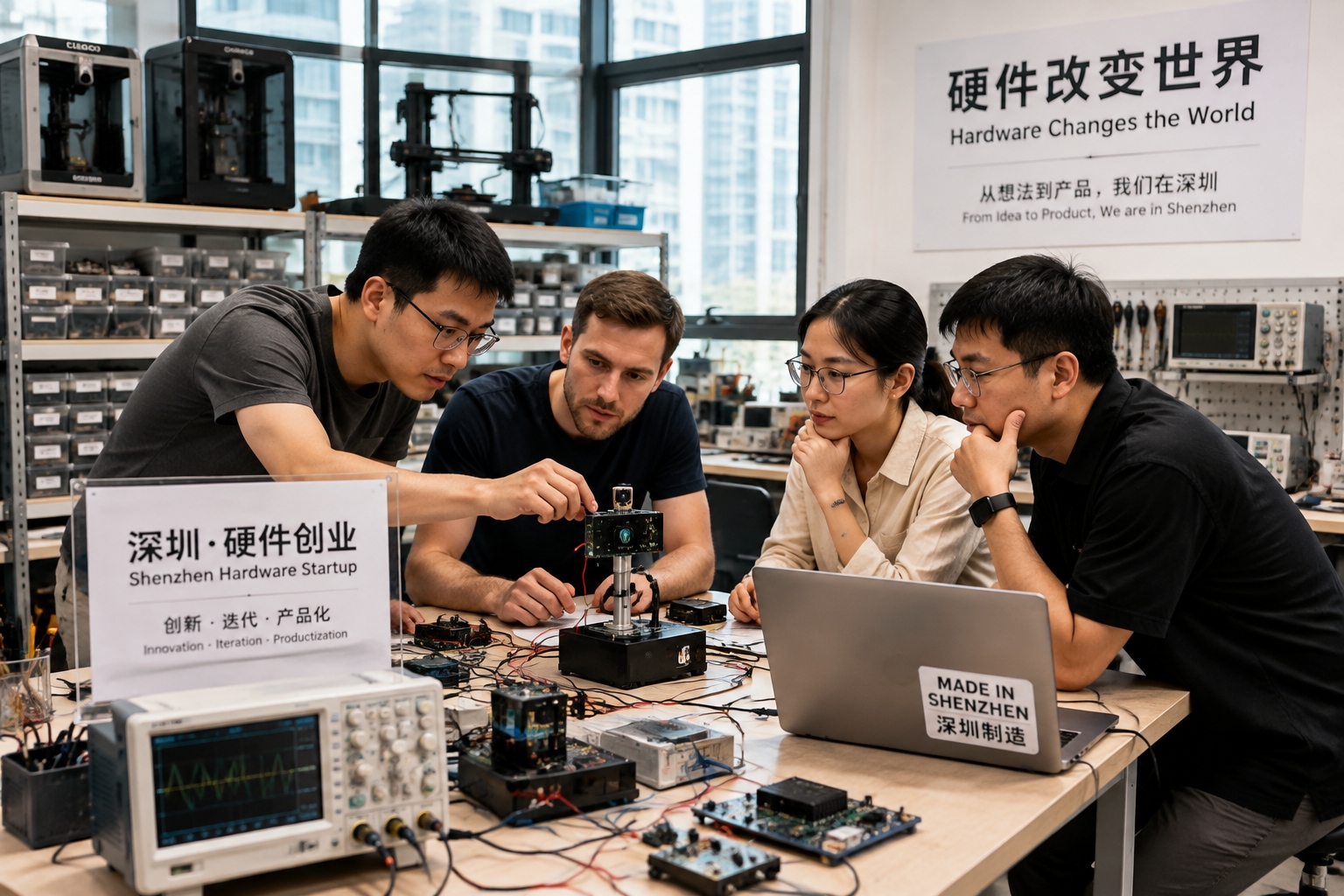
Shenzhen: The World’s Fastest Hardware Prototyping Market
Shenzhen’s edge is not its factories alone; it is the compactness of the full supply chain. Within a few subway stops, an inventor can find PCB prototyping, mould makers, firmware engineers and industrial designers. In 2027, Shenzhen will likely also be the top Chinese city for embodied-AI robotics, because many robot makers need quick access to custom sensors and actuators. The Nanshan and Bao’an districts are home to dozens of hardware accelerators. Some are operated by state-owned innovation platforms; a handful by corporate players such as Huawei. For a foreign startup, Shenzhen is where you validate physical products with a one- to two-week iteration cycle.
Hangzhou: Consumer Internet Logic and Platform DNA
Hangzhou, once known mainly for Alibaba, has turned itself into a broad consumer-technology and digital-life lab. In 2027 it is the reference point for e-commerce-embedded finance, domestic consumer brands and platform-driven rural services. Foreign consumer brands looking for a China-specific growth strategy often choose Hangzhou because local talent knows how to navigate Chinese e-commerce and social-commerce ecosystems. The city also runs one of the most ambitious cross-border e-commerce pilot zones in the country.
Where Capital Will Flow in 2027: Four Sectors
Across public policy documents and private fund track records, a clear consensus is forming. By 2027, capital will focus on four fields, each with distinct sub-sectors and funding dynamics.
AI Applications Beyond the Model
After the hype cycle of large language models, the money will go to vertical applications that create measurable cost savings. Look for clinical decision-support software, AI-driven manufacturing quality control, and copilots designed for energy grids or logistics networks. Government procurement will be a major first customer for many of these products. Foreign startups should consider a dual approach: a local joint venture to qualify for procurement, plus a global commercial licence.
Enterprise SaaS
Chinese companies are under constant pressure to improve operational efficiency. The market for software-as-a-service is still less mature than in the United States, which means room for fast followers. In 2027, cross-border privacy rules and industrial data classification will reward companies that can offer local-first architecture. International SaaS players may not take a majority share of the market, but they can become valuable partners to Chinese cloud providers rather than direct competitors.
Green Economy and Energy Decarbonisation
China’s carbon-neutrality pledge has turned climate tech into a mature industrial policy agenda. By 2027, the dominant opportunities will be in solid-state battery components, grid-scale storage integration, long-distance clean hydrogen logistics, and building retrofits using heat-pump systems. Many municipal governments will use carbon-accounting standards to determine subsidies and procurement. Expect large energy groups and city-level green funds to co-invest with smaller innovators.
Biotech and Health Tech
China’s regulatory reforms for innovative drugs and medical devices are slowly aligning with global standards. In 2027, more multinationals will create cost-sharing R&D structures with Chinese biotech companies, focusing on cell therapy manufacturing, gene-editing niches and hospital automation. The best point of access is often through the local science-park operator, which can help you understand matching national and provincial grants.
Incubators and Accelerators: Who Can Actually Help You?
There is no shortage of incubators in China, but the quality of help they can offer foreign teams varies considerably. After screening the ecosystem, four types of players are worth your time in 2027:
First, university-linked incubators affiliated with Tsinghua, Shanghai Jiao Tong, Zhejiang University and others usually provide lab equipment and academic contacts. Second, corporate accelerators run by large OEMs, such as Foxconn, NIO, CATL or pharmaceutical groups, offer industrial data and supply-chain connections. Third, local government-run international innovation parks, often called international cooperation bases, help with legal registration, work visas and access to pilot projects. Finally, professional venture accelerators like the Beijing Zhongguancun International Incubator, or similar platforms in Shanghai and Shenzhen, provide structured programmes for foreign teams.
If you are a foreign first-time founder in China, our advice is to choose one flagship programme in one city rather than joining several weak ones. The most valuable asset these programmes give you is a local interface that knows how to talk with regulators.

Money Matters: RMB and USD Funds in 2027
The venture-capital pool in China is not disappearing; it is changing currency composition. RMB funds now dominate both in number and amount of new deals. According to data from CVSource and PEdaily, in 2024 RMB funds accounted for roughly 85% of the total newly raised venture capital in China. We expect that ratio to remain high by 2027, with more capital flowing from state guidance funds and large corporates. The days of purely offshore USD rounds for Chinese Internet companies are unlikely to return at scale. Instead, foreign investors will increasingly participate through existing RMB vehicles or Qualified Foreign Limited Partner (QFLP) arrangements, which several cities are trying to expand.
This matters for founders because valuation expectations are now more sober, and the primary exit route is China’s own exchanges – STAR, ChiNext and the Beijing Stock Exchange. A startup can still take a round from a USD fund, but by 2027 such money will often be attached to a right to convert into RMB when needed for onshore intellectual-property transfers or to buy access to industrial parks.

Five Practical Ways to Find an Innovation Partner in 2027
Instead of using vague concepts like entering the Chinese market, think of partner discovery as a series of experiments. Here are five channels that will be active in 2027:
1. Start with a government interface. Every major city has a foreign investment promotion agency. Even before you arrive, send a detailed note about the product you want to develop in China. The staff at these agencies are measured by how many projects they help land; they will schedule visits to relevant companies and science parks.
2. Attend a selective trade show, not a general one. The China International Import Expo in Shanghai remains a serious deal-making venue for health and consumer products; the World Artificial Intelligence Conference in Shanghai is best for AI hardware and software collaborations; and the Beijing Zhongguancun Forum is a good platform for deep-tech licensing. For hardware, the Shenzhen International Electronic Machinery Equipment industry exhibition is more useful than a huge consumer-electronics event.
3. Use the university relationship. Many Chinese universities now encourage companies to sponsor joint labs or research fellowships. A non-Chinese company can fund a modest research programme at a local university to access students who will become your first local hires. This builds trust early and sidesteps the problem of cold sales outreach.
4. Partner with an incorporated local venture studio. Instead of dealing with regulators and banks alone, foreign entrepreneurs can take a 40-49% ownership in a local special-purpose vehicle organised by an established Chinese entrepreneur. The venture studio helps with local equity matching, accounting and an office; you contribute product know-how or overseas data. This structure gives foreign partners a credible legal seat at the table while keeping control with the Chinese party.
5. Take advantage of cross-border data sandboxes and pilot zones. By 2027, several data-trading zones in Shanghai, Shenzhen and Hainan will be in their second generation. If your business relies on overseas data, use these zones to experiment with compliant integration before making a full commitment.
Bottom Line: What Is Prediction, What Is Context
To be precise about 2027: the overall direction of the Chinese venture ecosystem is not terra incognita. Fundamentals such as a strong STEM talent pool, capable supplier networks and clear national industrial policy will remain intact. The key projections we make here are the growth of RMB funds, the strengthening of state-backed co-investment vehicles, and the rise of cities beyond Beijing and Shenzhen as early-stage testbeds. These forecasts rest on visible policy statements and capital-flow data from 2024 and 2025.
At the same time, important variables remain: the global geopolitical climate, the regulatory approach to cross-border data, and the pace of US-China technology decoupling. Any of these could accelerate or slow the trend lines. Therefore, treat 2027 as an ideal time to build a low-cost presence and run pilot projects – not as a date when China will have become an easy market. The founders who go farthest will be those who show up early, observe on the ground and test assumptions, because China’s innovation system rewards persistence and practical problem-solving over remote speculation.
Start the discussion at forum.chinacomes.com