


The Lunch Break Meditator
At 12:30 pm, Lin Wei, a 28-year-old graphic designer, sits on a bench outside her office in Beijing’s Chaoyang district. She puts in her earbuds, closes her eyes, and spends ten minutes following a guided meditation on her phone. The app’s voice—calm, female, with a soft accent—asks her to imagine her thoughts as clouds passing across a vast sky. “I don’t try to stop my thoughts,” Lin says. “I just watch them drift away.”

Lin is part of a quiet but significant shift in urban China. Meditation—once associated with monks, retirees, or New Age enthusiasts—has become a mainstream tool for harried office workers. And unlike the mindfulness movement popular in Silicon Valley, this Chinese version is heavily flavored by Daoist philosophy.
The Data behind the Trend
The numbers are hard to ignore. According to iiMedia Research, China’s meditation and mindfulness market grew by over 20 percent in 2023, reaching 4.3 billion yuan (roughly 600 million USD). The two leading meditation apps, Tide (潮汐) and Now (Now冥想), each claim more than 20 million registered users. A search on Meituan, China’s top local-services app, shows over 2,000 “meditation” related studios and courses in Beijing and Shanghai alone—a figure that was almost unthinkable five years ago.
What’s driving this growth? Stress, for one. A 2023 survey by the Chinese Medical Association found that nearly 70 percent of urban professionals reported symptoms of burnout. But it’s also about changing attitudes toward mental health. In the past, talking about anxiety or insomnia was often stigmatized. Today, younger workers treat meditation as casually as going to the gym.
Why Daoist Philosophy Resonates
What makes China’s meditation culture distinct is its philosophical foundation. While Western mindfulness often traces its roots to Buddhist vipassana, many Chinese apps and courses lean heavily on Daoist concepts like wu wei (无为, effortless action) and qing jing (清静, clarity and stillness). These ideas are not academic relics—they’re woven into daily language and practical wisdom.
“In Daoism, the goal is not to force your mind into silence, but to stop fighting the noise,” explains Professor Zhang Ning, who teaches philosophy at Fudan University and has collaborated with mindfulness startups. “That resonates with a generation raised on high-pressure competition. You can’t always change your workload, but you can change how you relate to it.”
This reframing can be deeply practical. A common technique in Chinese meditation apps is “listening to silence”, adapted from the Daoist practice of ting xi (听息), focusing on the natural rhythm of your breath. Another is “body scanning” paired with the philosophy of shun qi zi ran (顺其自然), or “following nature”, which encourages accepting discomfort rather than trying to control it.
From Temples to Tech Nirvana
How did a centuries-old tradition become a digital lifestyle product? The answer lies in a new wave of Chinese tech companies and wellness entrepreneurs who are commercializing “guofeng” (国风, national style) aesthetics alongside mental health.
Tide, founded in 2016, began as a minimalist focus app with nature sounds. It later added “Daoist-inspired” sessions featuring bamboo flutes, water sounds, and spoken instructions referencing Zhuangzi’s stories. Now, which launched in 2019, goes further by offering a “Daoist Sleep” program that guides users through yin-yang imagery before bed.
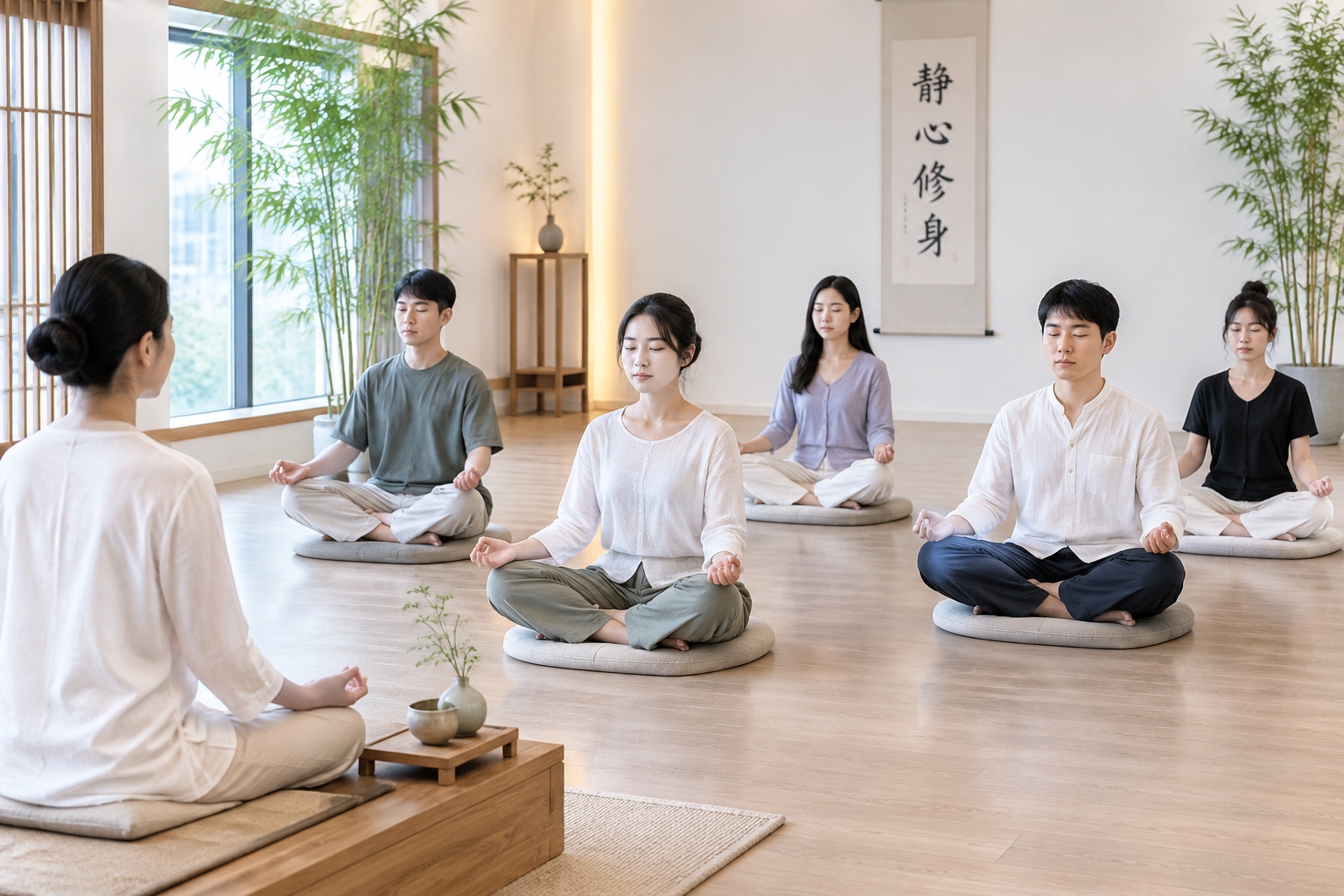
Offline, the trend is even more visible. Studios like “Here Now” in Shanghai offer courses that blend sitting meditation with tai chi exercises and calligraphy. Some companies now hire meditation coaches for their employees. At a tech giant in Shenzhen, a former Buddhist monk leads a weekly “ming xiang” (冥想) session in a room decorated like a bamboo garden.
Not Just a Digital Fad
To understand why this matters, it helps to look at how practitioners talk about it. Chen Jie, a 31-year-old marketing manager in Shanghai, started meditating during the city’s 2022 lockdown. “I was scared about work, my parents, everything,” she recalls. “A friend sent me a Daoist meditation audio that said: ‘The mountain doesn’t hold onto clouds; let your worries pass like them.’ It gave me a way to sit with fear instead of drowning in it.”
Chen now meditates for 20 minutes every evening. She says the practice hasn’t made her more productive at work, but it has changed her reaction to stress. “I’m less likely to snap at people. And I’ve started to question—maybe in a Daoist way—what things truly deserve my energy.”
Not everyone is convinced. Social media is full of criticism that these apps are just “selling escapism” and that turning Daoism into a consumer product dilutes its depth. Some skeptics point out that real Daoist cultivation requires a teacher and years of discipline, not a ten-minute app session.
Old Philosophy, New Routine
Yet perhaps that’s precisely the point. For many young Chinese, engaging with Daoism through a meditation app is a starting point, not a destination. The apps often include quotes from Laozi and Zhuangzi, which prompt users to explore the original texts. Libraries report that copies of the Dao De Jing are frequently checked out. Online courses on Daoist philosophy are among the most popular on platforms like Bilibili.
“This isn’t a religious revival,” says Professor Zhang. “It’s a form of cultural self-care. People are cherry-picking useful ideas—non-attachment, spontaneity, balance—and applying them to the pressures of modern life. It’s what any living tradition does.”
Lin Wei, the designer we met at the beginning, puts it more simply: “The ancient Daoists lived without endless notifications and meetings. They knew something about stillness. If a two-thousand-year-old idea helps me get through a Thursday, I’ll take it.”
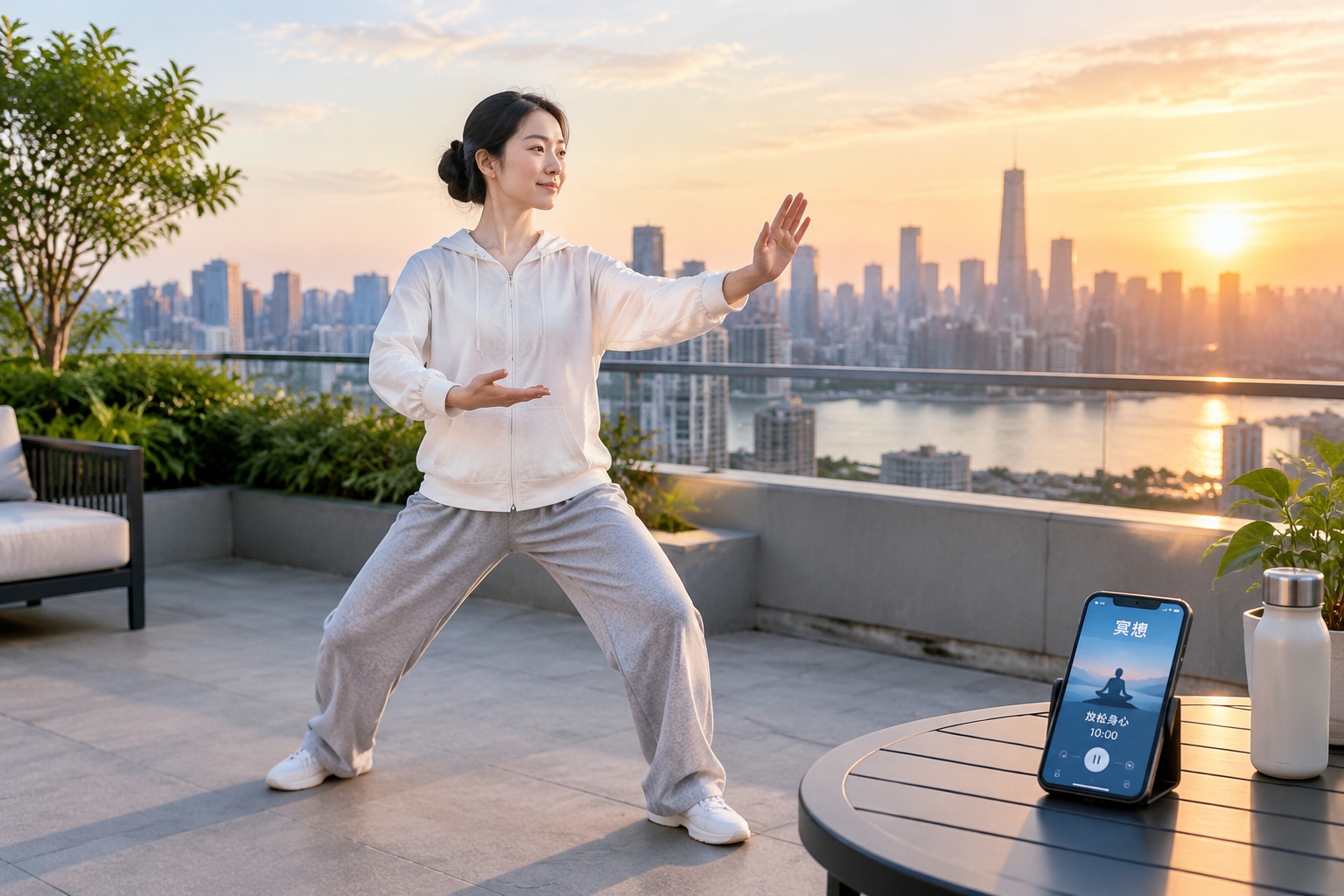
In a country that often appears to be advancing at breakneck speed, this quiet turn inward is a counterpoint. It shows that even as China builds robots, high-speed trains and super-apps, millions of ordinary people still find meaning in the old art of sitting still. And that may be the most modern thing of all.
Start the discussion at forum.chinacomes.com