
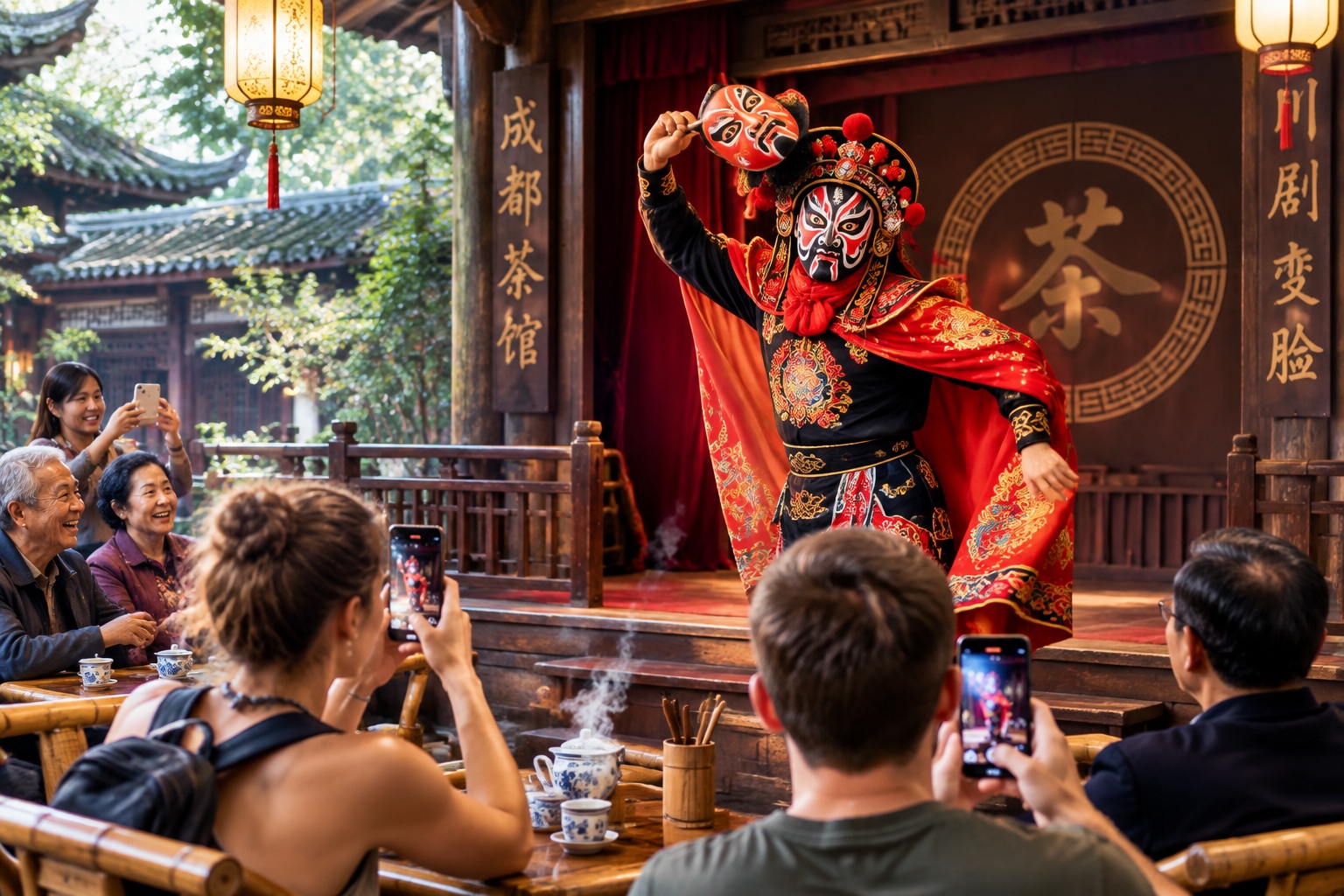

One Flick, Four Faces, One Very Confused Tourist
On a wooden stage at a Chengdu teahouse, the performer took a step forward, snapped his head to one side, and his bright red mask changed to black. The room gasped. A woman on my left grabbed my sleeve. “Did you see that?” she whispered. Nobody had seen it. That’s the point.
For anyone watching Sichuan opera face-changing for the first time—especially a foreign tourist with a phone in one hand and a cup of jasmine tea in the other—the experience is equal parts awe and confusion. You know there’s probably a trick. But no amount of slow-motion video will tell you what you just missed. The face changes in a snap, and the only honest reaction is to laugh and ask how.
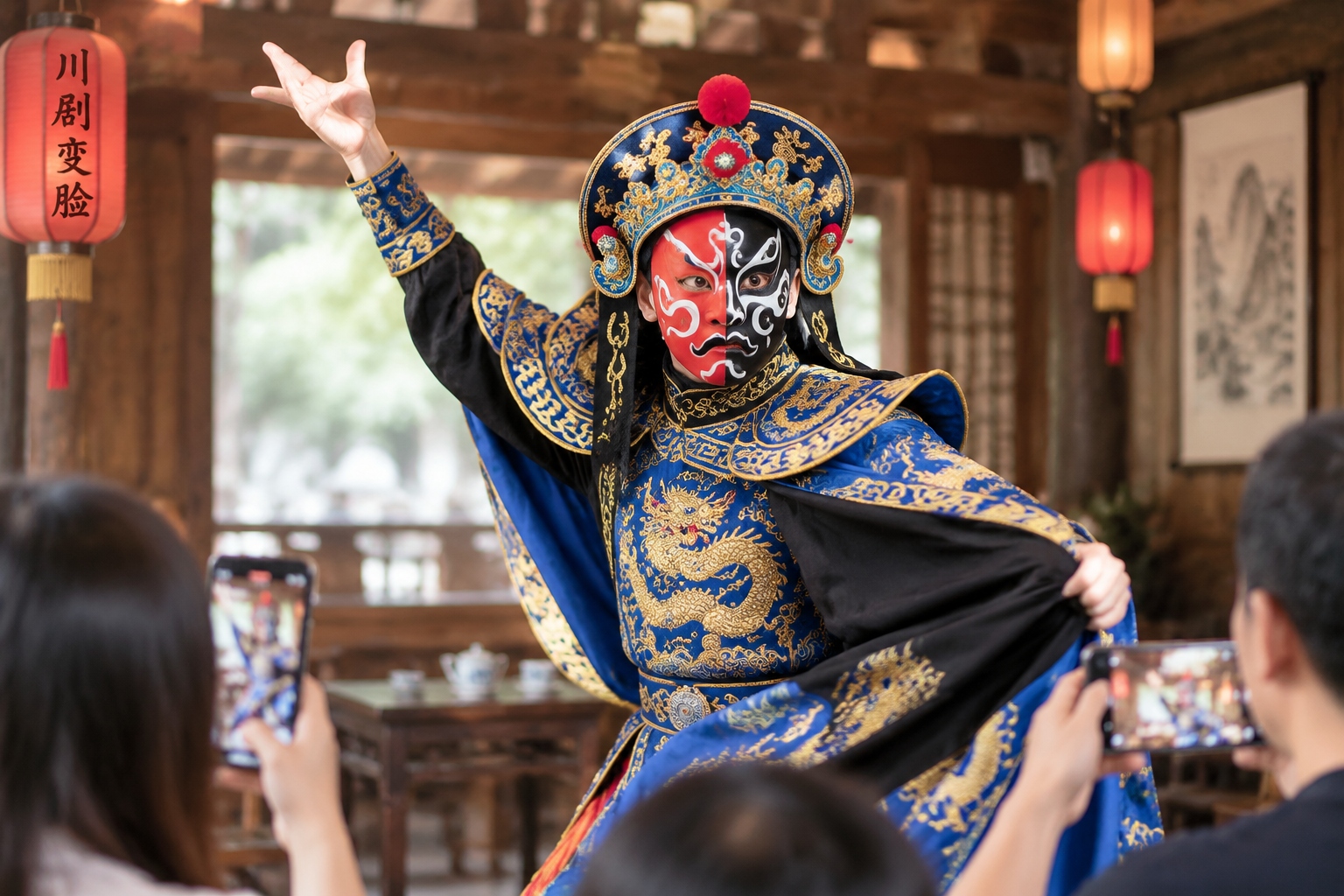
Wait, What Is Bian Lian?
Face-changing, or bian lian, is one of the most famous techniques in Sichuan opera, a regional Chinese theater tradition with roots hundreds of years old. In a typical performance, the actor moves, spins, and sometimes dances while wearing a costume designed to allow rapid mask changes. The masks themselves are paper-thin layers, often painted with exaggerated expressions. With a flick of the wrist or a sharp turn of the head, the performer swaps one mask for another.
The exact construction and method are not published. Performers usually train for years, and the skill is often passed down from master to apprentice. That secrecy is part of why tourists find the sight so baffling. And it’s why everyone leans forward when the performer starts to move faster.
A Teahouse Is Slow Food for the Senses
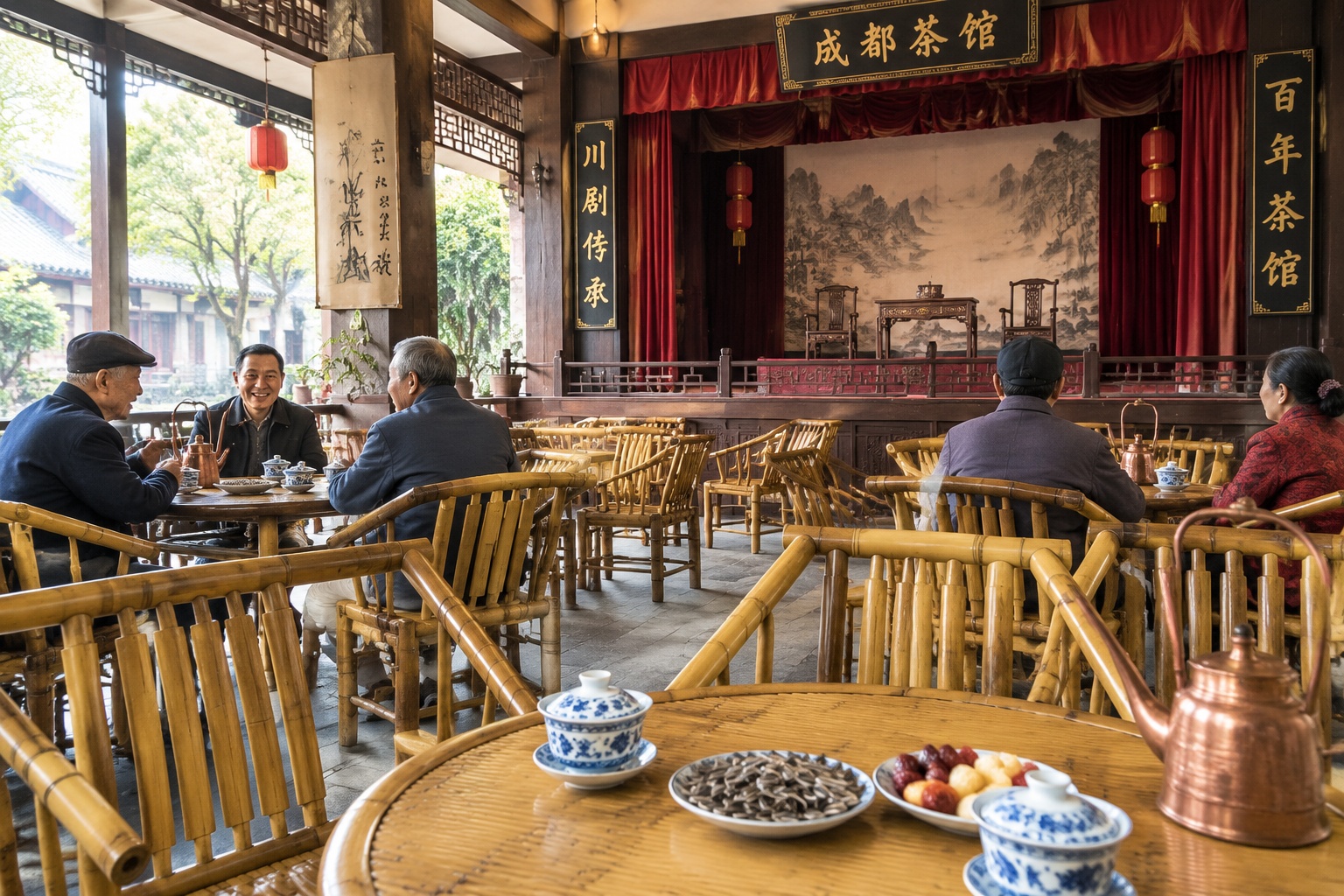
In many cities, you’d see opera like this in a large, formal theater. In Chengdu, the teahouse is the classic venue, and that’s a very different experience. The room is small, noisy, and full of life. Bamboo chairs squeak. Old men pour tea from long-spouted copper kettles. Waiters carry trays of melon seeds, dried fruit, and cold noodles. You buy a ticket, grab a seat, and spend the afternoon in a comfortable haze of steam and chatter.
It’s easy to think of the teahouse as a tourist stop, but locals treat it as their living room. I saw three generations at one table, a group of friends playing cards near the stage, and a solo woman knitting between songs. The show itself is the main course, but the atmosphere is the appetizer.
Same Gasp, Different Flavors
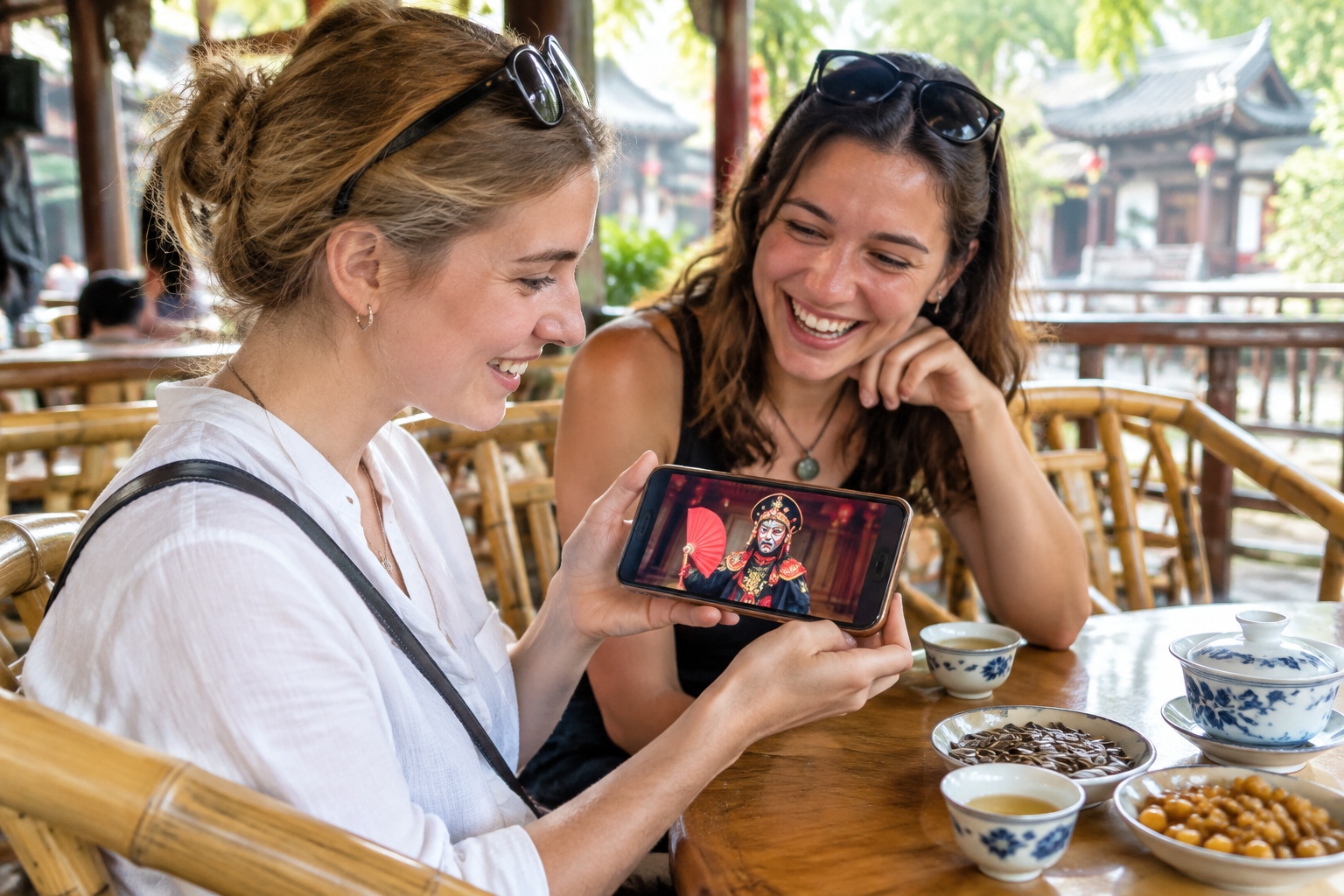
The beauty of face-changing is that it unites the room across cultures. Locals know the story of the opera, the rhythm of the music, and the proper moments to shout. Foreign tourists don’t have that cultural map, so they focus on the mechanics. While local guests applaud an elegant turn, the man next to me was rewinding his phone footage with his thumb and muttering, “How? How?”
His mission failed. I tried the same thing. Your phone’s slow-motion feature will not catch the change, because the move is designed precisely to live between glances. That’s not a flaw; it’s a century-old performance technique. You are supposed to be stunned.
This gap in expectations can be funny. The first time I saw bian lian, I genuinely wondered if the performer was pulling the mask down with an invisible string. I looked at the ceiling, I looked at his sleeves, I even looked at the teapot on my table. No clue. At some point, I gave up and just clapped with everyone else.
The Masks Are Not Just Face Paints
Sichuan opera uses bold colors and patterns, and face-changing is not random. Each mask can represent an emotion or a personality: white for cunning, red for loyalty or bravery, black for seriousness, gold for supernatural beings. The rapid changes show a character’s inner conflict finding its way to the surface. In everyday Chinese, “changing face” also means to hide one’s true intention. So the art is both visual and ironic.
You don’t need to know all of that to be amazed, but it helps explain why locals take the tradition seriously. It’s not a street gimmick. It’s a skill built on years of training, a piece of cultural memory that refuses to sit quietly in a museum.
The Modern Life of an Ancient Art
Face-changing has survived for centuries partly because it adapts. These days you can see bian lian at a teahouse, at a private banquet, on Chinese television, and even in short videos on social media. Some traveling troupes bring the performance overseas. In 2006, Sichuan opera was added to China’s national intangible cultural heritage list, giving the tradition more institutional support for training and preservation. Still, the performance remains captivating because it is live. No screen can really replace the nervous energy of sitting three meters from a man who suddenly has a new face.
Seeing It Yourself in Chengdu
If you want to see bian lian up close, Chengdu is the right place. Several teahouses in the city include face-changing in their evening programs, especially around Jinli Street, Wenshu Monastery, and the city’s older cultural areas. Shows are informal and often rotate between different acts: opera singing, acrobatics, and sometimes a comedic sketch. You’ll likely get a seat, a cup of tea, and permission to take photos. Most shows last an hour or two, and tickets are usually affordable.
A few small tips: arrive early to get a seat near the front, keep your camera ready but be prepared to be fooled, and don’t spend the whole time staring through a screen. Some moments are better when your eyeballs do the work.
After the show, I asked a teahouse worker whether the performer was ever tempted to reveal the secret. She laughed. “Then there would be no show,” she said. And with that, she walked off to refill a customer’s tea.
Start the discussion at forum.chinacomes.com