
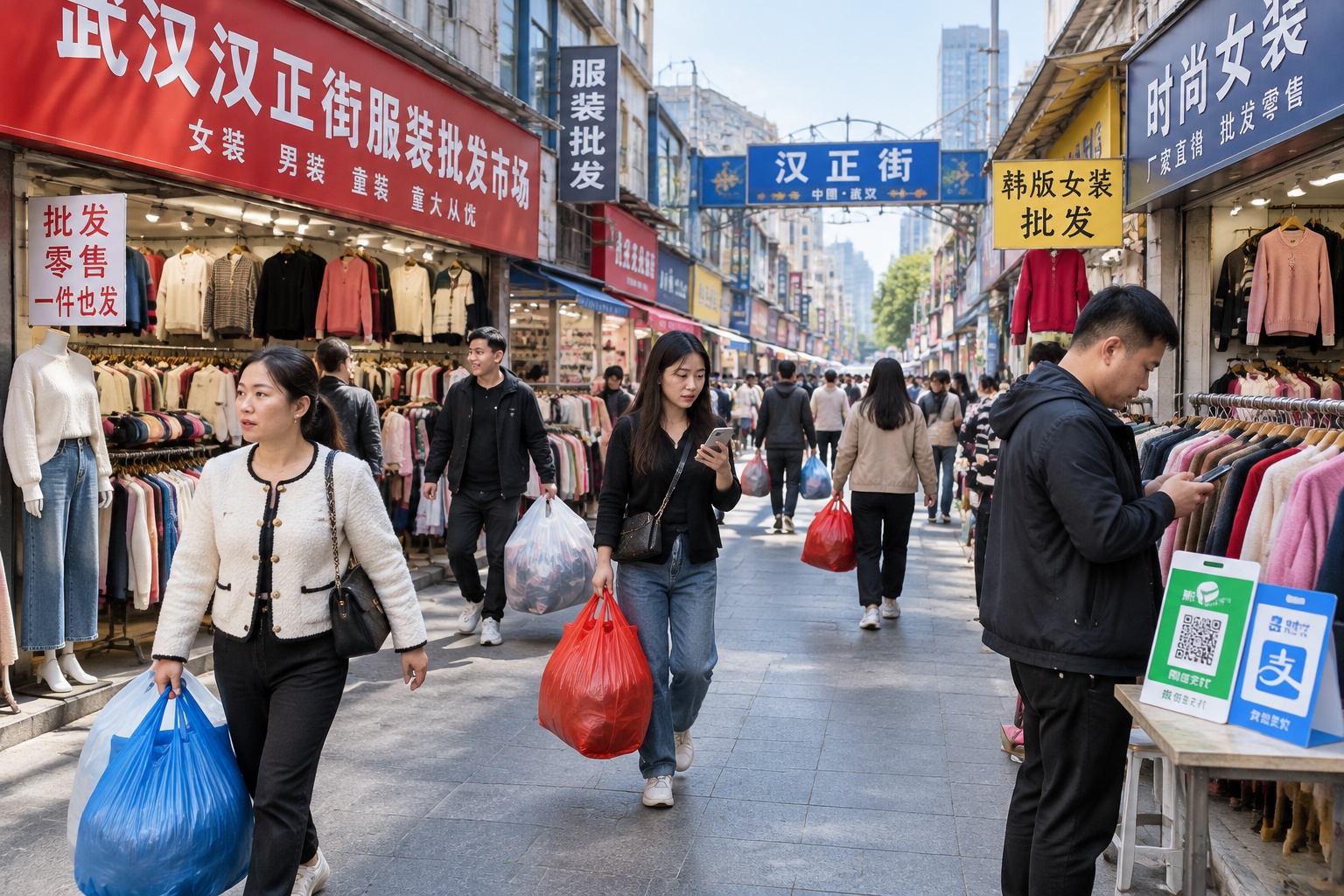

The Scene: A Wholesale Market in the Smartphone Age
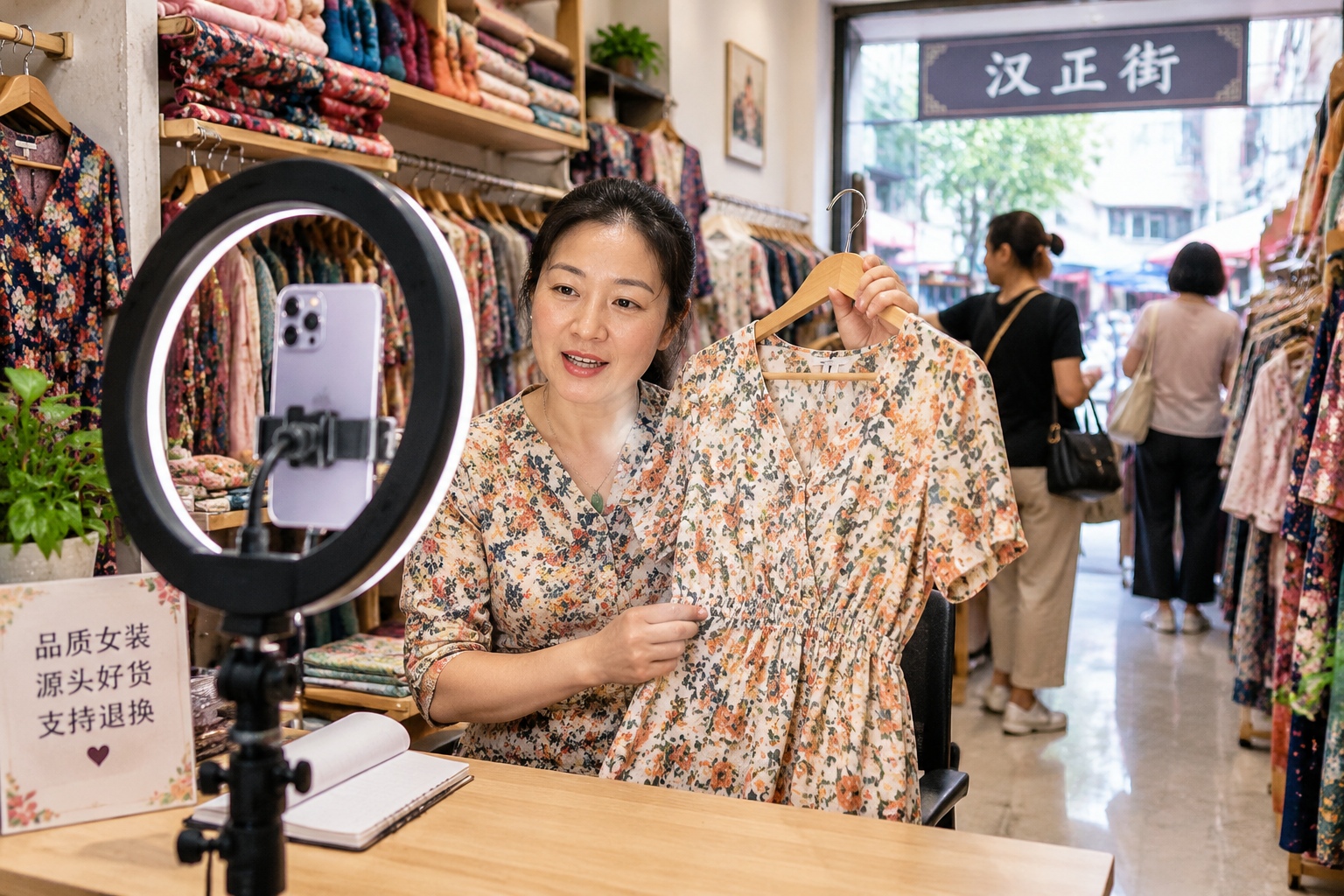
On a humid Tuesday morning, Thomas, a fashion retailer from Lagos, squeezes through the narrow alleys of Han Zheng Street in Wuhan. His phone buzzes with messages from customers back home asking about prices and sizes. He stops at a tiny shop where a middle-aged woman is using a ring light to livestream a floral dress to an audience thousands of kilometers away. In many ways, this is still the same wholesale market that has existed for centuries — but the way it works has changed beyond recognition.
A Brief History: From Imperial Wharf to “No. 1 Street”
For more than 500 years, Han Zheng Street has been a commercial artery. In the Ming Dynasty, it was a bustling wharf area where merchants from across China gathered to trade rice, salt, and fabrics. The name “Hanzheng” itself literally means “Han River side,” grounding it in its geography. Fast-forward to the 1980s, when China began its market reforms. Han Zheng Street rebranded itself as a small-commodities wholesale center, selling everything from buttons and belts to cheap electronics. Locals dubbed it the “No. 1 Street in the World” because of its sheer volume and variety. At its peak, it attracted tens of thousands of buyers daily, many of whom traveled overnight by train to stock up for their hometown shops.
However, by the 2010s, e-commerce platforms like Taobao and JD.com had reshaped retail habits. Long-distance wholesalers began to order online instead of visiting in person. Thousands of brick-and-mortar stores emptied. Analysts predicted that Han Zheng Street would become another ghost mall. But the opposite happened: the street evolved.
The Digital Makeover: From Bargaining to Livestreaming
The most visible shift is the integration of digital tools into every transaction. Mobile payment apps like WeChat Pay and Alipay are now ubiquitous. Many merchants run a dual operation: they open their physical store for walk-in clients during the day, and at night they become livestreamers, selling to audiences in Southeast Asia, the Middle East, and Africa. Some stores have turned their back rooms into mini studios, complete with ring lights, background racks, and a small team handling online orders.
Take a shop owner named Chen Jie, who has been at Han Zheng Street for 20 years. She used to rely on steady foot traffic. Now, every evening, she spends two hours on a livestream platform, showcasing new styles of women’s clothing. She often speaks in simple English or uses a translation app for her international viewers. The result? Nearly 30% of her revenue now comes from cross-border online orders. Her story is not unusual. A district government report data suggests that the number of cross-border e-commerce businesses in the Hanzheng area has doubled in the past three years.
The pandemic accelerated this transformation. When international travel halted, buyers could not come to Wuhan. So merchants went to them, using video links, virtual sample rooms, and 3D product images. The “remote sourcing” model has proven so efficient that many foreign buyers now continue to order online even after travel restrictions were lifted.
Hubei’s Apparel Industry: More Than Just a Market
Han Zheng Street is not a standalone bazaar; it is the retail front-end of a deeply integrated industrial region. Hubei province is one of China’s major textile and garment production bases. Within a radius of 200 kilometers from Wuhan, there are thousands of factories, from large original equipment manufacturers to small family-run workshops. This proximity allows an extraordinary speed: a prototype can be made in days, and bulk production can start within a week. For fast fashion brands, that kind of agility is gold.
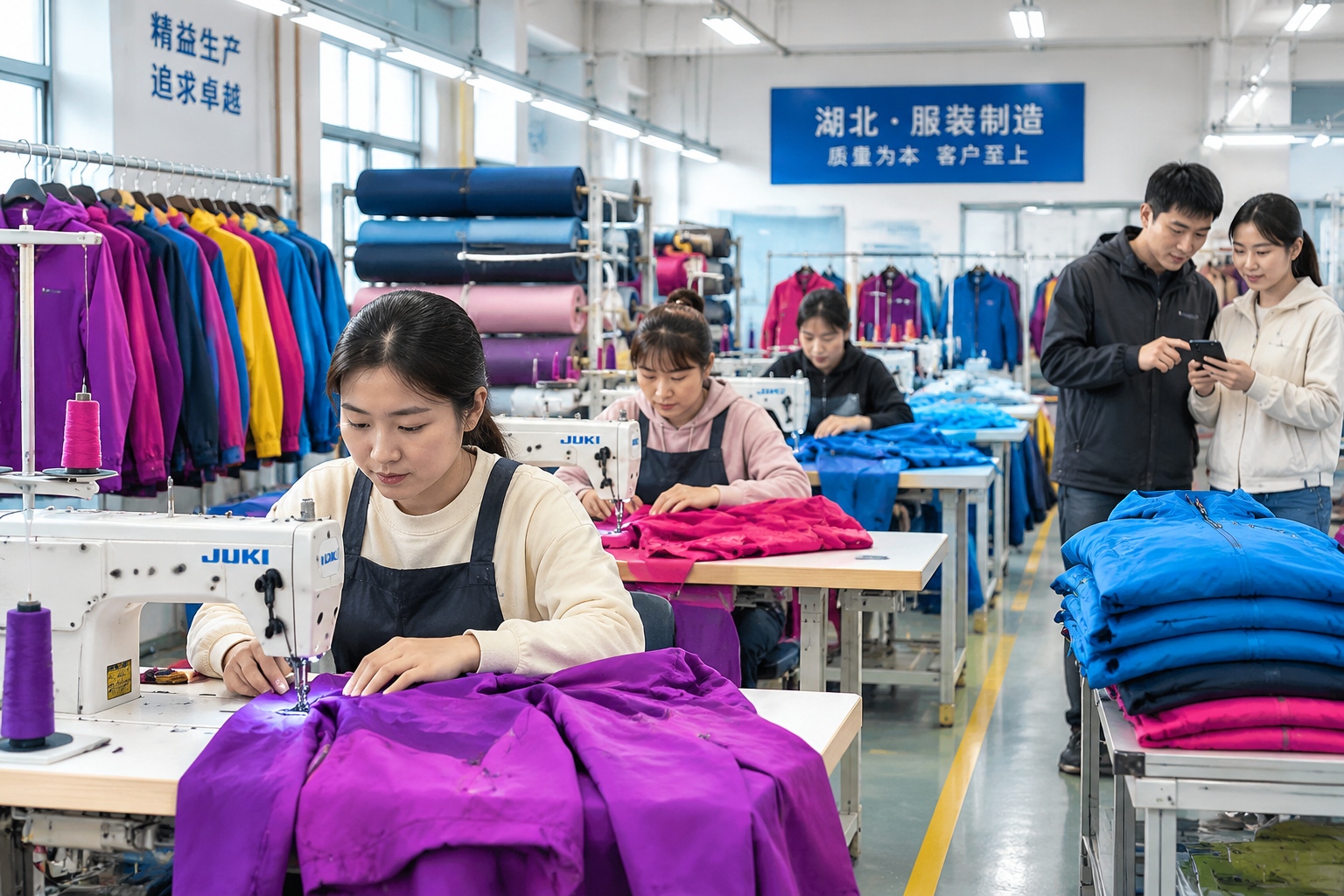
The supply chain is sophisticated. Upstream, there are textile mills producing polyester, cotton, and synthetic blends. Downstream, there are dyeing and finishing plants, printing shops, and accessory suppliers for buttons, zippers, and lace. Many of these businesses have relocated to modern industrial parks outside the city center, but they maintain close digital connections with the bargaining hubs on Han Zheng Street.
The rise of cross-border e-commerce platforms has been a game changer. Hubei-based manufacturers can now register on Amazon, Shopee, or AliExpress and sell directly to consumers or retailers overseas. They no longer need to go through trade intermediaries in Guangzhou or Hong Kong. This is reshaping the map of Chinese exports: more and more “Made in Hubei” labels are appearing on fashion items in global markets.
A Day in the Life of a Han Zheng Street Merchant
Let’s walk through a typical day for Liu Wei, who runs a small shop selling men’s jackets. At 7 a.m., he arrives at his stall, which is barely 15 square meters but piled high with samples. His first task is to check online messages from overseas clients who are active while he was asleep. He replies using translation software, sends photos and videos of different colors, and negotiates prices. By 9 a.m., local domestic buyers start to arrive. They are usually people who run clothing stores in other Chinese cities or on livestream platforms. Liu Wei offers them discounted wholesale rates but keeps the same friendly, direct tone.
At noon, he leaves his assistant to mind the store and walks three blocks to a textile accessories market to buy zippers and buttons. He also checks on a new fabric sample he ordered from a supplier. In the afternoon, he goes to a nearby factory to inspect a production run of 5,000 jackets. The factory is only 40 minutes away by metro and bus, which is why Wuhan’s industrial ecosystem is so convenient. Back at the shop by 6 p.m., he sets up a smartphone and a ring light for his evening livestream. His audience includes buyers from Kenya, the Philippines, and Brazil. He doesn’t speak their languages, but the visual information is often enough: “Look at this stitching! Feel this fabric!” He gestures, holds the jacket up to the camera, and presses the fabric to show its quality. Orders flow in.
What Foreign Buyers Need to Know
If you’re an overseas entrepreneur thinking of sourcing from Han Zheng Street, here are some tips. First, many shops are wholesale-only, with minimum order quantities ranging from 6 to 12 pieces. If you want to buy a single item, you can often do so, but at a higher price. Second, bargaining is expected, but keep it respectful. The starting quote is usually not the final price. Third, the language barrier is less of an issue than you might fear. Many merchants have experience with foreign buyers and use translation apps. But learning a few Chinese phrases goes a long way.
Payment is easiest through WeChat Pay or Alipay, but international buyers can also use bank transfers. Some shops work with logistics agents who handle small parcel shipping at competitive rates. The surrounding area has many freight forwarding offices, making it simple to consolidate orders and ship them in bulk. A lot of traders from Nigeria, Egypt, and Russia have established long-term partnerships here, visiting a few times a year and ordering online in between.
One more thing: the lunch scene around Han Zheng Street is an experience in itself. You’ll find street vendors selling hot dry noodles (re gan mian), spicy duck necks, and all kinds of dumplings. It’s a reminder that commerce and life are intertwined here.
The Social and Economic Frictions
The transformation hasn’t been all smooth. The older parts of Han Zheng Street still suffer from narrow roads, aging buildings, and fire hazards. In recent years, the Wuhan city government has relocated part of the wholesale functions to the Hanyang and Qiaokou districts, with new infrastructure and more space. This has caused tension among long-established vendors who fear losing their customer base. Some have closed; others have adapted by becoming showrooms rather than warehouses.
Intellectual property is another thorny issue. Knockoffs are produced quickly, and it’s difficult for small brands to protect their designs. As Hubei’s industry shifts from imitation to innovation, this is becoming a more urgent problem. There are also labor and environmental concerns. While large factories are improving, some small workshops still operate with lower standards. Fast fashion generates textile waste, and disposal is a growing challenge. Acknowledging these issues isn’t a dismissal of the industry’s achievements; it’s part of understanding its complexity.
Looking Ahead: From Street to Global Brand
What does the future hold for Han Zheng Street? It’s unlikely to become an upscale shopping mall or a heritage museum. Instead, it may continue as a hybrid space: physical, digital, and global. The next generation of merchants, many of them university graduates, are more focused on branding and customer experience. They are leveraging data analytics to understand what offshore customers want, and they’re designing original collections rather than copying trends.
At the same time, Wuhan’s growing role as a logistics hub — with railway freight to Europe and Central Asia, and river-sea intermodal transport — makes it easier for Hubei goods to reach faraway markets. The China-Europe Railway Express, which links Wuhan with cities like Duisburg and Hamburg, has been running regular services. That means a garment made in Hubei can be on a train to Poland within a few weeks. For a local entrepreneur, the world is no longer distant.
Han Zheng Street is often described by Chinese media as a “living fossil of commerce.” But fossils are static. This street is still mutating, adapting, and connecting. For anyone who wants to understand how China’s local industries are going global, it’s a perfect starting point — bustling, contradictory, and full of energy.
Start the discussion at forum.chinacomes.com