
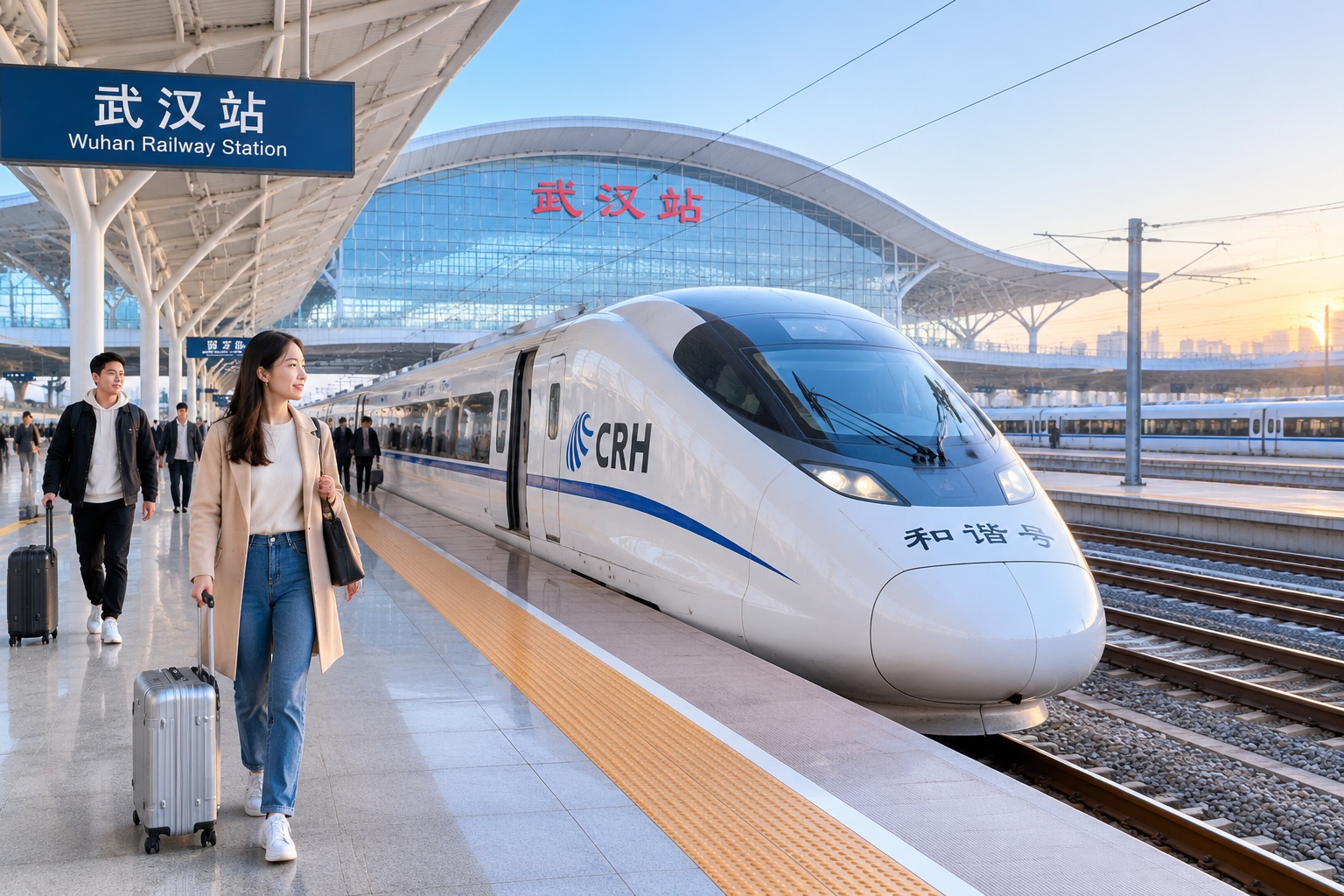

It’s a Friday evening at Wuhan Railway Station, and the waiting hall is packed with a familiar mix of office workers, students, and families. A young man in a hoodie checks the departure board: “G1033 to Guangzhou South, on time.” He’s heading home for the weekend — a trip that now takes four hours. Not long ago, it was a toothache of a journey: a 12-hour train ride or a flight requiring its own lost day at the airport.
That’s the kind of change Wuhan’s residents have stopped noticing, because it became normal. But for visitors — and for anyone trying to understand why central China has been growing so fast — the high-speed rail hub at the heart of Wuhan is a good place to start.

Five hours to just about everywhere
Wuhan sits at the convergence of the Yangtze and Han rivers, and for centuries it was China’s inland crossroads. The old nickname “thoroughfare of nine provinces” captured that role. Rail added a new layer in the 20th century, but the real transformation began when the national high-speed rail network expanded into a dense web centered on Wuhan. Today, the city has three major passenger stations — Wuhan, Hankou, and Wuchang — plus a newer Wuhan East Station that is still growing in importance. Trains leave for dozens of destinations at intervals that sound more like a subway timetable than an intercity rail service.
From Wuhan, Beijing is about four and a half hours away, Shanghai about four, Guangzhou about four, Chengdu about seven. Many smaller cities are reachable in two hours or less. This creates what planners call a “five-hour circle”: a living map that puts Wuhan at the center of a region home to hundreds of millions of people. If you drew a rough circle around Wuhan with a five-hour driving radius, you’d cover a lot of trade and production. High-speed rail shrinks that radius dramatically.
The engineering behind it is worth a moment too. High-speed rail lines in China typically run at 300 to 350 kilometers per hour. Building those tracks through central China meant designing huge bridges across the Yangtze that could carry trains safely over one of the world’s busiest rivers. The stations themselves were often built on greenfield sites, and new residential districts, bus lines, and subways were built around them.
Why people choose the train over the plane
Ask Wuhan residents why they prefer high-speed rail for trips under 1,000 kilometers, and you’ll hear practical reasons. The stations are located in the city, not in a distant suburb. Security checks are quicker and less theatrical. Trains leave every few minutes for busy routes, so missing one doesn’t ruin your day. And the ride itself is smooth enough to work or sleep — a stark contrast to the overbooked patience test that domestic flying has become.
Take a tech worker I met at a Wuhan startup meetup. He commutes to Changsha, a neighboring provincial capital, once or twice a week. The train takes about an hour and a half each way. “It’s like a long subway ride,” he said. “I take my laptop, answer emails, and arrive fresh. I could never do that on a plane.” His schedule would have been impossible a decade ago.
For families, the calculus is even simpler. An elderly couple in Hankou might decide on a whim to visit their daughter in Nanjing for the weekend, because a two-hour train ride feels less tiring than a cross-town car trip during rush hour. Students use high-speed rail to go home every holiday, instead of once a semester. Young professionals in nearby cities treat Wuhan as their weekend hotspot for concerts, exhibitions, and shopping.
The economic ripple effect
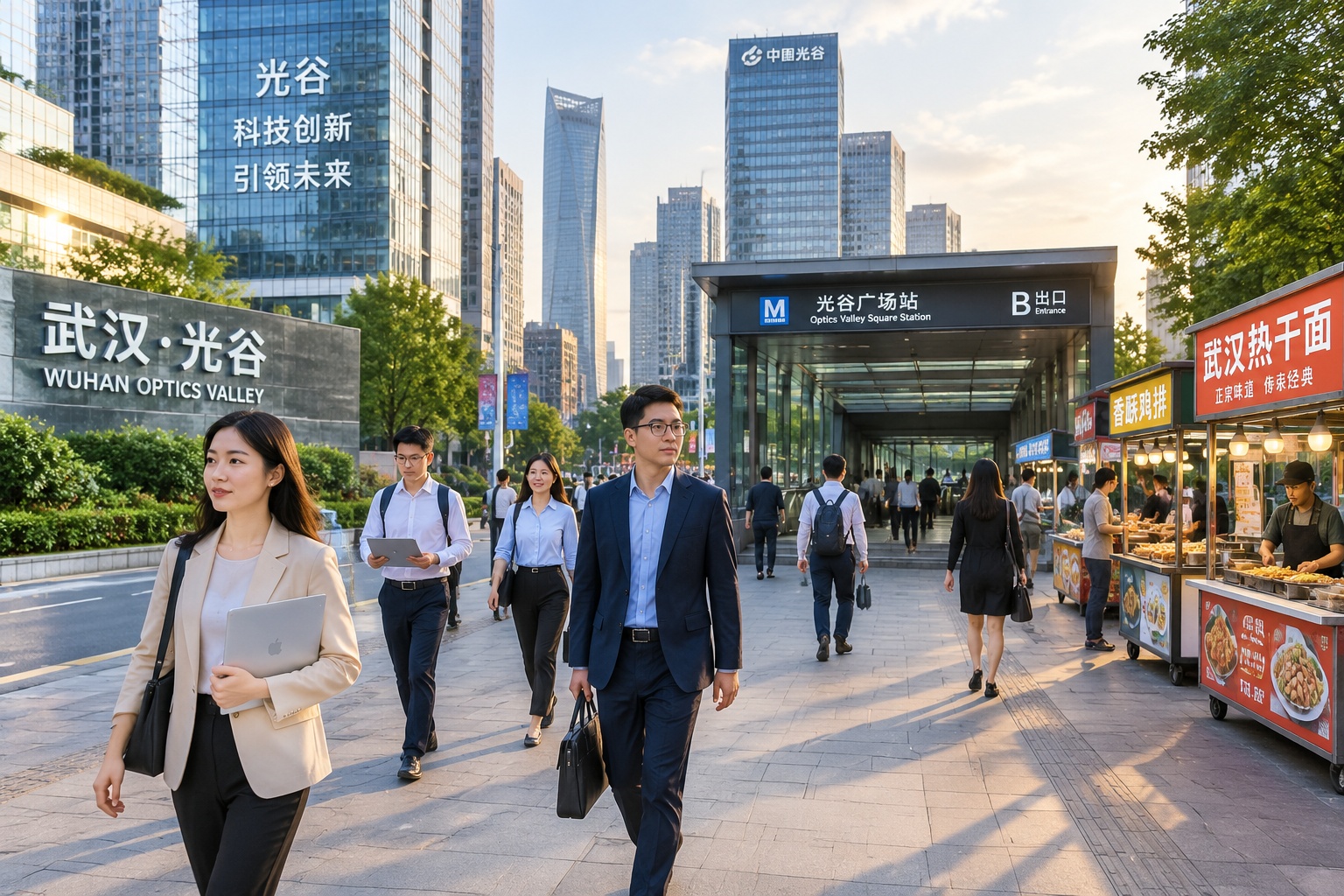
Connectivity has a way of redrawing the map of business. Companies that once clustered on the east coast are finding that a mid-sized city like Wuhan offers lower costs, a huge graduate labor pool, and fast access to the rest of China. The city is now a major hub for electronics, automotive manufacturing, and even the semiconductor industry. Chinese tech giants operate large R&D centers here, not just for the talent but also because the logistics are genuinely faster.
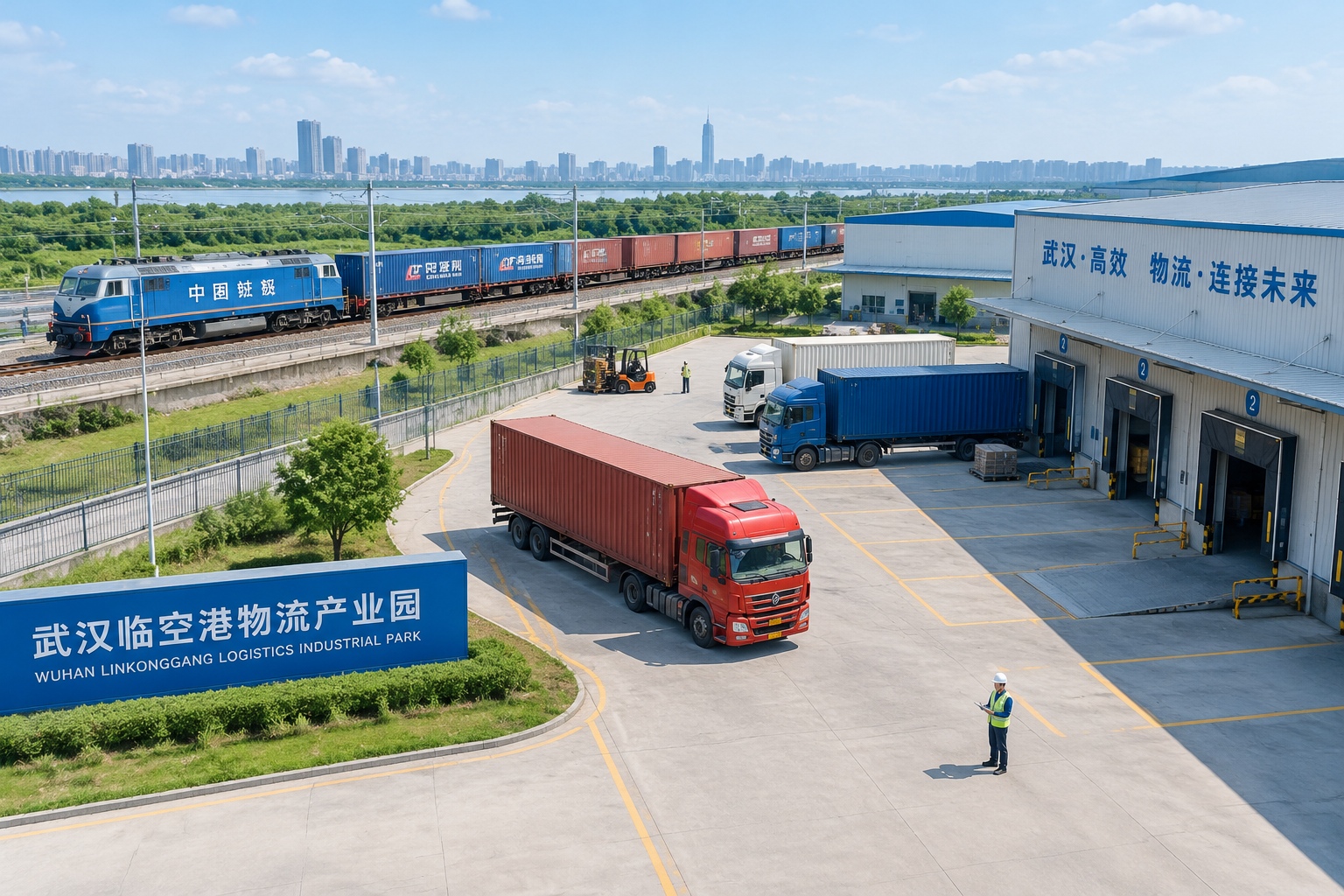
Freight matters too. Wuhan’s Yangluo Port and its rail freight service to Europe are part of the same story. High-speed rail moves people; standard rail and river ports move goods. Together they make Wuhan a place where a manufacturer can source components from the coast, assemble inland, and ship westward without losing much time. That’s one reason why central China’s growth rate has often outpaced the national average over the past decade. By 2024, Wuhan’s GDP had surpassed 1.9 trillion yuan — roughly $260 billion — making it one of the strongest inland economies in the country.
The effect shows up in everyday places. The city’s tech startups are full of people who have returned from Beijing or Shenzhen, bringing skills and networks. They often say the same thing: high-speed rail makes it easy to do business in Wuhan while keeping a foot in the coastal world. A meeting in Shanghai at 10 a.m. is still possible if you catch an early train; you can be back in Wuhan for dinner.
Living with speed: what locals say
Tourism has gotten a boost as well. Wuhan University’s cherry blossoms in spring, the Yellow Crane Tower, and the city’s famously hearty breakfast culture — hot dry noodles and soup dumplings served before 9 a.m. — are all within day-trip range for millions more people. Local food bloggers joke that high-speed rail is the best thing that ever happened to Wuhan’s street food scene, because it delivers hungry visitors in bulk.
On a weekday morning, you can see the rhythm clearly. At Wuhan Station, people in business suits sip coffee from takeaway cups, while elderly travelers with small trolley bags navigate the wide corridors. The station has become a kind of public square, a place that feels more like a shopping mall than a train depot. The platform gates open a few minutes before departure, and passengers pour onto the train like commuters boarding a metro. There’s no rush, because there will be another train in an hour or two.
Not the whole story
It would be too neat to say that high-speed rail built modern Wuhan. There are real limits. Ticket prices, though cheaper than flights for many routes, are still out of reach for some rural households. The rail expansion also encouraged urban sprawl, with new satellite towns growing up around stations before the jobs fully arrived. And not every city on the network has benefited equally; some have seen talent drain to larger hubs like Wuhan itself. Infrastructure alone can’t create growth, but it sure helps when the other ingredients — education, policy, river shipping, and local initiative — are already in place.
There’s also the question of maintenance and expansion. Keeping the network running safely requires constant monitoring and billions in upgrades. The allure of high-speed rail has led some planners to propose lines that may not have enough ridership to justify their cost. Wuhan’s own growth has been impressive, but it also brings congestion, higher housing prices, and pressure on public services. A fast train doesn’t automatically solve those problems.
More than a railway
Wuhan’s high-speed rail story is not just a tale of concrete, steel, and timetables. It’s a lens for seeing how a city can reinvent itself. The old “thoroughfare of nine provinces” was always about movement. Now the movement is faster, smoother, and more accessible to ordinary people. For the young man boarding the G1033 on Friday night, it simply means home is closer. And for the entire region stretching from the Yangtze to the coast, closeness is exactly what progress feels like.
Start the discussion at forum.chinacomes.com