
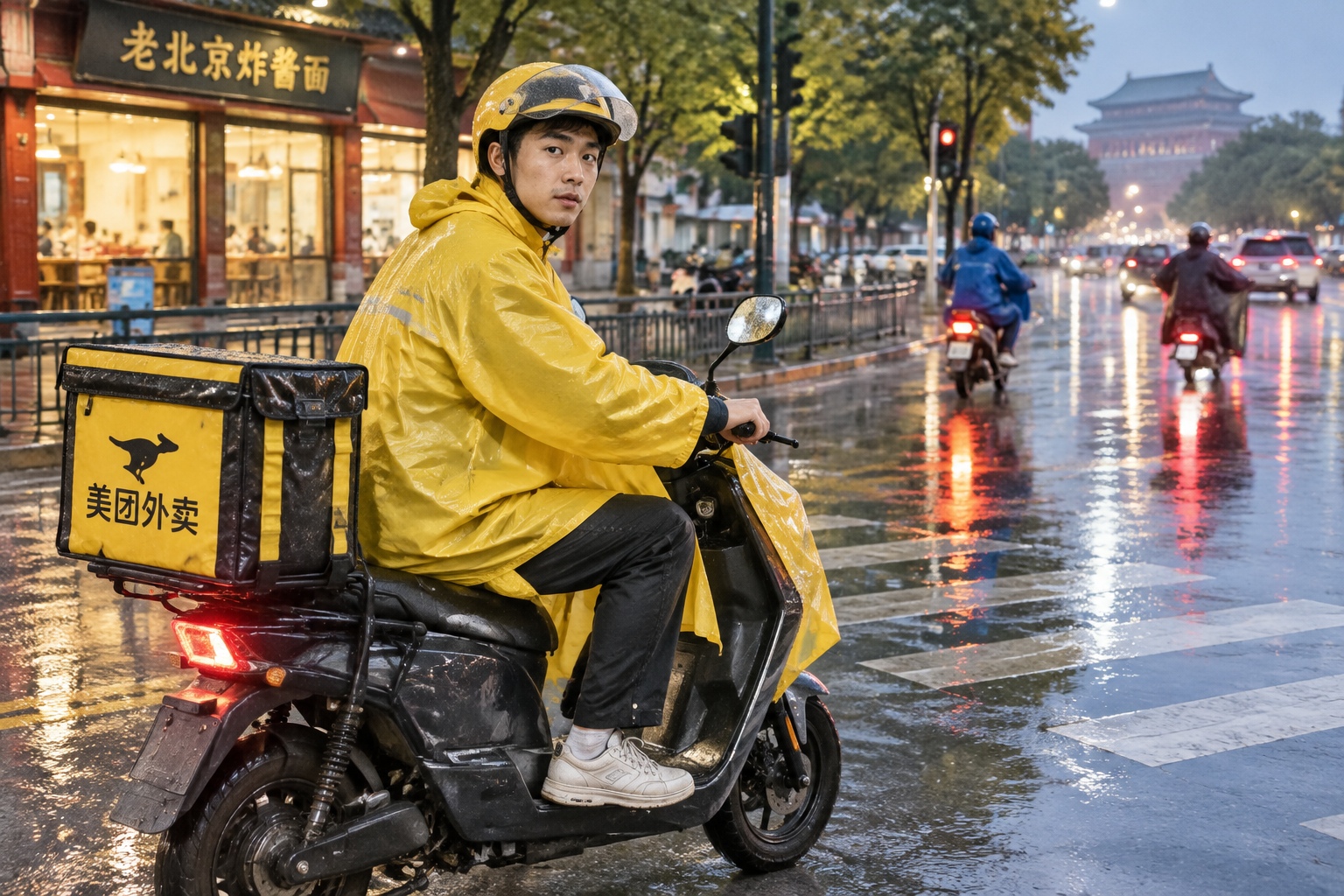

8:47 p.m., and the Water Is Already Ankle-Deep
In Wangjing, in the northeast of Beijing, July rain doesn’t arrive so much as break in. The sidewalk is fine. Four minutes later it’s a river with strong opinions about where you should be standing.
I’m under the awning of a noodle shop in a borrowed rain jacket that is failing in real time. Next to me, Wang Lei sits on his electric scooter, phone clamped to the handlebar, face lit green by an order card. Eleven minutes to collect two milk teas and a bowl of beef noodles. Four point two kilometers to cover. Rain: heavy, with a note of personal hostility.
“Ready?” he says. Not to me. To the puddle.
Most visitors leave China with skyline photos and a vague sense that everything here moves fast. The speed isn’t in the skyline. It’s in this: a 32-year-old man on a scooter capped at 25 km/h, threading a city of 22 million people, carrying soup.
Wang Lei calls what he moves through “the road that isn’t on the map.” I’d call it an invisible highway — not asphalt, not elevated, but a live network of phones, algorithms, e-bikes, kitchen back doors, security guards, battery cabinets and customers, stitched together in real time. More than ten million people work somewhere along it, by most industry estimates. On its busiest days, Meituan alone handles close to 100 million food orders.
The Guy on the Bike
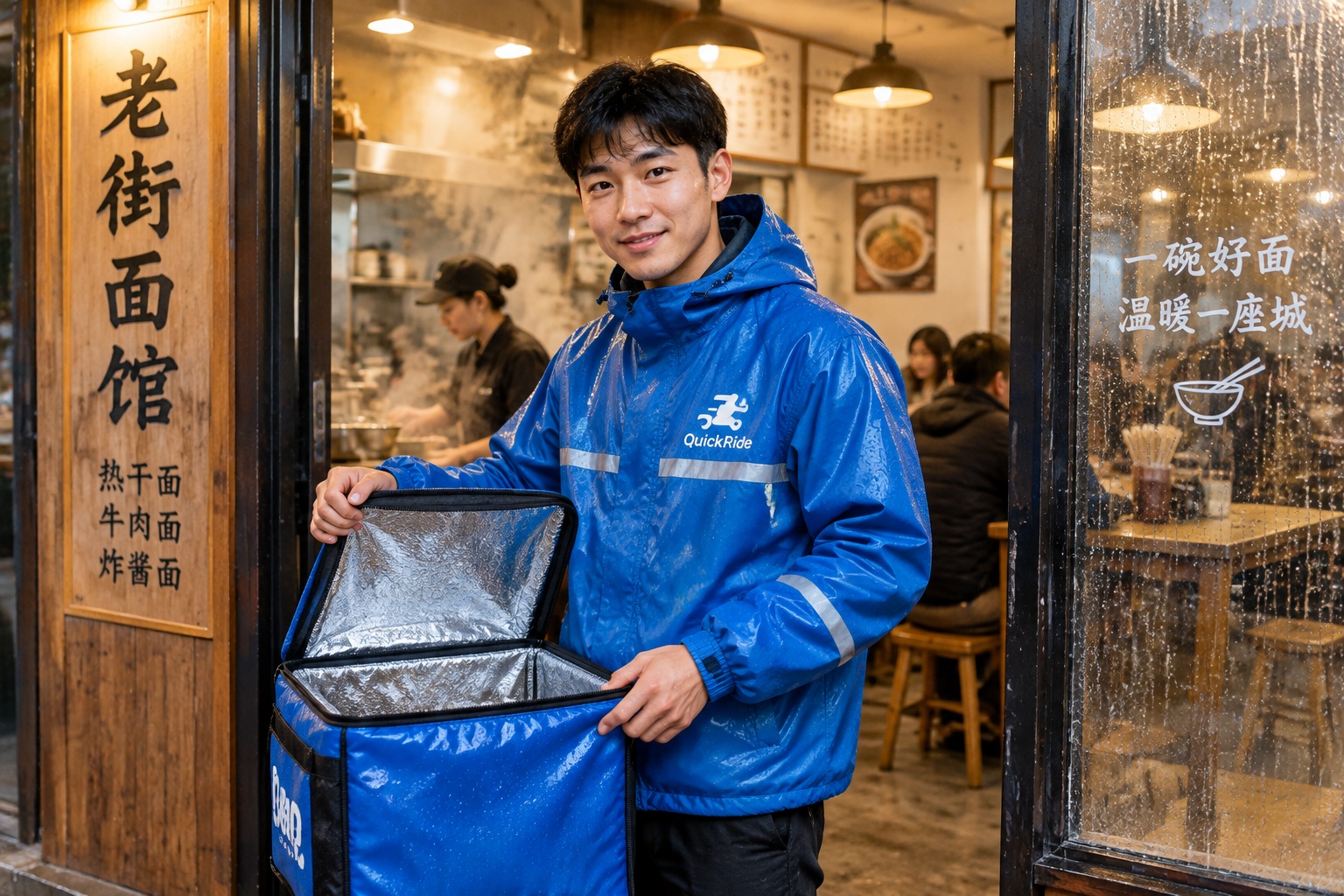
Wang Lei grew up in Zhoukou, in Henan province, and came to Beijing at 24. Warehouse first, then a decoration crew, then, three years ago, a scooter and a delivery app.
“In a warehouse you stand still for twelve hours,” he says. “This job, you get rained on. But sometimes you get to sit down. And nobody stands over you.”
His day splits into three shifts. Login at 10:30. Lunch peak, 11 to 1:30, is the money — orders arrive faster than he can finish the last one. From 2 to 4, he naps. Where? “Anywhere. Under a tree. At the rider station. Once in a hospital lobby, until the guard found me.” Dinner peak runs 5 to 9. Then the part I came for: the late shift, 9 p.m. until his legs or the algorithm call it.
A normal month in Beijing lands between 7,000 and 11,000 yuan — roughly $970 to $1,530 — depending on weather, luck, and how many Sundays he skips. Deduct the scooter rental (about 400 yuan), battery swaps (250 to 300), phone data, meals, and the automatic 3 yuan a day for accident insurance. Rain brings subsidies. One wrong-parking ticket eats an afternoon.
“Rain is the best money and the worst night,” he says. “Both at once. That’s the whole job.”
What the Highway Is Actually Made Of
Start with the software. When an order comes in, the platform doesn’t simply match one rider to one customer — it bundles. Two noodle orders heading the same way, a milk tea on the route, a pharmacy pickup tagged on because it’s 300 meters off the line. The estimated arrival time is computed from distance, historical rider speed, traffic, and the weather feed. When rainfall crosses a certain threshold, the system stretches every ETA on its own and quietly switches off the late penalty.
Riders learn to read it the way a sailor reads clouds. Which merchants are slow — one hotpot place means twelve minutes of standing. Which buildings have a service elevator behind the mall. Which compound locks its north gate after 10 p.m.
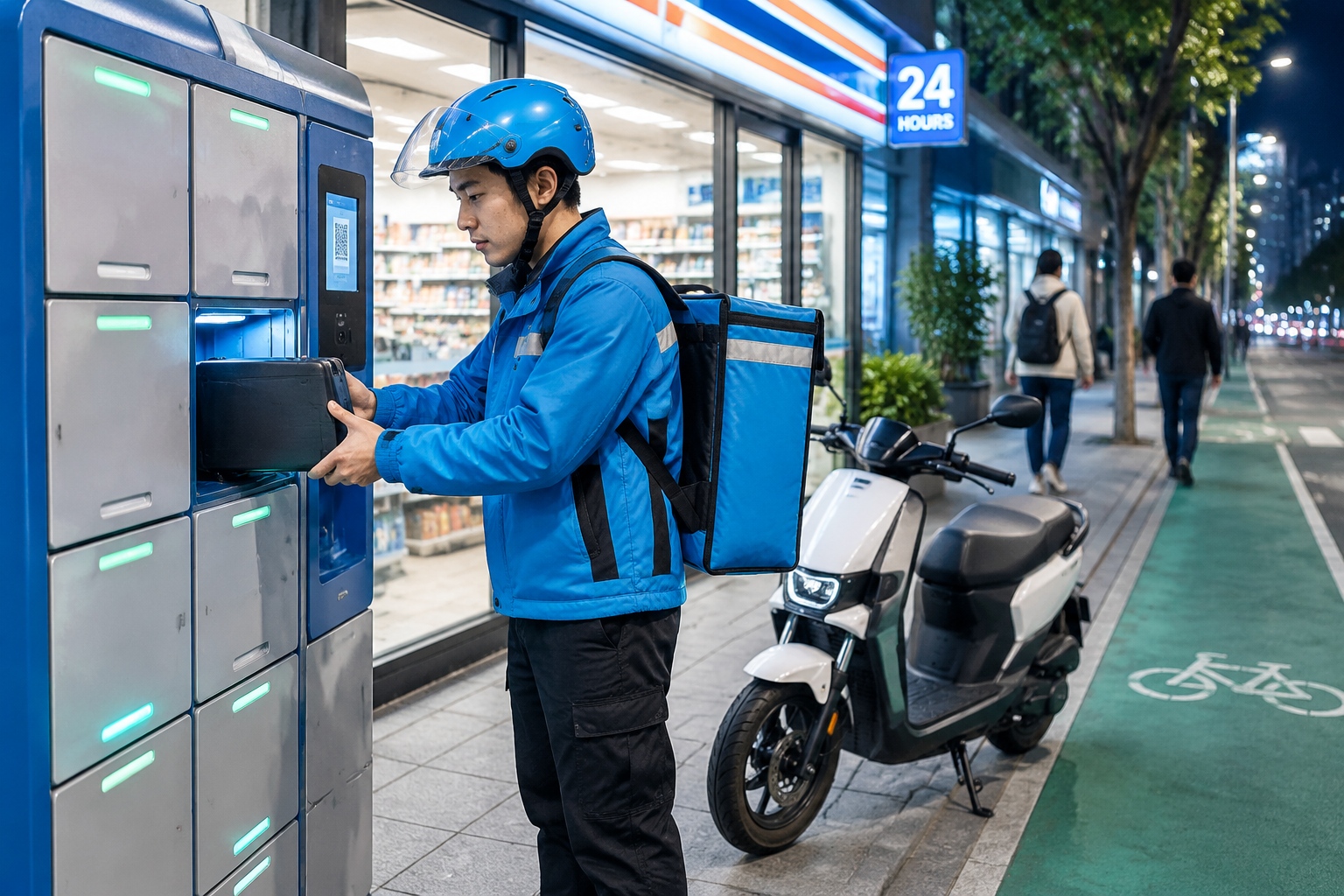
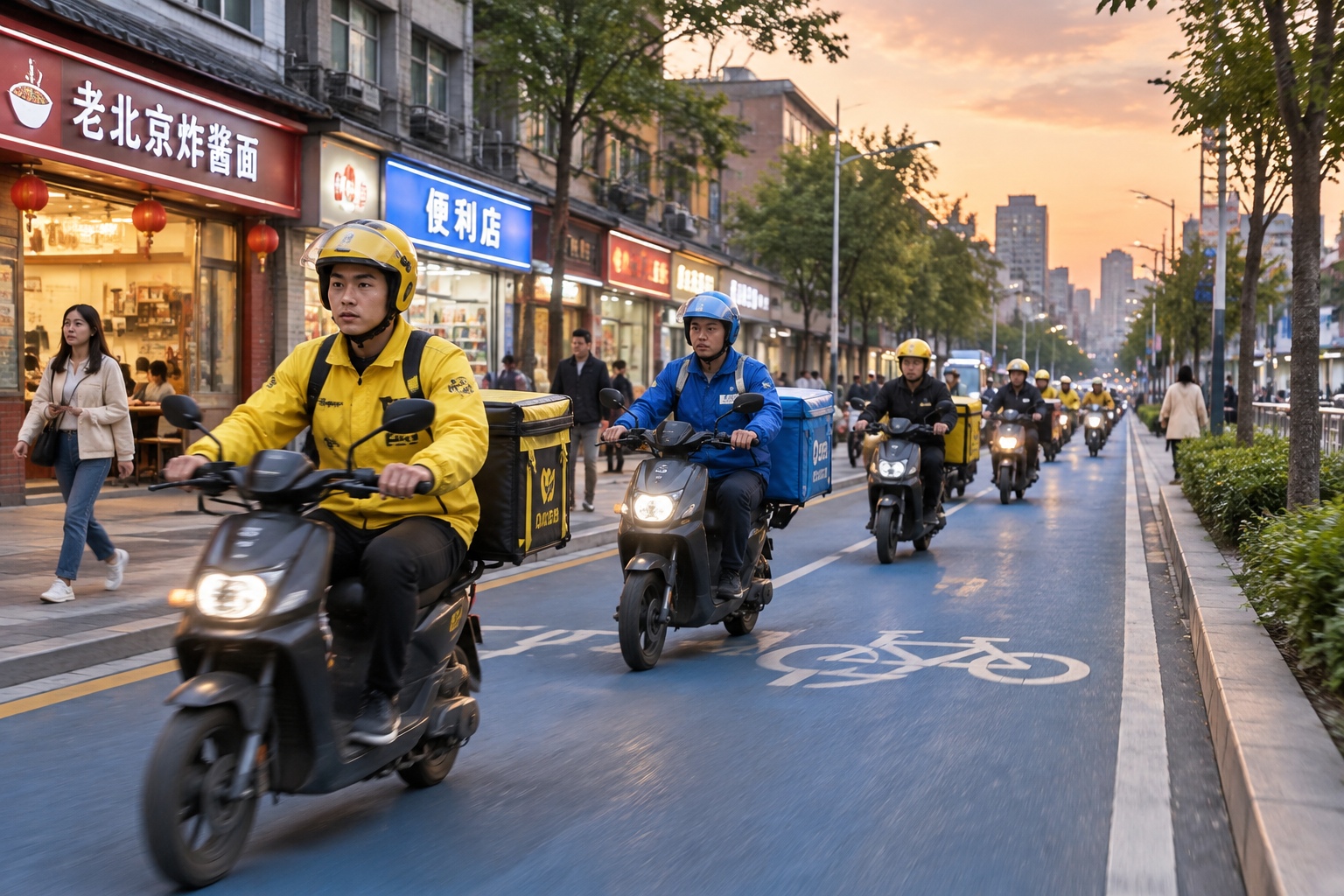
Then there’s the hardware, and it’s mostly borrowed. Painted bike lanes three meters wide. Underpasses. The alley behind a wet market that cuts four minutes off the main road. The back staircase of an office tower. Delivery lockers clustered at compound gates. Battery-swap cabinets humming outside convenience stores, where a dead battery becomes a full one in about ten seconds. And the 24-hour convenience store, which at night isn’t really a shop — it’s a logistics node with coffee.
None of this was designed as a delivery network. Bus lanes, alleys, underpasses, elevators, lobby shelves, subways — a city grew up for other reasons, and ten million people quietly repurposed it.
One Delivery in the Rain, Start to Finish
The noodles are not ready. They will not be ready for six minutes. Wang Lei stands in the kitchen doorway, plastic bag already open, watching a cook who is watching a pot. He doesn’t complain and he doesn’t rush the cook. This isn’t patience. It’s accounting: a rider who annoys a kitchen waits longer next time.
The bag finally comes out, wrapped twice, knotted at the top. He puts it in the insulated box, straps it down, and we go.
Two hundred meters on, the underpass is a swimming pool with a bus in it. He doesn’t stop to think. Left, up onto the sidewalk, a wide loop past a construction fence, back down. It costs 90 seconds and saves 15 minutes. A car driver would have sat there with everyone else.
Then the customer’s phone goes to voicemail. Twice. Wang Lei sends the standard message — your order is downstairs — and waits in the rain, holding someone else’s dinner. He gives it 40 seconds of grace, mutters something philosophical, and heads for the gate.
Inside the compound, the building elevator needs a card. He takes the stairs to the 14th floor. Two minutes later than planned — but the ETA had already stretched itself, so nothing happens. No fine. No drama. The door opens; the customer, mid-video-call, takes the bag, says “thanks, sorry, rain,” and closes it.
“That’s a good ending,” Wang Lei says on the way down. “Nobody angry.”
The 1 A.M. Customers
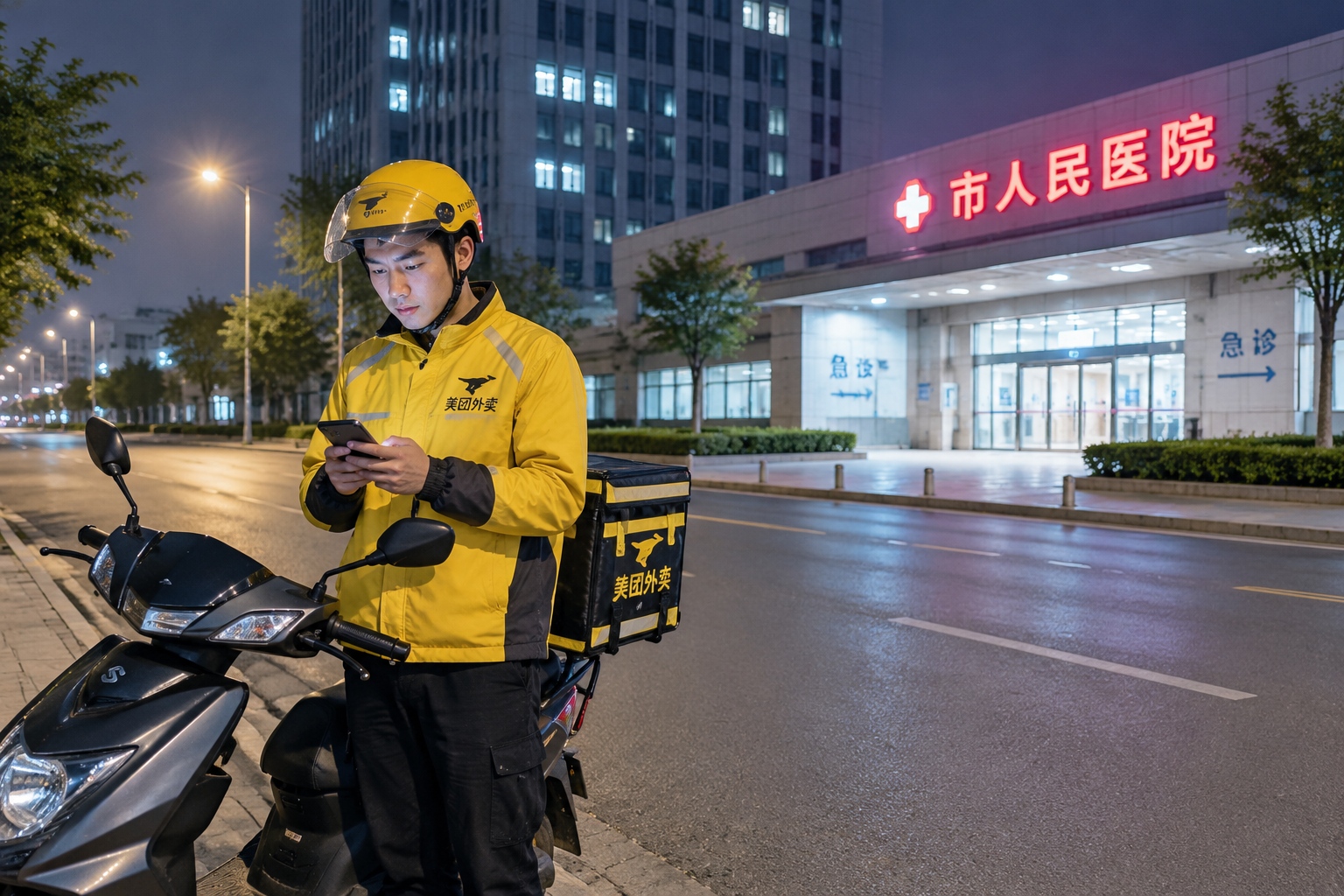
Late at night, the orders change shape. Fewer family dinners, more of everything else. Hospital night shifts. Hotel front desks. Internet cafés. A 3 a.m. request for children’s fever medicine from a 24-hour pharmacy — the closest thing this city has to an ambulance that doesn’t need one.
Then there are the office towers with three windows still lit at midnight: overtime, deadlines, a team that decided to eat instead of going home. And the riders themselves, who order from each other at 2 a.m. because nothing else in the neighborhood is open and, frankly, nobody else is awake to cook for them.
This is how the night economy actually works — not just bars and food streets, but a thin, steady pulse of small orders that makes it worth keeping a kitchen open until 4 a.m. Cities like Changsha and Chongqing are famous for it. Beijing does it more quietly, behind office glass and hospital doors.
The Costs Nobody Posts About
The risk is real and the math is unromantic. E-bikes, insulated boxes, wet roads, tired eyes. Fire-safety rules in recent years pushed battery charging out of apartment hallways and stairwells, which is better for everyone and also means a rider with a dead battery at 1 a.m. needs a swap cabinet, not a socket.
Coverage has been the bigger story. For years, the 3-yuan daily commercial accident insurance deducted from a rider’s account was the entire safety net. In 2025, JD.com said it would pay full social insurance for its full-time delivery riders, and Meituan began piloting similar coverage — the first time the major platforms have put serious money behind the phrase “gig worker.” How far it reaches part-time riders who work across several apps is still an open question, and riders know it.
What riders build themselves is less official and more reliable. Neighborhood WeChat groups where someone posts “north gate locked tonight” or “elevator in Building 3 is dead,” where a spare charger gets handed over at a traffic light, where a rider with heatstroke has his orders reassigned by the guys around him before the platform even notices.
Rest stations — hot water, a microwave, a place to charge a phone and close your eyes — now exist in most districts. They’re not glamorous. They’re used constantly.
Why It Feels Like an Invisible Highway
Three things make this network possible, and none of them are futuristic.
Density. A single Beijing compound can hold 8,000 people, with 200 restaurants within a kilometer. Bundling three orders into one trip only works if the orders are close together — and in Chinese cities they almost always are.
Frictionless payment. Nobody handles cash, nobody makes change, nobody waits for a card terminal. The money moves before the food does.
Electrification. A cheap scooter with a 60-kilometer range and a battery you can swap in ten seconds is, over short urban distances, faster than a car and easier to park than a bicycle.
Compare that with a Thursday night in London or New York: a $3 to $8 delivery fee before tip, 35 to 50 minutes, and by 11 p.m. your options are shrinking fast. In Beijing, the fee on many orders is 2 to 6 yuan — under a dollar — and 2 a.m. isn’t a special occasion. It’s Tuesday.
It isn’t magic, and it isn’t free. It’s cheap partly because the labor is cheap, the margins are thin, and the churn is high. Riders leave constantly; new ones arrive constantly. The system is impressive and fragile in the same breath, and the people inside it will tell you that before anyone else does.
12:40 a.m., Back at the Battery Cabinet
The last order is a bowl of porridge to a hotel two streets away. Wang Lei swaps his dead battery for a charged one at the cabinet outside a convenience store — click, hum, done — and then stands there for a minute doing nothing, which is the closest thing he has to a break.
He’s saving. Two or three more years, he says, then back to Zhoukou to open something small: a shop, maybe a noodle place of his own, “not delivery.” He laughs at that. “Or I deliver for my own shop. That counts too.”
Then he rides off, and the street goes back to being a street. A few green dots are still moving on the map above the city — someone’s medicine, someone’s midnight noodles, someone’s questionable decision at 1 a.m.
If you want to understand a Chinese city, the landmarks won’t help much. They’re mostly for photographs. Watch the small electric bikes instead, and the phone screens strapped to the handlebars, and the unglamorous, half-invisible road they’ve built between them. It doesn’t appear on any map. It just runs, every night, in the rain.
Start the discussion at forum.chinacomes.com