

5:45 a.m. — A park that fills up before sunrise
The first thing you hear at the gate of Caoyang Park is not music. It is the flat slap of a shuttlecock being kicked back and forth — jianzi, a game played with a weighted feather disc — followed by somebody coughing, and then somebody else laughing about the coughing.
Caoyang New Village sits in the northwest corner of Shanghai, about twenty minutes by metro from the skyscrapers downtown. It was built in 1951 as the country’s first planned workers’ housing estate: three-storey brick blocks, running water, indoor toilets, courtyards laid out on something close to British garden-city lines. Model textile workers were handed the keys. Seventy-odd years later the buildings have been renovated and elevators bolted onto the outside of some of them, but the same families — and now their grandchildren — still use the park the way it was designed to be used.
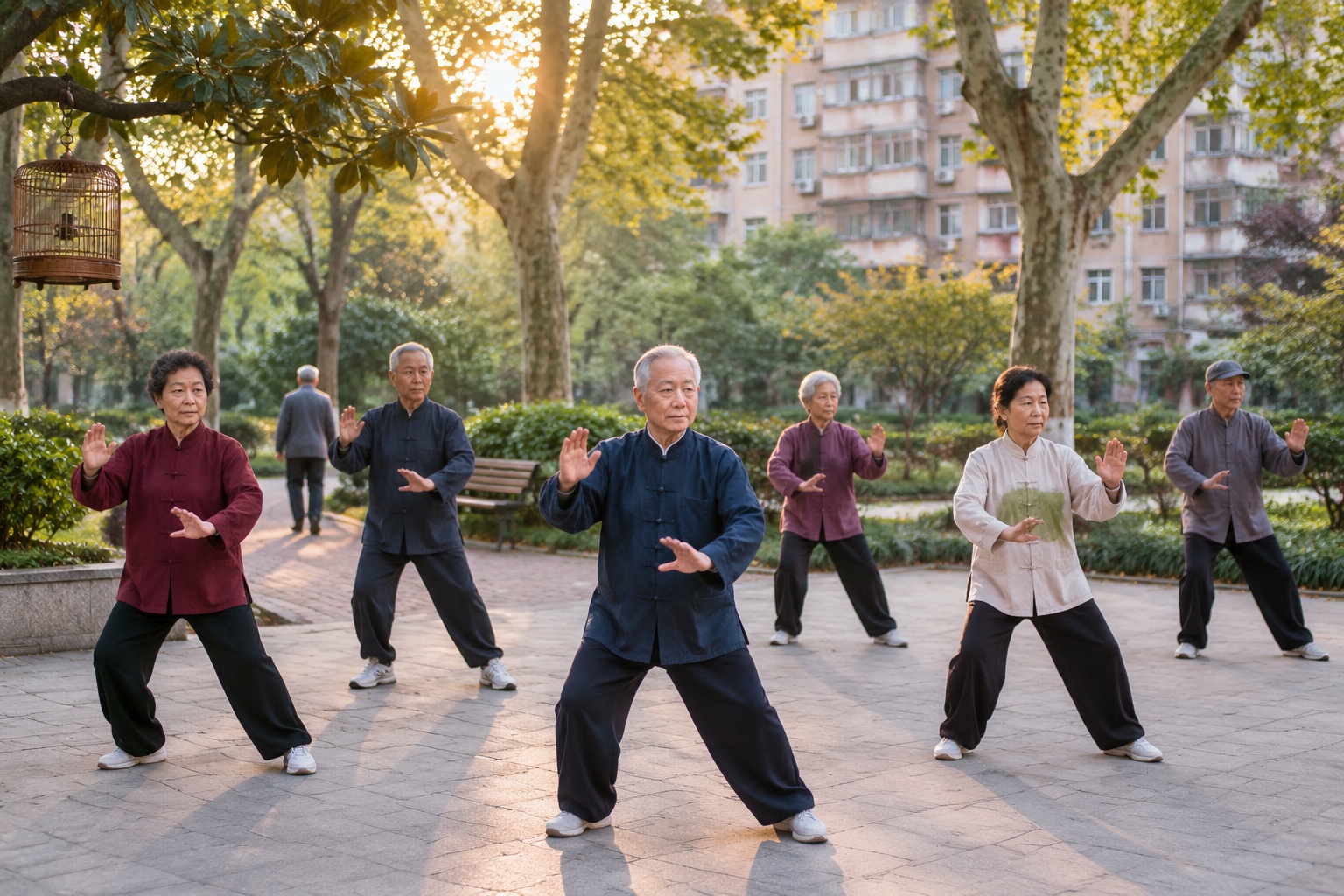
By six o’clock there are maybe eighty people inside. Two groups do tai chi on opposite sides of a plane tree, each with its own small speaker, each politely pretending not to hear the other. A man walks backwards around the perimeter path, which is said to be good for the knees. Someone has hung a birdcage in a magnolia branch and stands underneath it, hands clasped behind his back, listening.
6:40 a.m. — Breakfast for under ten yuan
Walk five minutes east along Lanzhou Road and the pavement turns into a market. Vegetable sellers have laid tarpaulins on the ground; a woman trims the roots off a pile of kongxincai, water spinach, with a flick of her wrist. A stall folds jianbing — a thin batter crepe around an egg, scallions and a sheet of fried dough — for six yuan, roughly 85 US cents. Next to it: soy milk, steamed buns, and youtiao, long strips of dough pulled straight from the oil.
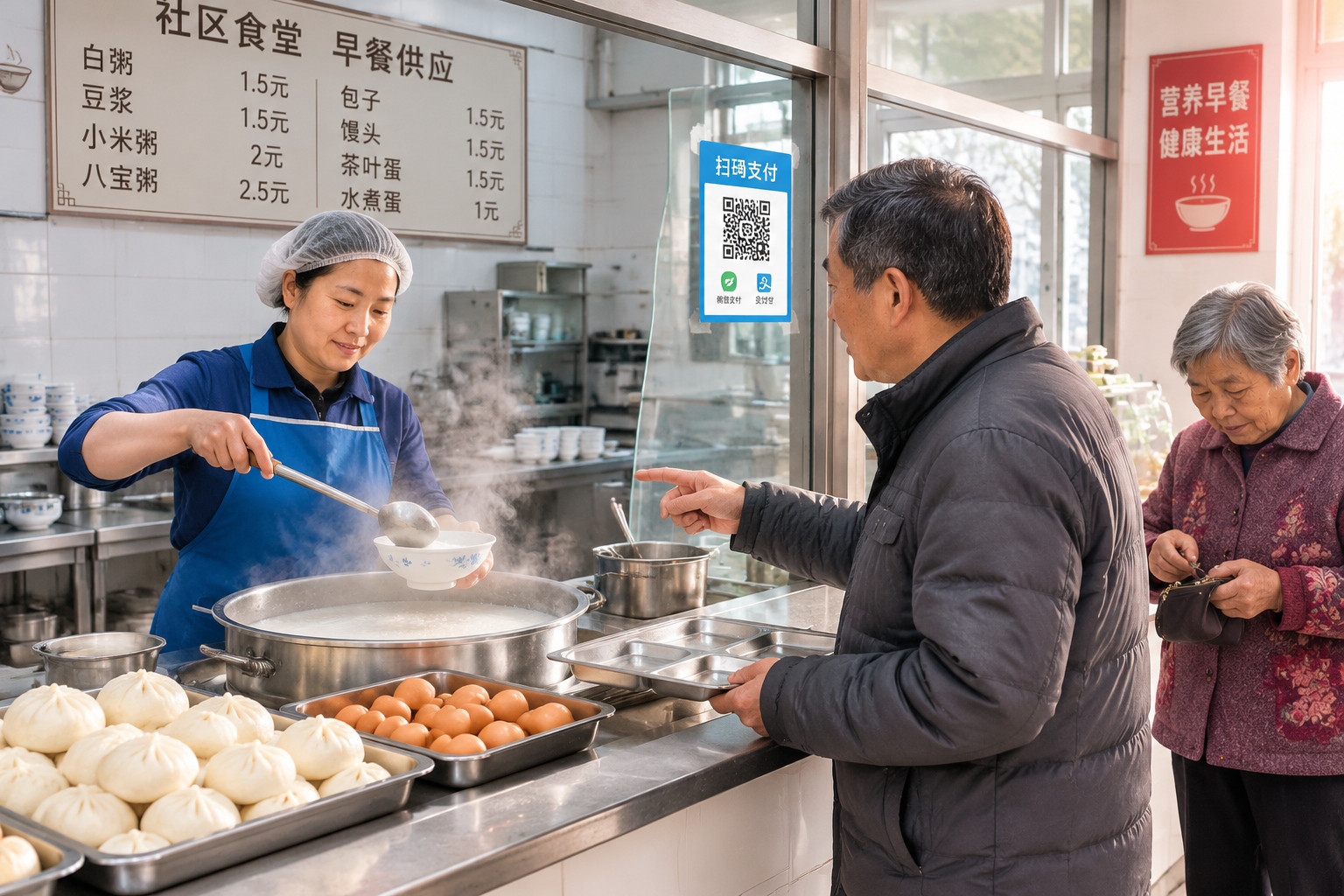
Behind the market, the neighbourhood runs a community canteen, a shequ shitang, that opens for breakfast at 6:30. These canteens started as a way to feed elderly residents who live alone and no longer want to cook three meals a day. Shanghai now counts well over a thousand of them. Breakfast is congee, a bun and a boiled egg for six to eight yuan. Residents over 70 pay less; the discount is tied to a local ID and applied automatically at the register.
At seven in the morning the dining room is mostly people in their seventies and eighties, several of them carrying their own chopsticks in a cloth roll. A woman at the corner table eats slowly and reads a newspaper folded down to the width of a single column. Nobody is being helped. Nobody looks lonely in the way outsiders expect. Two men argue about the price of pork — loudly, happily — for fifteen minutes.
9:00 a.m. — The park built on a railway line
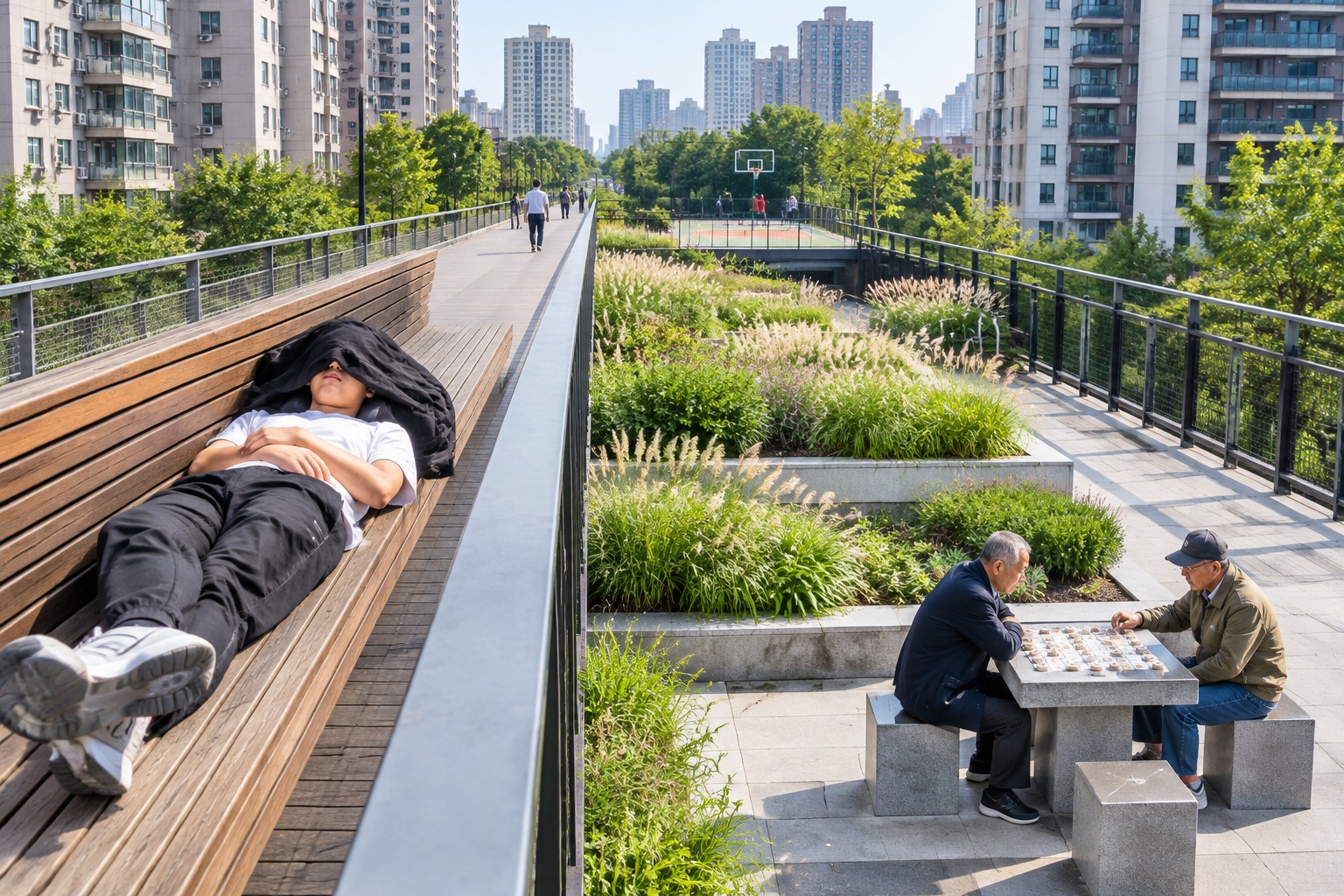
Ten minutes’ walk south is Baiyulan Park, easy to miss because it is narrow: a ribbon of green about 880 metres long running behind apartment blocks, on land that was a freight railway spur, then a street market, and since 2021 a linear park. It is built on three levels — an upper deck at roof height with basketball courts and a long bench people use for napping and phone calls, a middle band of planted terraces, and a ground level where old men play Chinese chess on a stone table and slap the pieces down with theatrical force.
The design detail that tells you the most is the noise. Quiet zones are marked with signs, and the loudest activities — exercise groups, amplified singing — have been steered to the far end, next to the road. It is not a perfect system. It is a system that was negotiated, and it works most mornings.
11:45 a.m. — Lunch, and everybody eats at the same table
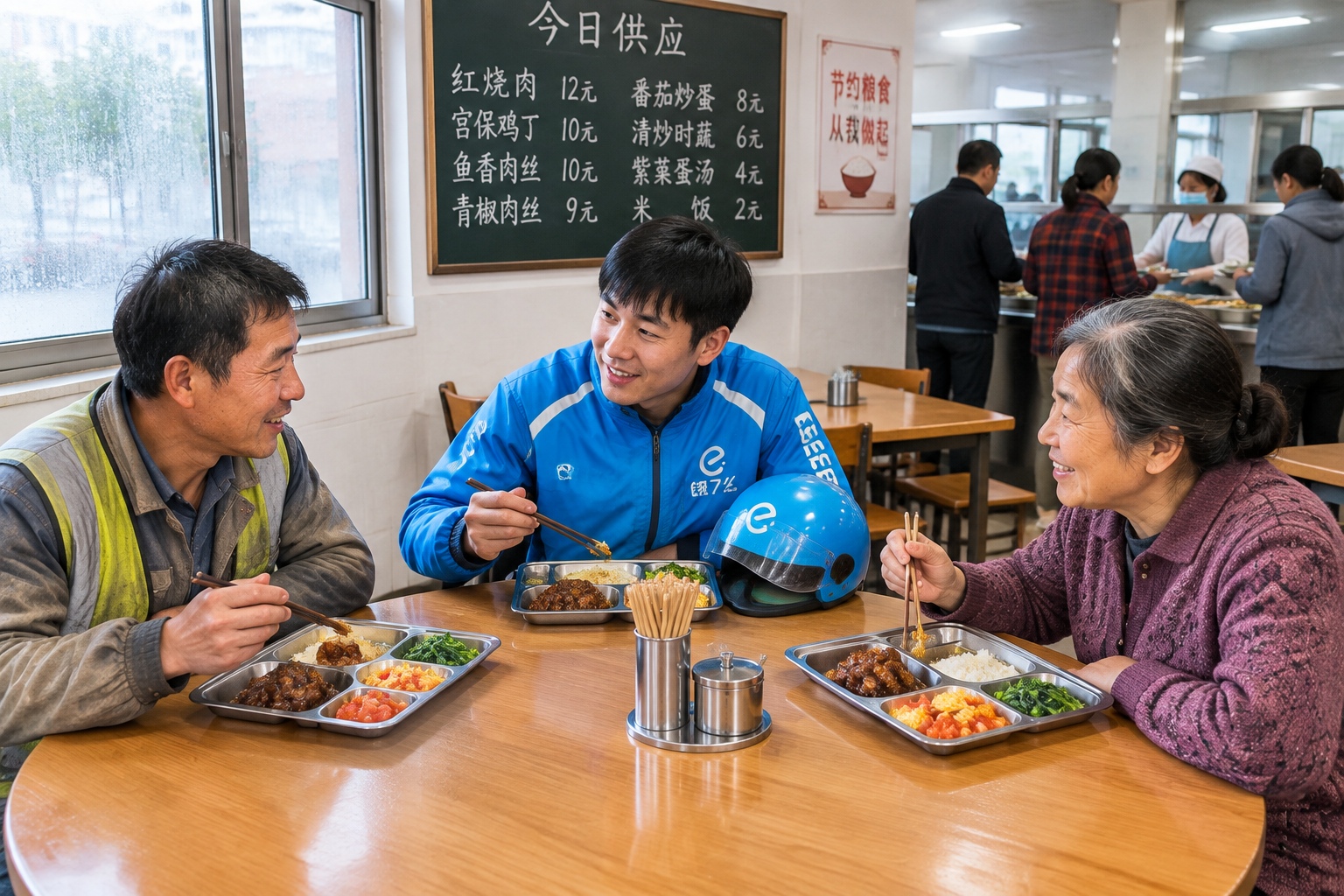
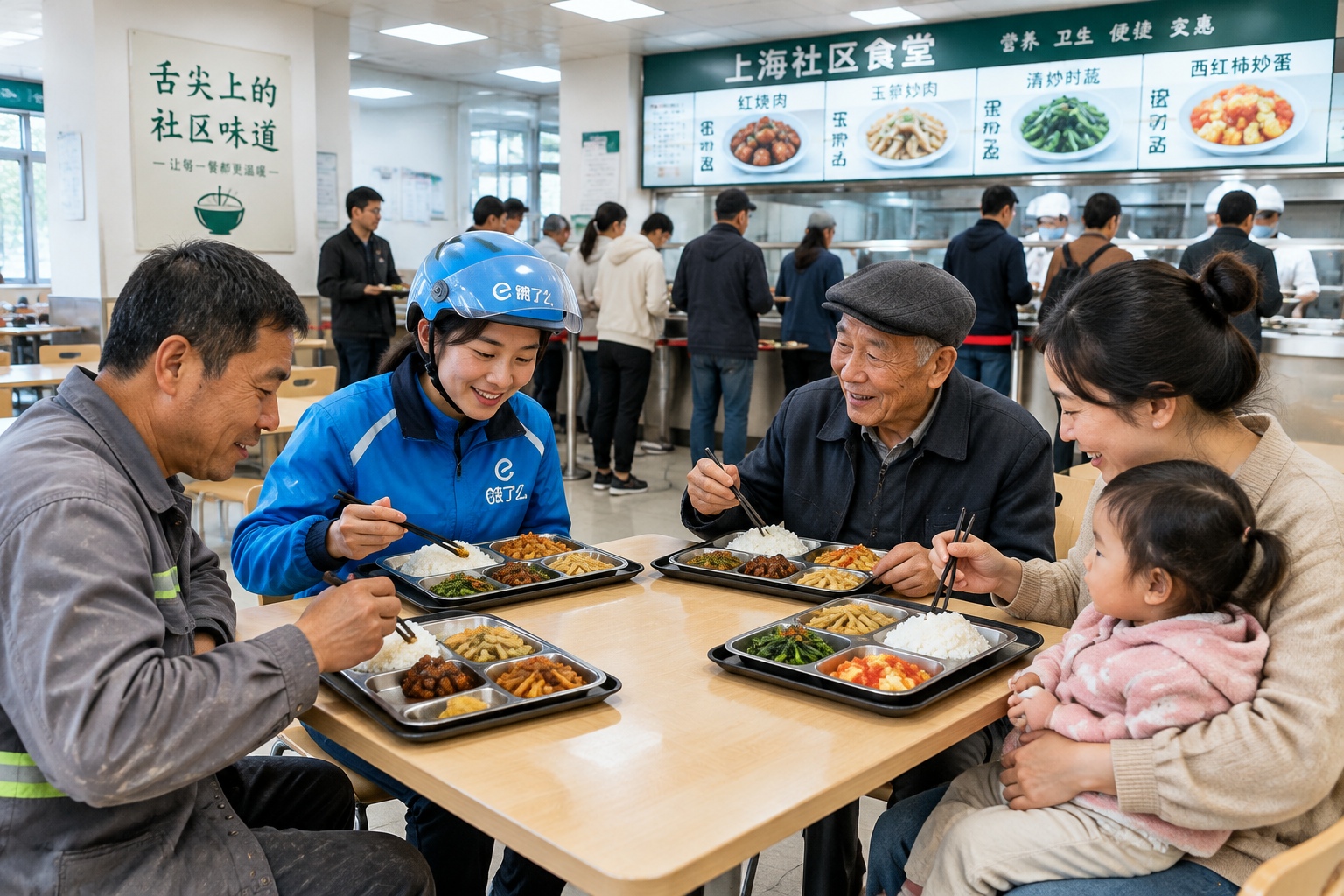
Back at the community canteen, the lunch queue starts at 11:30 and is out the door by noon. What surprises a visitor who expected an old people’s dining hall is who is in it: retired couples, yes, but also construction workers in dusty trousers, delivery riders grabbing ten minutes between orders, a mother with a toddler, and office staff from an insurance branch nearby who come because lunch costs 18 yuan instead of 45 at the mall.
The menu is chalked up and changes daily: braised pork belly with bamboo shoots, steamed fish, stir-fried greens, tomato and egg, soup. You take a tray, point, and pay by phone. Tables are shared, which means strangers talk. A retired teacher next to me explains that she does not come for the food — she can cook — but because, in her words, eating alone at home makes the day longer.
3:15 p.m. — The hours that belong to grandmothers
At 3:15 the primary school gates open and the street outside fills with grandparents carrying umbrellas, juice boxes and small backpacks. The children come out running; the grandmothers come out negotiating — with the child, and with each other about who is collecting whose. This is the quiet engine of urban China: tens of millions of retired people providing daily childcare so that both parents can keep working. You can see it in any neighbourhood, and it is why the parks empty between three and five.
7:00 p.m. — The speakers come out
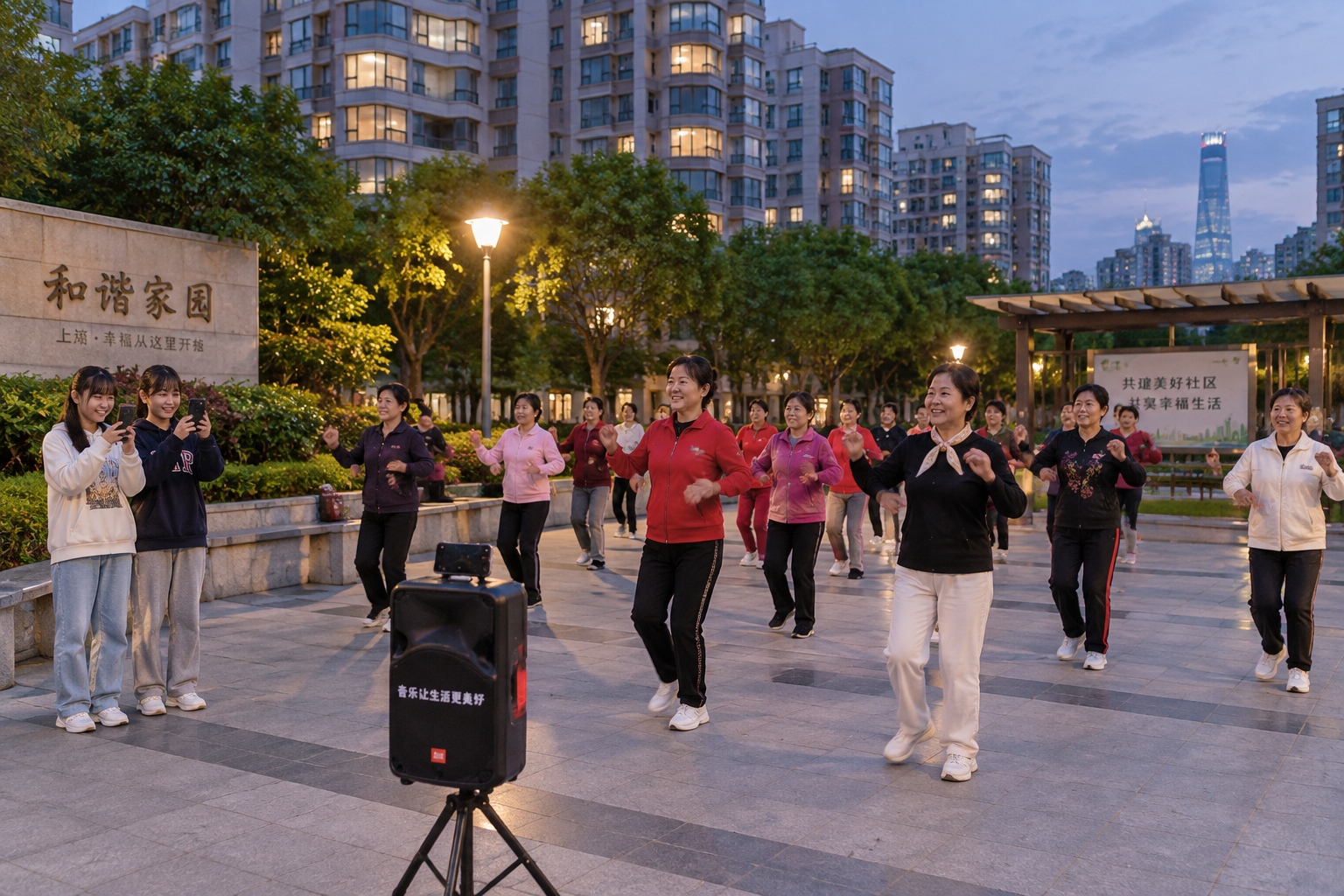
Square dancing, guangchang wu, has been treated abroad as a punchline and resented at home as a nuisance. Standing in the middle of it, the first thing you notice is how organised it is. Groups have designated plots, claimed years ago. One person owns the speaker; another keeps the playlist on a USB stick. The routines are choreographed to the beat, and the women leading them are usually the ones who learned first and taught everybody else.
Shanghai has rules now. Amplified music in public space is limited to certain hours — broadly after 6 a.m. and before 10 p.m. — and there are decibel caps. Some neighbourhoods have installed directional speakers that throw sound forward and keep it away from apartment windows; stand three metres behind one and you hear almost nothing. Not every group likes them. The alternative was years of complaints, police visits and, occasionally, things thrown from balconies.
Watch the dancers and you notice something else: they are not all old. At the edge of the formation, two teenage girls copy the moves, badly, filming themselves. A man in his forties dances with his mother, holding her elbow. In another corner of the same plaza, retirees practise a fan dance while a young couple plays badminton under a streetlight, waiting for the space to clear.
9:30 p.m. — Who is still out
The canteen closed at eight. The park lights dim at 9:30. The street does not empty. Delivery riders in blue and yellow jackets wait outside a noodle shop, phones mounted on handlebars, engines off. A convenience store does steady trade in beer, ice cream and phone chargers. A 24-hour gym above a bank branch glows, half full. A woman walks a small dog in a reflective vest. Two men sit on the low wall outside the shuttered canteen with tea in thermos lids, still arguing about something.
What one day here actually shows
None of this is a monument. Caoyang has no ticket booth and appears on no standard tourist list. What it has is a set of shared spaces that were built, argued over, and then adjusted: a park designed in 1951 and rebuilt twice; a freight railway turned into a garden; a canteen meant for the elderly that quietly became a place where a construction crew, a delivery rider and a retired teacher eat the same 18-yuan lunch at the same table.
China is ageing fast. Roughly 297 million people — about 21 per cent of the population — are 60 or over, and in Shanghai the share among registered residents is closer to 37 per cent. That number is usually reported as a problem. Spend a day in these spaces and you see the other half of it: an enormous amount of daily life is organised, informally and cheaply, by people in their sixties and seventies, supported by public infrastructure that costs almost nothing to use.
It is not frictionless. The decibel fights are real. The canteens are subsidised and some are financially fragile. Not every neighbourhood has a Baiyulan Park. The interesting thing is not that China has solved shared urban space. It is how much negotiation happens inside it, every single day, mostly without anyone raising their voice — and how good the morning congee is.
If you go
Where: Caoyang New Village, Putuo District, northwest Shanghai. Metro Line 3 or 4 to Caoyang Road, or Line 11 to Fengqiao Road.
Best time: 5:45–7:30 a.m. for the park and the market; 11:30 a.m. for the canteen lunch rush; 6:45–8:30 p.m. for the dancing. Weekday mornings are calmer.
Costs: breakfast 6–10 yuan; canteen lunch 15–25 yuan, less for local seniors; both parks free; metro from 3 yuan.
Etiquette: you can join a dance group and people will teach you, but ask before filming, especially of children and of people eating. Do not assume the person beside you speaks English. Do not assume they do not.
Start the discussion at forum.chinacomes.com