

The Street Changes at 4:40 p.m.
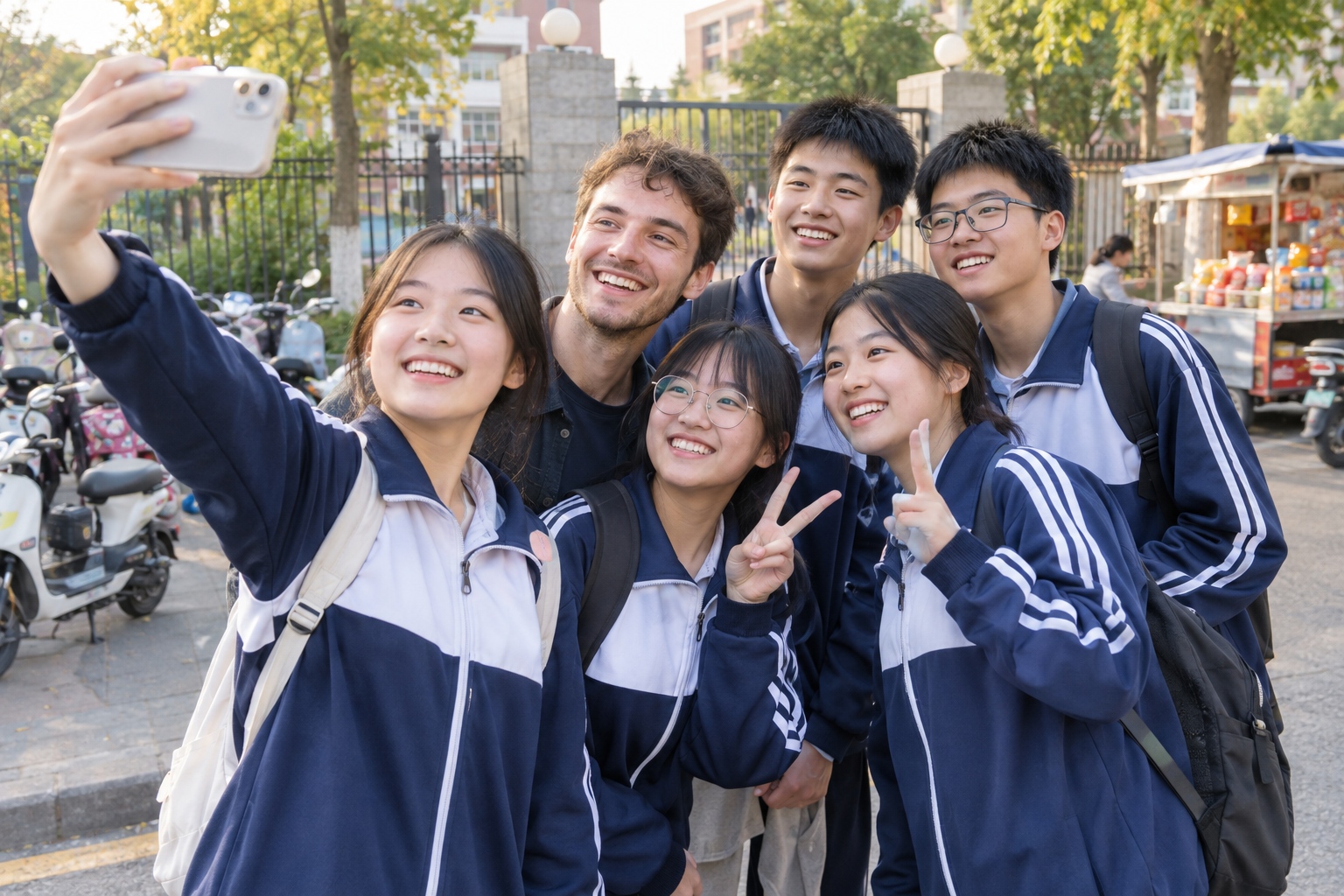
In Chengdu, where I live, the east gate of the middle school down the road from my apartment opens at 4:40 p.m. First the security guard rolls the metal gate back. Then the sound arrives — less a roar than a river that has been held behind a dam all day and is finally let go. Navy-and-white tracksuits, backpacks worn on both shoulders because the straps are heavy, one boy carrying a cello case as if it were a suitcase. Grandmothers on electric scooters have been lined up along the curb since 4:15, some with a bag of oranges hooked over the basket. Two snack carts park in the alley: grilled cold noodles at six yuan, and a woman selling candied hawthorn on sticks. A teacher with a whistle holds up one hand at the crosswalk.
On this particular Tuesday I was walking home from the wet market with tofu and greens in a plastic bag, and I made the mistake of stopping to let the crowd pass.
“Excuse Me — Can I Take a Photo With You?”
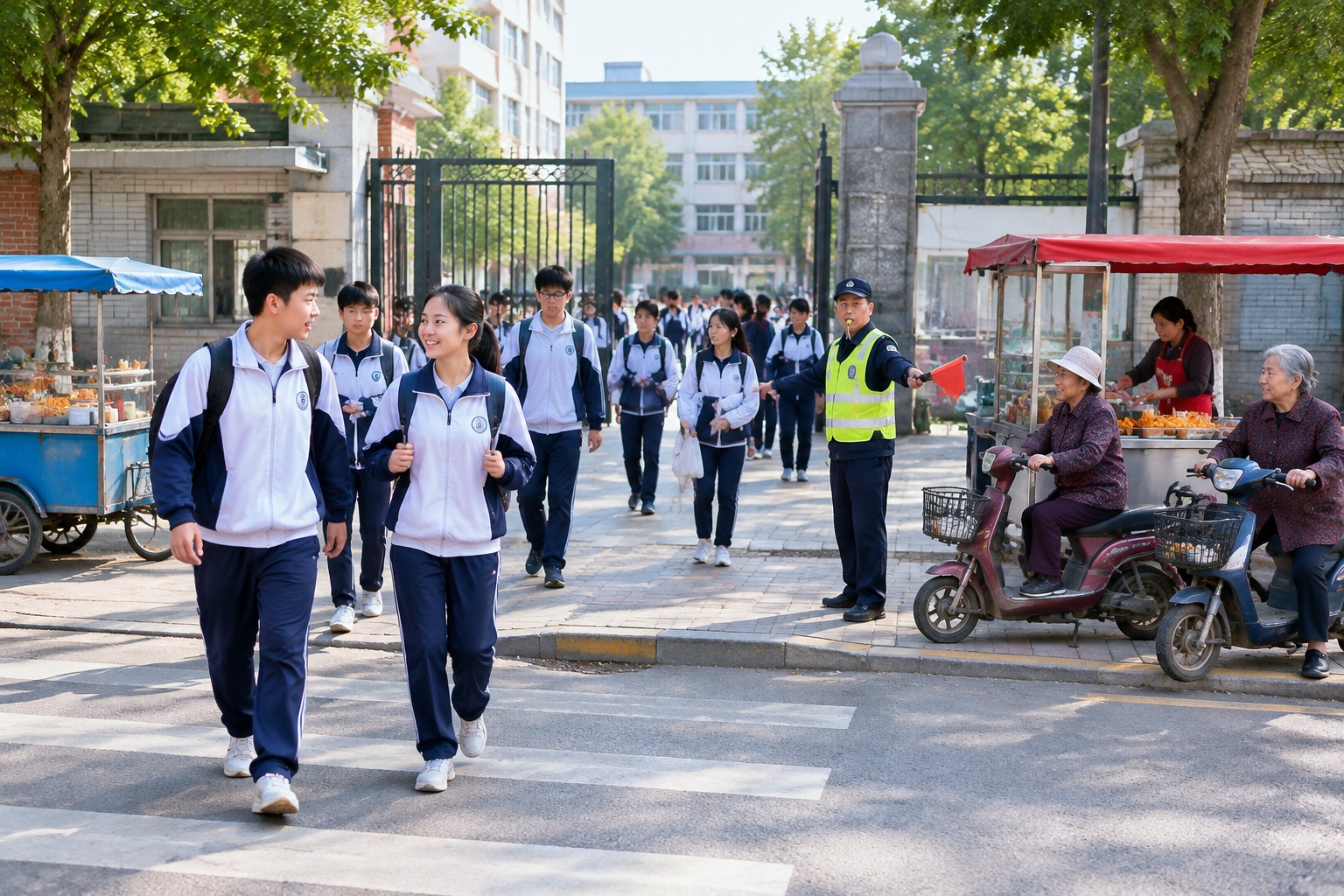
Something tapped my elbow. A girl, maybe thirteen, in a school tracksuit, with glasses that sat slightly crooked. Two friends stood behind her; one was already hiding her face in her hands. “Excuse me,” she said, placing each word down carefully, like tiles. “Can I take a photo with you?”
I said yes. What happened next is the part I keep turning over.
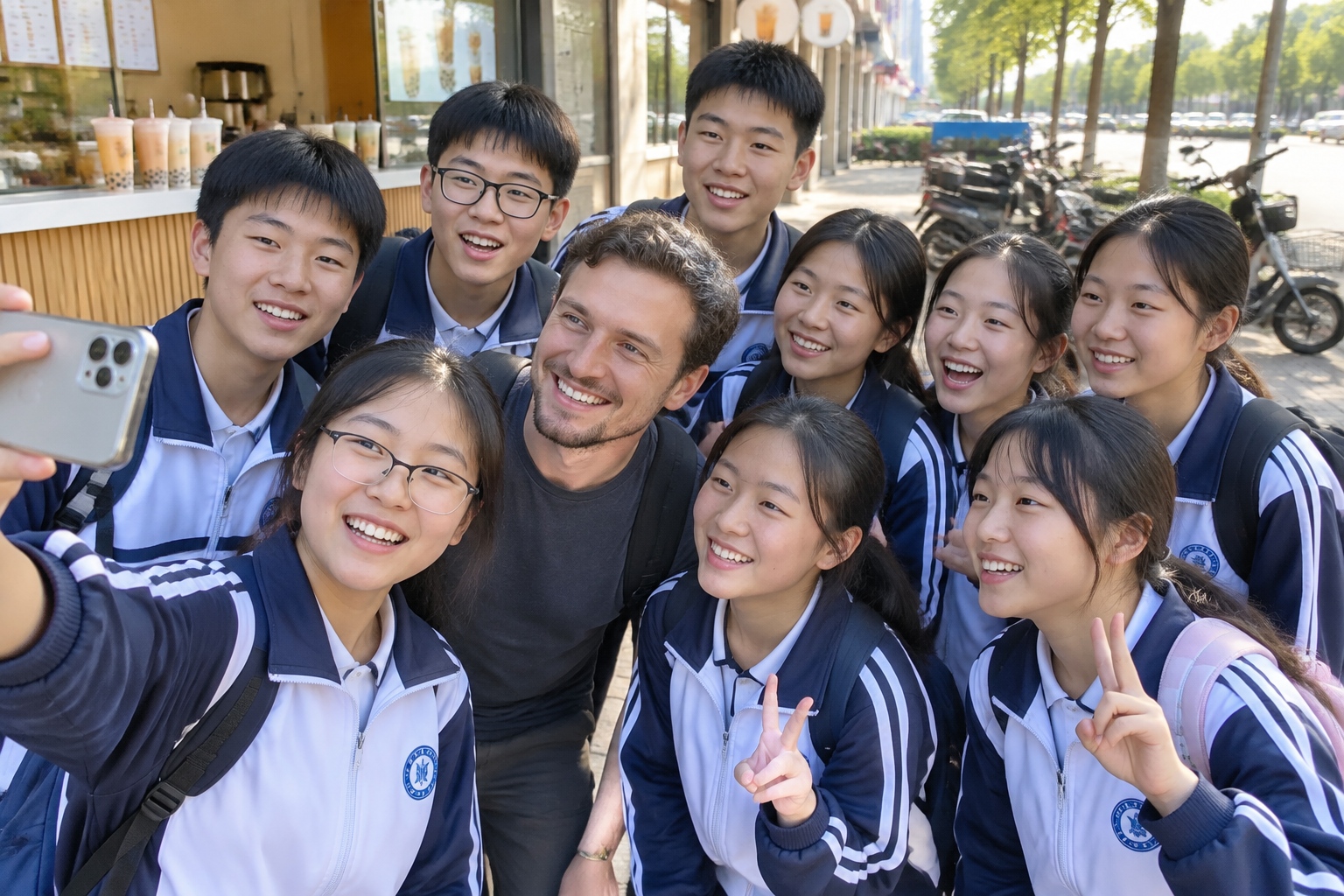
She didn’t take the photo. She turned and waved, and four more girls sprinted over from the bubble tea queue. Then two boys. Inside a minute there were eleven of them, arranged in a loose semicircle, phones being passed to whoever had the longest arms. Nobody asked my name. Somebody counted down from three in English, badly. Ten screens went up at once.
If you have never lived in a Chinese city outside the big coastal ones, this is worth explaining: asking a stranger for a selfie here is not usually a way of treating someone as an exhibit. It is closer to enthusiasm that has nowhere else to go. The students had been in class since 7:40 that morning. Their phones, collected at the door at 7:30, had just been handed back. For about ninety seconds, I was the most interesting thing that had happened to them all day.
The Questions They Actually Asked
“Where are you from?”
“Do you like Chengdu?”
“Can you eat spicy food?” — this one from a boy who then added, deadpan, “I can’t. I’m from here and I can’t.”
One boy asked me to say a full sentence in English so he could record it. I said, “Your English is better than my Chinese,” which was true. He played it back twice, grinned, and said, “I will show my teacher.” A girl near the back, quieter than the rest, asked something different: “Is it strange? That we ask you?” I told her no. She looked relieved, and that surprised me more than the request itself.
Most of them spoke in fragments they had rehearsed in class — textbook lines delivered with real effort and slightly wrong stress. Two of them gave up on English and just pointed at the camera, then at me, then at themselves. That worked fine too.
Why This Happens More Than It Used To
English is a required subject in Chinese schools from third grade in most of the country, and in many cities from first grade. It stays compulsory all the way to the gaokao, the university entrance exam, where it is worth 150 points out of 750. That adds up to roughly a decade of study for hundreds of millions of people. For most of them, the only fluent English speaker they will ever meet face to face is a stranger on a sidewalk holding a bag of vegetables.
The other half of the equation is numbers. China’s National Immigration Administration reported about 27 million foreign entries in 2024, nearly double the figure for 2023, after visa-free entry was extended to dozens of countries. That sounds like a great many people until you divide it by 1.4 billion residents and more than 600 cities. In Shanghai or Beijing, nobody looks at a foreign face twice. In most of the country, outside the tourist districts, it is still a small event — and the people most likely to react to it are fourteen-year-olds who have been studying English since they were eight.
Where Those Photos Went
I never saw them. That is one honest feature of these encounters: the memory is more lopsided than the photograph. I remember the girl with the crooked glasses and the boy who kept restarting the countdown because someone blinked. They have eleven images of an afternoon I can barely reconstruct.
Some version of it probably ended up on Douyin or Xiaohongshu that evening, captioned with something like “met a foreigner outside school today!” A few dozen likes, maybe a comment from a cousin. And then it sank, the way everything does.
The Parts That Aren’t Charming
I want to be careful not to sell this as purely lovely, because it is not always.
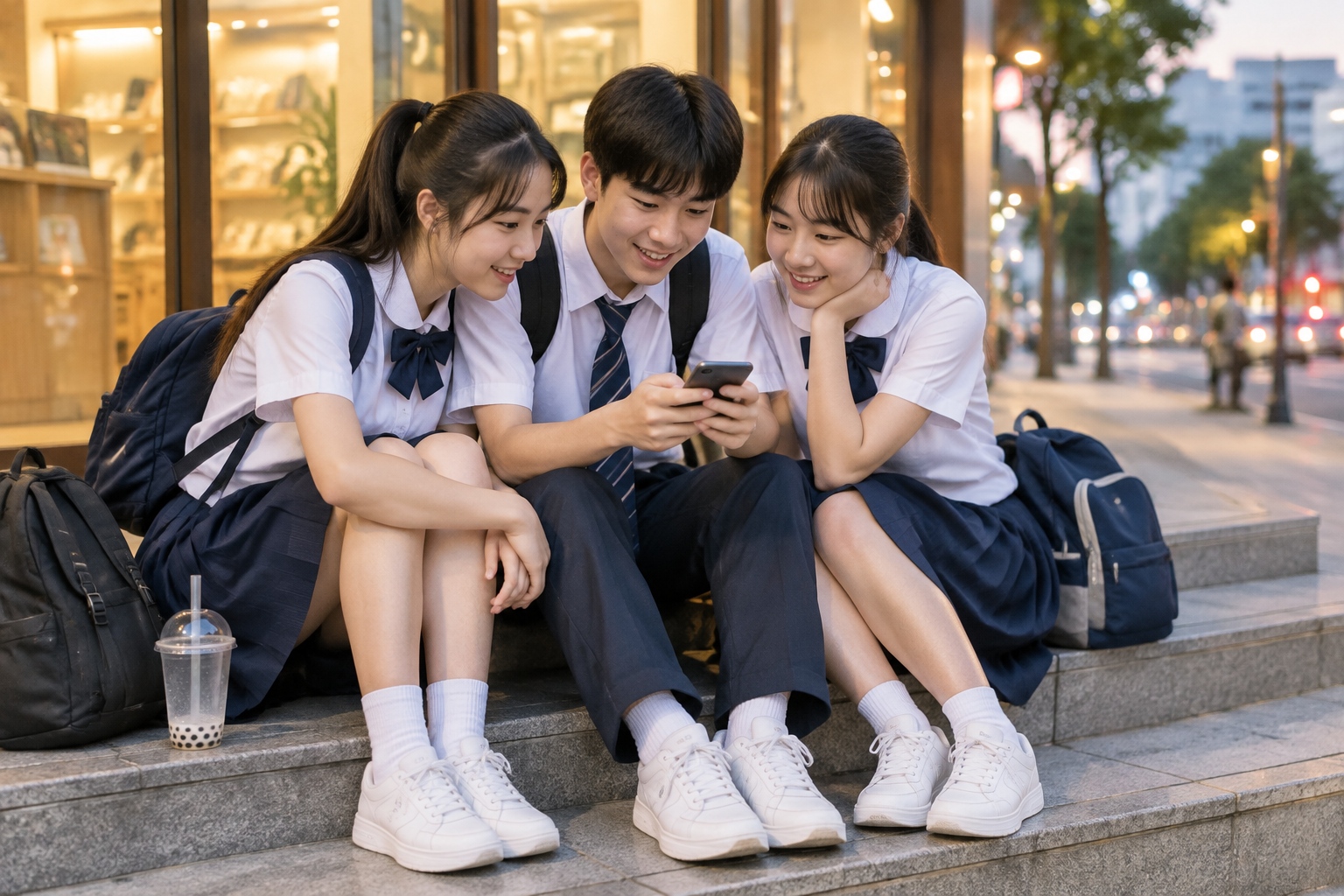
There are days when you are tired, when you are buying medicine, when you have been photographed four times before lunch, and being a walking attraction is simply a tax on running errands. It happens less in big cities and more in smaller ones, and it can tip over from curiosity into something less comfortable — a hand on your hair, a phone shoved close to your face without a word.
There is also the question people ask that has no easy answer: “Do you like China?” Everyone who lives here as a foreigner learns that a complicated answer lands badly. Students ask it too, and you can watch their faces tighten while they wait. I usually say something true and simple — the food, the streets at night, the fact that I can walk home safely at 11 p.m. — and let it stand.
And the curiosity runs both ways. Chinese students abroad get photographed by classmates, get asked where they’re really from, get treated as representatives of 1.4 billion people. Being on the receiving end of it for ninety seconds is not a burden. It is closer to a reminder of how thin most of our contact with each other still is.
What I Keep From That Afternoon
The girls took their photos and drifted off toward the bubble tea shop, already scrolling. One boy turned back and shouted, “Bye bye! Welcome to China!” — a line from a textbook, delivered like it mattered. Then the crowd closed over the sidewalk again and I walked home with my tofu.
I don’t think anything changed for them. Maybe one of them will remember the afternoon a foreigner stopped at the school gate, the way I remember the girl who asked whether it was strange. What I keep is smaller and more useful: a reminder that most of the distance between people is maintained by nobody in particular, and that saying yes to a stranger’s camera costs almost nothing.
For about ninety seconds, I was part of somebody’s ordinary Tuesday. That isn’t a small thing.
Start the discussion at forum.chinacomes.com