
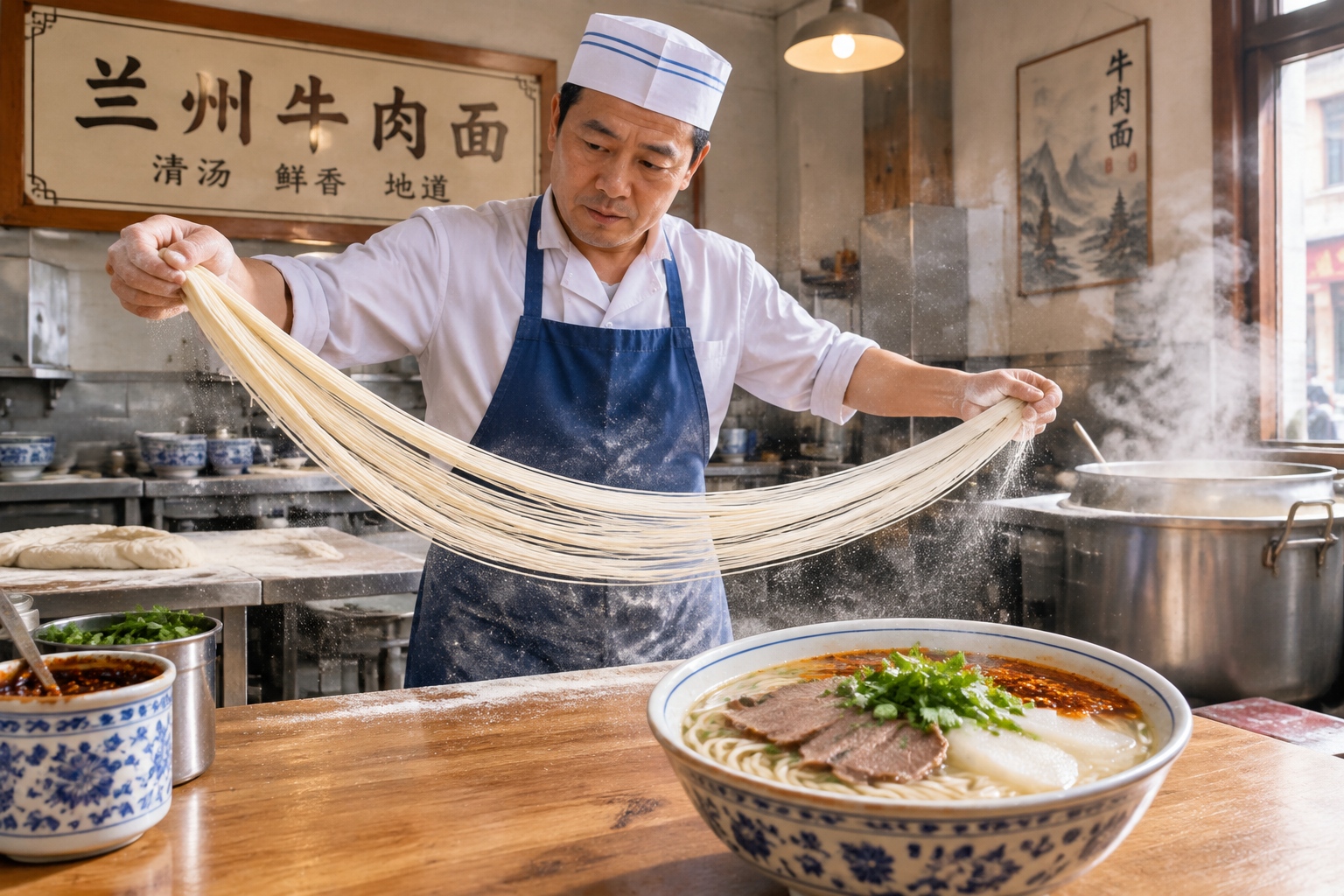

6:47 AM, One Bowl Before the City Wakes
The steam hits your face before the door fully opens. It smells of beef bone, radish, and chili oil. A man in a blue apron slaps a rope of dough against the counter—twice, three times—then pulls it into threads thinner than a shoelace. Behind him, a pot the size of a washing machine bubbles quietly. The first customers are already seated: a taxi driver, two nurses in scrubs, a teenager with headphones. No one talks much. They eat fast, heads down.
This is Lanzhou at 6:47 AM. And this is the city’s most famous breakfast: Lanzhou beef noodles.
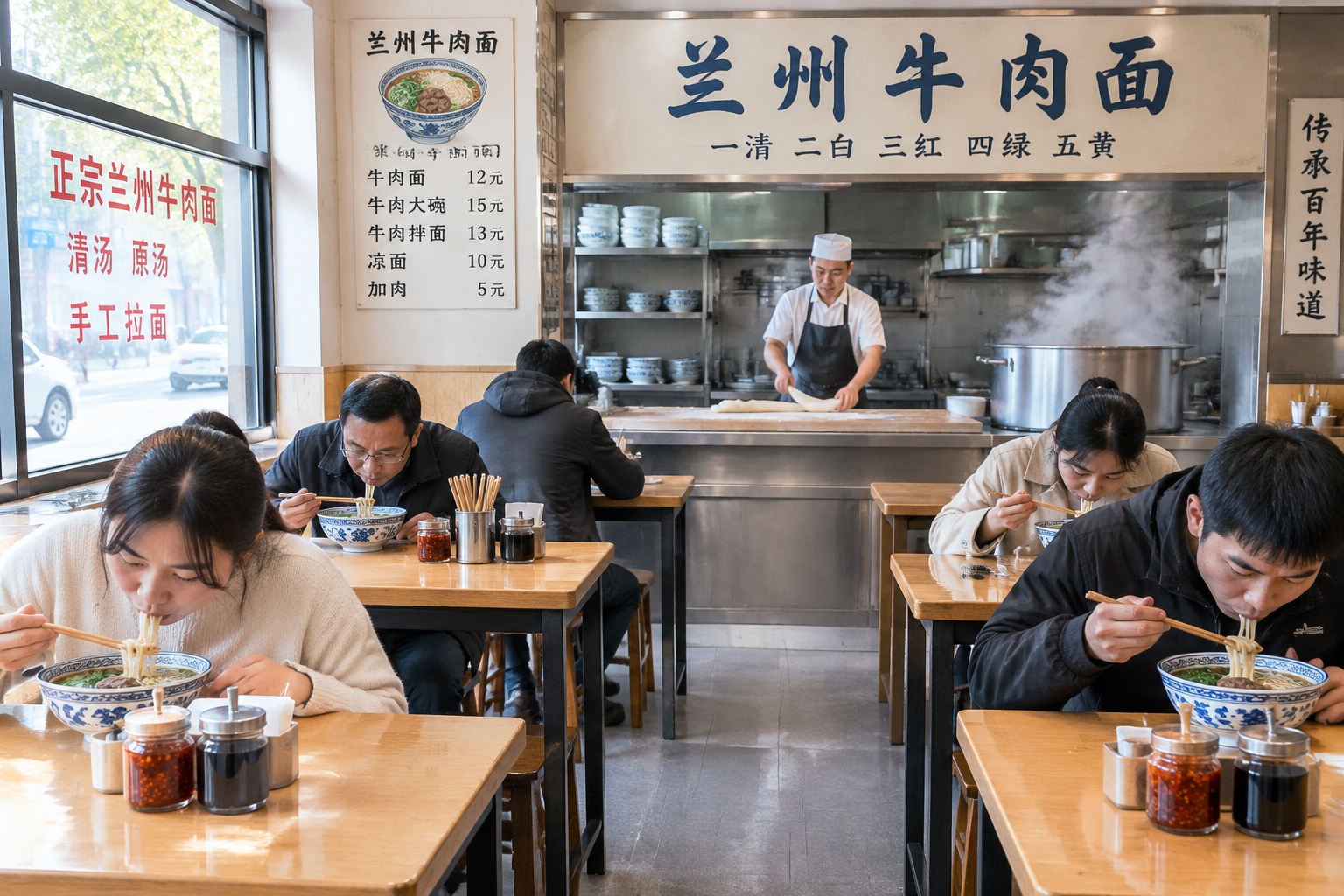
What ‘One Clear, Two White, Three Red, Four Green’ Actually Means
Locals describe a proper bowl with a four-part code: yi qing, er bai, san hong, si lü—one clear (the broth), two white (radish slices and noodles), three red (chili oil), four green (cilantro and scallions). It sounds like a poem, but it’s a quality checklist. The broth must be clear enough to see the bottom of the bowl, yet rich enough to coat your lips. The radish must be soft but not mushy. The chili oil should float in small islands, not dominate. The herbs go in last, just before serving.
This standardization is what makes Lanzhou beef noodles different from other Chinese noodle soups. The recipe is not a family secret—it’s a public standard. In 2018, the Lanzhou Beef Noodle Association even published a formal guideline: beef bones must be simmered for at least four hours, the dough must rest for a specific time, and the final bowl should contain exactly 50 grams of beef slices. Some chefs scoff at the numbers, but most follow them. The result is a bowl that tastes almost the same in a tiny alley shop or a highway rest stop.
Yet within that standard, there is room for handwork. The pulling of the noodles—la mian—is done by feel. A good puller can make nine different thicknesses, from maoxi (thin as thread) to da kuan (wide as a belt). You order by name: ‘Capillary, please’ or ‘Belt, please.’ The cook nods, pulls, drops the noodles into boiling water, and counts seconds. Too long, and they turn soft. Too short, and they taste of raw flour. The whole performance takes less than a minute.
The Yellow River Is Not a Backdrop—It’s a Neighbor
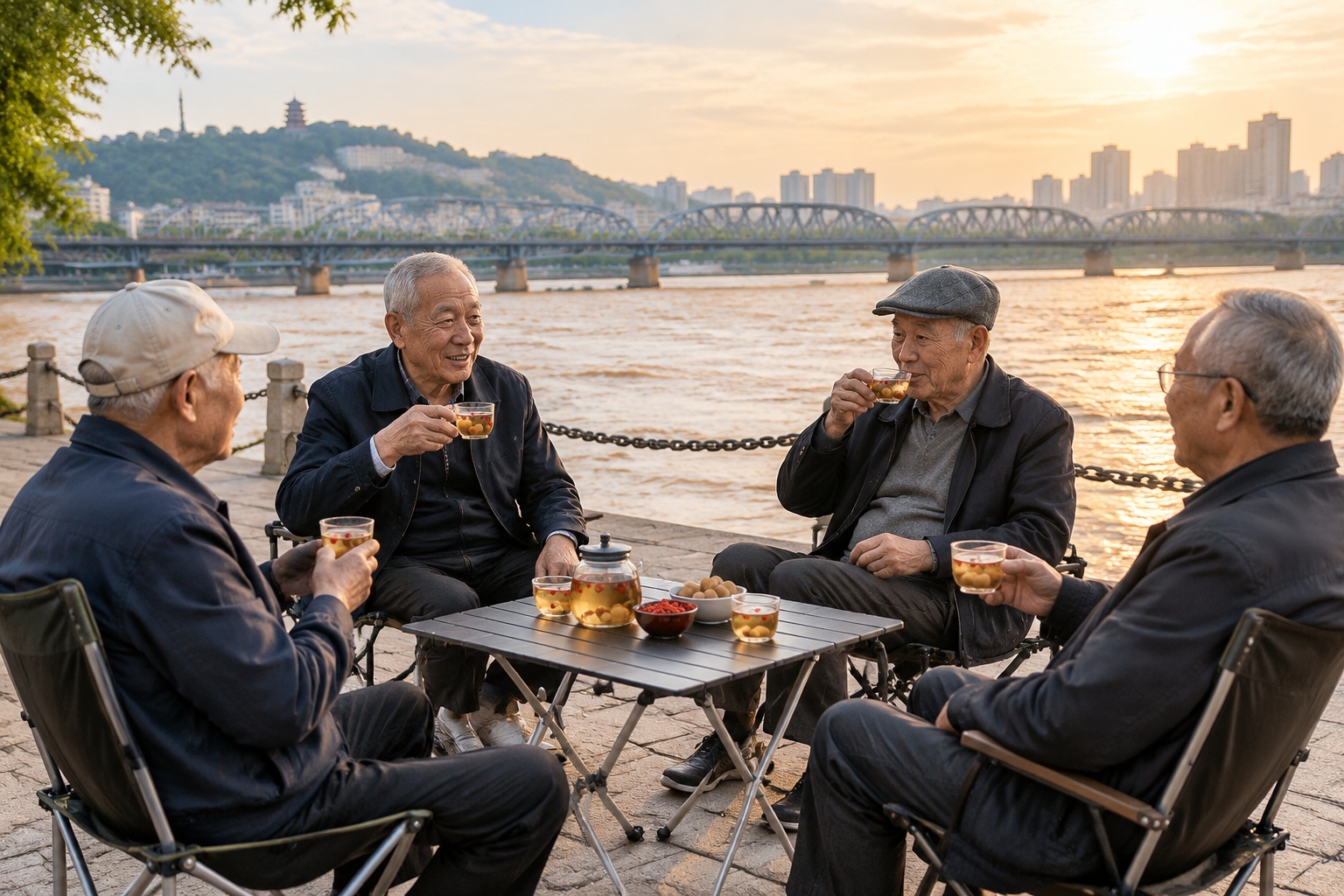
After breakfast, walk ten minutes east and you hit the Yellow River. Lanzhou is one of the few Chinese cities where the river runs through the center, not around it. On the south bank, near the Zhongshan Bridge, old men sit on folding chairs with glass cups of san pao tai tea—a mix of green tea, rock sugar, dried longan, and goji berries. They pour hot water from thermoses, refill, and watch the water go by. The river here is not blue. It’s the color of wet cement, moving slowly, carrying silt from the Loess Plateau.
Further along, you might see a sheepskin raft—yangpi fazi—bobbing near the shore. These rafts are made of inflated sheep hides tied to a wooden frame. They were once the main cargo transport on the upper Yellow River. Today, only a few remain, mostly for tourists. A ride costs about 30 yuan and lasts fifteen minutes. The raftman poles standing up, and the raft spins slowly in the current. It’s not thrilling. It’s quiet. You hear the water slapping the hides and the raftman humming a local tune.
For Lanzhou people, the river is not a scenic spot. It’s where they walk after dinner, where they fly kites in spring, where they sit and do nothing. The river is the city’s living room.
Why Hand-Pulled Noodles Matter to a City on the River
To understand Lanzhou beef noodles, you need to know two things: geography and migration.
Lanzhou sits at a crossroads. To the west, the Hexi Corridor leads to Xinjiang. To the south, the Tibetan Plateau begins. To the east, the Loess Plateau stretches toward Xi’an. For centuries, traders, soldiers, and nomads passed through. They brought wheat, beef, and spices. The noodles we call ‘Lanzhou’ today likely evolved from a fusion of Hui Muslim cooking (clean, halal, no pork) and Han Chinese noodle techniques.
The hand-pulling method—stretching dough into thin strands without a machine—is a Hui Muslim tradition. It requires a specific kind of wheat flour, high in gluten, and a precise ratio of water to ash water (a traditional alkaline solution that gives the noodles their yellow tint and springy bite). The alkaline water, called peng hui, is made by boiling certain plants. It sounds exotic, but it’s the same principle behind ramen’s kansui.
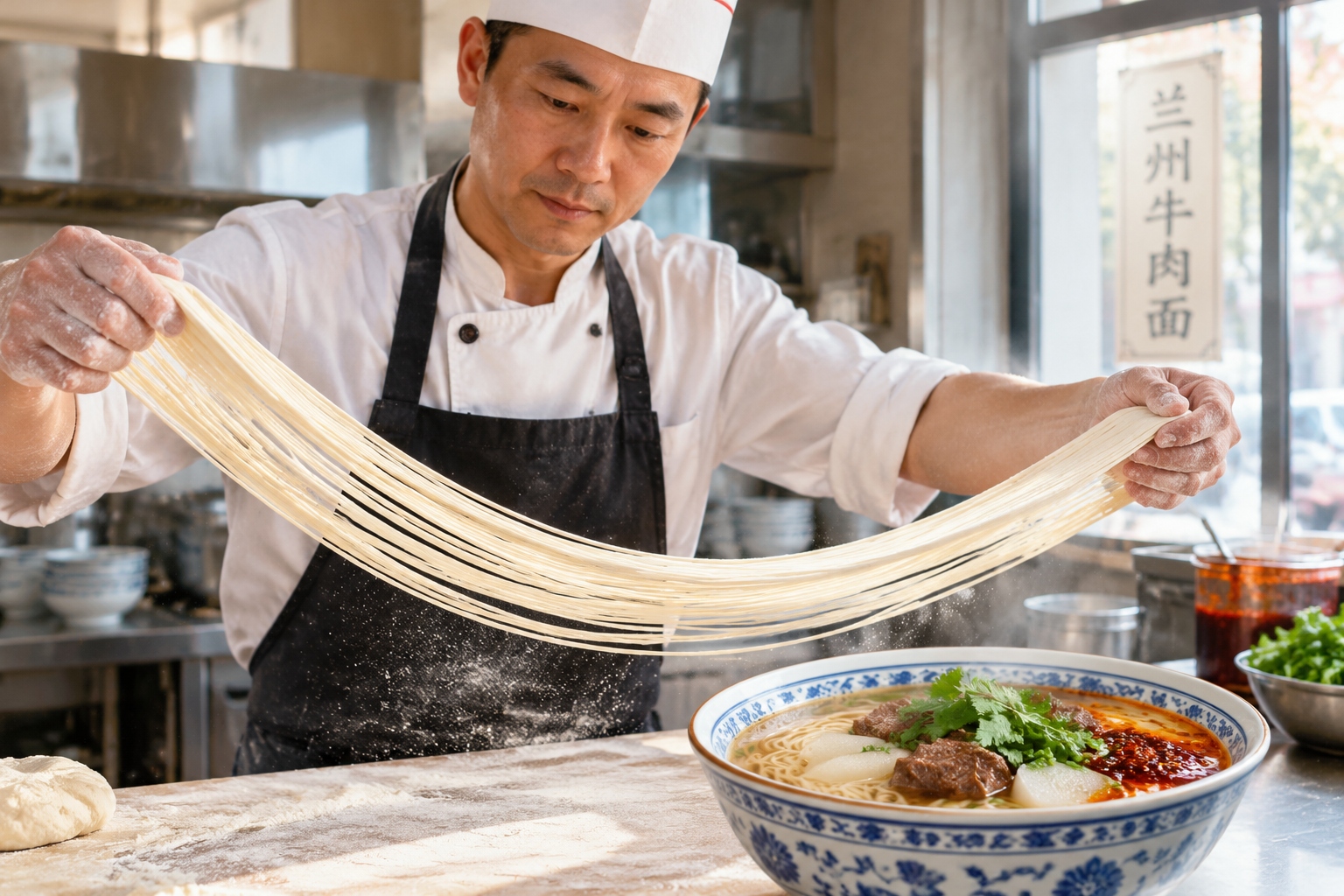
Today, Lanzhou has over 1,200 beef noodle shops. The city government estimates that the industry employs more than 100,000 people, from noodle pullers to beef suppliers to chili oil makers. A bowl costs between 8 and 15 yuan (about $1.10 to $2.10). It’s cheap, fast, and filling. For many workers, it’s the only meal they buy outside the home.
From Dawn to Midnight: The City’s Second Shift
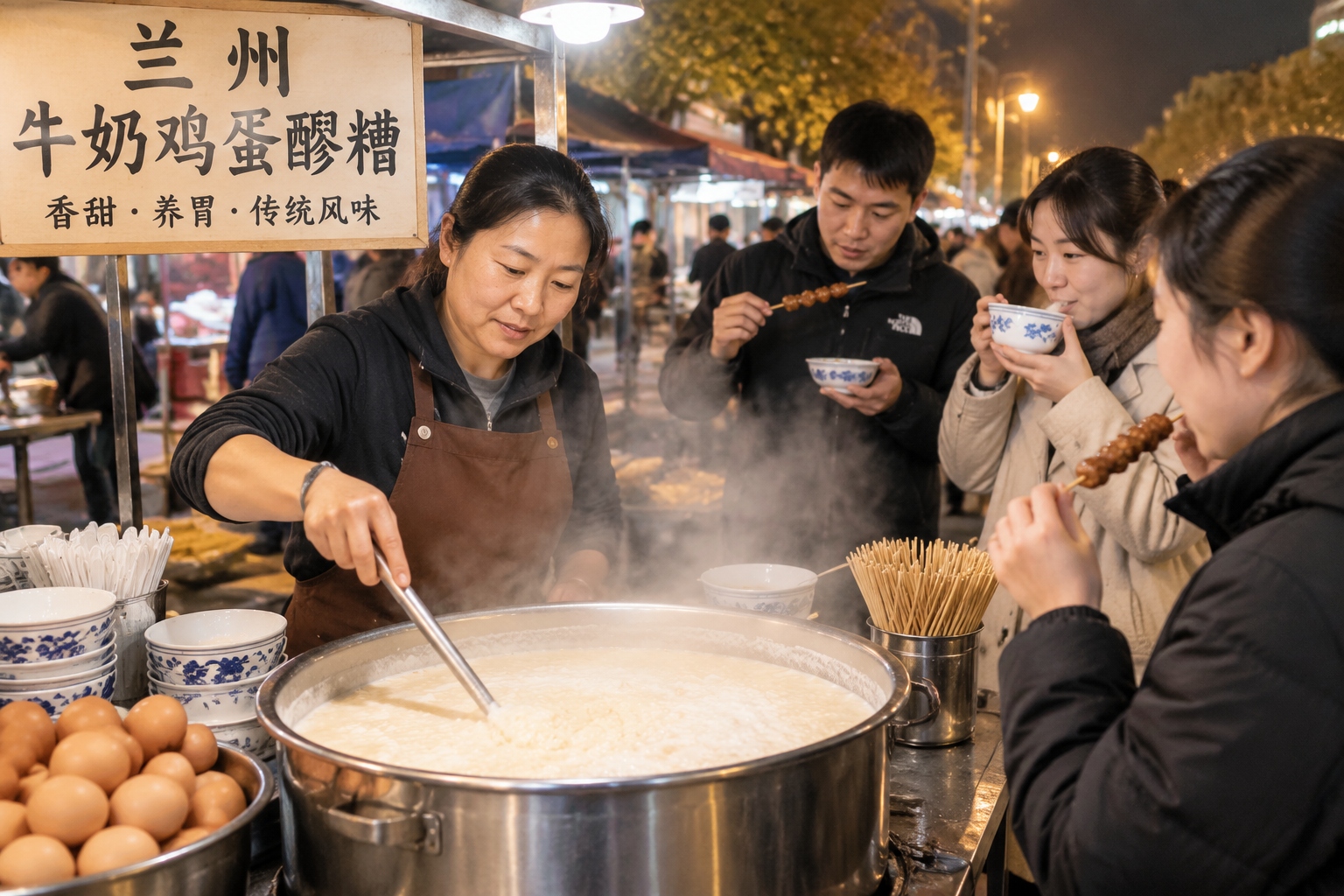
By 9 PM, the beef noodle shops are closed. But the city hasn’t stopped eating. In the night markets near Zhengning Road, the smoke changes from beef bone to charcoal. Skewers of lamb sizzle. Vendors call out prices. And in one corner, a woman stirs a large pot of niunai jidan laozao—milk, eggs, and fermented rice.
This dessert-soup is Lanzhou’s other signature. It’s sweet, warm, and slightly alcoholic from the fermentation. The woman cracks an egg into boiling milk, adds a spoonful of laozao (fermented glutinous rice), and sprinkles sesame seeds and raisins. A bowl costs 6 yuan. You drink it standing up, blowing on the surface. Around you, students eat grilled oysters, couples share fried potatoes, and a man in a suit eats alone, scrolling on his phone.
The same river flows nearby, dark now, reflecting the streetlights. The city that started with a bowl of noodles ends with a bowl of sweet soup. Between those two bowls, there is work, school, traffic, arguments, laughter—all the ordinary things.
What a Bowl Tells You About Lanzhou
Lanzhou is not a wealthy city. Its GDP per capita is below the national average. Many young people leave for Beijing, Shanghai, or Chengdu. But the city has a rhythm that is hard to find elsewhere. It is a rhythm built around the river and around food. The beef noodle shop opens at 6 AM and closes by 2 PM. The tea stalls by the river stay until sunset. The night market runs until 2 AM. People eat, talk, walk, and eat again.
For a visitor, the easiest way to feel this rhythm is to do what locals do: order a bowl of noodles in the morning, sit by the river in the afternoon, and eat laozao at night. You don’t need to understand the history. The bowl explains it.
Start the discussion at forum.chinacomes.com