
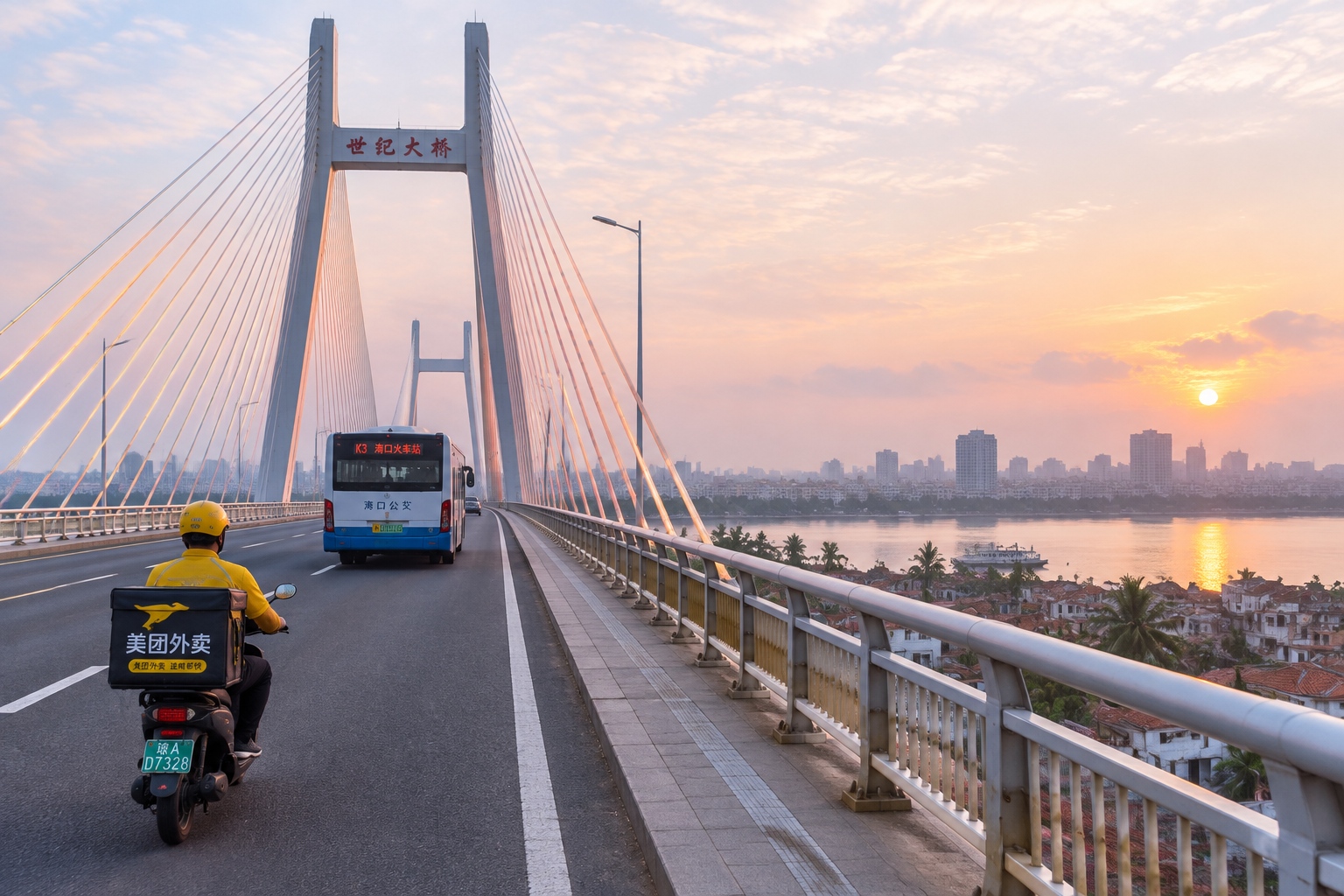

6:40 a.m., halfway across the Century Bridge
The deck of Haikou’s Century Bridge is already warm underfoot. It is 6:40 on a July morning, and the sun has come up behind Haidian Island, turning the Haidian River below into a sheet of grey-pink. Two buses cross in opposite directions. The bridge makes the sound that cable-stayed bridges make at that hour — a low hum in the stay cables, a clack-clack-clack where tires hit the expansion joints.
Down on the mud bank at low tide, a man in a faded polo shirt is fishing with a handline, unhurried. North of him, Haidian Island stacks up in cream and grey apartment towers. South, the old town sits low and dense, its rooftops interrupted by air-conditioning units and a few coconut palms. The river runs between them like a seam.
Most visitors to Hainan land at Meilan Airport, go straight to Sanya, and never see this. Which is a shame, because Haikou — the island’s capital, a tropical port of just under three million people — is a place where you can watch two eras share the same street map without pretending they don’t touch.
What the bridge actually does
Century Bridge opened in 2003. It runs about 2.6 kilometers, cable-stayed, on two H-shaped towers, and it does the least romantic job in the city: it moves traffic across the Haidian River between downtown Haikou and Haidian Island, where Hainan University’s campus sits along with student dormitories, seafood restaurants and newer apartment blocks.
Before the bridge, crossing meant a ferry or a long loop around. Now it takes five minutes. Watch it at 11 p.m. and you see what it really is: delivery riders with insulated boxes, taxis, container trucks heading for the port, a bus carrying three passengers.
It is also, whether the city planned it or not, a viewing platform. Around 7 p.m. in the drier months, couples in rented gowns come out to the approach roads for wedding photos, and older men park their electric scooters on the sidewalk to watch the sun drop into Haikou Bay. There are pedestrian walkways on both sides. At noon in July you will have them to yourself. At dusk, you won’t.
Under the arcades: a South Seas street that is still a street
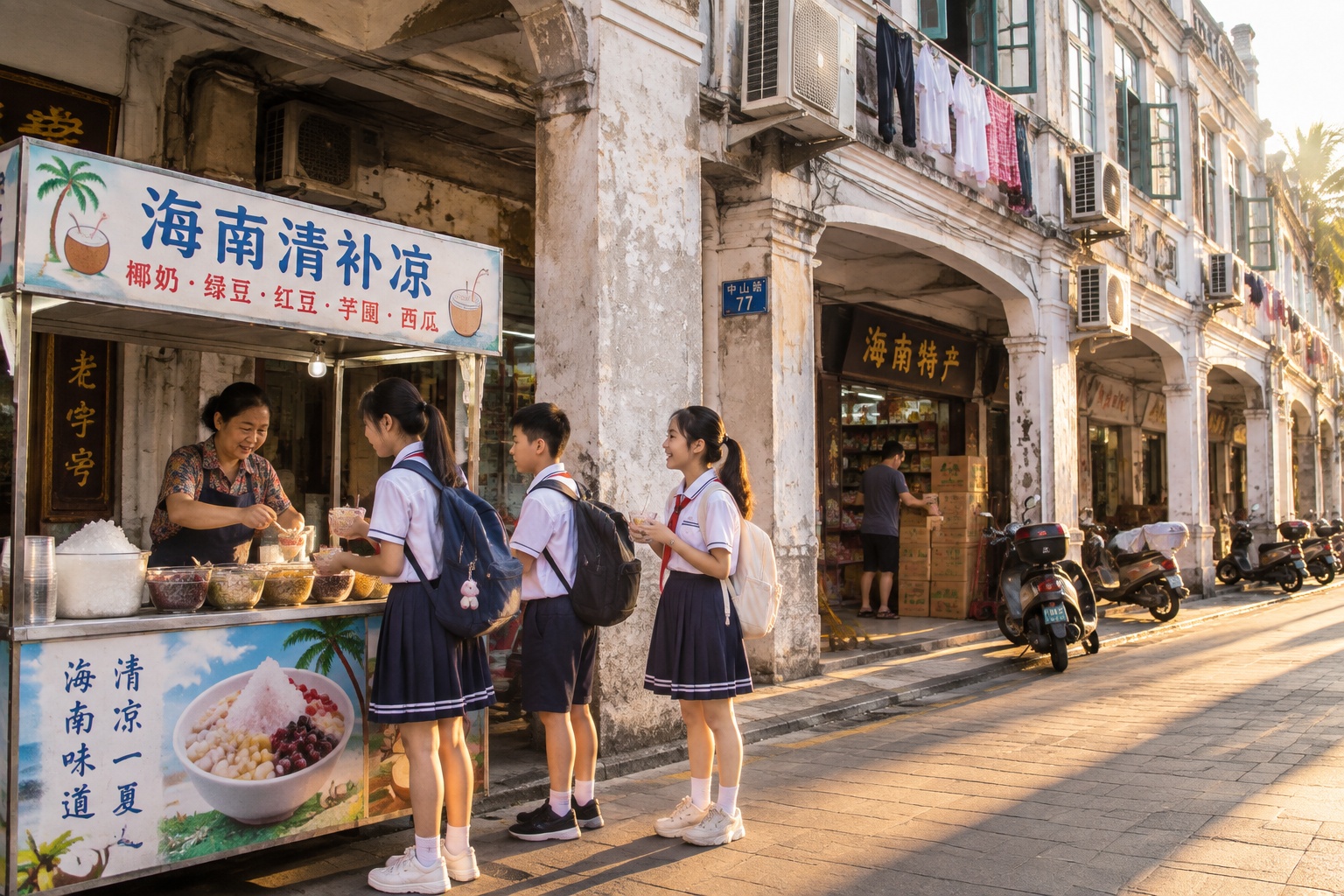
Fifteen minutes south of the bridge, the city changes scale. The streets of the old district — Zhongshan Road, Bo’ai Road, Deshengsa Road, Xinhua Road, and the narrow lane called Shuixiangkou — are lined with qilou, literally “riding buildings”: shophouses whose ground floors are set back behind columns, leaving a covered walkway for pedestrians and weather.
Step into one at noon and you understand the architecture without needing a plaque. Outside it is 34°C and the light is white. Inside the arcade it is shaded and moving with air, the pavement cool, and every few meters a shop the width of a corridor: a herbalist, a barber, a phone-repair counter, a woman selling incense and paper money for ancestor rituals.
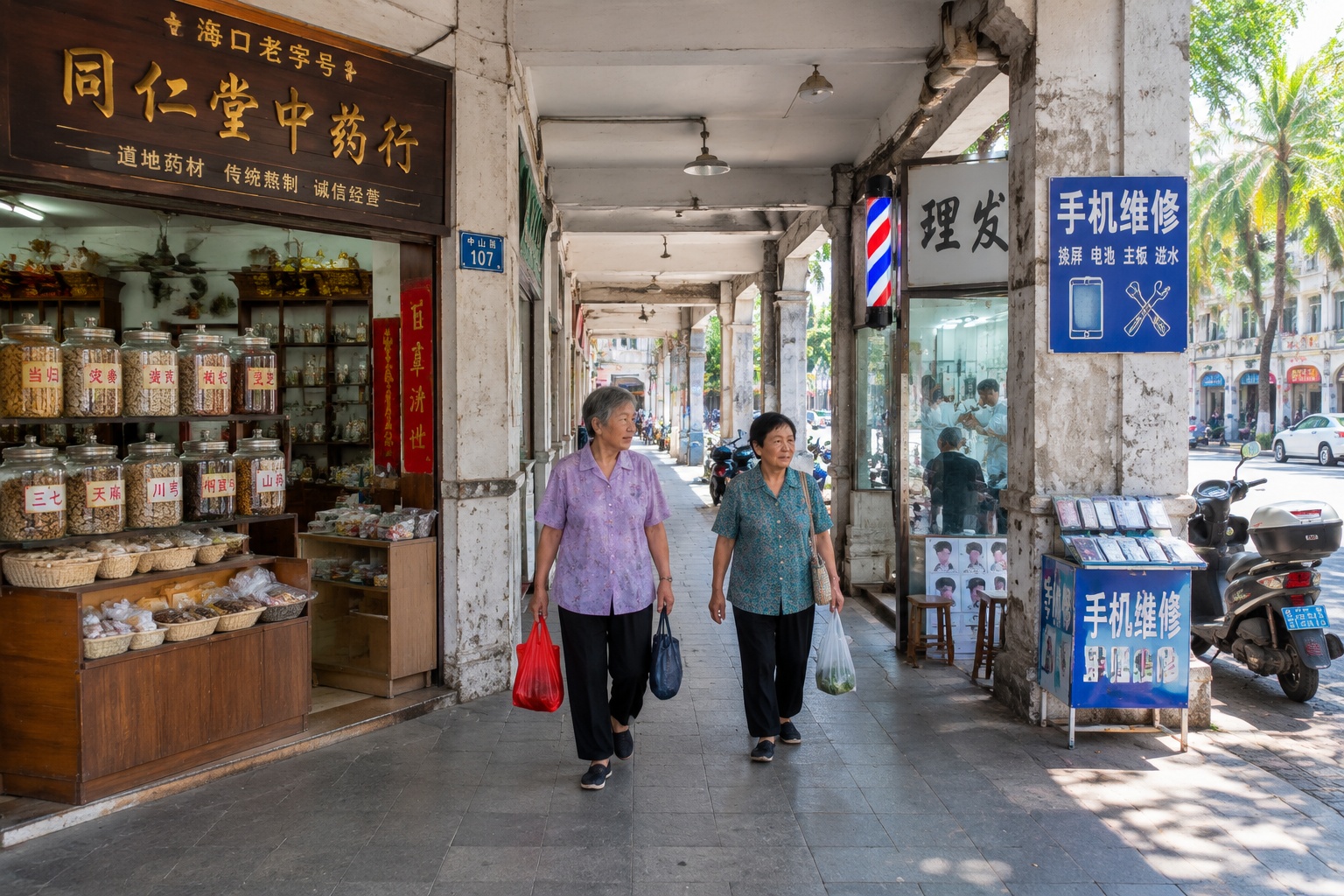
The buildings went up mostly in the 1920s and 1930s, paid for by merchants and by Hainanese who had gone to Southeast Asia to make money — Singapore, Malaya, Indonesia, Vietnam, Thailand — and came home to build. That is why the details don’t sit inside one tradition: Baroque-ish parapets and plaster mouldings above Chinese carved panels and shuttered timber windows, tiles and proportions borrowed from the colonial shophouses of Penang and Singapore. Locals call the mix Nanyang — “South Seas” — style.
The district had a practical job, too. Haikou was a treaty port, and goods moved between the wharves and these streets. The bell tower by the river, first built in 1929, was there to keep time for the port, not for tourists.
What keeps the place alive is that nobody emptied it out. Walk one block off the restored pedestrian stretch of Zhongshan Road and you find laundry strung under the arches, split air-conditioners bolted to 1930s walls, motorbikes parked three deep, a woman selling pork at 7 a.m. Some buildings still carry unsafe-structure notices, with thin steel props against the facades. The pedestrian section was finished about a decade ago; it tidied up the postcard view, and people argue about whether it went too far. The argument itself is a sign that this is a neighborhood, not a set.
One morning, hour by hour
At 6:30, Shuixiangkou smells like white pepper. The pepper-soup rice shops on the lane open before dawn: a bowl of pork-and-pepper broth, a slice of sausage, a fried egg, rice. Workers eat standing, then ride off.
By 8, the tea houses on the side streets are full of older men. This is laoba cha — “old dad tea” — a Haikou institution with almost nothing to do with the ceremony visitors expect from Chinese tea. You order a glass of milk tea or coffee with condensed milk, you get a plate of buns or a bowl of noodles, and you sit for three hours. Fans turn overhead. Somebody is always discussing lottery numbers.
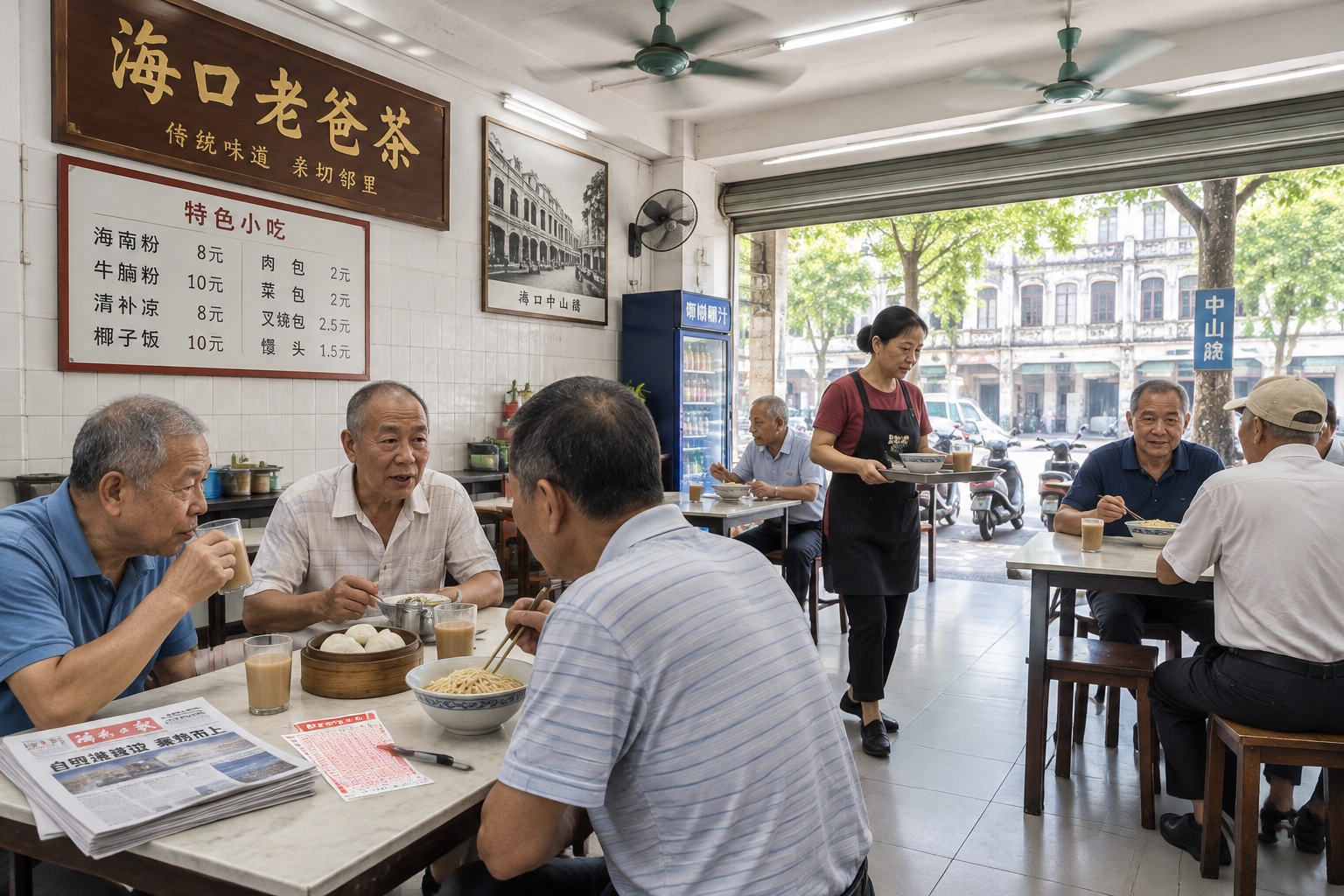
At 10, the herbal medicine shop on Bo’ai Road is weighing dried roots on a brass balance. There is an abacus on the counter that hasn’t moved since the 1990s, and beside it a mobile-payment QR code that gets scanned fifty times a day.
At 11:30, school lets out. Uniforms, backpacks, and a run on the qingbuliang stall — coconut milk, crushed ice, red beans, jelly, taro, peanuts, in no fixed order. It costs about the price of a bus ticket, and it is the reason some people here will tell you Haikou’s summer is survivable.
At four in the afternoon, if you are lucky, you will hear an amateur Qiong opera troupe under the arcade: a few instruments, a folding table, a small crowd, no stage, no tickets.
The walk: from arcade shade to river wind
You can connect the two halves of this article on foot in about an hour and a half. It is roughly four kilometers, almost entirely flat, and it is the best free thing to do in Haikou.
Start at Shuixiangkou or the eastern end of Zhongshan Road, early, while the arcades are still cool. Walk north through the grid toward Deshengsa Road, then west along the river to the Bell Tower on Changdi Road. From there, follow the water.
This is where the walk changes character. The arcades end, and the shade ends with them. The Haidian River opens into Haikou Bay, and the promenade runs west along the coast, fishing boats on one side and a strip of lawn on the other, where people do tai chi in the morning and fly kites in the evening. Around 5:30 p.m. the wind arrives off the water, the temperature drops a few degrees, and everyone in the city seems to remember they live on a tropical island.
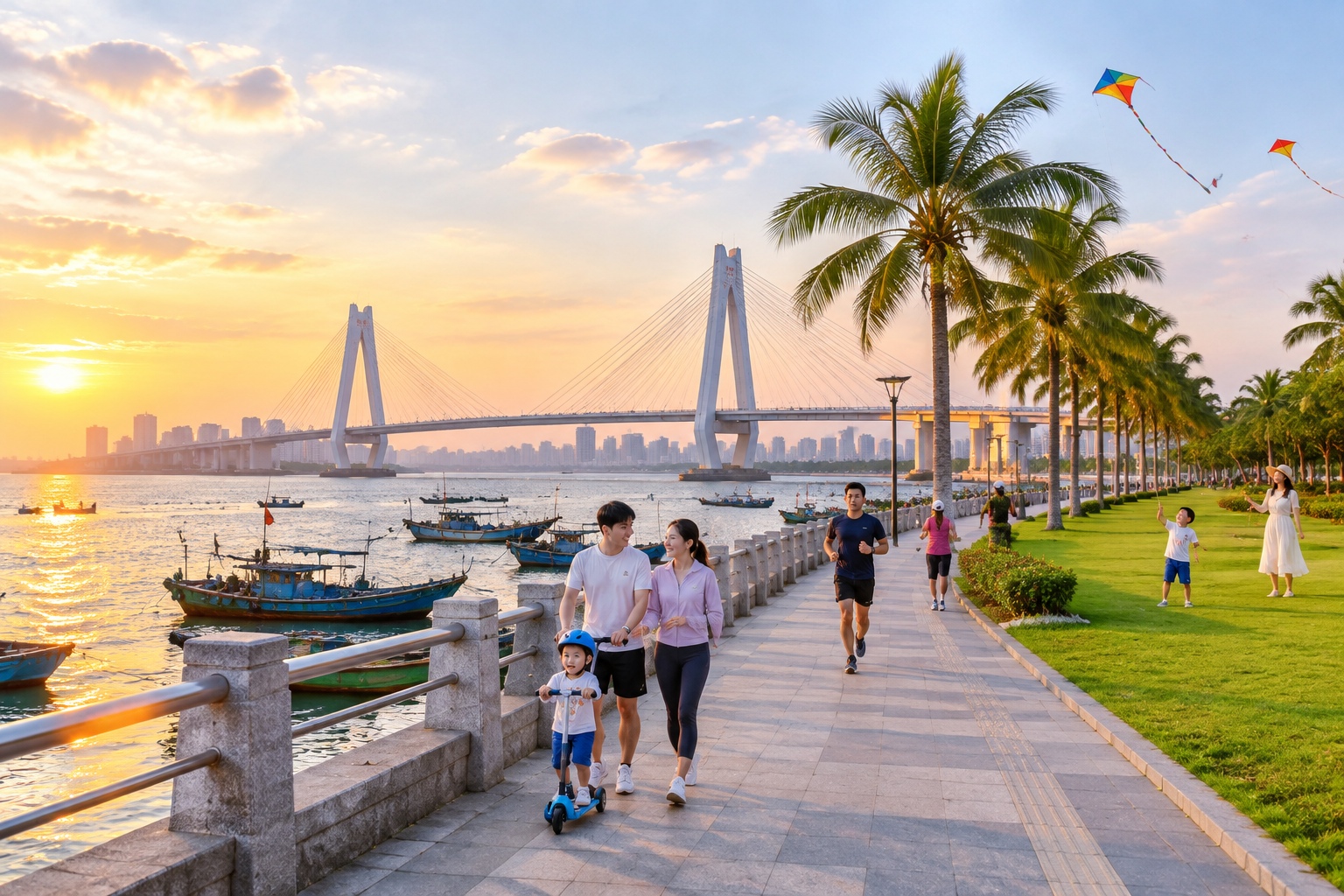
Keep going west to Evergreen Park, roughly 70 hectares of palms and lawns, and the Century Bridge appears ahead of you, its two towers lit at dusk. The whole route is four to five kilometers. Do it once at 6:30 a.m. and once after 5 p.m.; in between, in a Haikou summer, the sun is not a joke, and the afternoon rain comes fast and warm and then simply stops.
Why Haikou’s landmarks don’t look like anybody else’s
Chengdu has the Anshun Bridge, a covered bridge over the Jin River that now houses restaurants and glows red at night. Guiyang has Jiaxiu Tower, a Ming-dynasty pavilion planted in the middle of the Nanming River. Both are beautiful, and both are, in the most literal sense, destinations: you go to them.
Haikou’s equivalents are different in kind. Century Bridge was built for traffic in 2003 and became scenery by accident. The qilou district was built for trade in the 1920s and never stopped being a place where people buy pork, get their blood pressure checked and send their kids to school. Neither was designed to be looked at. That is exactly why they are worth looking at.
There is a real tension here, too. Renovation has made the eastern stretch of Zhongshan Road prettier and more expensive; some longtime residents moved out; several buildings behind the facades are still waiting for money to be fixed. A visitor who walks only the clean pedestrian street leaves with a slightly too-sweet story about “old Haikou.” Walk three streets further and the story gets more complicated — and truer.
If you go
- Time it: 6:30–9 a.m. or after 5 p.m. Midday between May and October is a test of character.
- Getting there: Haikou Meilan Airport has direct flights from Southeast Asia; the island’s high-speed rail loop stops at Haikou East. The old district is about ten minutes by taxi from the center — get out anywhere near the Bell Tower or Zhongshan Road.
- Money: mobile payment is nearly universal. Small shops may or may not take cash, but they will take a QR code.
- Eat: pepper-soup rice at Shuixiangkou, Hainan rice noodles, laoba cha, and qingbuliang after 3 p.m.
- Walking the Century Bridge itself: sidewalks exist on both sides, but it is a working road with fast traffic. Many locals prefer to look at it from Evergreen Park or the riverside promenade and cross the river by bus or taxi.
And if you are assembling a longer trip: Chengdu’s river bridges, Guiyang’s Jiaxiu Tower, Kunming’s Golden Horse and Jade Rooster arches, the Potala in Lhasa, Xi’an’s city wall — China’s urban landmarks are not one type. Some are monuments you visit. Some are bridges you drive across on the way to work. Haikou’s happen to be the second kind, which is why they deserve a morning.
Start the discussion at forum.chinacomes.com