


Two hours by train, zero comprehension
A man from Wenzhou boards a high-speed train and rides about 90 minutes north to Hangzhou. Both cities sit in Zhejiang province, roughly 300 kilometres apart. When he steps off and asks for directions, the person he stops may understand nothing he says. Wenzhou dialect is that far from what people speak an hour and a half away.
Shrink the distance further. Fuzhou and Xiamen are both in Fujian, about 250 kilometres apart. Fuzhou speaks a Min Dong variety; Xiamen speaks Hokkien. The two are not merely hard to follow for each other. They are genuinely separate. The same holds for Guangzhou and Taishan, an hour’s drive apart in Guangdong, where the local speech diverges enough that Cantonese speakers regularly ask for repeats.
For most people outside China, this is the first surprise. The country looks linguistically uniform from a distance: one writing system, one national language on the evening news. Up close, it is one of the most linguistically diverse places on earth.
The English word dialect misleads you
In English, a dialect usually means a variation you can mostly follow. British versus American. Bavarian versus standard German. Accent, vocabulary, a few grammatical quirks.
In Chinese, the everyday word is 方言, fangyan, literally regional speech. It carries none of the mutual-intelligibility assumption. Linguists usually classify Mandarin, Yue (which includes Cantonese), Wu (Shanghainese and its neighbours), Min (Hokkien, Teochew, Fuzhou), Hakka, Gan, Xiang and Jin as separate languages inside the Sinitic family. Most of them fail the standard test of intelligibility completely.
The scale is comparable to the Romance languages. A Portuguese speaker and a Romanian speaker do not chat. A Cantonese speaker and a Shanghainese speaker do not either, unless both switch to Mandarin.
Even Mandarin itself is not one thing. The Mandarin group covers a vast area, from Sichuan to the northeast. Those varieties are broadly intelligible to each other, but they sound very different. A Chengdu resident and a Harbin resident understand each other fine, and can also tell in three seconds where the other is from.
What actually holds the country together: characters
The shared writing system. The character 我 means I everywhere. In Mandarin it is read wǒ, in Cantonese ngó, in Hokkien góa. Same character, same meaning, three unrelated sounds.
The closest analogy for an English speaker is Arabic numerals. Everyone reads 3, but says three, trois, drei or sān. The symbol crosses borders; the sound stays home. Written Chinese works on the same principle, which is why a Cantonese speaker in Hong Kong and a Mandarin speaker in Beijing can read the same news article, then fail to order lunch for each other.
The unity is not total. Cantonese has its own colloquial written forms — 唔 for not, 嘅 for the possessive — used constantly in Hong Kong texting and social media, and mostly opaque to readers from the north.
Then the country decided everyone needed one common language
Putonghua, usually translated as standard Mandarin, is based on Beijing pronunciation and was codified in the 1950s. It spread through schools, radio, television and later the internet. By 2020 the Ministry of Education estimated that about 80 percent of the population could use it, with a goal of 85 percent by 2025. Two generations earlier, that number was far lower, especially in the countryside and the south.
Readers from Europe may recognise the mechanics. Italy only made standard Italian a genuinely national language after unification in 1861, through schools, railways and conscription. Regional languages such as Sicilian and Neapolitan survived, but shrank. France did something similar with Occitan and Breton, more forcefully. China’s version was less coercive than France’s and less bottom-up than Italy’s, but the toolkit was familiar: classrooms, broadcasters, and jobs that required a shared tongue.
Almost 300 million people moved, and the language moved with them
China’s urbanisation rate went from under 18 percent in 1978 to roughly two-thirds today. Close to 300 million rural migrant workers left home for factories, construction sites, restaurants and delivery work in cities, very often in provinces where their own speech was useless.
At the same time, people married across provinces at a scale with no precedent. When a woman from Hunan and a man from Shandong raise a child in Shenzhen, the household language is usually Mandarin, because it is the only one both parents share. Teachers speak Mandarin. Television speaks Mandarin. The kid’s friends speak Mandarin.
That is how the change is actually experienced. Not as policy, but as a child answering his grandmother in the wrong language.
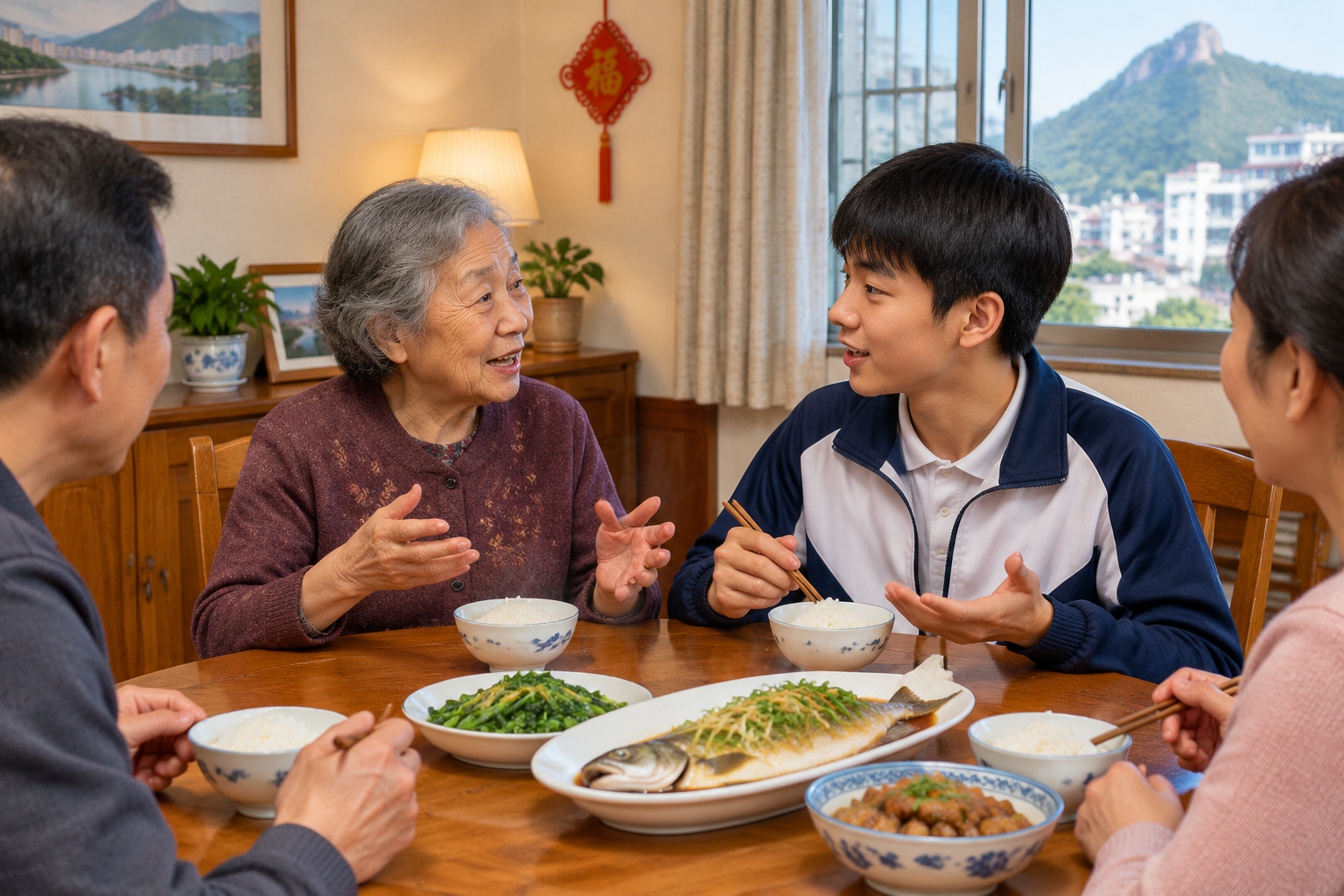
What a family dinner in Guangdong sounds like
Picture a Taishan family in a Guangdong apartment. The grandmother is 78 and speaks Taishanese at the table, the way she has her whole life. Her 16-year-old grandson understands perhaps two-thirds of it and replies in Mandarin. Nobody is making a political statement. Nobody is being disrespectful. It simply happened, the way water finds a lower place.
If you grew up in an immigrant family in the United States, Canada or Australia, this may feel oddly familiar: grandparents in Spanish, Vietnamese or Tagalog, grandchildren answering in English. The difference is that in China nobody crossed a border. The boundary between the languages is internal, and it has been there for centuries.
Where this becomes practical, including for visitors
If you study Mandarin for three years and then move to Guangzhou, you can still find yourself in a wet market where the vendors are chatting in Cantonese. Most will switch to Mandarin the moment they hear your accent, since service workers in big cities are used to it. But a lot goes on around you that your textbook never covered.
Television handles the same problem in its own way. Chinese broadcasters routinely subtitle dialect speech in standard Chinese, for domestic audiences. Regional broadcasting exists — Cantonese programming in Guangdong, Hokkien in parts of Fujian — but its share has been shrinking for decades.

The revival is real, and mostly online
Since roughly the mid-2010s there has been pushback against the flattening. Some Shanghai metro lines added Wu-language announcements. Schools in a number of cities run optional dialect clubs. Guangdong’s Cantonese-language television has defended its airtime. On Bilibili and Douyin, dialect content pulls serious numbers: Sichuanese rap, Cantonese comedy skits, Wu-language vlogs, Hakka folk songs. Voice assistants from the big tech companies now handle a handful of regional accents.
Researchers who work on Wu varieties, especially around Shanghai and Suzhou, are nonetheless blunt. Among children born after 2010 in major cities, the local language is often a second language at best, and frequently a passive one — understood, never spoken.

If you are from Europe or North America, here is the nearest comparison
Take the European Union. Similar land area to China, dozens of official languages, and English functioning as the everyday lingua franca across borders. China has one official language and a comparable amount of underlying diversity.
The divergence is historical. In Europe, regional languages often became national languages with their own states, dictionaries and political movements. In China they were folded into a single written tradition and a single state, and labelled fangyan, regional speech, rather than separate languages. Whether you call something a language or a dialect is, in the end, as much a political decision as a linguistic one. That is true in China, and it is true in Europe too.
What to carry with you
If you visit China and hear people around you speaking something you cannot place, it may not be Mandarin at all. If you learn Mandarin well and still cannot follow the taxi driver in a small southern city, you have not failed. You have simply met the reality that Chinese is a family of languages, not a single one, and that the country runs every day on a working compromise between one shared standard and hundreds of local homes.
Start the discussion at forum.chinacomes.com