
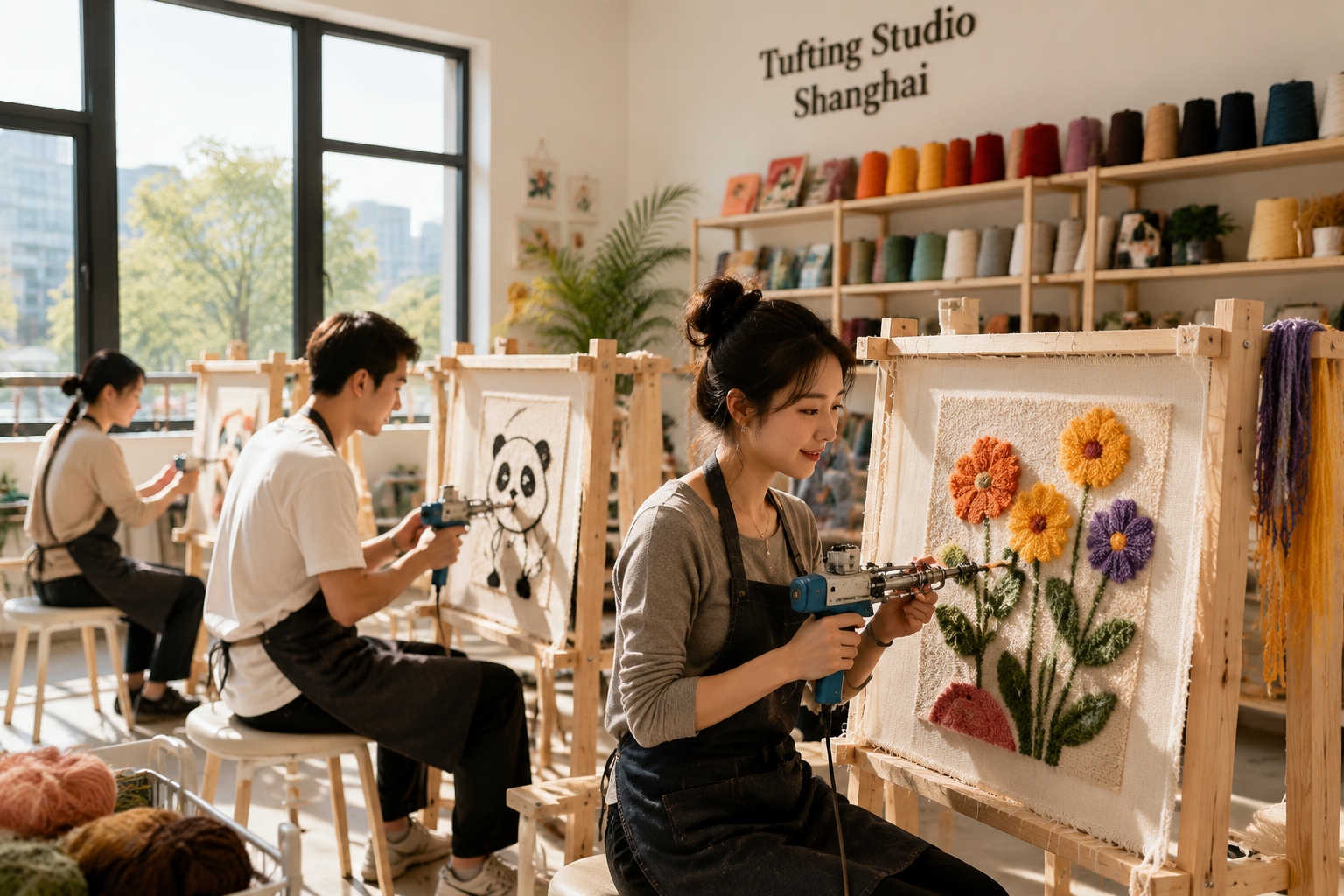

A Busy Afternoon at a Tufting Studio
It’s a Sunday afternoon in Shanghai, and inside a small studio in the Jing’an district, eight people are hunched over wooden frames, each holding a tool that looks like a heavy stapler with a needle. The room hums with a rhythmic buzzzz. On the walls hang colorful rugs, some shaped like clouds, some like cartoon cats, and a few with Chinese characters that read “good fortune.”
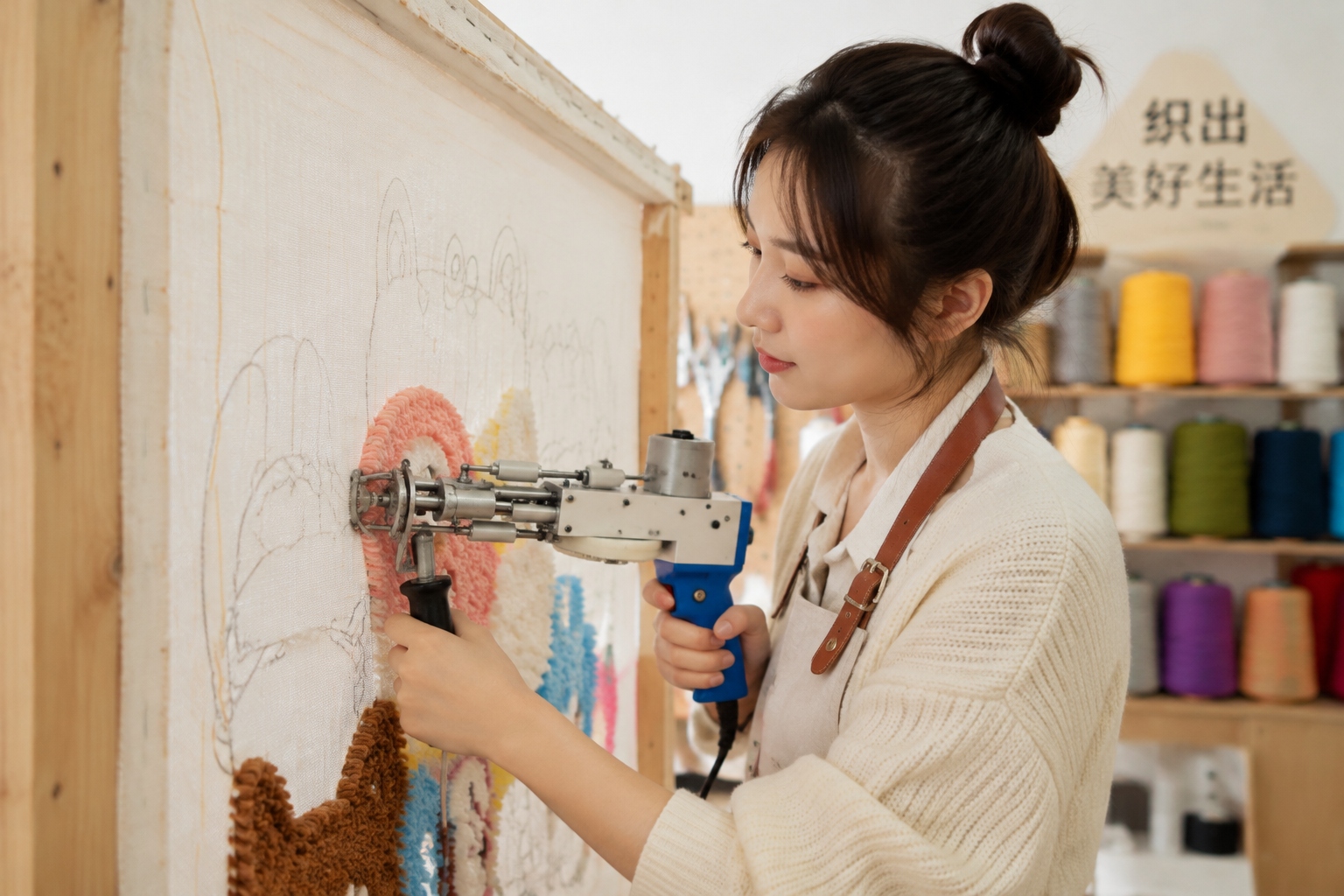
This is a tufting studio — one of the hundreds that have popped up across Chinese cities in the past two years. Tufting is a simple technique: you feed yarn through a hand-held tufting gun, and it punches loops into a stretched piece of cloth. With practice, you can “draw” with yarn, filling in shapes and colors until the cloth becomes a plush, textured carpet.
Unlike traditional weaving, which requires a loom and a patient understanding of interlacing threads, tufting is fast, forgiving, and easy to learn. A beginner can grasp the basics in ten minutes. That accessibility is exactly why it has become a crossover hit among China’s urban youth — part craft, part therapy, part night-out-with-friends activity.
From Rug Factory to Urban Pastime
Tufting is not a new invention. For decades, it has been used in the commercial production of carpets, especially in China’s eastern provinces. The mechanized process was developed in the early 20th century, and Chinese factories have long exported tufted rugs to the world. But the idea of turning the tufting gun into a hobby tool for ordinary people only began to circulate around 2020, when short-video platforms like Douyin and Xiaohongshu started showing millennial and Gen Z creators making their own mini rugs in living rooms.
It caught on because it feels both familiar and fresh. The tool is small enough to hold with one hand, the yarn comes in every color imaginable, and the finished product is soft and practical. Instead of learning to weave on a huge loom, you can tuft in a tiny studio apartment. That fits the lifestyle of many Chinese city dwellers, where space is limited but the desire to create is not.
Why Young People Are Hooked
The Chinese phrase “解压” (jiě yā), meaning “release stress,” is often the first thing people say when I ask why they came. A 26-year-old named Lin Tao, an accountant, tells me he spends his workdays staring at spreadsheets. “I just wanted to make something tangible with my hands,” he says, carefully guiding the gun along a traced outline of a mushroom. “It’s like meditating, but you get a rug at the end.”
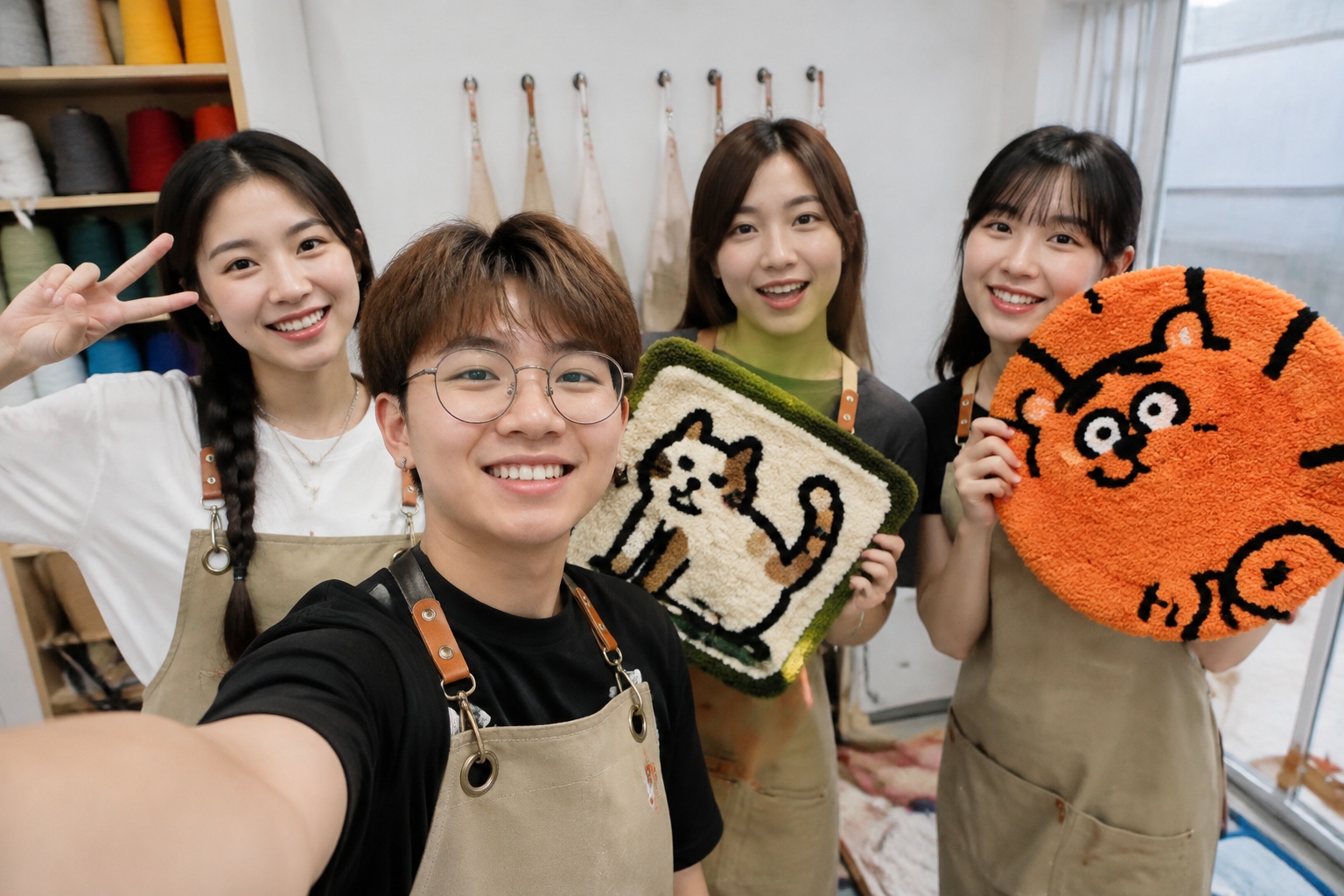
The popularity of tufting in China also feeds on social media. On Xiaohongshu (China’s lifestyle app, similar to Instagram), there are over 200,000 posts tagged with “tufting.” Young people come to studios not just to make something, but to take photos of themselves mid-process — wearing an apron, gripping the tufting gun, surrounded by vivid yarn. The soft, tactile, colorful visuals are tailor-made for the camera.
Many studios have turned this into a social experience. In Shanghai, Beijing, Chengdu, and Hangzhou, tufting studios are often located in converted warehouses or trendy loft spaces, with photo corners, neon signs, and drinks. Group bookings are common: friends celebrate birthdays, couples make matching coasters, and colleagues come after work for team-building. It’s a perfect example of “experience-based consumption” — spending money not on things, but on moments you can photograph and remember.
What It Feels Like to Tuft Your First Rug
I decided to try it myself. The process starts by picking a design — most people bring a picture from their phone. A staff member projects the image onto a piece of woven fabric stretched over a wooden frame, and traces the outline with a pen. Then you select your yarn colors from a wall of options — regular acrylic, thick bouclé, or soft chenille.
The tufting gun itself feels a bit intimidating. When I press the trigger, the needle pierces the fabric and draws a continuous line of yarn through it. The first few seconds are wobbly; the gun teats and the loops are loose. But within ten minutes, I find a rhythm. The gun moves like a heavy pen, and I learn to plan my strokes like I’m filling in a coloring book.
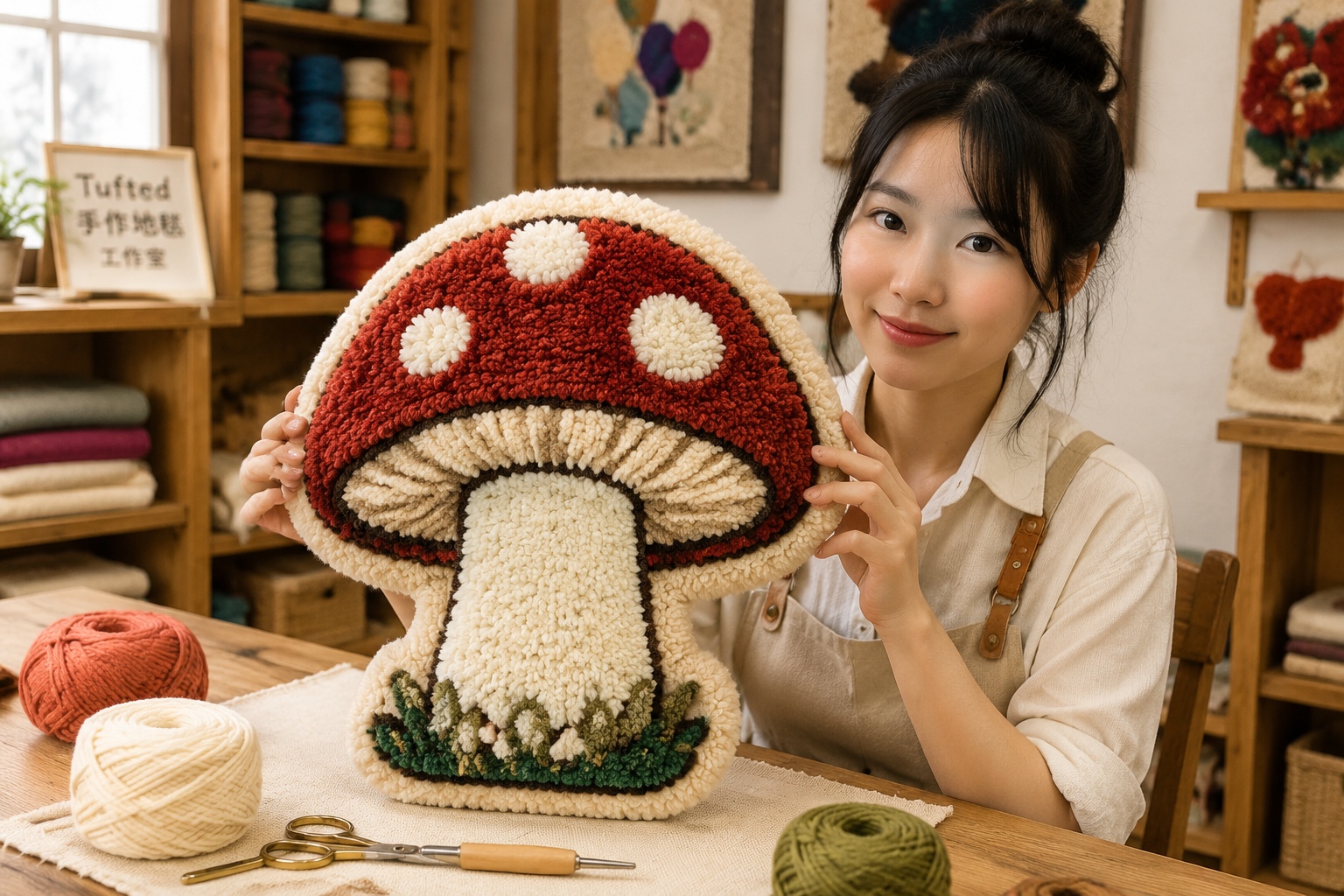
When the entire design is filled, you trim the excess yarn, apply glue and a backing, and then carve the surface with electric clippers to create depth and texture. The whole thing takes about three hours. For many beginners, the moment of stepping back and seeing their finished rug is pure delight. It doesn’t look perfect — but it’s yours.
A student named Chen Xue, who was making a small rug for her boyfriend, tells me: “I usually give him store-bought gifts. But this has my time and effort. He can see that I spent three hours thinking of him.” For her, and for many others, tufting is a way to make personalized gifts that feel more meaningful than anything from a mall.
Tufting Economy: Gifts, Décor, and a New Way to Earn
While most customers are first-timers, some have turned tufting into a side business. Finished rugs can be sold online. On Taobao, handmade tufted rugs in small sizes (about 40×40 cm) sell for 200–500 yuan (roughly $28–70). Custom pet portraits, wedding logos, and even brand mascots are popular commissions.
Studio owners are also doing well. The founder of the studio I visited, who asked to be called Xiao Tang, says she opened in 2021 after her previous job in advertising made her feel burned out. “The initial investment is not big: rental, frames, yarn, guns. We charge about 150 yuan per hour, and a typical session lasts three hours,” she explains. “We usually have around twenty customers on weekends, and we need to book a week in advance.”
For interior designers and home décor brands, tufting has become a fresh way to create statement pieces. In Shanghai’s café and boutique shops, tufted wall hangings are now ubiquitous. They add a handmade warmth to otherwise minimalist spaces. Some artists are pushing the medium further, creating large-scale tufted installations that blur the line between craft and contemporary art.
A New Handicraft for a Digital Generation
Tufting’s rise in China comes at a time when many traditional handicrafts are struggling to attract young apprentices. Embroidery, weaving, and carpentry require years of practice. Tufting, in contrast, offers instant gratification — a phrase that is sometimes used critically, but also captures why it works in today’s fast-paced urban culture. We don’t have to choose one over the other. For many young Chinese, trying tufting is a gateway into the broader world of handmade objects. Some studios even combine tufting with traditional elements, letting customers create patterns inspired by Chinese embroidery or batik.
At its core, tufting is more than a trend. It is a quiet answer to digital fatigue — a way to touch, create, and feel proud of something physical. As I left the studio, I saw a woman carefully wrapping her finished rug in bubble wrap, a smile stuck on her face. She was probably already planning her next tufting session.
Start the discussion at forum.chinacomes.com