
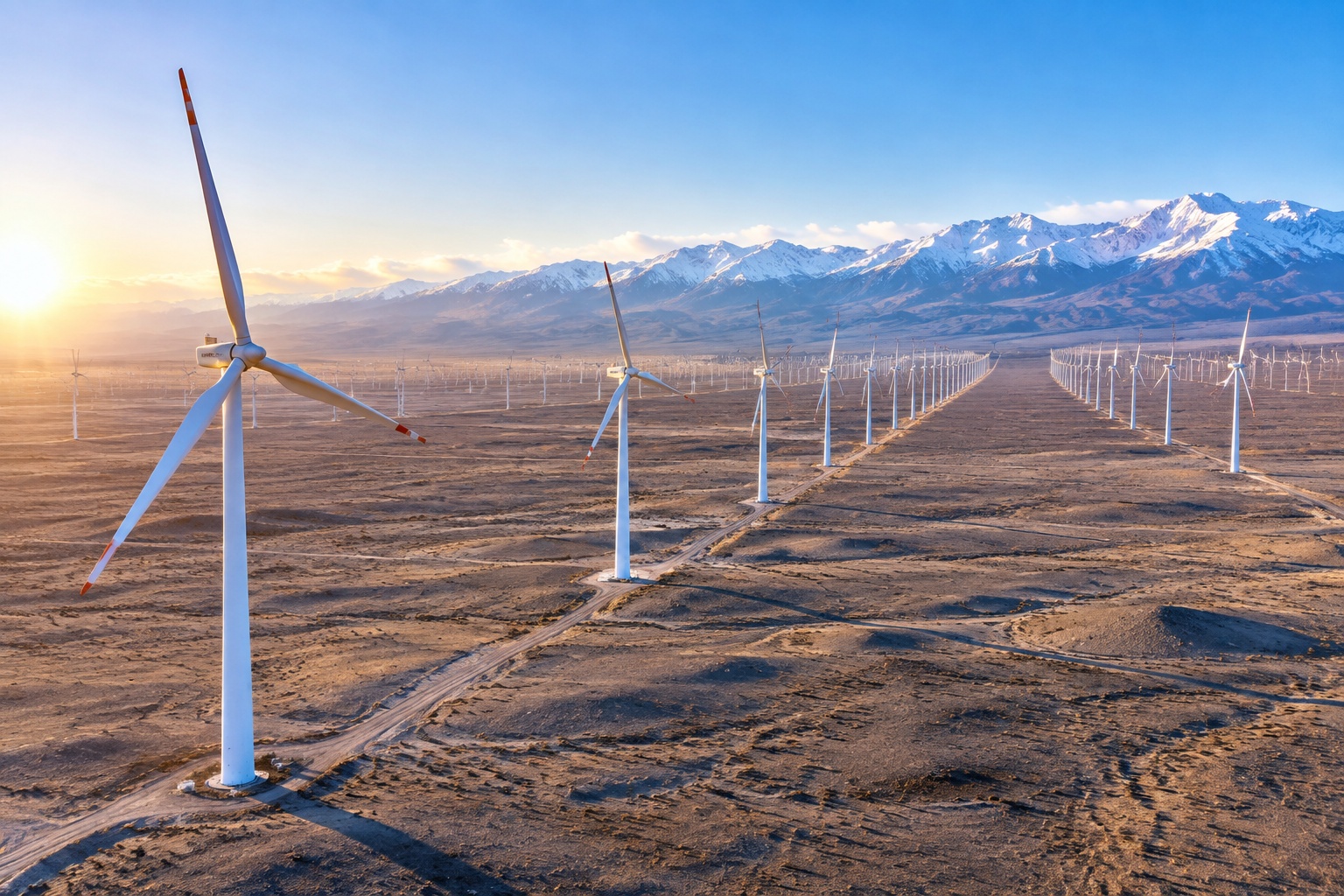

Driving Into a Forest of White Turbines
The road from Jiayuguan to the Jiuquan Wind Power Base is a lesson in scale. For nearly two hours, the Gobi Desert stretches out in every direction, empty and grey. Then the turbines appear, one after another, as far as the eye can see. Each stands about 100 meters tall, with blades as long as a passenger jet’s wingspan. There are thousands of them, spread across an area roughly the size of a small European country. This is not a single wind farm but a collection of dozens of them, sharing the same grid connections and transmission lines. Together, they form the Jiuquan Wind Power Base, a project that has been called the world’s largest wind power complex.
With a planned capacity of up to 20 gigawatts, the base is designed to be the biggest wind power cluster on Earth. By 2023, more than 10 gigawatts had been installed — enough to power about 15 million average Chinese homes. The turbines are grouped in clusters around the counties of Guazhou and Yumen, where wind speeds average more than six meters per second, making the Gobi floor one of China’s best areas for wind energy.
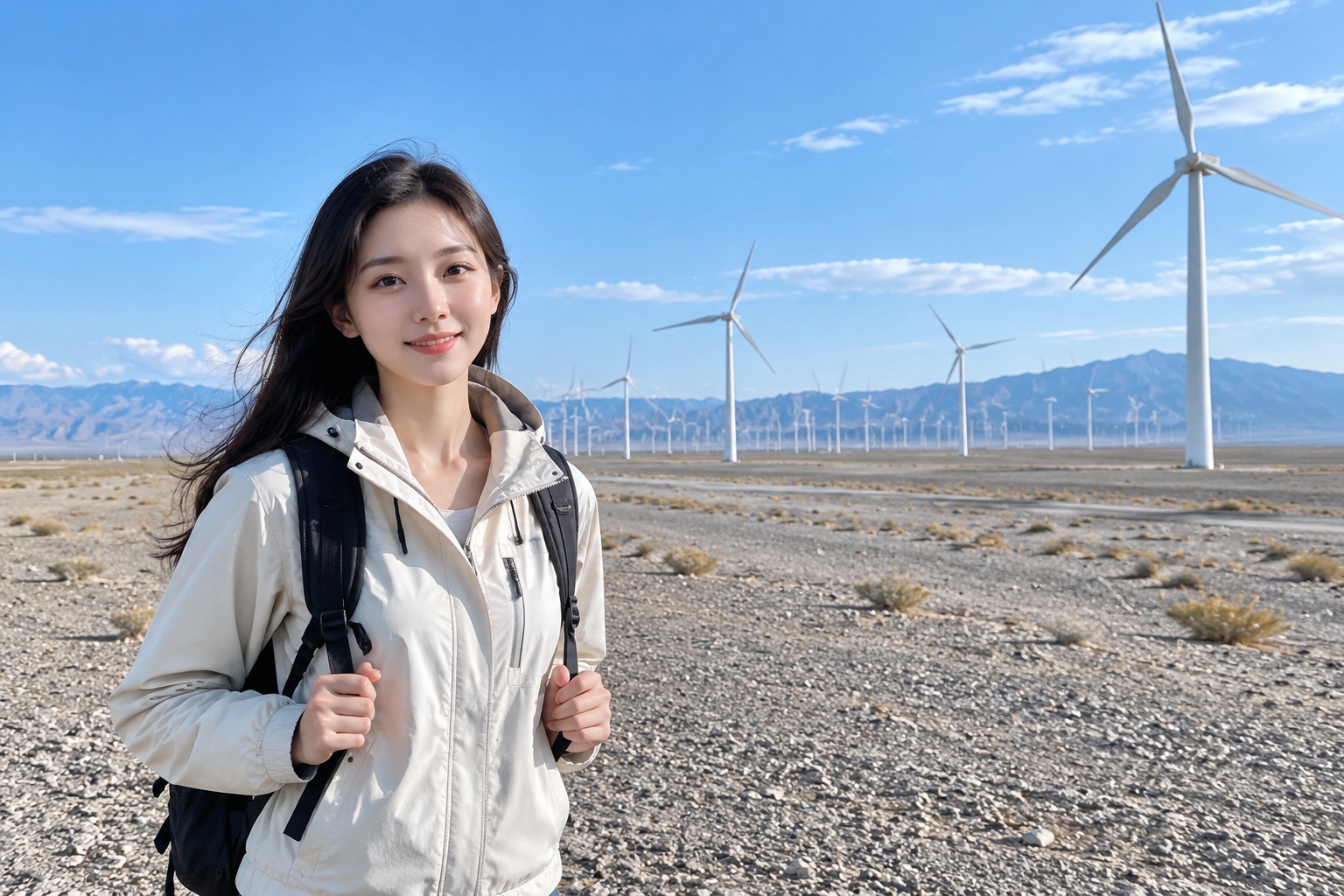
How a Desert Wind Farm Powers Cities Thousands of Kilometers Away
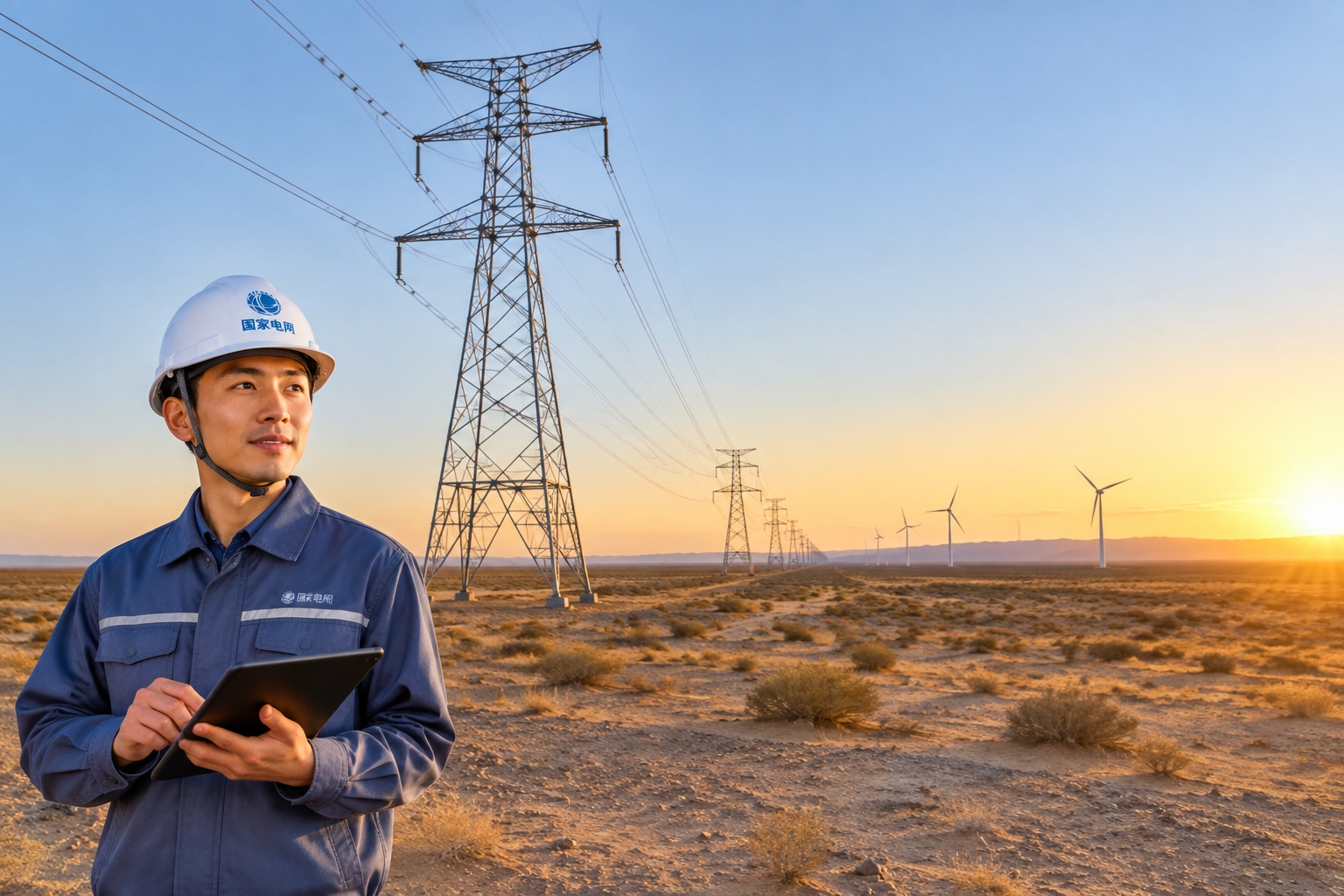
Wind energy is simple in principle: the wind turns the blades, which spin a generator inside the nacelle, producing electricity. But at Jiuquan, the complexity lies in what happens next. Each turbine produces electricity at a voltage of around 690 volts. That current flows through cables to an on-site transformer, which steps it up to 35 kilovolts, then to 110 kilovolts, and finally to 750 kilovolts for long-distance transmission.
The real breakthrough is the Jiuquan–Hunan ultra-high-voltage direct current (UHVDC) line, which opened in 2017. This 2,383-kilometer transmission line carries up to 8 gigawatts of electricity from the Gobi Desert directly to Hunan Province in central China, bypassing the crowded coastal grids. UHVDC technology is one of China’s key engineering achievements in clean energy, and Jiuquan sits at the starting point of the world’s longest and most powerful transmission lines of their kind.
The line solved a serious problem known as “curtailment” — when wind turbines had to be shut down because there was no way to use the power they generated. In the early 2010s, some farms in Gansu lost as much as 20% of their potential output. Thanks to UHVDC and better grid management, curtailment rates have fallen drastically, even as total installed capacity grew.
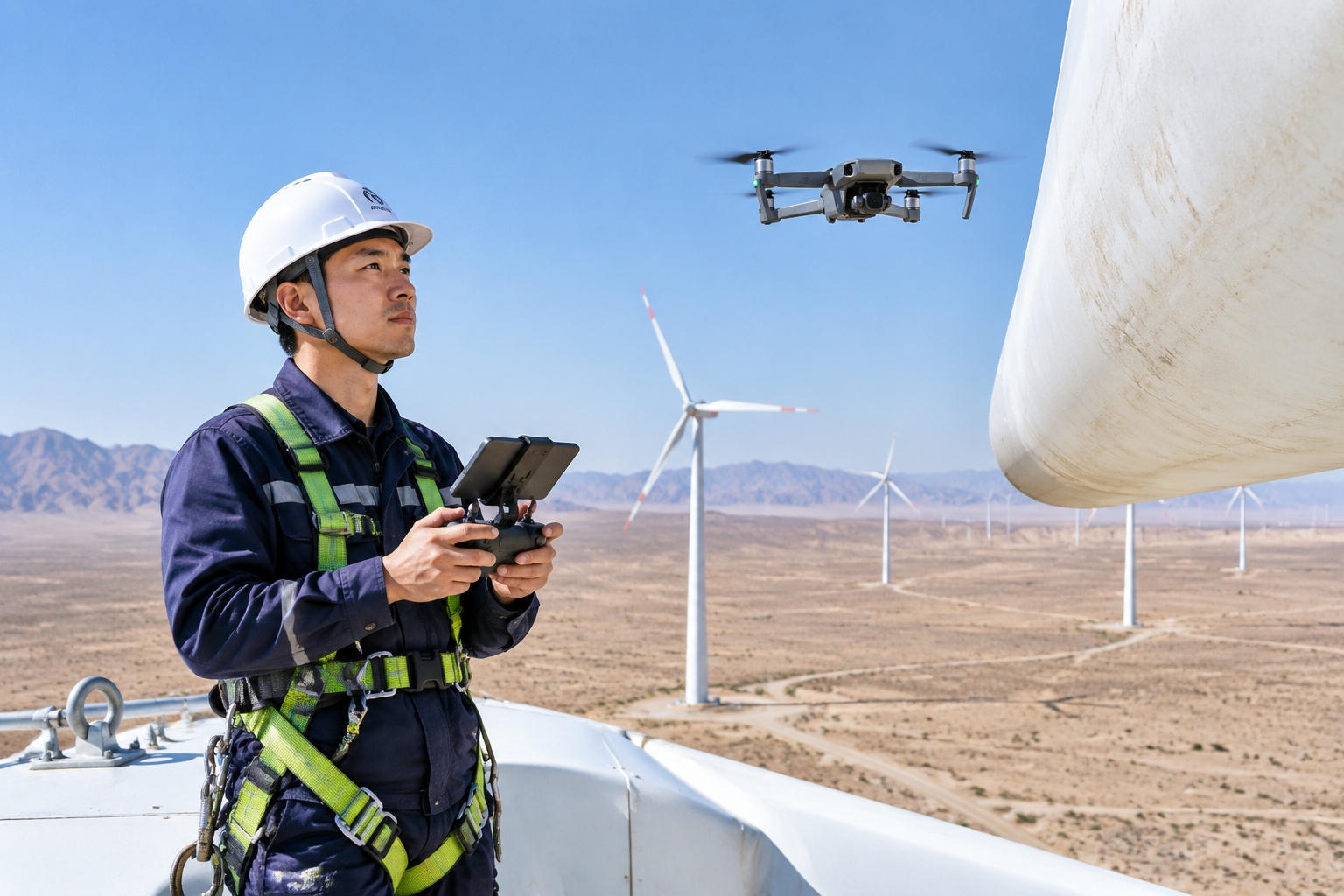
Keeping the Giants Turning: Maintenance Up Close
For engineers and technicians, the Jiuquan wind base is a workplace like no other. A typical workday involves driving up to a turbine, climbing a narrow ladder for 80 meters, and then spending hours inside the nacelle checking the gearbox, generator, and cooling systems. Many workers spend six days a week on the road, moving from one turbine to another. In recent years, drones have made inspections easier: a technician can fly a drone around the blades to spot cracks or lightning damage, saving days of manual climbing.
But the environment adds its own obstacles. Dust storms in spring can reduce visibility to zero and grind the turbine blades. Temperatures range from minus 30 degrees Celsius in winter to over 40 degrees in summer. The altitude, about 1,500 meters above sea level, means the air is thinner, affecting the performance of cooling fans. As a result, maintenance teams must be skilled not just in wind turbine technology but also in surviving in one of China’s harshest landscapes.
There is also the harder challenge of intermittency. When the wind stops or blows too hard, turbines must be feathered or shut down entirely. Grid operators use weather forecasts to plan output, and a growing fleet of battery storage units — some built on the same wind farm sites — helps smooth out the fluctuations.
Why Jiuquan Is a Pillar of China’s Clean Energy Push
Jiuquan is the largest single piece of a much larger picture. At the end of 2023, China had more than 400 gigawatts of installed wind power capacity, more than any other country, and about one-third of the global total. The Jiuquan base alone represents about 2.5% of that capacity, but its importance goes beyond numbers. It was the first project to prove that China could build and operate wind farms at the scale of the Gobi Desert, pioneering construction techniques for high-voltage equipment in sandy conditions.
The electricity generated here displaces coal-fired power that would otherwise consume millions of tons of coal per year. Estimates suggest that Jiuquan’s wind farms produce more than 20 terawatt-hours of clean electricity annually, avoiding over 15 million tons of carbon dioxide emissions. For comparison, that is roughly the emissions of 3 million cars over a year.
For the local economy, the wind base has been transformative. The city of Jiuquan, once chiefly known for its satellite launch center, now hosts wind turbine factories, maintenance companies, and a growing logistics and service sector. Tens of thousands of jobs in a sparsely populated region depend on wind power, from turbine blade technicians to truck drivers moving massive components across the desert.
What Comes Next for the Desert Wind Farms
The next phase of Jiuquan’s development is about integration, not just expansion. The Gobi wind farms are expected to work alongside large-scale solar parks, which are being built nearby, creating hybrid renewable bases that generate both day and night. Battery storage is also expanding: a 100 MW/400 MWh storage station was connected to the grid near Guazhou in 2023, and more are planned. In addition, state-owned energy companies have begun pilot projects using surplus wind power to produce green hydrogen, which can be used to make ammonia fertilizer or as fuel for trucks.
But there are real constraints. The desert ecosystem is fragile, and large-scale construction can disrupt the soil and wildlife. Wind turbines have killed migratory birds, especially along the East Asian–Australasian Flyway. Local governments are now pushing for environmental impact assessments and better siting. There are also limits to how much transmission capacity can be added, and how quickly. And while curtailment has fallen, it still appears on windy days when power demand is low. The next decade will test whether China can balance its clean energy ambitions with the reality of desert engineering.
Conclusion: A Landscape Changing Silently
Standing at the base of a single turbine, you feel the vibration through the desert floor — a quiet hum, less invasive than a train or a factory. The machine itself is low and white, strange against the ancient gravel hills. But thousands of them together change the meaning of this place. A region once ignored by the energy map now produces enough electricity to light a large province. The Jiuquan Wind Power Base is not a miracle; it is the result of careful planning, hard work, and the willingness to build enormous things in empty places. Understanding it is not just about understanding wind turbines. It’s about understanding how modern China works: big numbers, complex grids, and people who maintain it all in the middle of nowhere.
Start the discussion at forum.chinacomes.com