
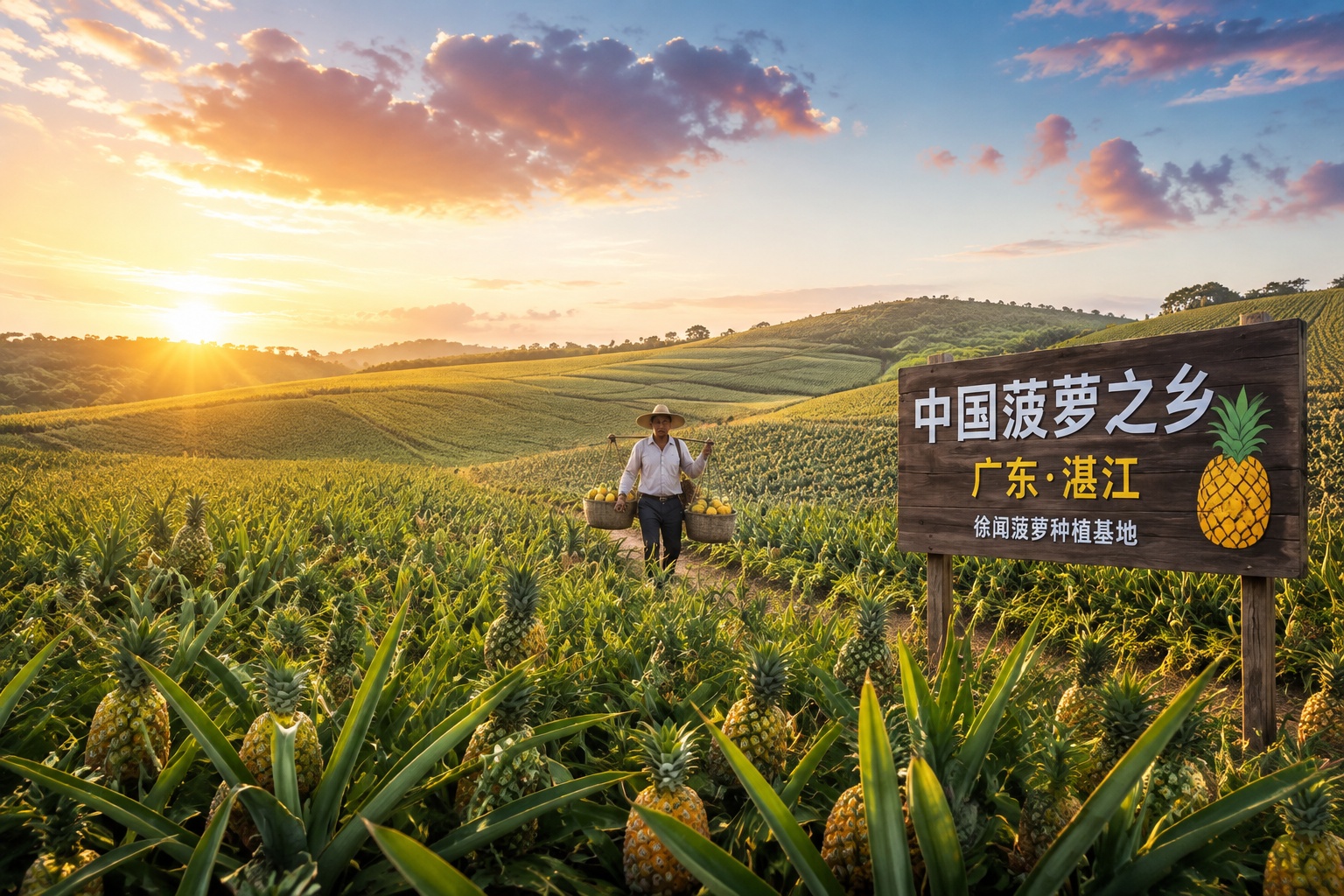

Introduction: A Green Ocean in Southern China
At 5:30 a.m., the sky over Xuwen County, at the southern tip of China’s Guangdong Province, is still a dim blue. Chen Guosheng, 52, is already walking between rows of pineapple plants that stretch over the rolling hills like a green ocean. His hands, rough and calloused, brush the spiky leaves as he checks the fruit. This isn’t a tourist viewpoint — it’s his daily workplace, a living “sea” that feeds millions of people.
The name “Pineapple Sea” is no exaggeration. In Zhanjiang, more than 400,000 mu (about 66,000 acres) of pineapples grow in undulating patterns, creating a landscape that has become famous on Chinese social media. But behind the postcard views are the farmers like Chen, whose ordinary day is anything but simple.
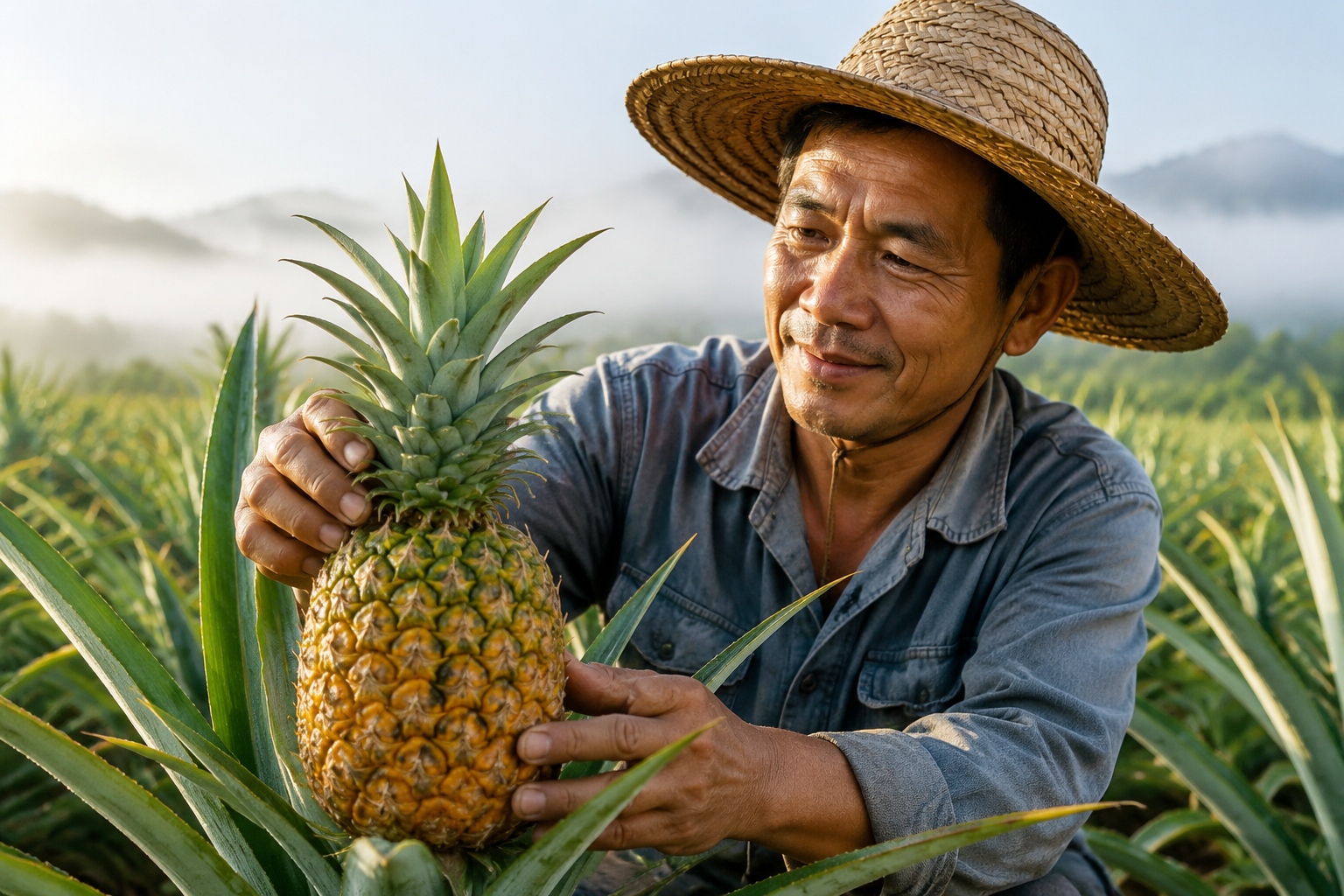
Early Morning: The Rhythm of the Field
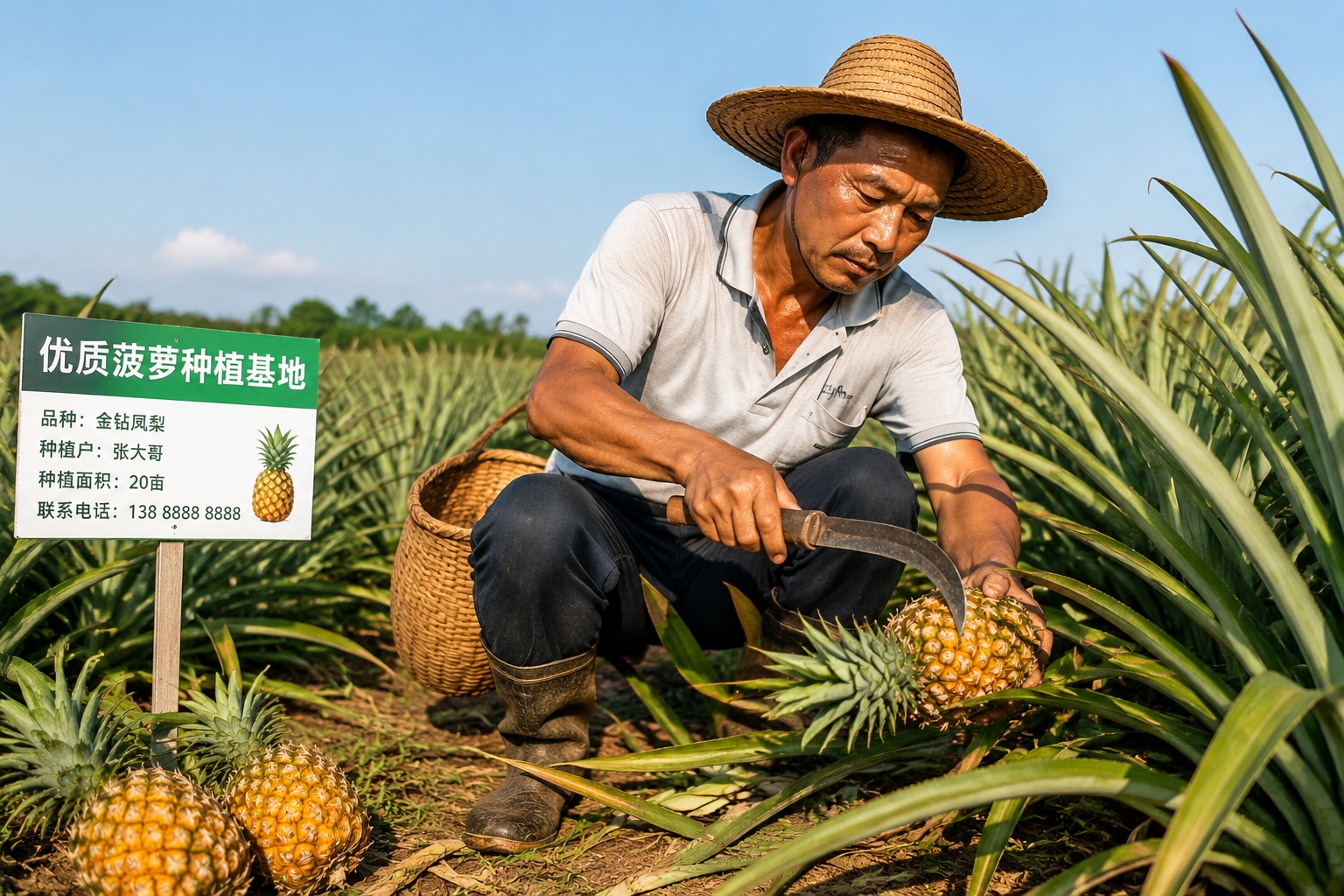
Chen’s day starts before sunrise. He tells us that the “golden hour” is not for taking photos — it’s the best time to cut fruit that might soon be cooked by the sun. “Pineapples are delicate. If you wait until noon, the heat makes them soft and hard to transport,” he says. He squats, uses a curved knife to slice the stem in one clean motion, then tosses the pineapple into a woven basket tied to his waist.
By 8 a.m., the baskets are full. Each weighs about 30 kilograms. Chen carries them to a tractor trailer at the edge of his plot. “You have to know which ones are ready — the base turns from green to a buttery yellow, and the smell becomes sweet,” he explains. A green pineapple might be left to ripen for a few more days, while a too-ripe fruit will not survive the journey.
The work is repetitive and tiring. His fingers are wrapped with tape to protect them from the prickly leaves. “Every farmer here has the same scars,” he says, pointing to his hands. But there is no complaint — this harvest is the payoff of months of waiting.
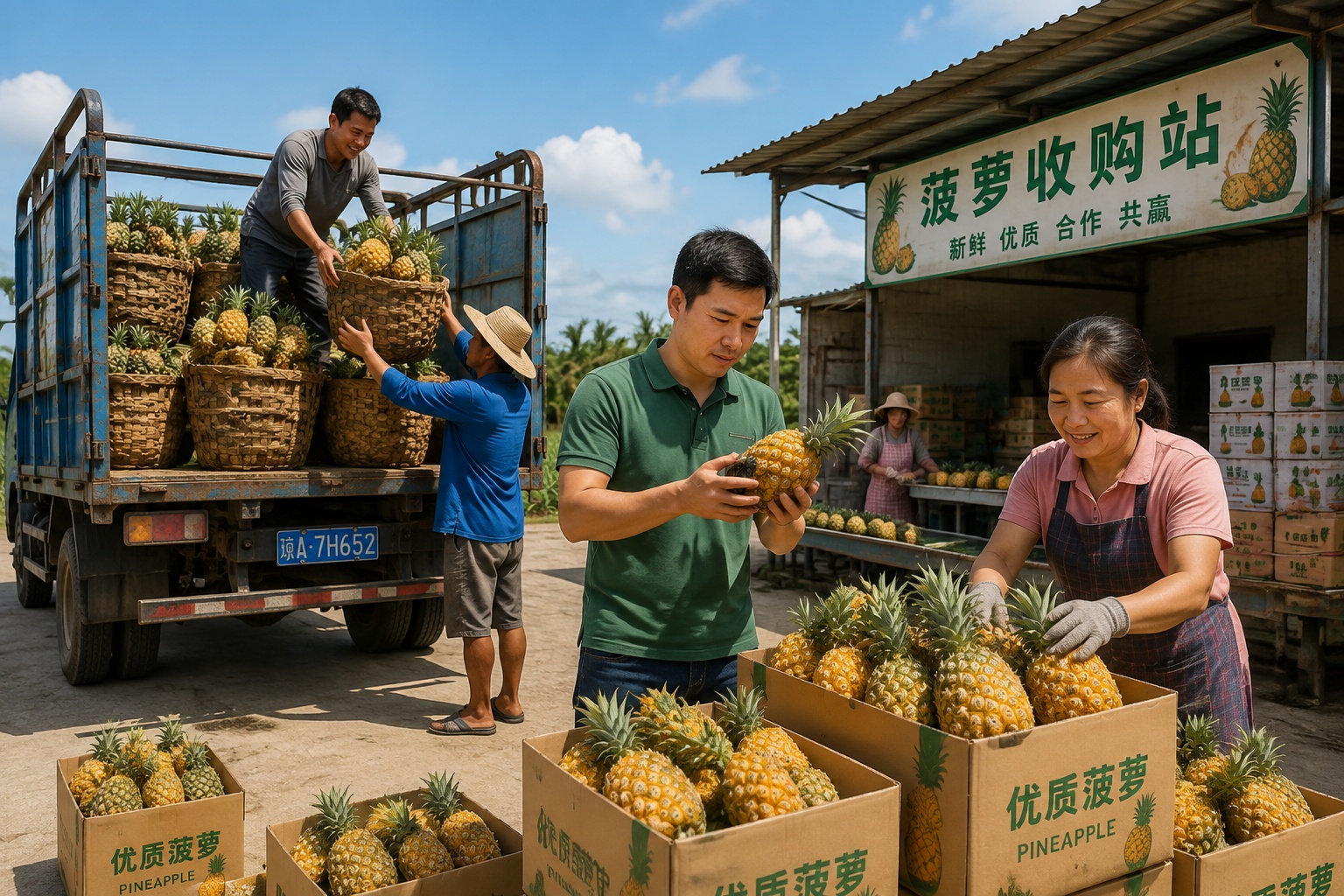
Noon: From Field to Trading Market
By noon, the narrow road near the village fills with pickup trucks and three-wheeled vehicles carrying pineapples. Chen stops his tractor at a collection point, a concrete yard shaded by a corrugated roof. Buyers from Guangzhou, Shenzhen, and even as far as Beijing are waiting with calculators and clipboards. The negotiations are quick, and often loud. A buyer inspects a few sample fruits, cutting into one with his knife. “The sweetness is good, but the core could be smaller,” he says, and they haggle over price per kilogram.
Chen sells his morning load for 2.8 yuan per kilogram (about $0.39). He calculates quickly: 600 kilograms bring roughly 1,680 yuan, minus the cost of fertilizer and labor, his profit is about 300 yuan. “Not bad for a morning’s work,” he shrugs. The money is paid immediately via mobile transfer — no cash, no waiting.
Nearby, a group of temporary workers sorts pineapples by size, packing them into cardboard boxes. The air is thick with the sweet scent of the fruit and the chatter of stall owners. At 1 p.m., Chen takes a break at a small food stall across the street. A bowl of steaming rice noodles with spicy beef and a dish of pickled mango — “tropical-style” comfort food — costs less than 15 yuan. He chats with the vendor about the weather and the price of diesel.
Afternoon: Where Tradition Meets Technology
Chen returns to his field after lunch, but this time he isn’t carrying a knife. He pulls out his phone to check a drone flying overhead. His son, Chen Lin, a 24-year-old who returned to the village after college, is operating the drone from a distance, using it to spray a precise amount of fertilizer on the pineapple plants.
“Last year, my son convinced me to try these new methods. We used to spread fertilizer by hand, and it took three days. Now it takes two hours,” the elder Chen says.
The drone is just one of the changes shaping this rural economy. A drip-irrigation system carries water and nutrients directly to the root zone, and some young farmers sell their fruit via livestreams, packing boxes with a “pan-made” sticker and shipping them to customers who have never seen a pineapple field. Chen Lin, who majored in e-commerce, says he sold more than 10,000 kilograms in one season by posting short videos.
But the elder Chen remains skeptical of the online hype. He walks to a patch where a drone missed a crop. “Technology helps, but the land still needs to be checked by feet and eyes,” he says, crouching to inspect a plant. “I’ll let the drone do the heavy work, but I won’t trust only a screen.” This mix of pragmatism and caution is typical of a generation that has seen both traditional farming and its digital reinvention.
Evening: Back Home and a Simple Reckoning
As the sun begins to dip behind the hills, Chen Lin arrives with a cooler full of fish from the nearby coast. The family sits around a table in the courtyard — Chen, his wife, his parents, and his son. The dinner includes stir-fried pineapple with pork, a local specialty, and freshly steamed rice.
The conversation is about the day’s income and the forecast of a typhoon. “If a storm comes in August, it could drain the fruit,” says Chen’s wife, frowning. They discuss whether to invest in a small cold-storage shed, which could let them sell during off-peak seasons. Chen Lin scrolls through his phone: “The price is expected to rise in a month, maybe to 3.5 per kilo, if we can store.”
The family is not wealthy. Their yearly income is about 80,000 yuan (about $11,000), similar to an average rural household in Guangdong, but it has been increasing. Chen’s daughter lives in the city and does not want to return to farming. Chen Lin has different plans. “The village is changing. There are e-commerce subsidies and internet infrastructure. I can earn a decent living here while keeping an eye on my parents,” he says.
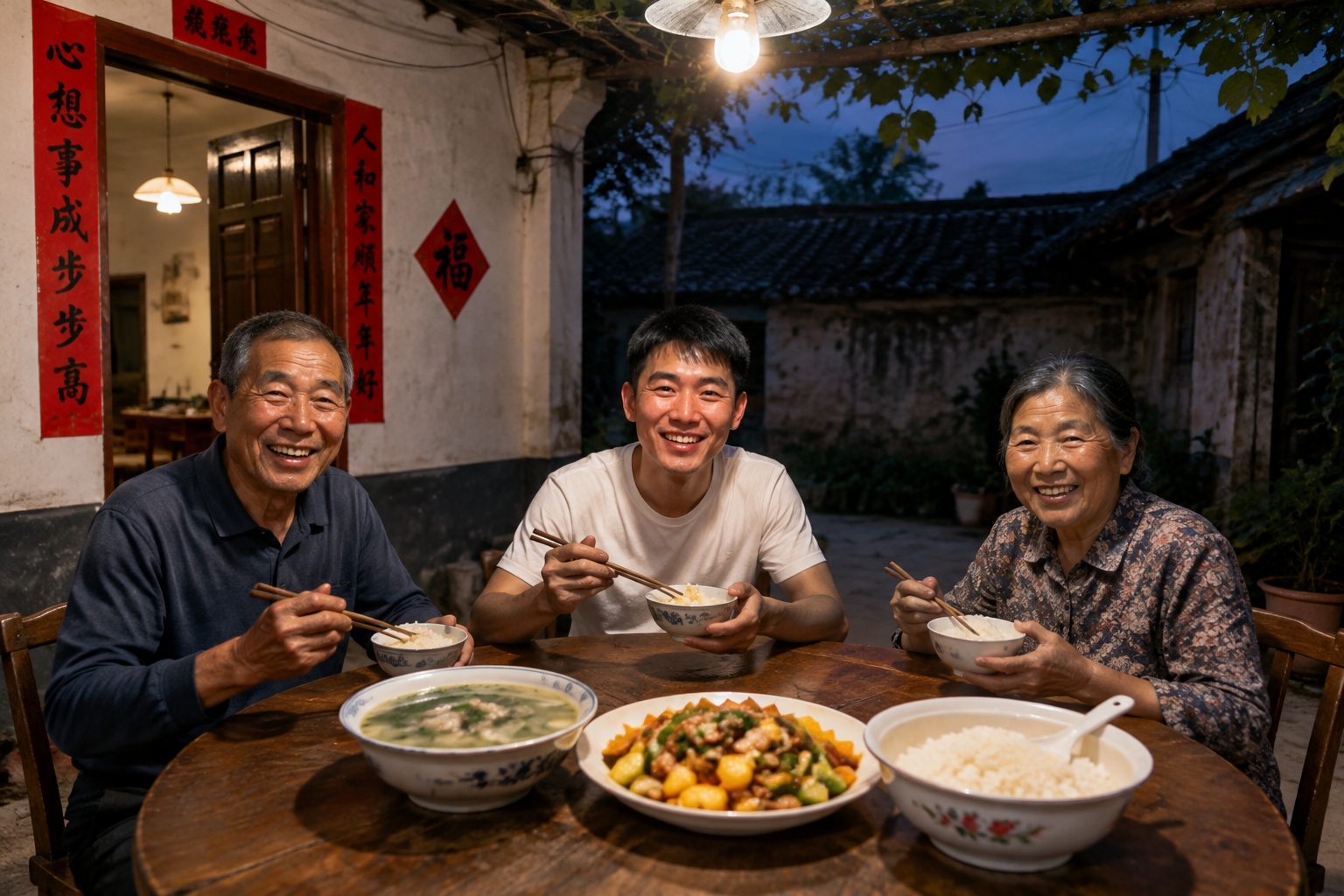
After dinner, Chen takes a walk to the edge of his land. The moon lights up the courtyard, and the leaves rustle. It’s quiet, except for the distant sound of a generator. For him, this “sea” is not a metaphor — it’s a field of responsibilities, calculations, and hopes.
Conclusion: More Than Just a Scene
The pineapple fields of Zhanjiang are often photographed as a stunning landscape, but for the people who work there, the view is inseparable from the daily grind. Chen’s day is a reminder that rural China is not a static image but a place of quiet resilience and slow transformation. Technology, market connections, and the younger generation are slowly rewiring the way farmers live and work — yet the core remains the same: a land to be cultivated, a family to be raised, and a life to be built.
Next time you see a pineapple in a supermarket, take a moment to think about the hands that harvested it, the truck that carried it, and the village computer screen where someone tracked its price. This is the real story of a place that looks like an ocean on a map but is, in truth, a home.
Start the discussion at forum.chinacomes.com