

A lake that turns out to be glass
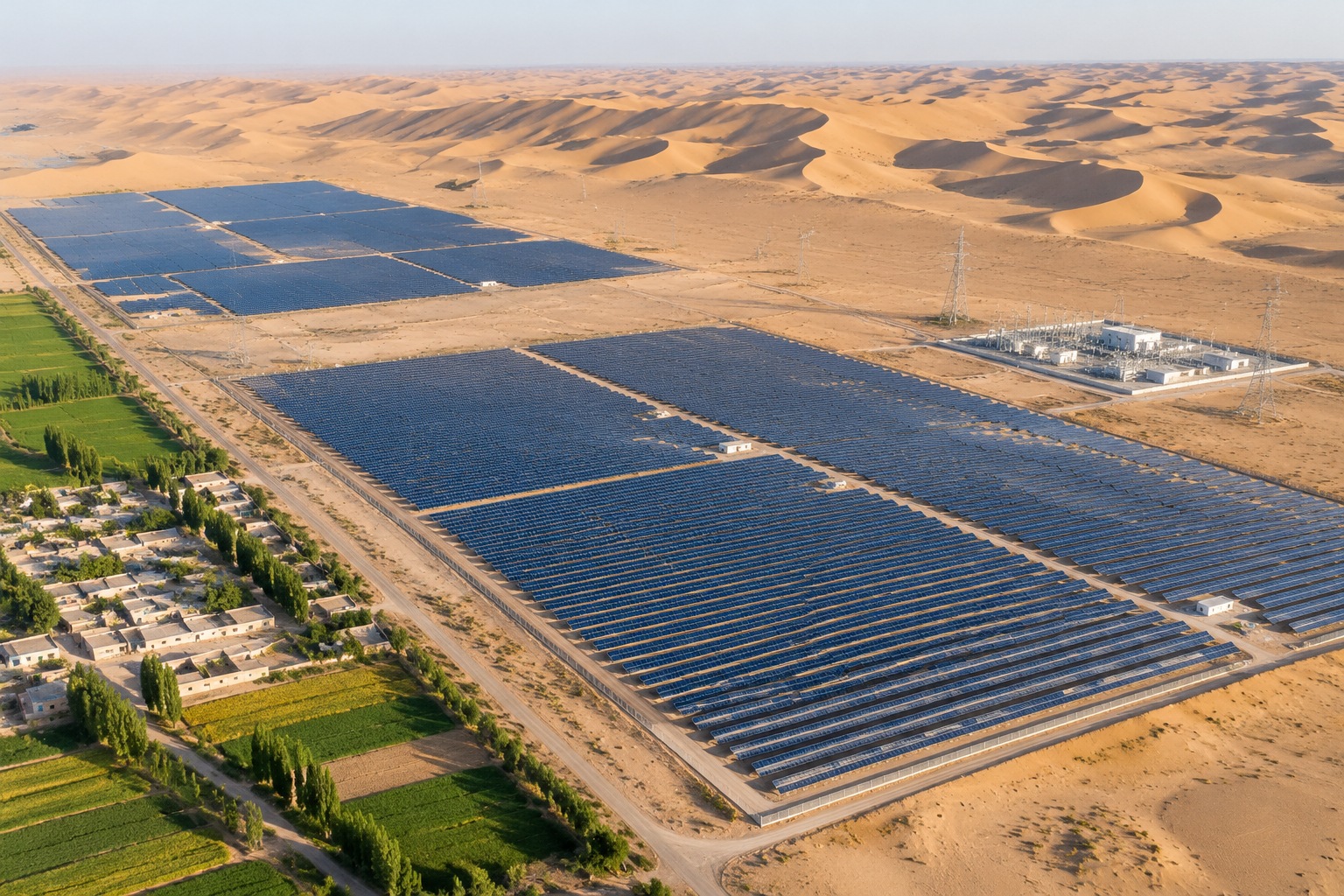
The first thing that looks wrong is the water. Driving west out of Zhongwei, in Ningxia, the road climbs away from the Yellow River and its green irrigation belt and into flat, pale gravel. Twenty minutes later a blue surface appears on the right, low and wide, catching the light the way a reservoir does. It takes a moment to understand that it isn’t water. It is glass: hundreds of thousands of rectangles, all tilted at the same angle, running to the horizon in rows so even they look drawn with a ruler.
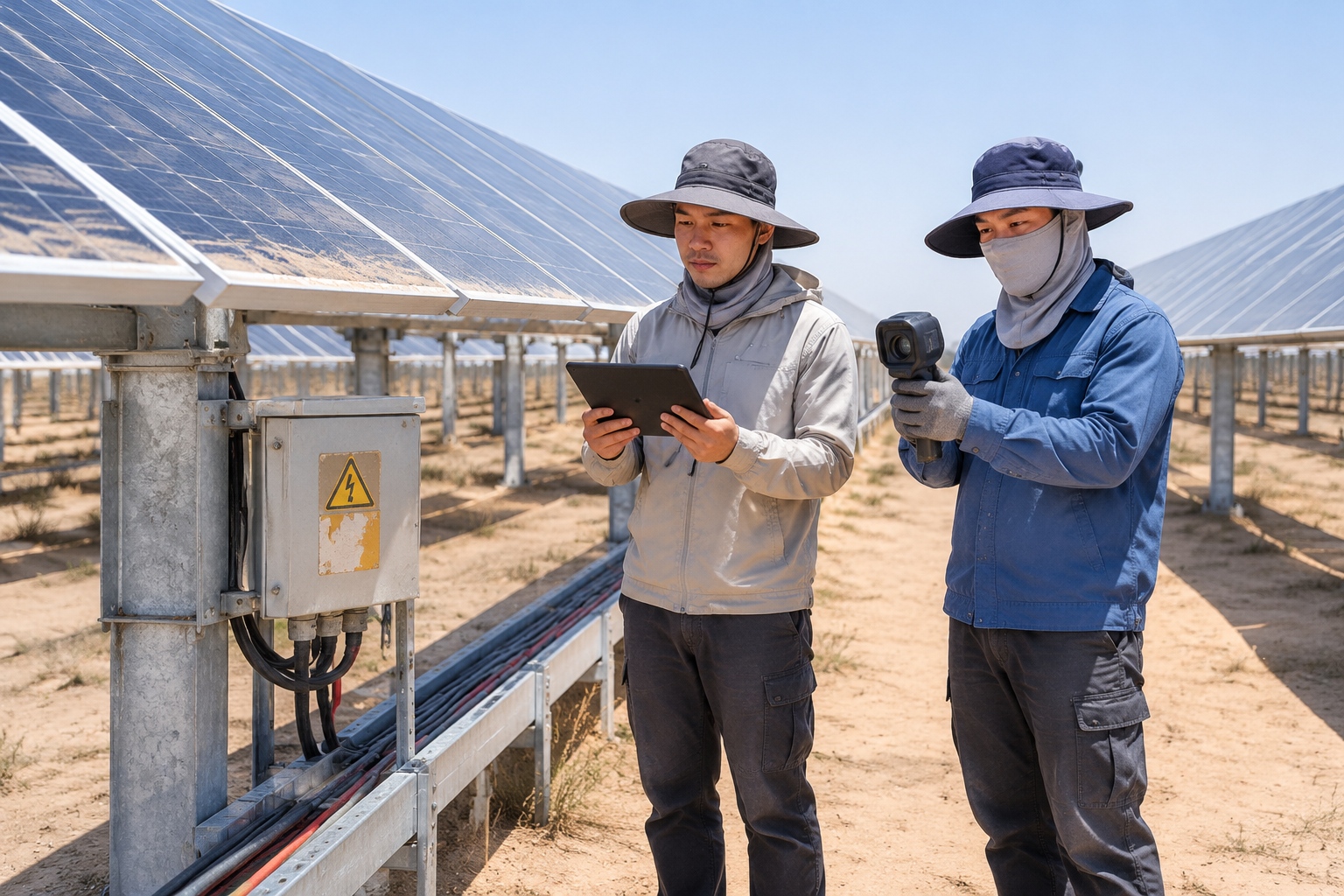
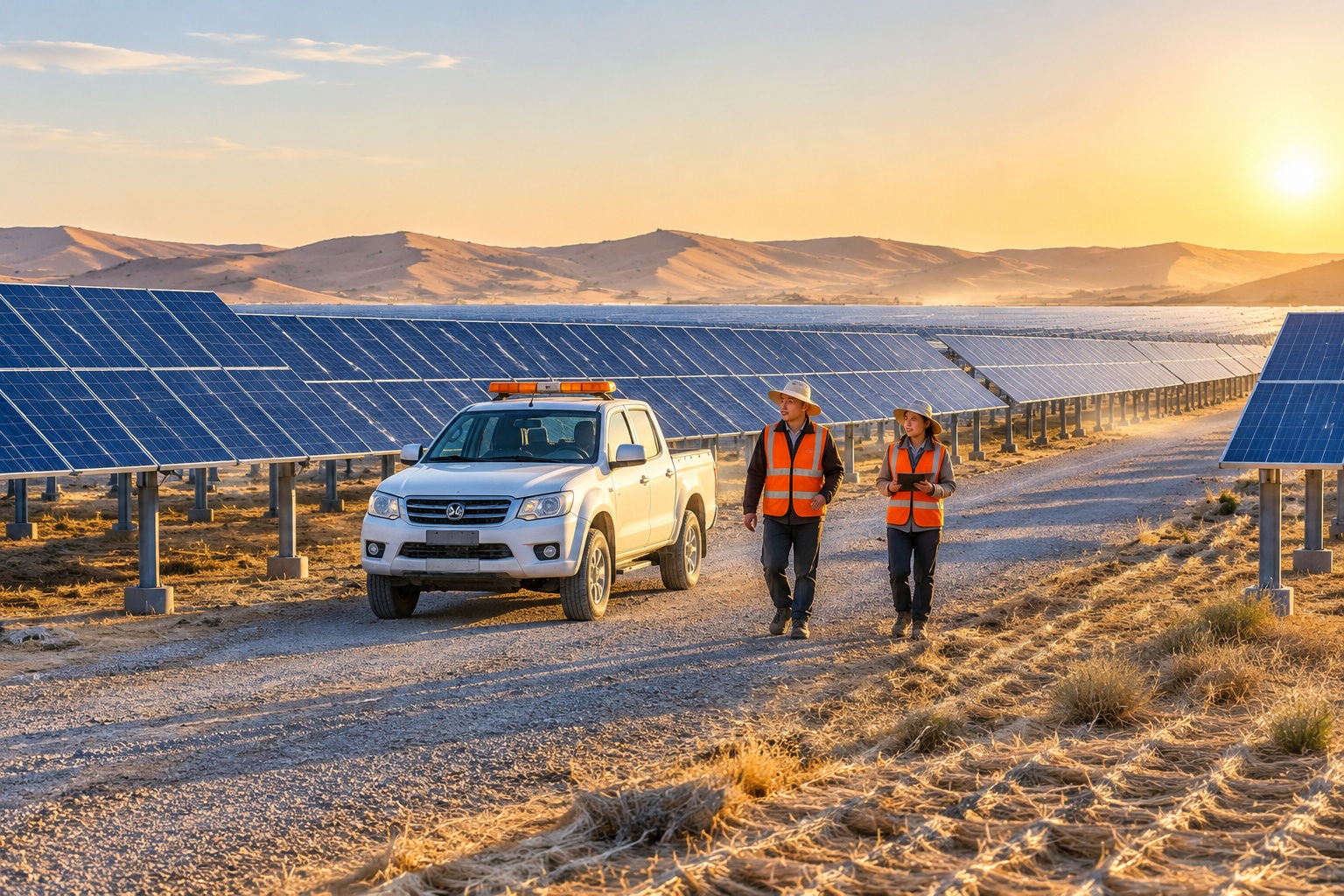
Up close, the illusion collapses into hardware. Galvanised steel piles driven into sand. DC cables in open trays. A junction box with a warning sticker half peeled off. A white pickup with an orange light bar parked between two rows. And two men in long sleeves, wide hats and cloth over their faces, walking a line of panels with a tablet and a thermal camera, because a panel that has quietly died shows up as a hot spot and has to be found by hand.
Why Ningxia, of all places
Ningxia is one of China’s smallest provinces: about 66,000 square kilometres, smaller than Ireland, with roughly 7 million people. It sits where the Yellow River turns north, the Helan Mountains on one side and desert on the others — the Tengger to the west, the Ulan Buh to the north, the Mu Us to the east.
Zhongwei, where many of the largest arrays sit, gets around 180 millimetres of rain a year and close to 3,000 hours of sunshine. The ground is flat, has almost no trees to clear, and much of it was already classified as degraded or unused, which made it cheap and administratively straightforward to convert. Those are the three conditions any desert solar base needs: sun, space, and land nobody is farming.
The fourth condition is less visible. Ningxia has been exporting electricity for decades, because of the Ningdong coalfield. Two high-voltage direct-current lines leave the region — one to Shandong, commissioned in 2011, one to Zhejiang, in 2016. So when people ask who uses all this power, the honest answer is: mostly not Ningxia. By the end of 2024, more than half of the region’s installed generating capacity was wind and solar, and the local grid could never absorb it. The wires running east are the reason the panels make financial sense at all.
What it takes to keep a “blue ocean” running
A base of a few gigawatts is tens of square kilometres of hardware. The panels are mounted on steel piles driven one and a half to two metres into sand, tilted at a fixed angle of roughly 35 degrees to face the southern sun. Each module is about 2.3 square metres and rated somewhere around 550 to 600 watts. Rows are spaced far enough apart that wind passes through and maintenance vehicles can drive between them.
Dust is the everyday enemy. In spring, sandstorms roll through and leave a film on the glass; without cleaning, output can drop by a few percent a month. Water is expensive here, so some sites use robots that brush the panels dry, and hand-washing with trucked-in water happens only a few times a year. Crews walk eight to ten kilometres a day. Inverters convert the direct current to alternating current, cables collect it at 35 kilovolts, and a booster station steps it up before it joins the grid.
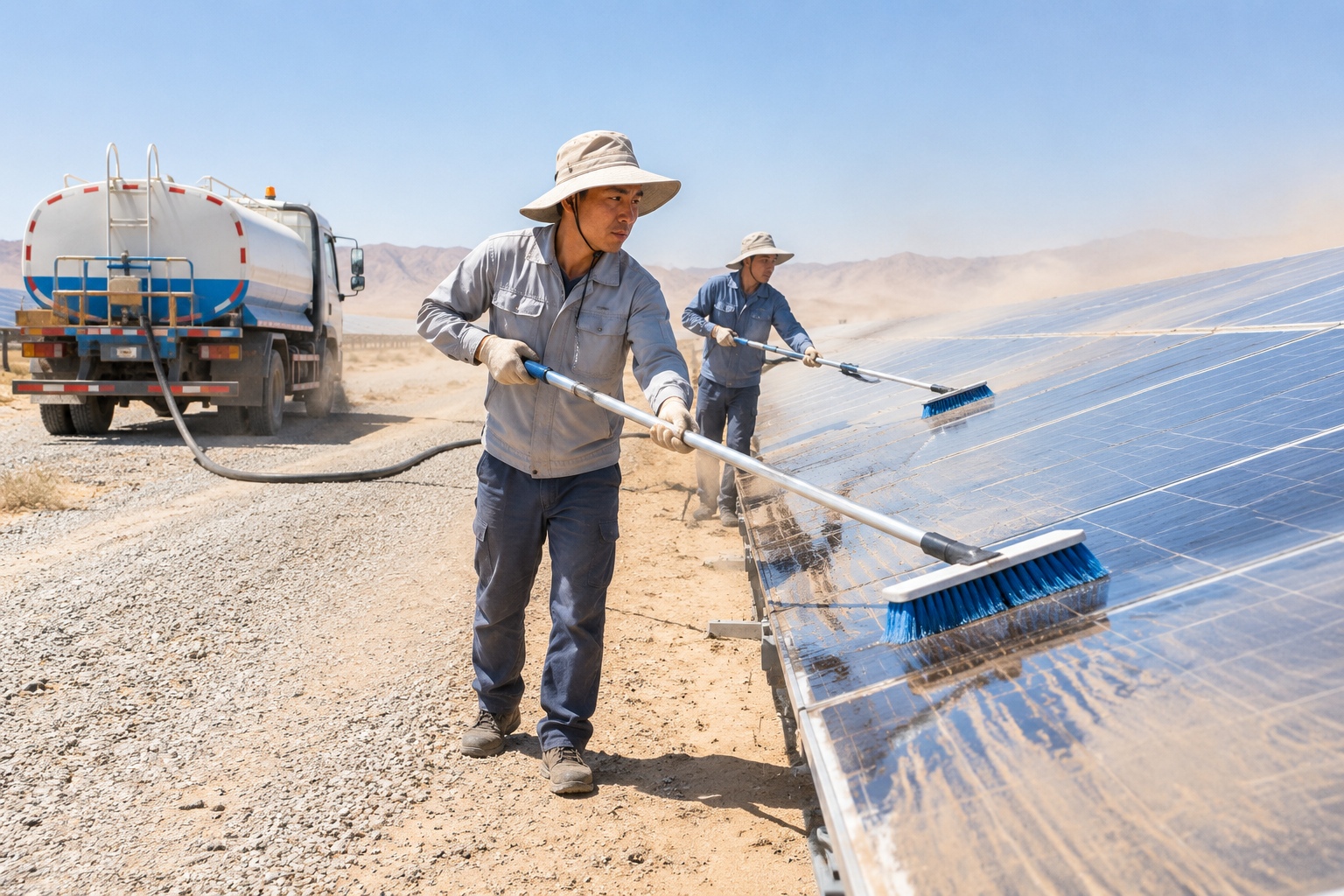
None of this is exotic technology. That is the point. What looks like a landscape from a science-fiction film is a maintenance business with a shift roster, a tyre budget and a spare-parts warehouse.
Who actually gets paid
During construction, a large base can put thousands of people to work for a year or two: driving piles, bolting frames, pulling cable, pouring foundations. Once it is running, the permanent staff shrinks to a few hundred — inspectors, electricians, cleaners, security, canteen staff, drivers.
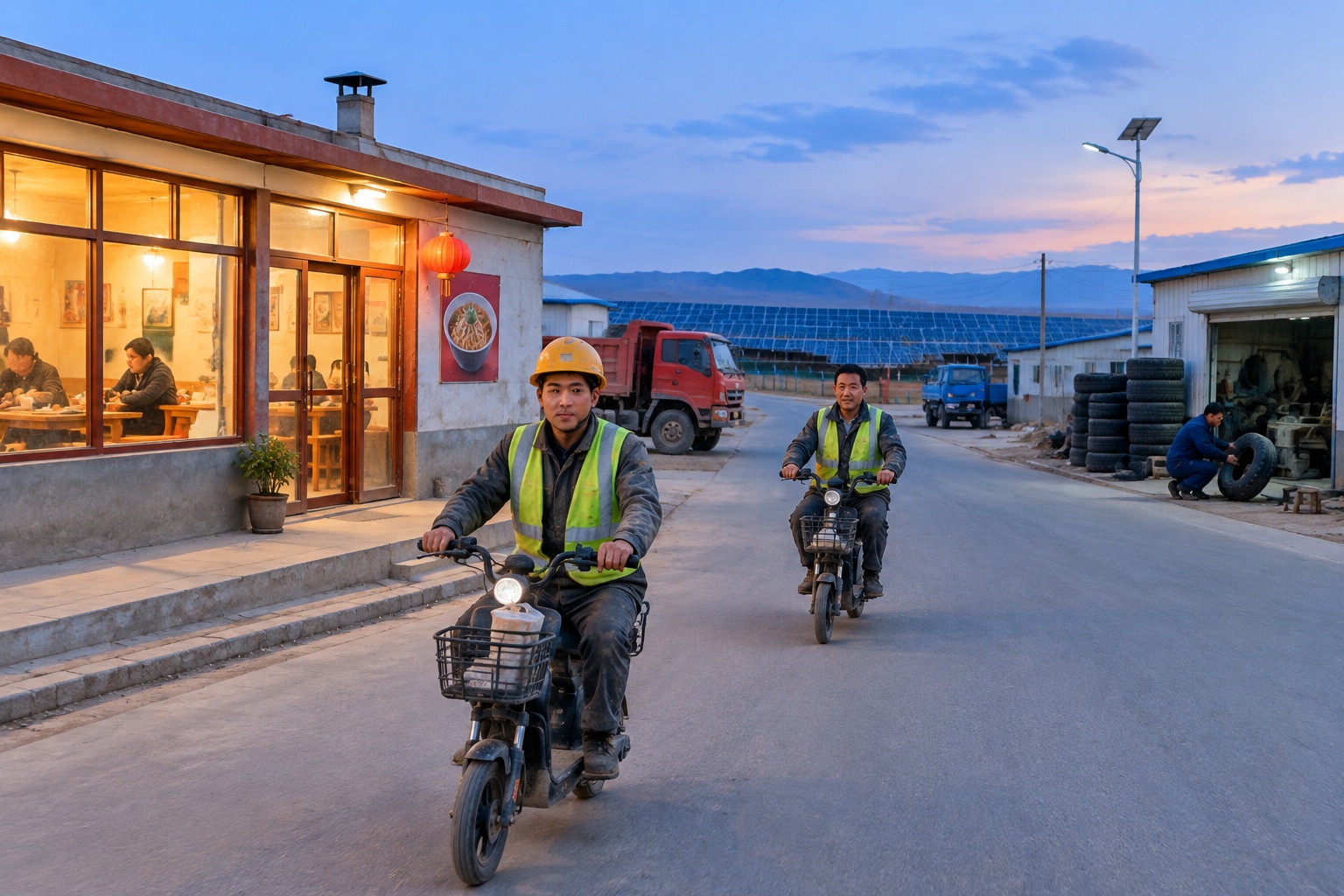
Many of those jobs go to people from the townships nearby. Cleaners and vegetation crews often come by electric bike or on a company bus, twenty to forty minutes each way. Training for cleaning and grass-cutting takes weeks, not years; technicians need certificates and are usually recruited from further away, and the engineering firms that commission the inverters often come from Jiangsu or Hebei.
Pay is ordinary rather than spectacular. Cleaning and grounds work tends to run around 4,000 to 5,000 yuan a month; an experienced technician might make 7,000 to 9,000. In a county where farming income is seasonal and uncertain, that is enough to change a household’s year — and enough for a noodle shop, a tyre repair yard and a small guesthouse in the nearest town to stay open later than they used to.
It is not a bonanza for everyone. Construction work is temporary, and the best-paid roles are not always filled locally. Ask people in the villages along the base and you get a mixture of approval and complaint: the rent from leased land is welcome, the dust from construction is not, and the jobs are real but not as numerous as the pictures suggest.
What grows in the shade
At the edges of the arrays you can see the older technology: straw checkerboards, one-metre squares of wheat straw pushed into the sand. The method was developed at Shapotou in the 1950s to keep the railway from being buried, and it still works. Contractors now lay it around the fence lines and along the service roads.
Inside the fence, the panels do something unintentional. They cast shade, which cuts evaporation; at dawn, condensation drips off the glass. Grass and low shrubs appear in strips between the rows, and in some bases sheep are let in to graze once the vegetation is established — the animals keep the grass down and the grass holds the sand.
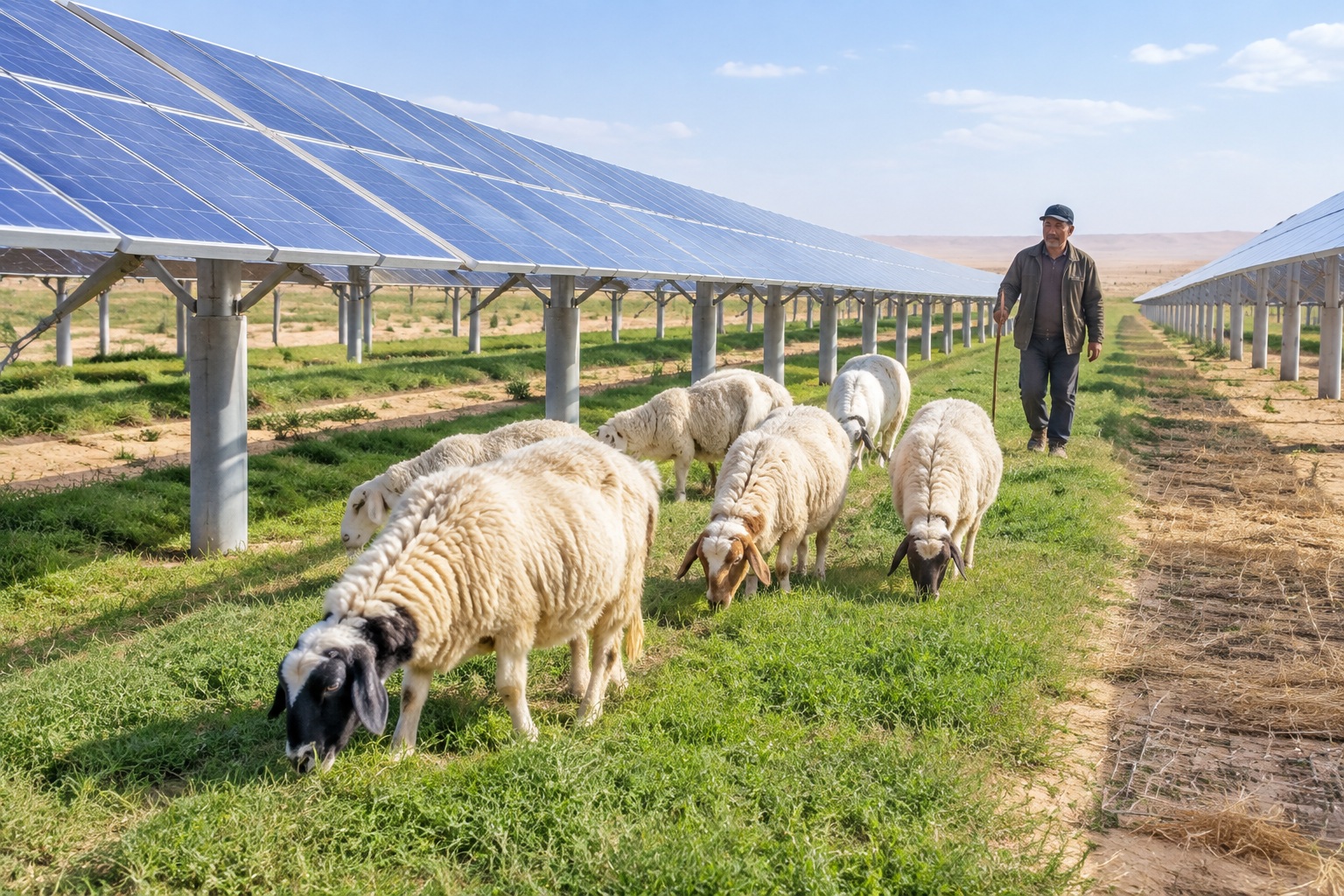
It is tempting to call this a desert turning green, and plenty of social media posts do. Researchers are more careful. Whether the vegetation thickens depends on rainfall, grazing pressure, soil and how the site is cleaned, and the effects take years to show. A solar base is not a reforestation project with panels attached.
The parts that don’t fit the brochure
Three problems come up again and again when you talk to people who work in the industry.
The first is water. Cleaning glass in a place with 180 millimetres of rain a year is a genuine trade-off, and dry brushing scratches the surface over time. The second is curtailment: solar output peaks at midday, when demand does not, and the grid cannot always take everything. Storage and the long DC lines help, but the timing mismatch does not disappear.
The third is money. From June 2025, new wind and solar projects in China no longer receive a fixed guaranteed tariff; their output is priced by the market. For a desert base, that means revenue depends on midday prices that are often low precisely because so much solar is being built. Developers who signed up under the old rules are fine. The ones building now are running different numbers.
Dusk, and the lights coming on
Around seven in the evening the angle changes. The panels stop looking blue and start looking orange, then grey, and the pickup trucks head back along the service road toward the gate. In the village a few kilometres away, the lights come on in kitchens and courtyards.
That is probably the most accurate way to describe this place. Not a wonder, not a mirage, not yet a green paradise. A very large piece of infrastructure, assembled panel by panel by people with thermoses and sun hats, that has quietly become part of how this dry corner of China earns a living.
Start the discussion at forum.chinacomes.com