
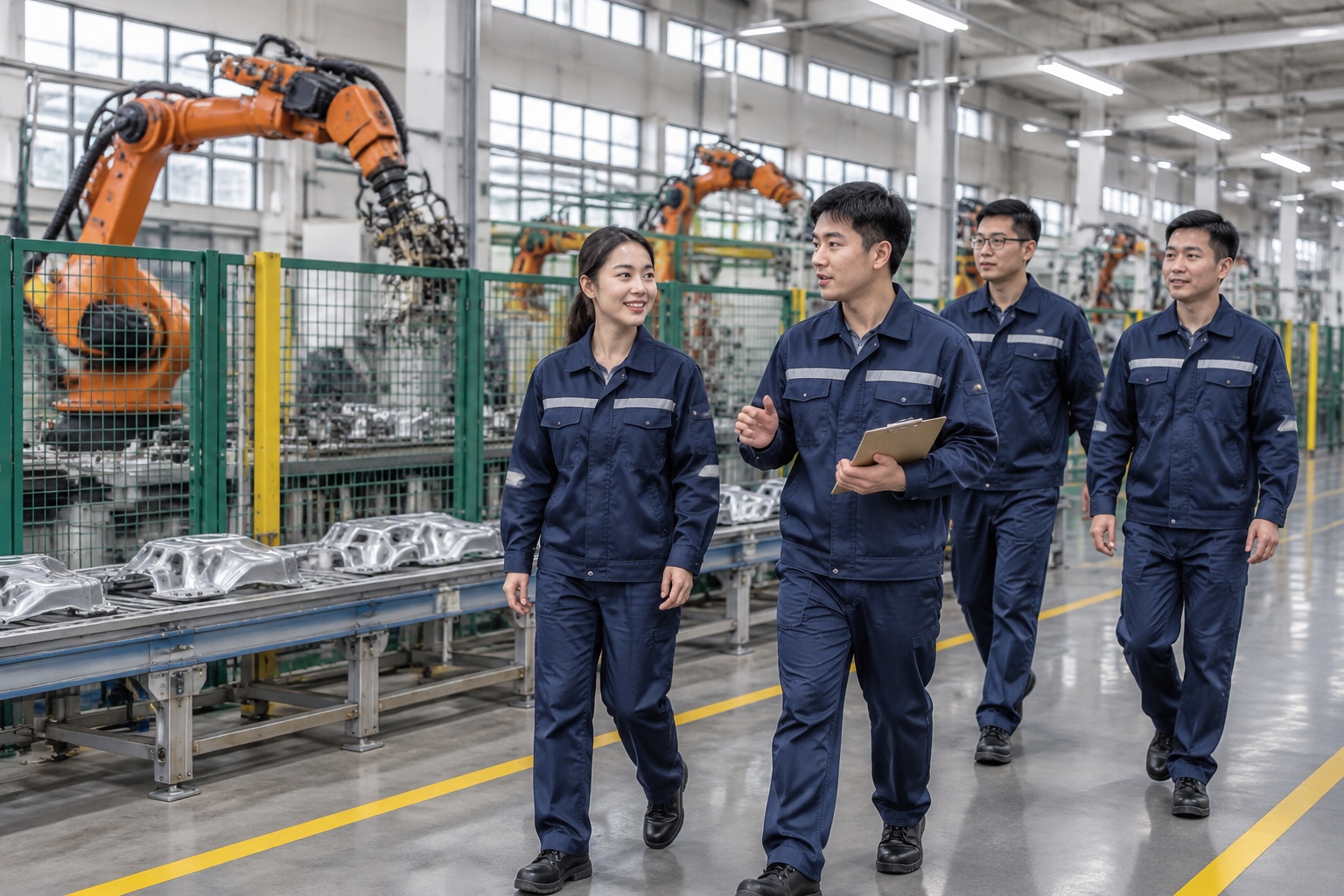

7:40 a.m. at an auto-parts plant in Wuhan
The shift handover takes twelve minutes. The night operator walks the line with the day operator and points at a screen: cycle time on line three crept up by 0.4 seconds overnight, and one welding gun needs its tip dressed. Chen Wei, 34, writes it on the back of his glove and takes over.
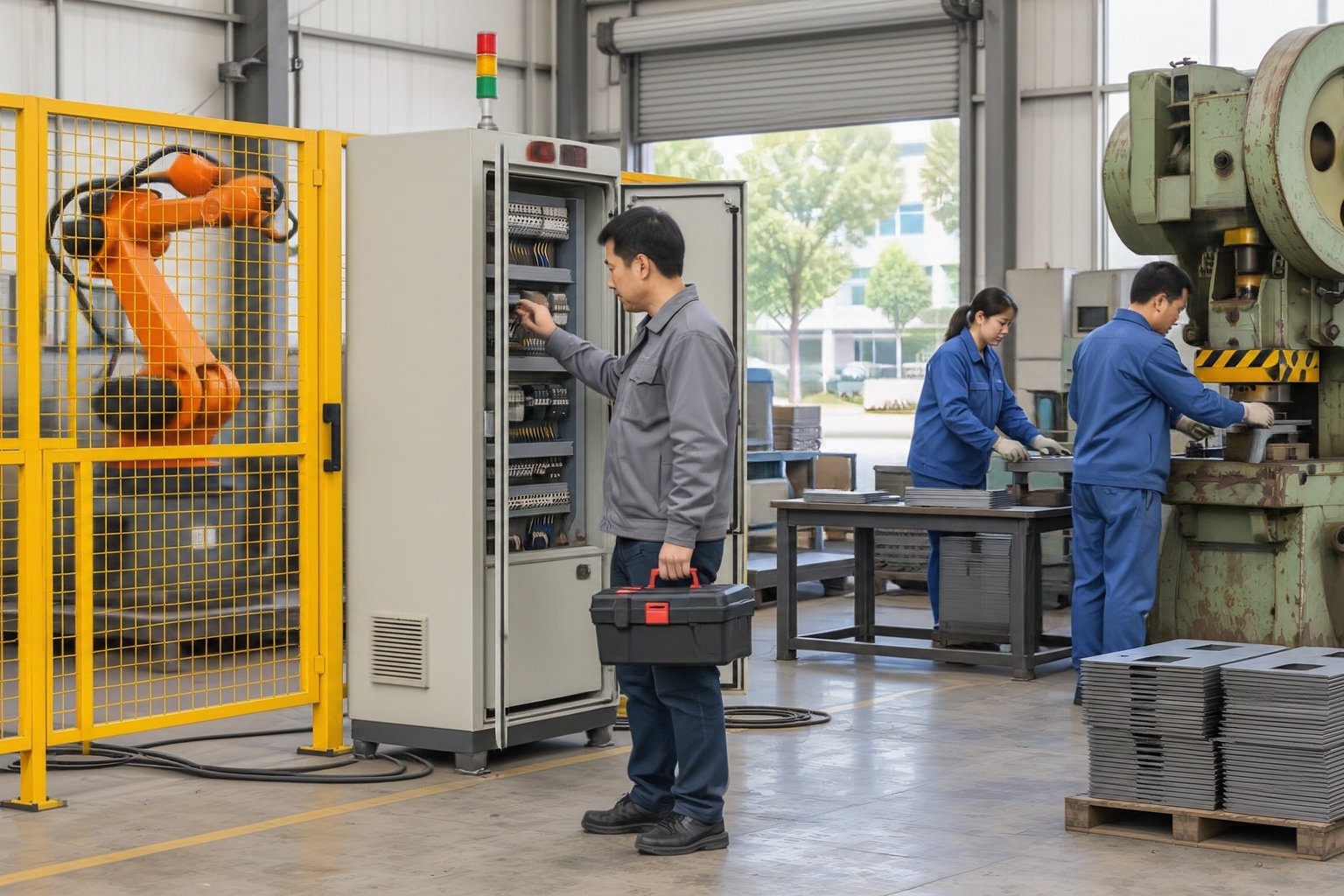
Behind the mesh fence, four orange arms fold and unfold above a jig of stamped steel, repeating the same six movements every 58 seconds. Nobody on the floor watches them directly anymore. Attention goes to the screens that report whether the movements are right.
Ten years ago Chen stood on the other side of that fence, welding the same part by hand with a gun that left his shoulder aching by Thursday. The robots did not arrive all at once. They arrived one cell at a time, over five years, each justified by a spreadsheet.
Why Hubei’s factories started buying robots
Hubei is not the first place outsiders name when they talk about Chinese manufacturing. It should be on the list. Wuhan is home to Dongfeng Motor and a dense ring of parts suppliers; Xiangyang and Shiyan build commercial vehicles and components; the East Lake High-Tech Zone — Optics Valley — makes optical fibre, displays and memory chips. Cars, electronics and photonics all reward consistency, and consistency is what a robot sells.
Four pressures pushed the change. Recruiting got harder as wages rose and the pool of young workers shrank. Quality specifications tightened, especially for electric-vehicle parts, where a weld that varies by a millimetre becomes a warranty claim. Order volumes started swinging, and a line you can reprogram beats a line you must rebuild. And local government helped pay: Hubei has subsidised “machine substitution” (机器换人) in small and mid-sized plants for years, typically covering part of the equipment cost.
The national numbers are large. China installs roughly half of the world’s new industrial robots each year, and the International Federation of Robotics put its robot density at about 470 per 10,000 manufacturing employees in 2023 — roughly ten times the 2015 level, ahead of Germany and Japan, behind South Korea and Singapore. Density is not ubiquity: the machines cluster in electronics, autos and metalworking, and in big plants far more than small ones.
What the robots took over, and what they created
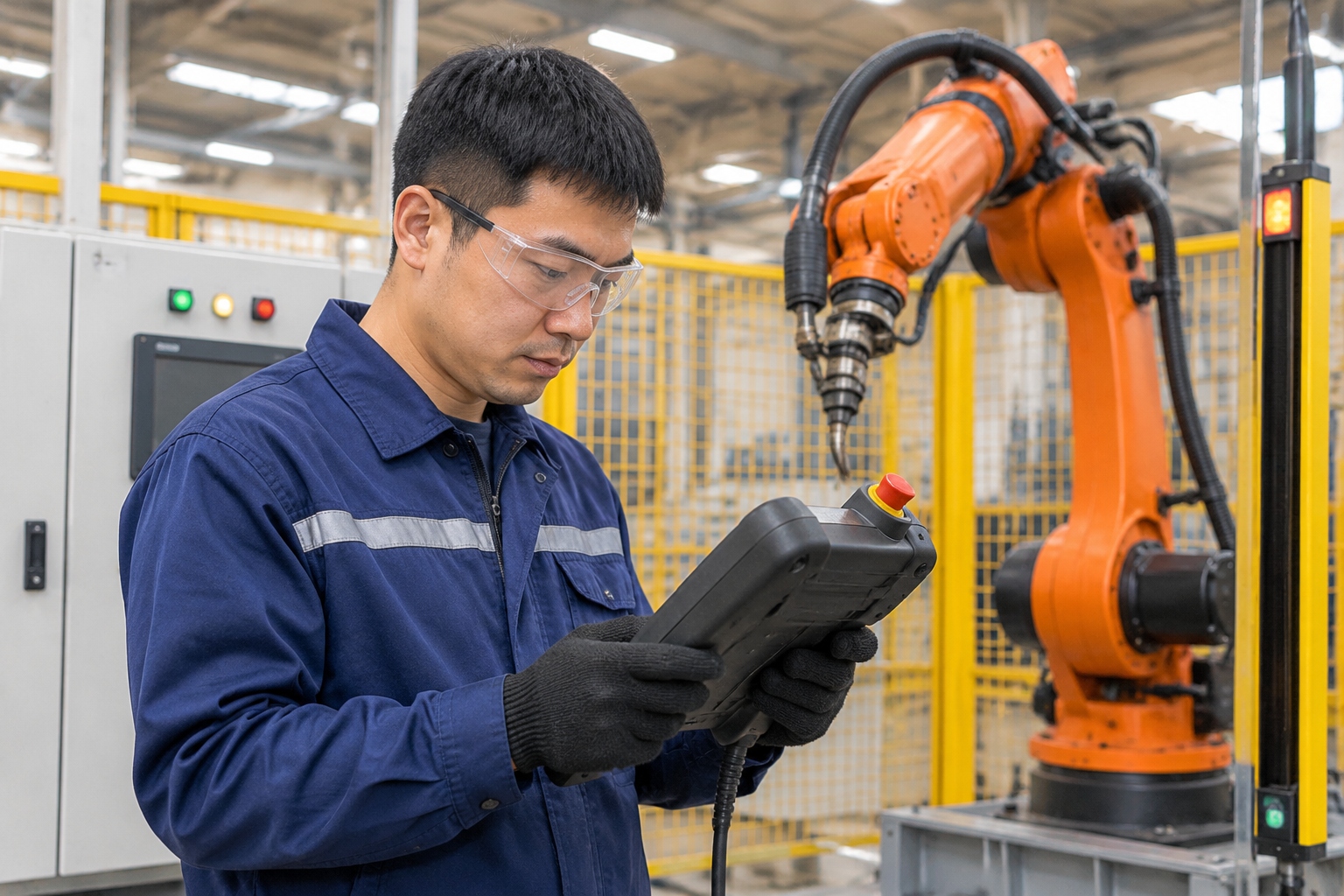
At Chen’s plant the first cells went into welding and press tending — jobs where a person stands in one spot, repeats one motion and carries the highest injury risk. Palletising followed, then painting, then inspection, where cameras now catch surface defects that eyes miss on a fast line.
Each cell removed two to four people from direct production and added roughly one job that did not exist before: someone who can start the cell, clear a fault, adjust a program and tell maintenance what actually broke. Around them grew a second layer — vision technicians, tooling coordinators, planners who schedule machines and materials together, maintenance crews who now work on servo drives rather than worn fixtures.
That is the honest arithmetic of machine substitution. Headcount on the floor falls, but not by the number of robots. The mix changes faster than the total.
Learning to stand next to a machine
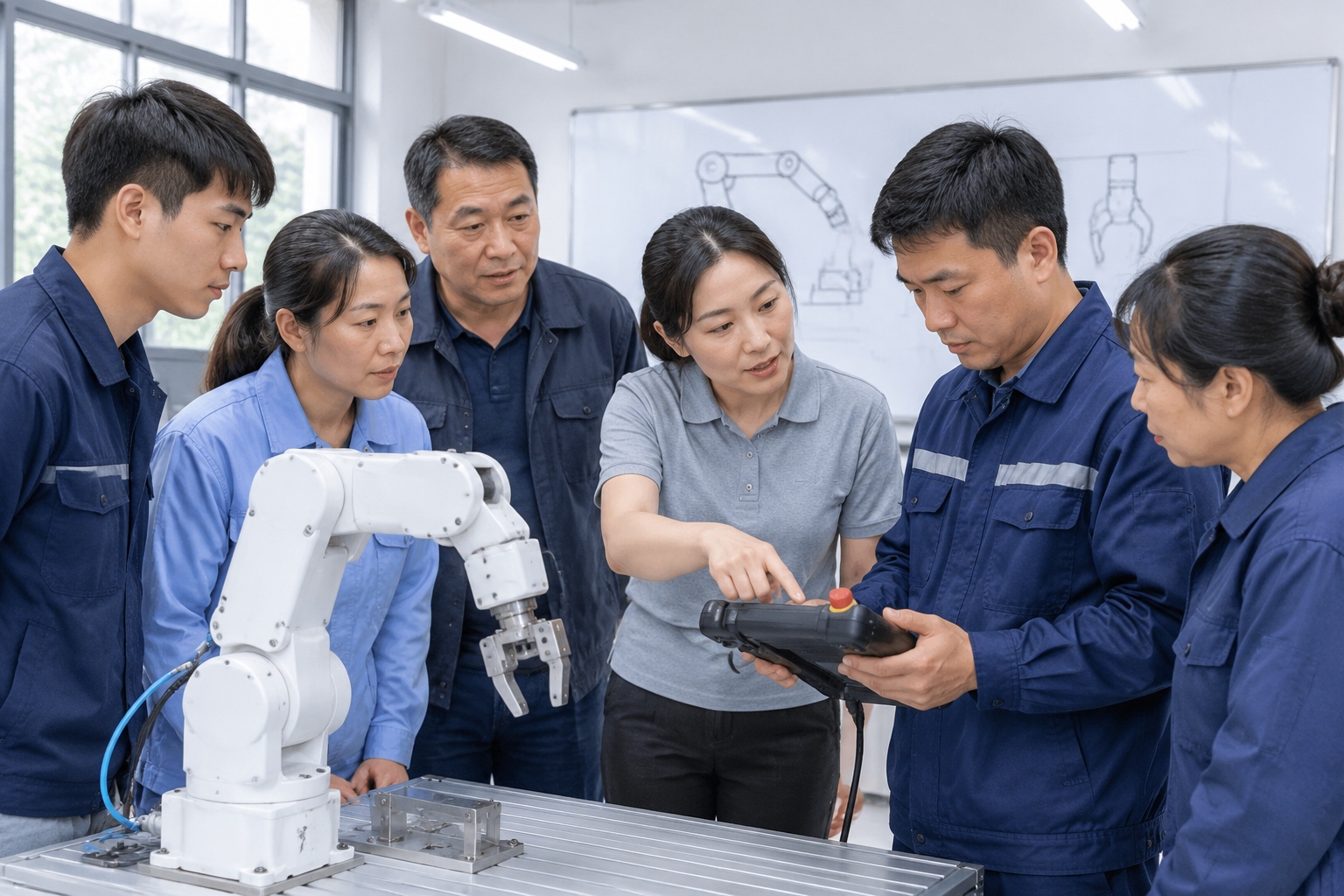
Chen’s retraining took three weeks, in two-hour blocks after his shift. The course was blunt: safety around a fence that will not stop for you, the teach pendant, coordinate systems, how to jog an axis without crashing it, the ten alarms behind most stoppages, daily checks on grease and cables.
The hard part was not the pendant. It was thinking in three dimensions. People who had spent fifteen years judging a weld by its colour and sound had to start reading numbers. Workers over 45 often needed a second course; some never took to it and moved into logistics, packaging, tooling preparation or inspection support, where experience still counts and the screen is simpler.
Three institutions share the training load. Factories run internal sessions, usually taught by the two or three technicians who learned first. Vocational colleges across Hubei now offer industrial robot operation and maintenance as a standard major, so graduates arrive already familiar with a pendant. City governments issue subsidised training vouchers, which matter most at small suppliers that cannot spare a worker for a month.
The anxiety is real, and usually not about robots as such. It is about training stacked on top of a full shift, and about what happens if you fail the assessment.
Pay, promotion and the question young workers ask
Money explains the shift faster than any slogan. On Wuhan recruitment listings, an entry line operator at an auto-parts plant sits around 4,500 to 6,000 yuan a month before overtime. A robot operator with a year of experience is listed at 6,000 to 8,000. A maintenance technician who can diagnose a servo fault is offered 8,000 to 12,000, and is the hardest person in the building to hire.
The ladder exists, but it is short. Above technician there are few rungs inside a single plant, and the jump to process engineer usually requires a degree that line workers do not have.
Younger workers ask a different question from their parents. They will run a machine; they are far less willing to stand at a manual station for ten hours. Factories now advertise air conditioning, no manual lifting and robot-assisted work as recruiting points — a pitch that would have sounded absurd in 2010.
The parts of the day that changed
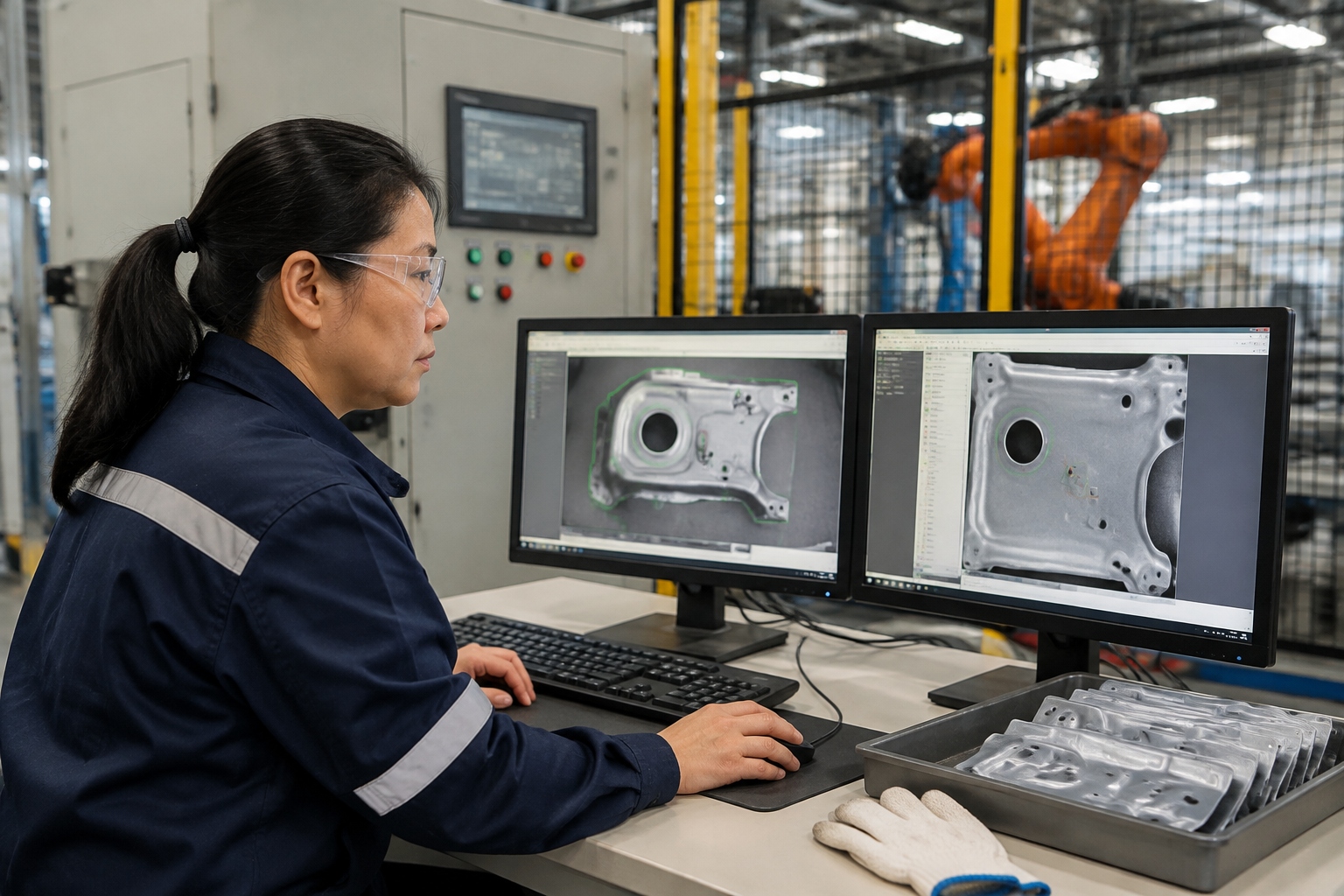
Liu Fang, 41, used to inspect parts by eye at the end of the line, eight hours a day. She now watches two monitors carrying the vision system’s verdicts, pulls suspect parts for a physical check and logs the misses. Her back pain is gone. Her eyes still get tired, differently.
Physical fatigue is down across the plant, and the safety record improved sharply once people stopped reaching into presses. What replaced it is a low, constant alertness: a stopped line costs money by the minute, and you are the one who has to explain it. Night shifts run with a skeleton crew — quieter, and lonelier.
Family routines shifted with the shift pattern rather than with the robots. Chen still leaves at 6:30 and is home for dinner. What changed is what he does in between, and what he studies afterwards: a six-month maintenance certificate, partly online.
Why not every factory becomes a lights-out factory
Walk into a small supplier on the edge of the same industrial zone and the picture gets messier. One new robot cell stands beside a 2008 press line still run by hand, because the volume on that part does not justify the capital. A basic six-axis arm costs 60,000 to 150,000 yuan; a working cell with guarding, feeders, vision and integration easily reaches several hundred thousand, sometimes more than a million. For a plant with 80 employees and thin margins, the payback maths is unforgiving.
Maintenance is the second barrier. A stalled cell with nobody to fix it is worse than a manual line. Small plants share one technician across too many machines, and spare parts take days to arrive. High-mix, low-volume work — custom parts, short runs, frequent changeovers — still favours hands.
That is why lights-out factories remain rare outside high-volume electronics. Across Hubei the realistic picture is a mixed floor: robots where volume and quality demand them, people where flexibility matters, and a lot of workers whose job is keeping both running together.
Back to 7:40 a.m.
The handover ends with a signature on a tablet. Chen walks the fence line, checks that nobody left a tool inside the cell, and starts the cycle. The arms begin their 58-second loop.
His job is not what it was, and not what the brochure promised either. He no longer makes the weld; he keeps a system of welds running, reads its complaints in numbers, and decides when to call someone with more training than himself. The robots took the motion and left the judgement — along with new things to learn, a slightly better wage, and the quiet worry that the next generation of machines will need less of that judgement.
That is what automation looks like from the inside: not one dramatic replacement, but a slow re-sorting of who does what, what counts as skill, and which 34-year-olds are willing to spend their evenings on a coordinate system.