
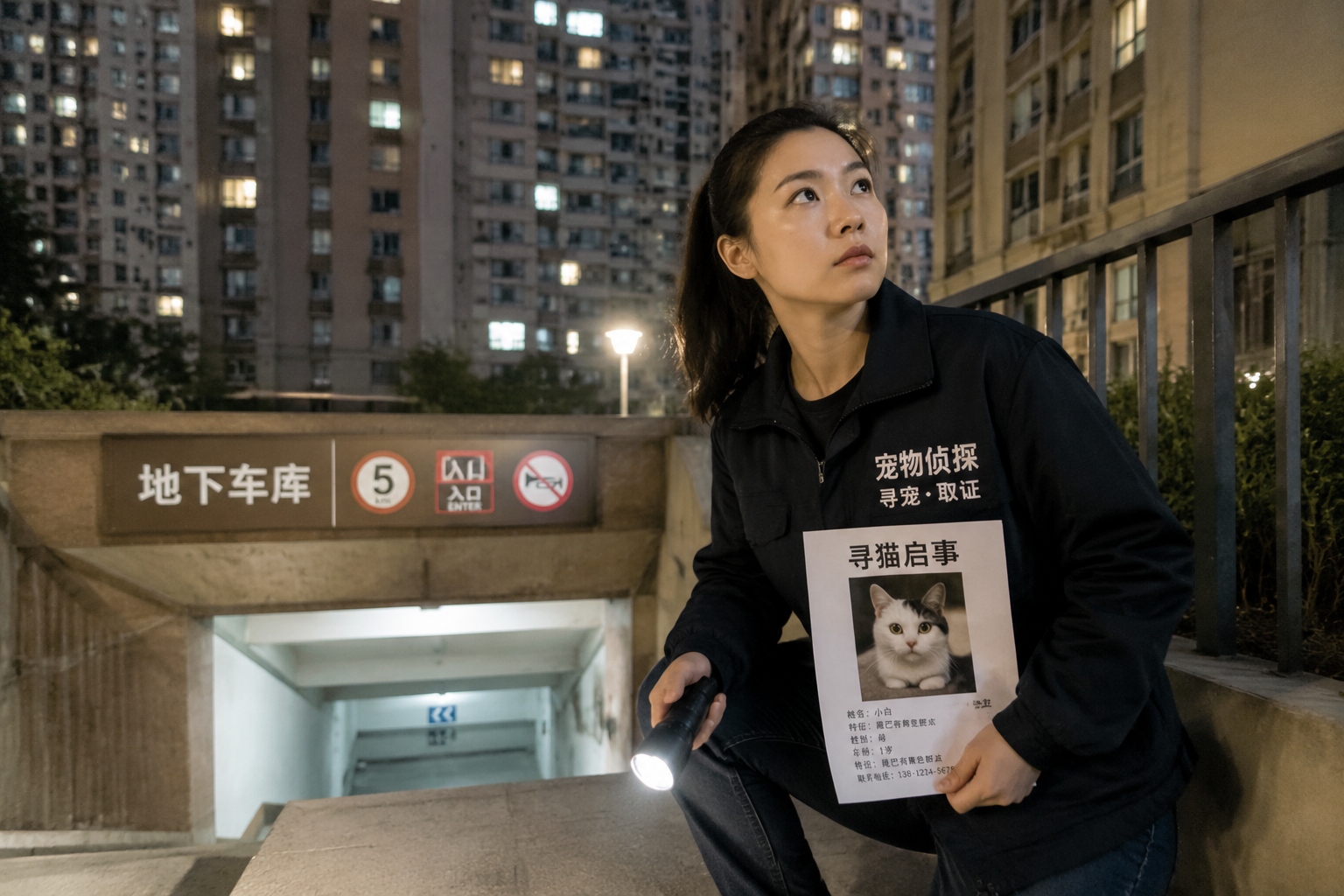

A search begins in the dark
At 11:30 p.m., in a Chengdu residential compound, Qin Yue kneels beside a row of storage lockers in an underground garage. Twenty-six floors of apartments stand above her, and somewhere in one of them a grey cat named Mei Mei has been missing for 16 hours. The building’s security camera caught Mei Mei slipping through a fire-stair door. Since then, nothing.
Qin Yue is part of a small group of self-taught specialists who search for lost cats in Chinese cities. People call them “chongwu zhentan,” or pet detectives. She has no badge or uniform, but her flashlight, laser pointer and a telescopic pole with a phone mount make it easy to understand what she does.
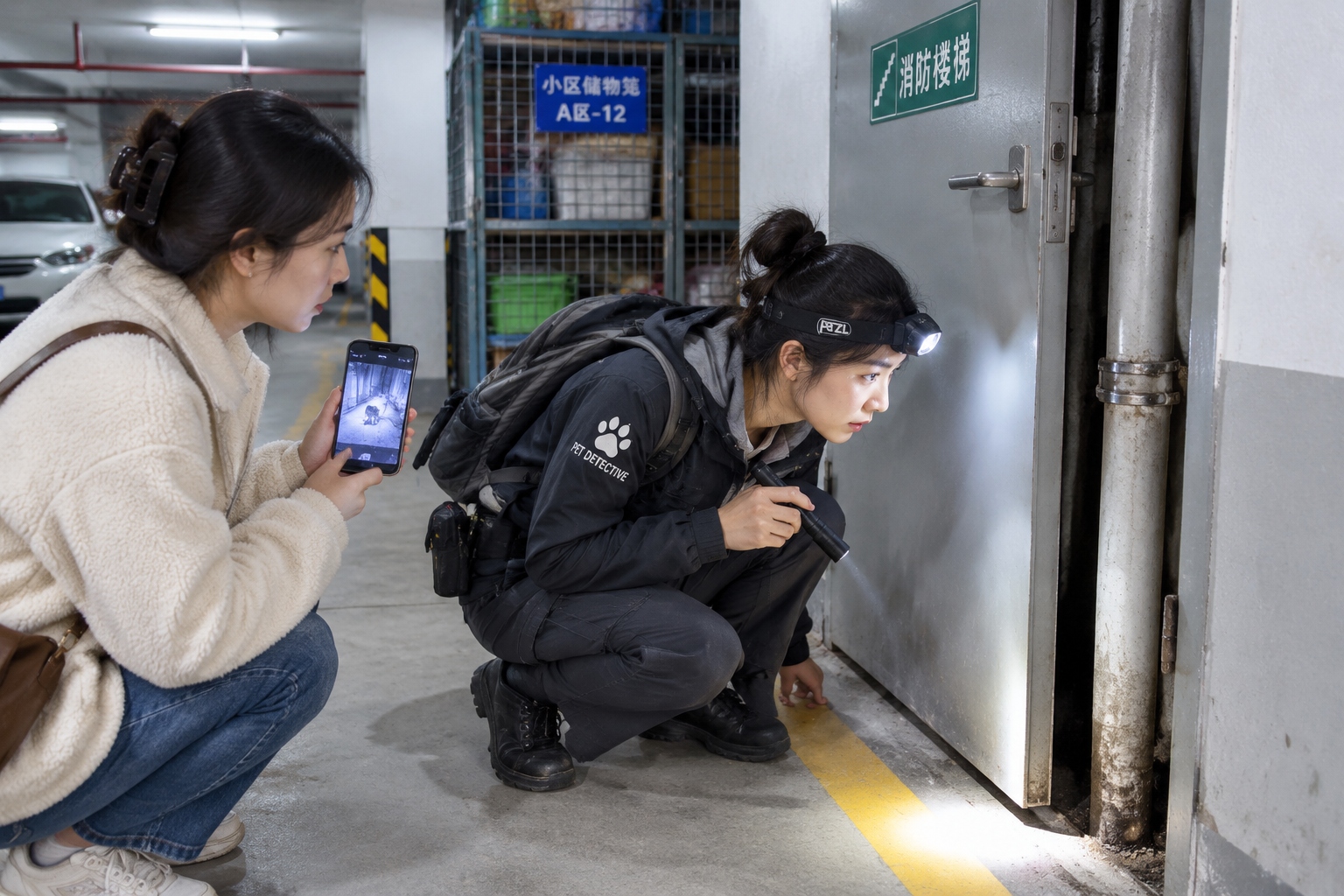
Last year, Qin says, she handled more than 190 requests from Chengdu and nearby cities. Owners call her because an indoor cat climbed out through a balcony, or an open door gave an ambitious tabby ten seconds of freedom. The owner loves the cat, but the first human instinct to run outside and shout almost never helps.
Lost is usually vertical, not horizontal
To understand the challenge, you need to picture a Chinese “xiaoqu.” These gated residential neighborhoods are usually clusters of high-rise apartment blocks. Inside each tower, floor after floor looks the same: apartments, corridors, fire doors, elevator lobbies and service stairwells. Behind the walls, though, run ventilation shafts, pipe chases and hollow spaces most residents never notice.
A domestic cat that escapes from a twelfth-floor flat is not like a dog running down the street. It often panics, looks for the first dark and narrow place, and rushes toward it. That place might be 30 meters from home — but on a different floor, or inside a false ceiling. Stressed cats usually stop meowing, which makes the standard “calling their name” almost useless.
“If the security footage shows the cat entered a stairwell, we don’t run outside,” Qin explains. “We start walking floor by floor, but we’re looking at places at knee level or above our heads. A human sees a smooth wall. A cat sees a staircase leading to a roof gap that we can’t see.”
The security camera is often the first tool. Most Chinese apartment buildings have closed-circuit cameras in lobbies, lifts and fire escapes. If the cat crosses into a service room and never appears again on the footage, the search narrows to that zone — sometimes to one wall.
What a pet detective carries
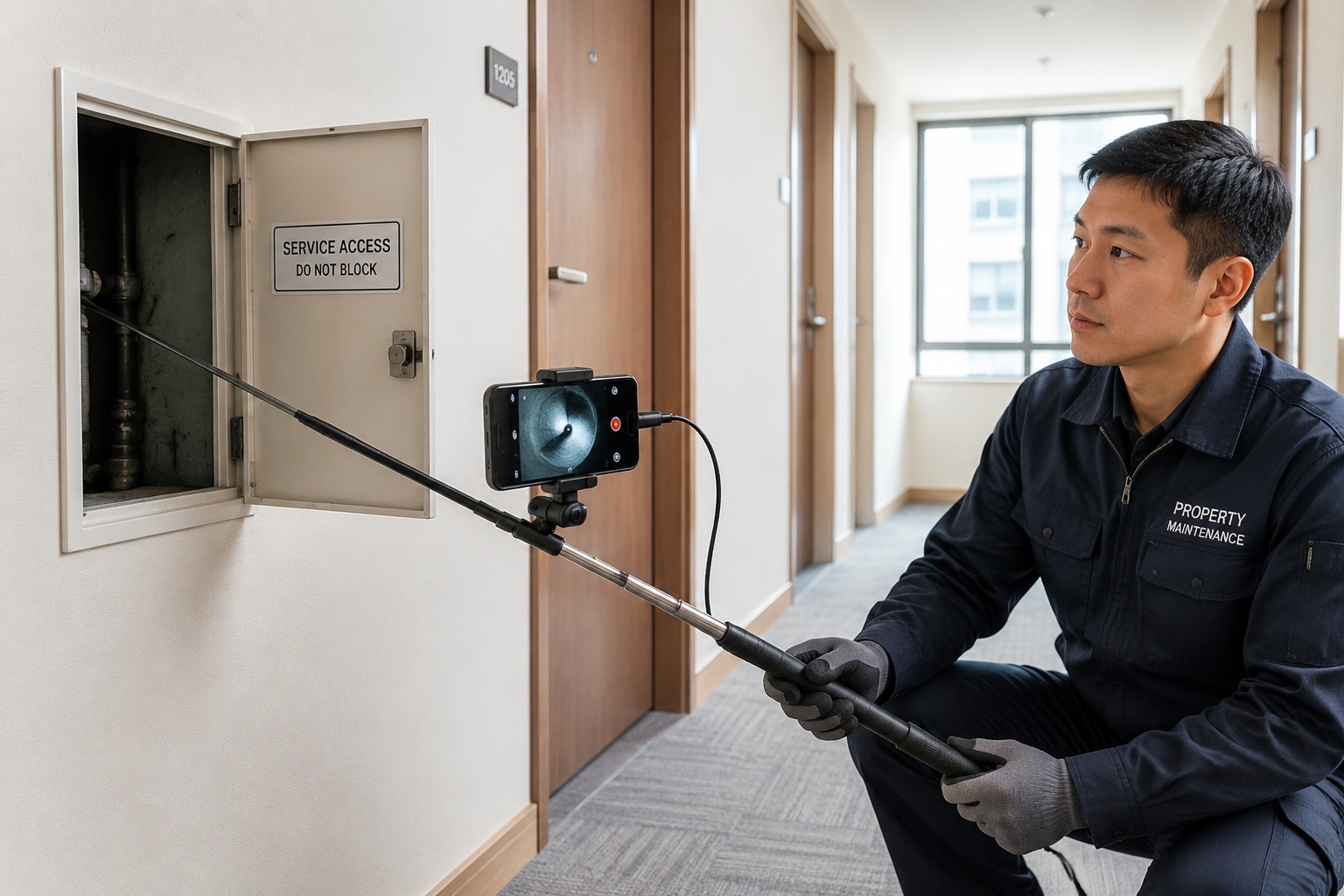
Qin’s backpack looks less like a detective kit and more like a curious handyman’s bag. Inside are a bright flashlight, a small endoscope camera on a flexible wire, a phone positioned on an extendable pole, and a laser pointer. There is also a simple folding net and, once in a while, a screwdriver.
She taps false ceiling panels with a finger, slides the endoscope camera through gaps that might be only five centimeters wide, looks for scuff marks on pipes, and listens after midnight, when the building falls quiet. Cats that hide during the day often start moving shortly after 2 a.m. If a hiding spot is suspected, she will place a bowl of food and wait — sometimes for hours.
It sounds simple, but the work is slow. “People want a dramatic rescue,” she says. “They want me to jump on a motorbike and follow a fur trail. The truth is more like being a patient plumber who happens to love animals.”
Case one: inside the building’s skin
One of Qin’s more unusual cases was a white cat named Tuantuan. CCTV showed the cat entering a fourth-floor equipment room but never leaving. The owner spent a whole day peeking beneath racks and behind cabinets, then called Qin.
Qin noticed a metal access panel in the wall, painted to match the corridor. With permission from the property manager, she pried it open just enough to insert the endoscope. On the phone screen, two green eyes reflected the light. Tuantuan had crawled into a ventilated cavity between the concrete wall and the building’s outer cladding. No cat food or calling could have pulled it out — the space was too far for a human arm.
A maintenance worker removed the panel, and the cat stepped out with dust on its fur, blinked, and walked straight to its owner. The rescue took two nights of waiting and less than a minute of action.
Case two: neighbours become the search team
Not every lost cat hides behind a wall. Some simply move through areas that people do not connect. A black cat named Tanghulu escaped from the ground floor hallway while a delivery rider was holding the door open. For four days, the owner searched nearby streets and parks. Qin took a different route.
She asked the owner to send a short message with a photo to the building’s WeChat group. In many Chinese apartment compounds, these group chats are used for announcements about water outages, package pickups and lost keys. Qin’s message added one simple request: “If you see a black cat in the corridor, do not chase it. Just take a picture and send it here.”
The first useful reply came from a cleaner who worked the night shift. She had noticed a cat sitting under a luggage cart in the unused server room on the second floor. Moments later, an older woman who feeds stray cats near the rubbish room sent another photo: the same cat, looking at an empty food bowl.
Armed with these two clues, Qin and the owner closed the fire door on the second floor and waited. After midnight, Tanghulu walked out from behind a water pipe, weak but unharmed.
“The person who found the cat was not the detective,” Qin says. “It was the cleaner who had seen every corner of that building for ten years. Other people just didn’t ask her before.”
The hidden community network
Qin says her job often turns into neighbourhood work. Delivery riders in large Chinese housing blocks pass through stairwells dozens of times a day. Security guards switch shifts at the same entrances. Elderly residents who feed stray cats know the location of every warm drainpipe and dry basement. These are not witnesses in a police drama; they are ordinary people whose daily routines happen to form a quiet map of the city.
“When you lose a cat in a high-rise, you are not just searching for an animal,” she says. “You are asking a tower full of strangers to open their eyes for one small creature. That changes how people look at each other.”

Of course, not every case ends well. Cats can fall from high floors, or slip through an unguarded gate and run into traffic. Qin estimates her success rate is around seven out of ten, and she is honest about the failures. “People often called me too late,” she says. “They spent days printing posters before they thought about checking the building’s pipe room.”
The rise of pet detectives in China says less about animal lost-and-found than about city life. In a concrete jungle where most people are separated by heavy doors and thin walls, a missing cat is an strange but effective excuse to turn strangers into a team. It may take a detective to find the cat, but it takes a neighbourhood to make the search possible.
That is the quiet magic of the job. Qin does not claim to see through walls, but she can remind people what a neighbour looks like, one lost cat at a time.
Start the discussion at forum.chinacomes.com