
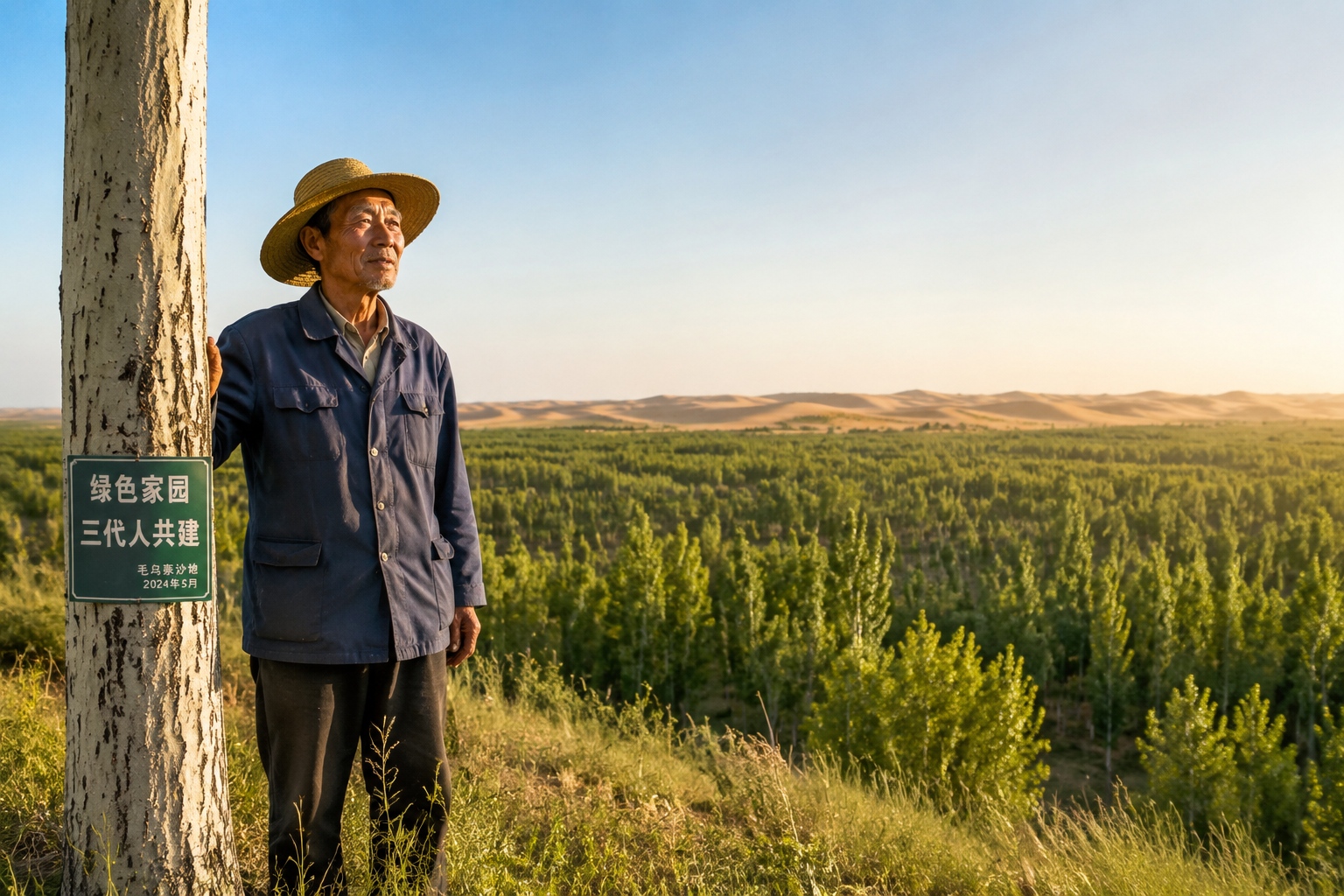

Morning Among the Trees
At 5:30 in the morning, the sun has just touched the black poplar crowns on the edge of the Mu Us Desert. Shi Guangyin, now 73 years old, laces his worn boots and walks slowly along the rows of trees he planted himself. Some trunks are as thick as a man’s waist; they mark each decade of his life since 1984. Behind him is the small farmhouse that used to be buried under sand during spring storms. In front of him, the green forest stretches until it meets the pale, dusty horizon. It was not always like this, he says. Back then, we could not open our doors in the morning because the sand was higher than the threshold.
Shi grew up in Haiziliang township in Dingbian County, on the southern edge of the Mu Us. He was born not long after the founding of the People’s Republic of China, at a time when sandstorms dictated every part of daily life. He remembers watching his family’s sheep suffocating one by one during a single windy afternoon. When he was a young man, he saw a house five kilometers away vanish under a dune in less than a week. The sand seemed alive; it could swallow your food, your fields, and even your home while you slept.
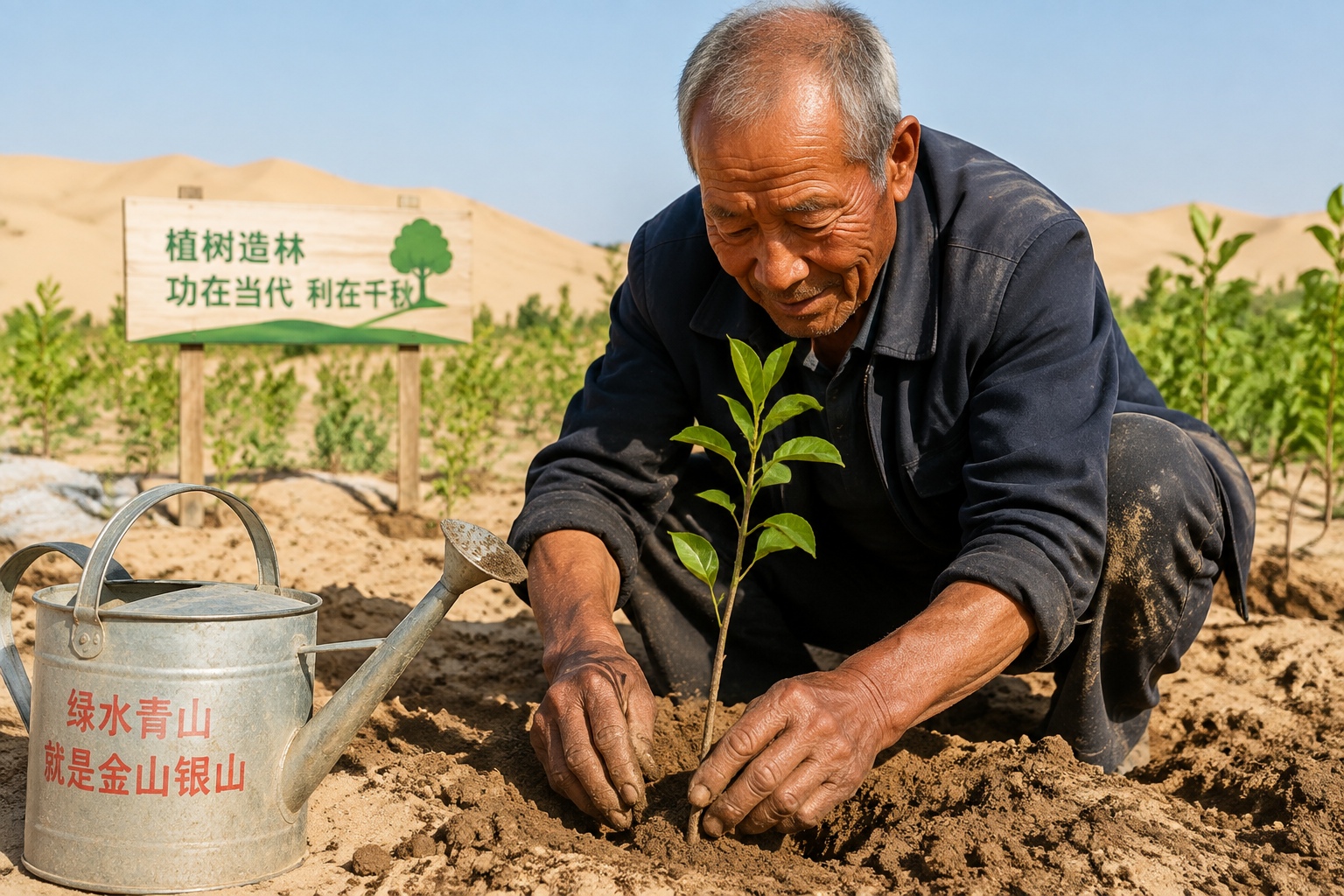
When the Sand Moved In
The Mu Us Desert is one of China’s most volatile drylands. For centuries, overgrazing, deforestation and climate change turned its fragile grasslands into about 40,000 square kilometers of shifting sand, which seasonal winds then lifted into the skies over central and eastern China. In the 1970s, villagers in Shi’s county had two choices: leave or become a gravedigger for their own land. Many left. Shi stayed.
In 1984, at an age when most men start to think about grandchildren, he signed a long-term contract with the local government. The contract gave him responsibility for thousands of acres of sandy wasteland. Everyone in the village laughed at him, saying that even the crows would starve on that land. To raise money for saplings, he sold his family’s cattle, his sheep, and his wife’s dowry—a few silver bracelets. With 100,000 seedlings and a dozen villagers, he spent the first year building a simple earthen shelter and planting in the shifting sand. The first spring storm wiped out almost every sapling.
Learning to Listen to the Sand
Shi could have stopped there, but instead he began a ten-year learning process. “You can’t fight desert with brute force,” he explains today, wiping dust from his glasses. “You have to study what elements survive and mimic nature.” He started testing native shrub species: caragana, sea buckthorn, willow and a legume called sand milk vetch. He also borrowed a technique now used across arid China: straw checkerboards. A grid of wheat straw is pressed into a shallow trench on the dune surface; these barriers block the wind and trap moisture and soil, so that a young tree root can establish itself without being blown out. Shi’s team went further by mixing small clusters of fast-growing willows with slow-growing pines, allowing the willows to act as living shields for the pine saplings.
The change in survival rate was dramatic. In the early years, only ten or twenty percent of trees survived. By the late 1990s, survival exceeded 85 percent. A forest began to appear where no forest had been for years. “The trees grow slowly, but every one that is alive is evidence that the land can come back,” Shi says.
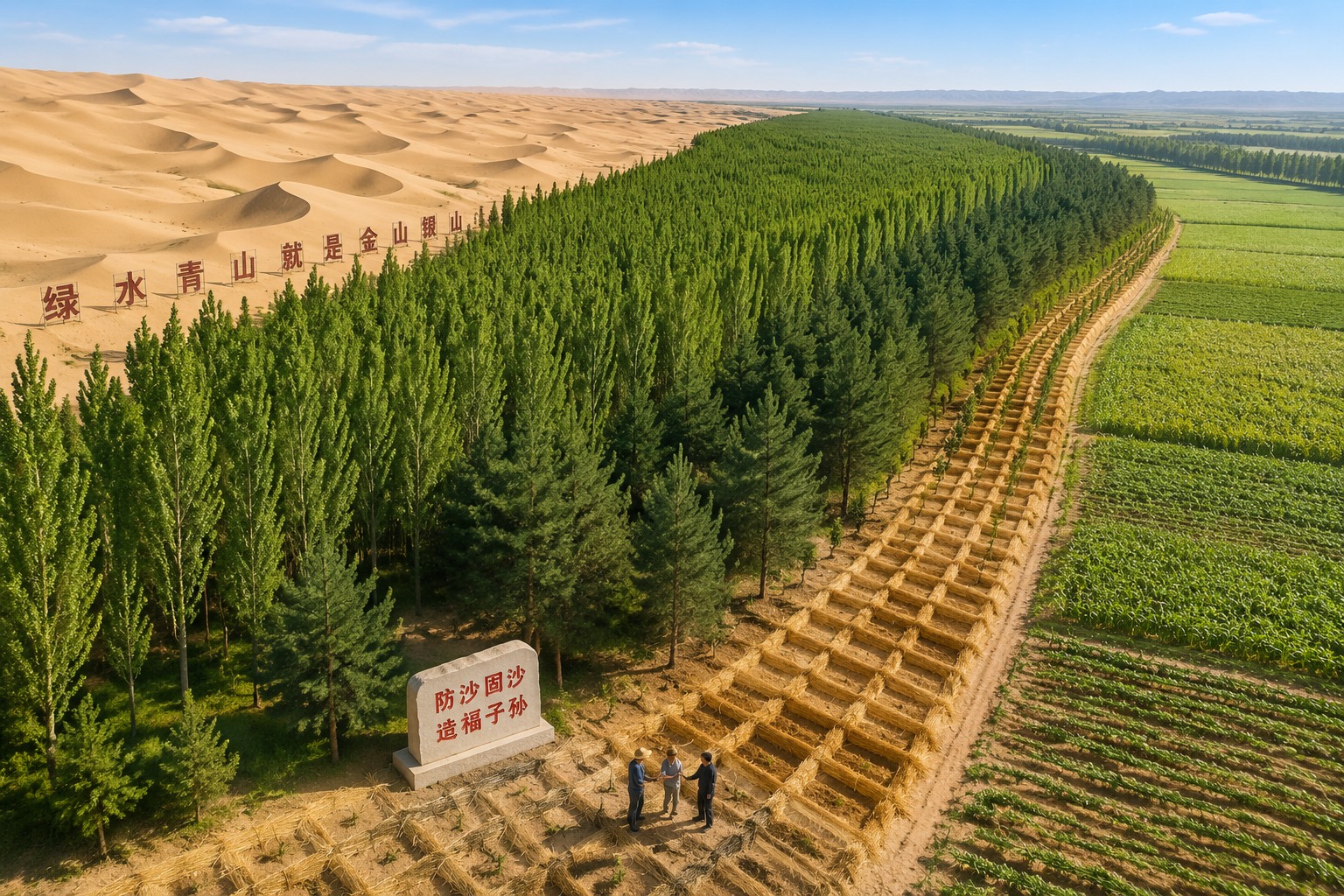
More Than One Man’s Obsession
Shi is not the only Chinese villager fighting dust storms. Since the late 1970s, China has carried out some of the largest ecological restoration projects in human history. The Three-North Shelterbelt Project, often called the Great Green Wall, stretches across northern and western China. Farmer-led afforestation is part of it. Government subsidies provide free seeds and real money for each hectare of mature forest. In Shi’s neighborhood, more than 1,400 households have joined his tree-planting network.
This kind of work has measurable results. China’s forest coverage rate rose from about 12 percent in the early 1980s to 23 percent in 2021, according to official data. Satellite imagery from NASA confirms that China is responsible for a large share of recent global leaf growth. In the Mu Us region itself, once-active dunes have been pinned down by roots. The provincial forestry service in Shaanxi announced that the mobile desert within its boundary has been practically stabilized, with the area of drifting sand reduced by more than 90 percent compared to the early 2000s.
From Dust to a Forest Economy
Perhaps the most surprising result is how green life creates new economic opportunities. Under Shi’s initiative, strips of sea buckthorn are now harvested for medicines and health drinks; farmers plant goji berries between rows of poplars. The flat area between dunes, once too dry for vegetables, now grows potatoes and corn, partly because trees trap moisture and lower the local wind speed. Shi has hosted students and international researchers, and his demonstration forest has become a classroom.
Shi is fond of saying that trees are not only for holding sand—they are for people. He lists the young farmers who used to move to cities and now come back to care for family plots: “If our grandchildren inherit a land of dust and hunger, all our work has failed. If they inherit a forest with clean air, they will stay.”
The Foolish Old Man Who Moved a Mountain
The Chinese fable Yu Gong Yi Shan tells of an old man who tried to move two mountains blocking his village with a basket and a shovel. When neighbors mocked his ambition, Yu Gong replied, “When I die, my sons will carry on; when my sons die, there will be my grandsons.” Shi once quoted that story at a public event.
Start the discussion at forum.chinacomes.com