
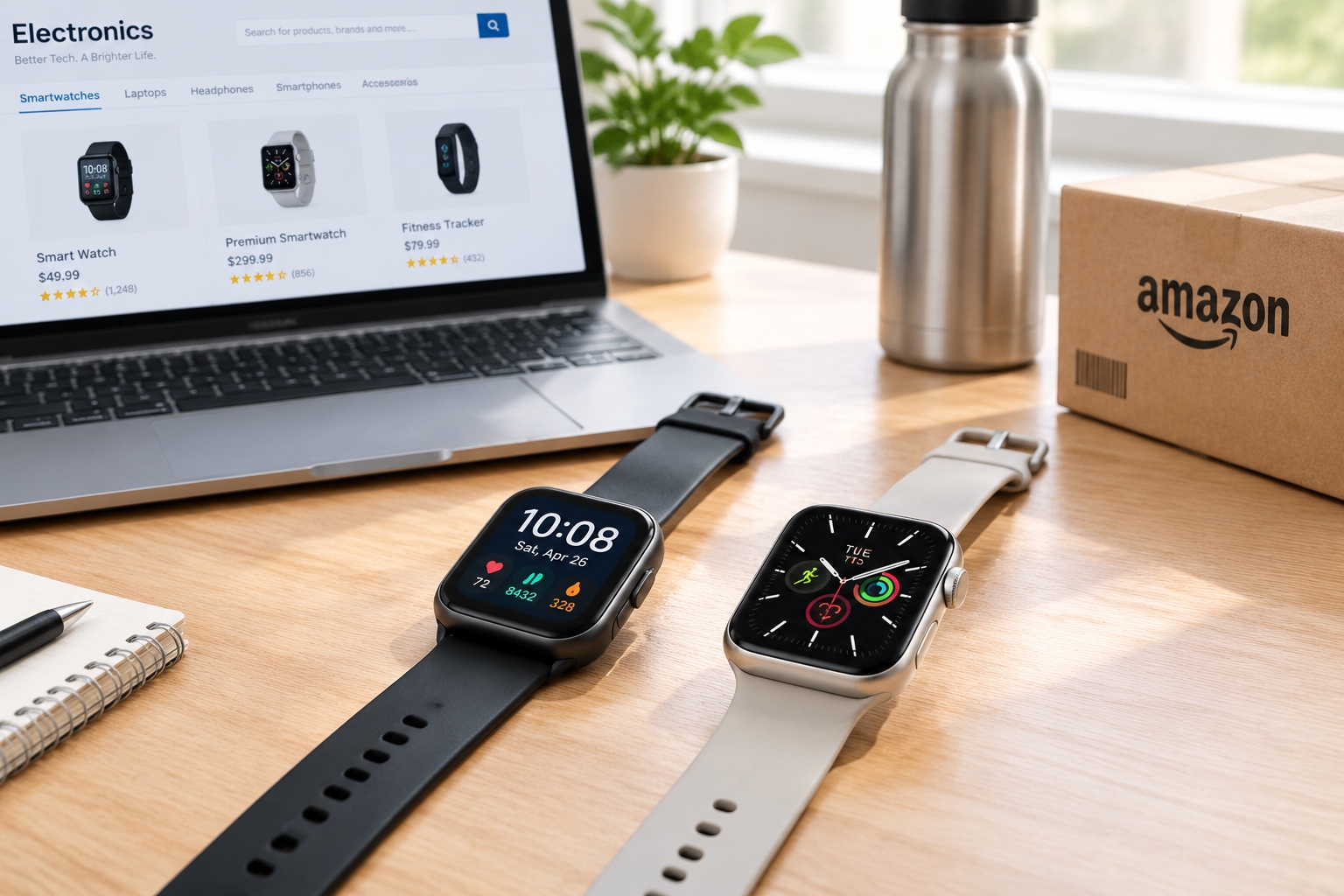

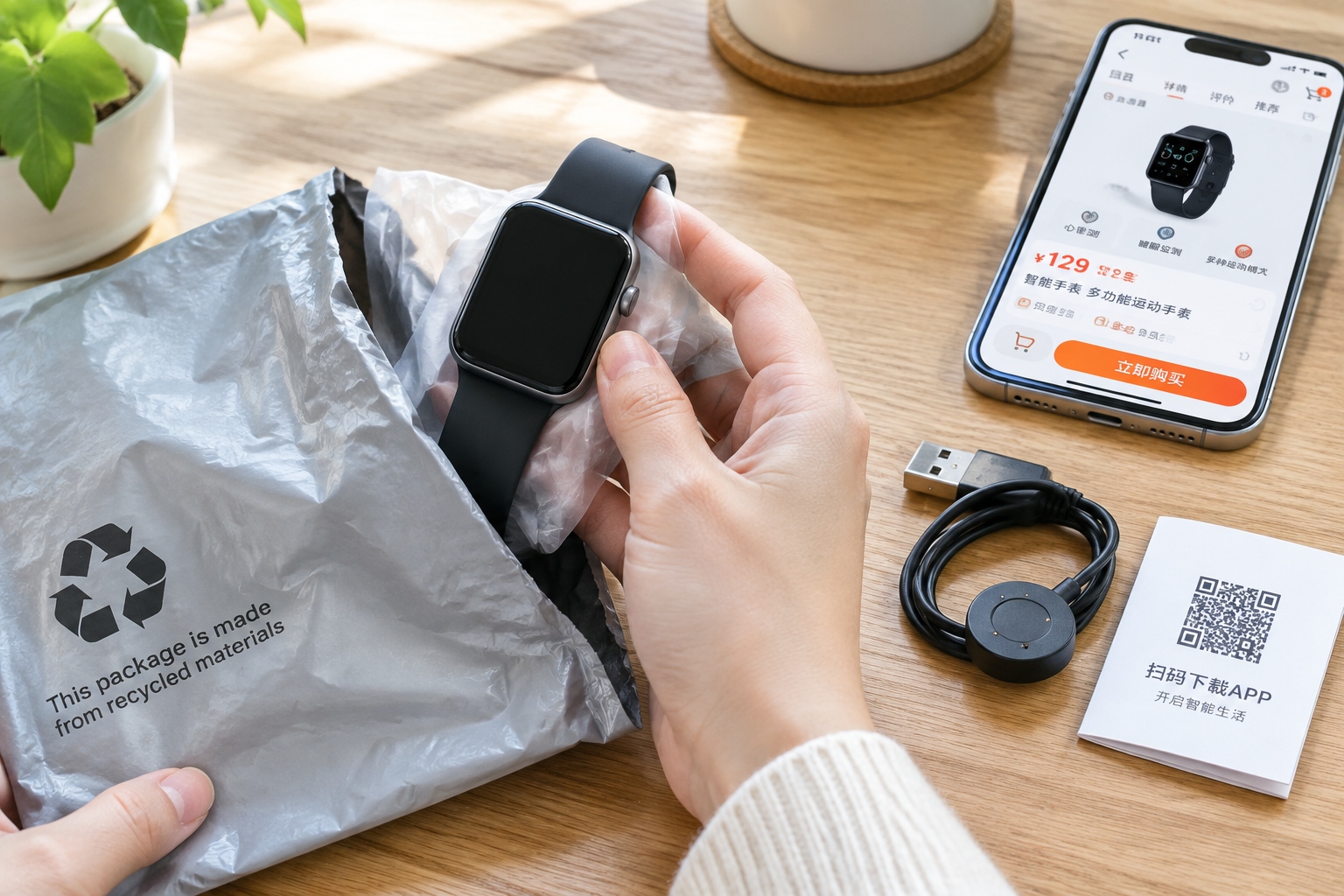
The parcel arrived on a Tuesday morning, a gray bubble mailer from Shenzhen. Inside was a smartwatch I had ordered from Taobao for ¥129 — about $18. The listing promised that it could do 90% of the functions of an Apple Watch. In the box I found a square watch with a 1.96-inch AMOLED screen, a magnetic charger, and a folded sheet of paper with a QR code. There was no manual, just a link to an online PDF.
The first impression was better than I expected. The metal-like case was solid and the silicone strap was comfortable. When I raised my wrist, the screen lit up and showed a colorful dial with steps, weather and heart rate. Pairing with my iPhone took about two minutes, and the watch began pushing notifications almost immediately.
I wore it to work, to sleep, and to the gym for the next ten days. I did not baby it. I wanted to know where exactly that 90 percent claim fell apart.
What $18 Actually Buys
At its core, this watch is a notification hub and a fitness tracker. It mirrors incoming calls, SMS, WeChat and WhatsApp messages, and lets you answer a call through the built-in speaker and microphone. It tracks steps, distance, heart rate, blood oxygen, sleep and stress. It has dozens of sport modes, from walking and running to jump rope and yoga. You can control music, trigger a remote camera shutter, set alarms, view the weather and change watch faces.
The display deserves special credit. At 1.96 inches, it is a real AMOLED panel with a 240×282 resolution. It is not as crisp or as bright as Apple’s display, but for everyday glance it works well. In harsh sunlight, however, the screen becomes hard to read. Reflections are a bigger issue than raw brightness at this price.
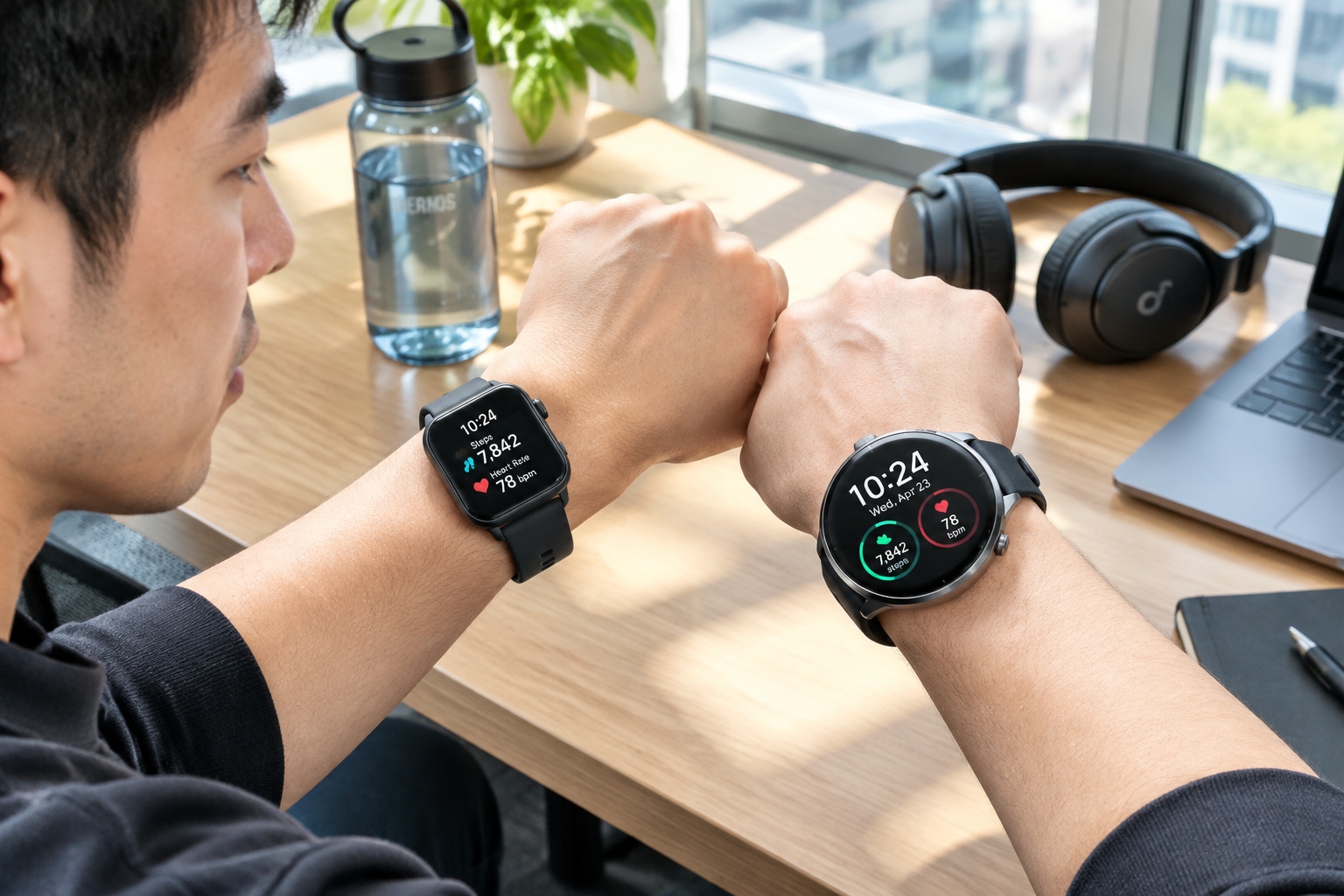
Feature-by-feature: budget watch vs. Apple Watch
- Display: The budget watch’s AMOLED panel is vibrant indoors. Apple’s screen is noticeably sharper and more legible outdoors, but the difference is not as dramatic as the price gap.
- Notifications: Both can show your messages. The cheap watch mirrors notifications from your phone, so it relies on a constant Bluetooth connection. It lags by one to two seconds, and it only reads messages — you cannot reply or type. Basic previews and alerts are fine; interactive workflows are not.
- Calls: Both let you answer phone calls. The $18 watch uses a built-in speaker and microphone that sound like an older smartphone on speakerphone. In a quiet room it works, but outdoors it struggles.
- Fitness tracking: Step counts are close to what a phone pedometer records. Heart rate while resting and sleeping looks plausible. During a high-intensity interval run, however, the sensor missed several spikes. Apple Watch uses more accurate optical sensors and years of refined algorithms, so serious athletes will want the real device.
- Sleep tracking: The budget watch records sleep stages — wake, light, deep. It is useful as a rough pattern but not a clinical tool. Apple Watch provides more context, including respiratory rate and wrist temperature trends.
- Battery: The cheap watch lasted six to seven days with Bluetooth calling enabled. Apple Watch usually needs a charge every day or every other day. For many people, this is the single most practical advantage of the cheaper device.
- GPS: The budget watch has no built-in GPS. To record a route when running or cycling, you must carry your phone. Apple Watch includes independent GPS, which is a real, everyday difference.
- Water resistance: The budget watch has IP67 protection, meaning rain and hand-washing are fine, but swimming is not. Most recent Apple Watch models can handle pool and open-water swimming.
- Extras: Apple Watch offers ECG, temperature sensing, fall and crash detection, voice assistant, contactless payments, offline maps and thousands of native apps. The $18 watch has none of those. It offers a small set of watch faces and basic reminders, then stops.
So is the 90% claim fair?
The honest answer is: it depends on what you call functions. If you count the things a casual user actually does every week — checking time, seeing messages, counting steps and sleep — this $18 watch covers roughly 90% of that experience. If you count the entire hardware, software and health ecosystem of an Apple Watch, the cheap watch reaches maybe 50% or less. That title is a marketing phrase, not a technical assessment.
Why Can It Be So Cheap? The Chinese Supply-chain Story
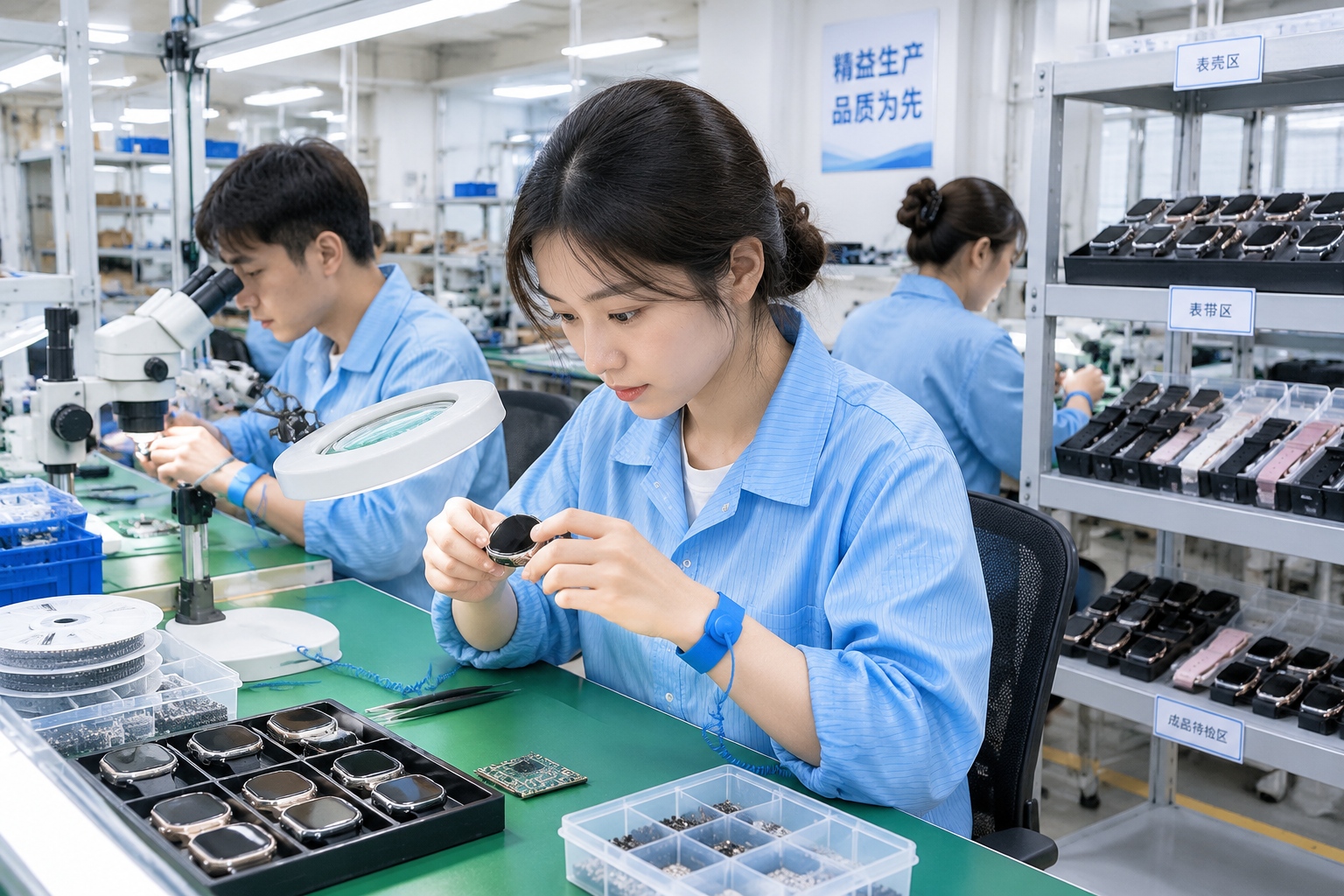
The price has little to do with copycat design and everything to do with industrial concentration in the Pearl River Delta. Shenzhen and its neighboring cities — Dongguan, Huizhou, Guangzhou — form the largest consumer-electronics production network on earth. The same region assembles premium devices like the Apple Watch and produces thousands of accessible components within a short driving distance.
For this particular watch, the main electronic cost components are all made in China. A low-power chipset with Bluetooth, an ARM processor and power management can be bought in bulk for about $3. A 1.96-inch AMOLED touch display costs about $4. Heart-rate and motion sensor modules — mature designs used in millions of fitness bands — cost $1.5 to $2. A 300mAh battery, a metal-look housing, strap and small parts add another $4 or $5. Altogether, the bill of materials for a device that retails at $18 often lands below $10. Order in large batches, and the entire product can be made for almost half the retail price.
This is possible because chipmakers and ODMs (original design manufacturers) offer reference designs. A small brand does not need to build an operating system from scratch or develop a health-tracking algorithm. It can buy a complete solution: software, hardware layout, and even the app. The factory in Shenzhen tunes the antenna, inscribes the logo, and starts molding cases in days. The supply chain is deep enough to allow a domestic consumer brand to turn an idea into a finished product in a few weeks.
The same ecosystem also benefits from scale and competition. Chinese smartphone giants like Xiaomi, Huawei and BBK Electronics have sold tens of millions of wrist wearables, which pushed local chip suppliers and sensor makers to improve yields and lower prices. That progress has a spillover effect. Ultra-low-cost brands that sell on Taobao, Pinduoduo or Amazon Europe can adopt these mature components with little research risk. They spend almost nothing on engineering and almost everything on low-cost distribution.
Where the Budget Watch Falls Short
I found two problems that no market claim can hide. The first is accuracy. During exercise, the cheap watch can produce numbers that look convincing but are not reliable. Heart-rate measurements at high intensity were sometimes 15 to 20 beats off. Sleep stages are estimates built on motion and heart-rate variability — helpful for spotting patterns, but not a substitute for medical-grade testing. None of these devices are cleared by medical regulators, and they should not influence health decisions.
The second is software and privacy. The companion app is basic, and data portability is not a priority. It can sync to your phone, but it often lives inside a closed cloud. Some apps ask for unnecessary permissions, and firmware updates may stop long after the product is launched. Users have no way to know how long the device will be supported. That is a very different commitment from Apple’s regular watchOS updates and strict privacy policies.
Hardware compromises also appear quickly. The vibration motor is weak, and I sometimes missed an incoming-call alert on a noisy street. The microphone makes callers sound distant, and the glass screen scratched after just a few days in a backpack pocket. The strap attracts dust, and the case is a magnet for fingerprints. If you hold an Apple Watch next to this device, the 90% number quickly drops back to 50 or even 40 percent.
Not a Miracle, but a Signal
After ten days, I went back to my regular smartwatch. But I kept thinking about why this cheap product stayed on my wrist as long as it did. On the subway, I saw a delivery rider checking a budget smartwatch at a traffic light. In a park, an elderly woman used a similar watch to measure her morning walk. These are not Apple customers; they simply want a lightweight reminder of the day.
That is the real story. China’s wearable industry has not defeated Apple, and it probably will not. But it has industrialized the basic smartwatch so deeply that many people can now afford to try one for the price of three pizzas. The Apple Watch remains the benchmark for polished integration and health-grade sensors. The $18 watch is not a substitute. Still, it proves something important: in China, the ability to deliver a functional electronic product at a point where technology becomes almost invisible is no longer a surprise. It is simply what the supply chain does.
Start the discussion at forum.chinacomes.com