


Before you send that ‘your price is too high’ email
You are in a video call with a supplier in Ningbo. You have a quotation for a stainless steel water bottle. The unit price is $4.20. You know a competitor got $3.90. You type ‘too high’ into the chat. The supplier pauses, smiles, and says, ‘This is our real price.’ Something has gone wrong — not because the supplier is lying, but because you are reading the quotation differently. In China, a quotation is often a starting point with a cost structure behind it. If you don’t understand that structure, you are negotiating blind.

How Chinese suppliers build a quote
Most quotes you receive from China are not random. They are assembled from visible and hidden parts: raw material, labor, machining, tooling, packaging, domestic transport, export documentation, tax treatment, payment terms, exchange-rate buffer, and profit. A $4.20 water bottle might contain $2.10 of stainless steel, $0.45 of labor, $0.30 of packaging, $0.25 of overhead, $0.60 of profit, and $0.50 of tax and financial costs. If you attack the total without asking which part can move, the supplier will simply protect the total.
Ask for a cost breakdown. Not every factory will give you a full spreadsheet, but most will tell you which elements are flexible. ‘Can we adjust the packaging?’ is a better question than ‘Can you do $3.80?’ The first invites problem-solving. The second invites a polite no.
Also check what is included. Is the price FOB, EXW, CIF, or DDP? Is tax included? Are mold costs amortized? Is the MOQ 500 or 5,000? A lower unit price at a higher MOQ is not necessarily a better deal. In Europe or North America, buyers often treat price as a single number. In China, price is a bundle of conditions. Negotiation is the process of unbundling them.
The bottom line is real — but it is not always where you think
Chinese suppliers do have bottom lines. Raw material prices are set by markets. Labor costs in coastal provinces have risen sharply over the past decade. Factory rents, electricity, and compliance costs are real. A supplier cannot sell below cost for long. But the bottom line for a first order may be different from the bottom line for a repeat order. Many factories will accept a thin margin on a small trial order if they believe a larger annual volume is possible. That belief is not charity. It is a calculation about future cash flow.
This is where cultural expectations differ. Many Western buyers are trained to push for the lowest price in every transaction, then move to the next supplier. Many Chinese suppliers are trained to build a relationship that produces repeat orders. If you only push, you may win a small battle and lose the factory’s attention. If you explain your volume plan, target price, and timeline, you give the supplier a reason to invest in you.
MOQ: the first real negotiation
Minimum order quantity is often the first wall. A factory says 5,000 pieces. You need 500. If you simply say ‘I need 500,’ the conversation usually ends with ‘Sorry, we cannot.’ A better approach is to understand why the MOQ exists. It may be because the raw material supplier has a minimum, because the printing plate costs $300, because the production line needs a full shift to be efficient, or because the factory’s sales team is measured on order value.
Try this: ‘I understand 5,000 is your standard MOQ. For our first trial, could we do 500 pieces using your existing material and standard packaging? We will pay the sample and setup costs separately. If the quality is good, our next order will be 3,000 pieces, and we can sign a forecast for 12,000 pieces over twelve months.’
This works because it addresses the factory’s real risks: setup time, material waste, and uncertainty. You are not asking for a discount on trust. You are offering a path to a larger order. Sometimes the supplier will still say no. That is useful information. It tells you the factory is not set up for small runs. You can then look for a trading company, a smaller workshop, or a supplier that already stocks similar products.
Payment terms: where risk meets cash flow
Payment is the most sensitive part of the deal. A common Chinese supplier request is 30% deposit by T/T before production, 70% before shipment. From the supplier’s side, this covers raw materials and reduces the risk of a buyer disappearing. From your side, it feels like you are financing the factory with no guarantee. Both views are rational.
If you are a new buyer, asking for 100% payment after delivery is usually unrealistic. Instead, negotiate in stages. For a small first order, 30/70 may be acceptable if the amount is low and you have inspected the goods. For larger orders, you can propose a letter of credit at sight, or use an escrow service like Alibaba Trade Assurance. You can also ask for the 70% to be paid after a third-party inspection. A supplier who refuses any inspection is a red flag.
Useful language: ‘We are comfortable with 30% deposit and 70% against the bill of lading copy. To protect both sides, we would like a pre-shipment inspection by SGS. If the inspection passes, we will release the balance within two working days.’ This is specific, fair, and hard to argue with.
Volume, forecasts, and the power of a serious plan
Chinese factories think in seasons, production slots, and annual targets. If you can show a realistic procurement plan, you become more than a one-time buyer. Even if you are small, a clear forecast changes the conversation. ‘We expect to order 1,000 units in Q2, 2,000 in Q3, and 3,000 in Q4. If you can support us with a lower MOQ now, we will keep the volume with you as we grow.’

Do not promise volumes you cannot deliver. Factories talk to each other, and a reputation for empty forecasts spreads. Instead, offer a tiered price: ‘If we order 500, we accept $4.20. If we order 2,000, can you do $3.95? If we order 5,000, can you do $3.75?’ This gives the supplier a reason to quote lower without asking them to guess.
Relationship maintenance: small signals, not expensive gifts
Many international buyers hear ‘guanxi’ and imagine lavish dinners or envelopes. In modern China, especially with export-oriented factories, the important relationship signals are simpler: replying to messages, paying on time, not changing specifications at the last minute, and remembering major holidays. During Chinese New Year, a short WeChat message or email — ‘Wishing you and your team a prosperous Year of the Dragon’ — is noticed. During Mid-Autumn Festival, a mooncake greeting is common but not mandatory.

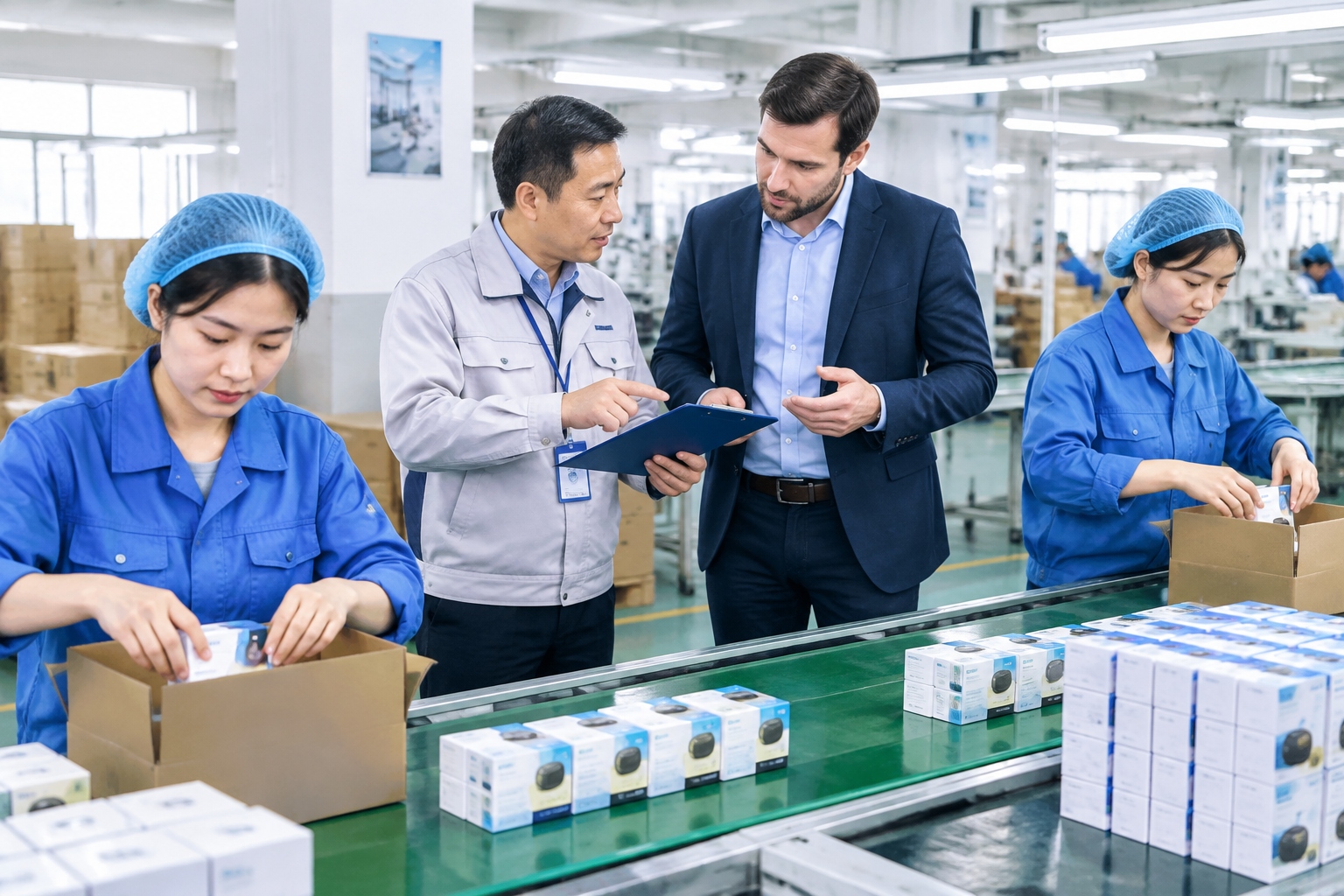
Visiting the factory still matters. A buyer who shows up, walks the line, asks about worker safety, and eats lunch with the team is remembered. You do not need to bring expensive gifts. In fact, expensive gifts can create compliance problems for both sides. A branded notebook, a local snack from your country, or a thoughtful photo from the last visit is enough. The goal is to be seen as a reliable partner, not a holiday Santa.
Two cases: what worked and what backfired
Case one: A German buyer wanted 300 units of a custom LED lamp. The factory quoted a $600 mold fee and a 2,000-piece MOQ. The buyer asked to use an existing mold with a slight modification, accepted a standard color, and paid the mold fee upfront. The supplier agreed to 300 pieces at a higher unit price. Eight months later, the buyer ordered 4,000 pieces and received a 12% lower price. The relationship was built on a small, real order, not a big promise.
Case two: An American buyer kept pushing a supplier to match a competitor’s price. The supplier agreed, then cut corners on packaging. The buyer received damaged goods and blamed the factory. The factory blamed the buyer for squeezing the price. Both sides lost. The lesson is not that price negotiation is bad. It is that price without specification is a trap. If you negotiate down, also negotiate what stays the same: material grade, packaging, inspection standard, and delivery date.
A practical checklist for your next supplier call
Before the call, write down your target price, your walk-away price, your ideal MOQ, your maximum MOQ, your payment ceiling, and your delivery window. Ask for a cost breakdown by component. Ask which parts are flexible and which are fixed. Be ready to offer a first trial order with clear next steps. Mention your forecast, but only if it is real. Bring up inspection early. And remember that the goal is not to win the argument. The goal is to find a deal that both sides can execute without resentment.
Chinese suppliers are not a monolith. Some are aggressive, some are conservative, some are excellent, some are not. The best buyers are not the toughest negotiators. They are the ones who understand the supplier’s cost structure, risk position, and need for predictable orders. That is the real art of negotiation — not a trick, but a shared plan.
Start the discussion at forum.chinacomes.com