


One evening in Shanghai, I met a product manager named Xu Ting for dinner. She was wearing no watch. Her wrist was bare, but a slim matte-silver ring stayed on her finger throughout the meal. “It’s a smart ring,” she said, noticing my glance. “It tracks my sleep, my heart rate, and my recovery. I basically stopped charging my smartwatch.”
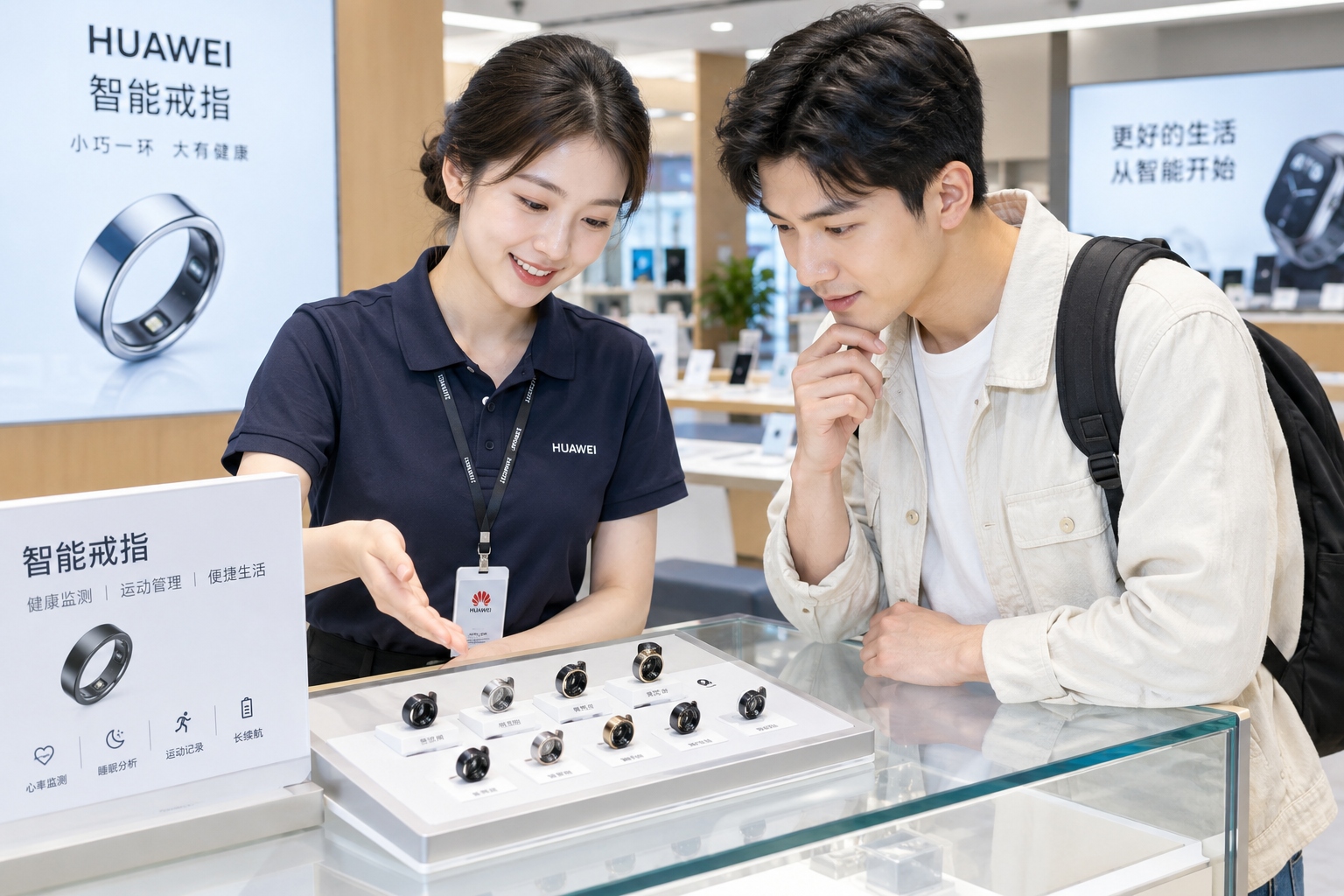
That was my first encounter with a device category that has quietly become one of the most talked-about gadgets in China: the smart ring. While smartwatches still dominate the wearables market, many Chinese consumers are now putting something smaller and more intimate on their hands.
Why Smart Rings Are Suddenly Popular
Smartwatches have a problem: they are addictive, but also exhausting. Notifications tug at your attention all day. Charging them becomes a daily chore. And for many people, wearing a bright screen to bed feels like sleeping with a tiny television on your wrist.
Smart rings solve these problems by removing the screen. There are no buzzing alerts, no glowing display, no app icons to scroll through. Instead, the ring stays on your finger for days and lets the data quietly accumulate. Most models offer five to ten days of battery life, so you can track sleep without waking up to a low-battery warning.
The bigger shift is about what people want from wearable tech. In China, health data is no longer just a fun extra. Young office workers check their heart rate variability (HRV) and sleep scores the way they check the weather forecast. A ring is easier to wear all day than a bulky watch, and for nighttime use it is much more comfortable.

Who Makes Smart Rings in China?
When people outside China think of smart rings, they usually think of Oura, the Finnish-American company that helped create the category. But inside China, a much wider range of players is moving in.
Zepp Health, the parent company of Amazfit, launched the Amazfit Helio Ring in 2024. It is the clearest sign that mainstream Chinese wearable makers see the ring as a serious product line. Helio Ring offers sleep tracking, heart-rate monitoring, a PAI activity score, and surprisingly long battery life in a lightweight titanium body. It was designed to work with Amazfit’s ecosystem, but it can also be used on its own.
There are also dedicated startups like RingConn, which grew quickly through crowdfunding and now sells globally. On the manufacturing side, companies such as Tianjian Health Technology, an experienced contract manufacturer based in southern China, are helping global brands turn tiny sensor concepts into finished products. That matters: Shenzhen and the surrounding Pearl River Delta region have the supply chain, the acoustic component makers, and the battery specialists needed to make a small, comfortable device that is still medically ambitious.
The Engineering Challenges Inside a Few Grams
Putting a health lab on your finger is not easy. A ring has far less room than a smartwatch. Yet the basic hardware is now mature enough: a green or multi-wavelength LED sensor for heart rate and blood oxygen, a skin temperature sensor, an accelerometer and gyroscope for sleep and motion, and in some cases small metal electrodes that can measure single-lead ECG.
The real challenge is software. A ring can move slightly on your finger during the night, and motion artifacts can easily confuse the sensor. Chinese engineers and algorithm teams spend most of their time filtering out that noise. The result, when it works well, feels like magic. Users can see a sleep staging curve in the morning, an early warning of unusually high stress, or a temperature shift that helps women track their menstrual cycle more accurately.
Battery life is another battlefield. There is a tiny lithium battery wrapped around your finger, usually less than one-tenth the size of a phone battery. Chinese brands love to compete on battery life, which pushes them to design very efficient chips and firmware. Some budget rings claim up to two weeks of real-world use, though the brightest display-less models usually sit around seven to ten days.
Real Uses in Everyday Chinese Life
The most practical use today is sleep. I know an accountant in Chengdu who used to wear a smart band to bed but gave up because the band was uncomfortable under her wrist. With a smart ring, she says, she hardly notices it. She uses the data to plan when to do high-intensity workouts and when to rest.
Health analysis is only part of the story. In Chinese cities, NFC payment and access cards are everywhere. Most smart rings on the market today are still too small to pack a secure payment chip, but NFC-equipped rings and ring-style key fobs are starting to appear. A small but growing number of commuters use ring-shaped NFC tags to pass through subway gates or open apartment doors. It is not yet as common as scanning a QR code with a phone, but the infrastructure is already there, and the idea feels natural for a country that loves to leave cash and cards at home.
One important nuance: Chinese users do not expect a smart ring to replace their smartphone or their smartwatch overnight. Instead, many buyers treat the ring as a specialized health-tracking accessory. During the day they may still carry a phone and even wear a mechanical watch; at night, the ring takes over.

What Chinese Rings Do Differently From Oura
Oura built the blueprint, but Chinese challengers are competing on price, subscription fees, and local habits. Oura uses a subscription model to unlock full data analysis. Most Chinese brands avoid subscriptions or include analytics for free, because local consumers are used to one-time purchases with free companion apps.
Price also matters. Smart rings from Chinese brands are often priced lower than Oura’s entry-level ring, and that gap becomes even wider if you factor in subscription costs. This does not automatically mean lower quality; many domestic models now offer similar optical sensors, temperature tracking, and a titanium or ceramic finish that feels intentional and premium.
Localisation goes further than language. Chinese apps frequently support data export to Apple Health and WeChat, and some work with local health-management services. Cloud servers in mainland China also make it easier for customers to meet data security expectations. Even practical details are adjusted: Chinese wearable brands usually provide many ring sizes, and understand that Singaporean or South Korean users might have smaller hands than the models used in marketing photos.
Still a Young Market, but Growing Fast
There is no shortage of hype. On Chinese e-commerce platforms, search interest for smart rings has risen sharply, and online reviewers have posted hours of videos testing sleep accuracy and workout tracking. Some posts call smart rings the “next Apple Watch.” Other users, however, are more cautious. Sensor accuracy can vary when fingers press against an object or when the ring slips during deep sleep. The categories are improving, but not every product lives up to the promise.
The smart ring is not yet the mainstream device that smartwatches are. But China’s advantage is industrial speed. New models ship rapidly, prices drop quickly, and competition forces engineers to refine the algorithms rather than just adding more lights and buzzers. This is why I suspect the next major step—whether it is smarter medical analysis, better battery management, or seamless public-transport payment—will come from a company working on the border between Shenzhen and Shanghai.
Beyond the Watch on Your Wrist
When smartwatches appeared a decade ago, many people asked whether they would kill traditional watches. That did not happen. What did happen is that a slice of the population adopted tiny wearable computers. Today, smart rings are opening a new path: they are more discreet, more humble, and in some ways more ambitious. They are not designed to keep you glued to your phone. They are designed to listen to your body.
Chinese consumers are early adopters of this idea, and Chinese hardware companies are especially well positioned to push it forward. The ring on Xu Ting’s finger did not look like a futuristic gadget. It looked like a piece of jewellery. That may be the most revolutionary part of the Chinese wearable industry right now: the future of health tech is small enough to forget you are wearing it.
Start the discussion at forum.chinacomes.com