
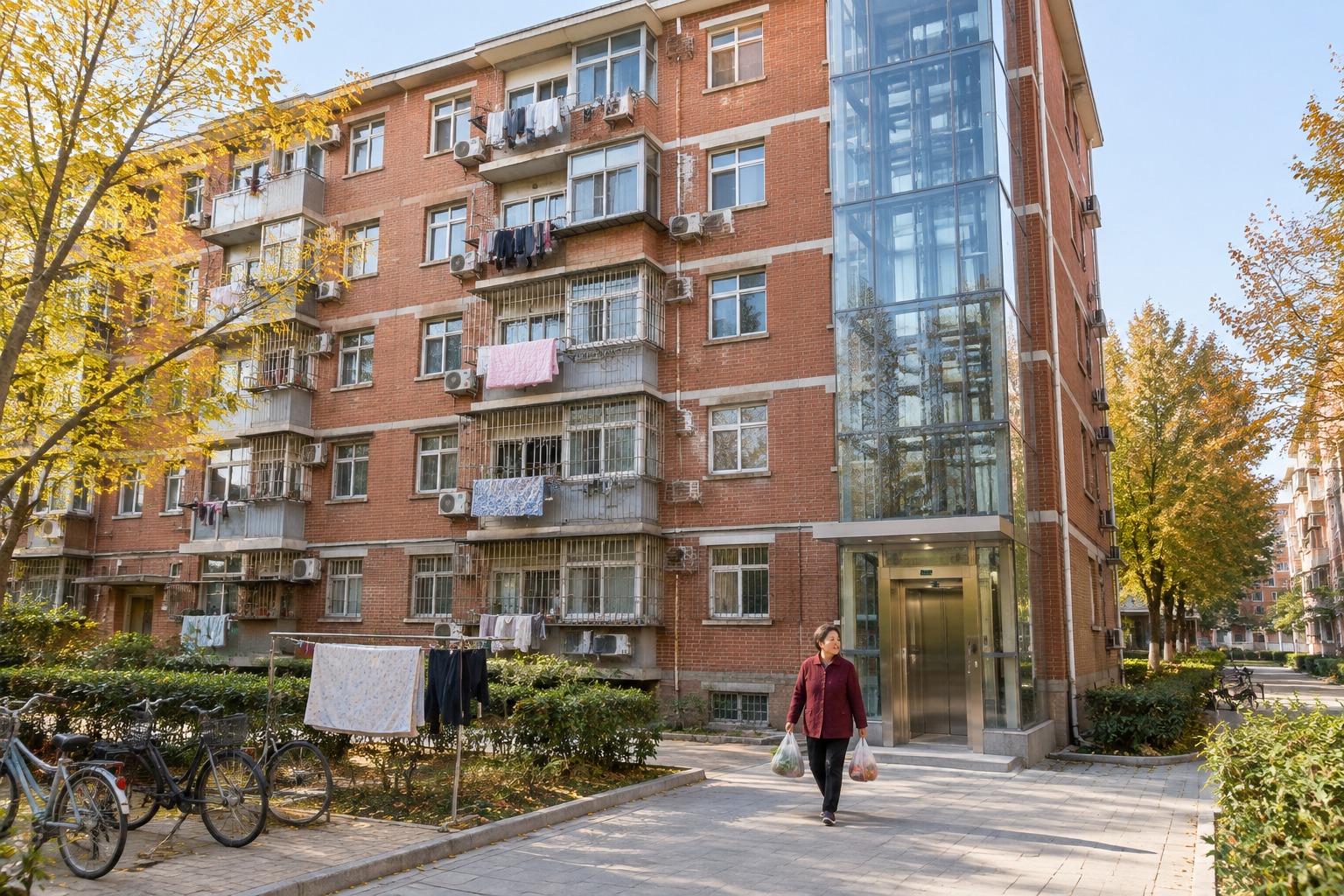

A stairwell in eastern Beijing
The stairwell of Building 4 smells of dust and cooking oil. Six floors, 96 steps, no elevator. Chen Yulan, 62, counts them without meaning to. She has climbed them twice a day for 31 years, and since last winter her right knee has made a sound she does not like.
The building went up in 1988, when the school district she worked for put four identical brick blocks on one plot in eastern Beijing. Twelve apartments, two per floor. Back then nobody asked for an elevator in a six-floor walk-up. Today the youngest household on the sixth floor is 57.
Chen started pushing in March 2023. The elevator took its first passenger — her, holding two bags of groceries — in October 2024. Nineteen months, eleven meetings, seven rounds of signatures, and 48,000 yuan charged to her apartment, of which she pulled 30,000 from her housing provident fund.
What follows is the sequence as she lived it. If you have ever tried to get neighbors to agree on anything, parts of it will feel familiar. The rest is specific to China, and to buildings designed for a country that no longer exists.
Step 1: Count the people who will say no
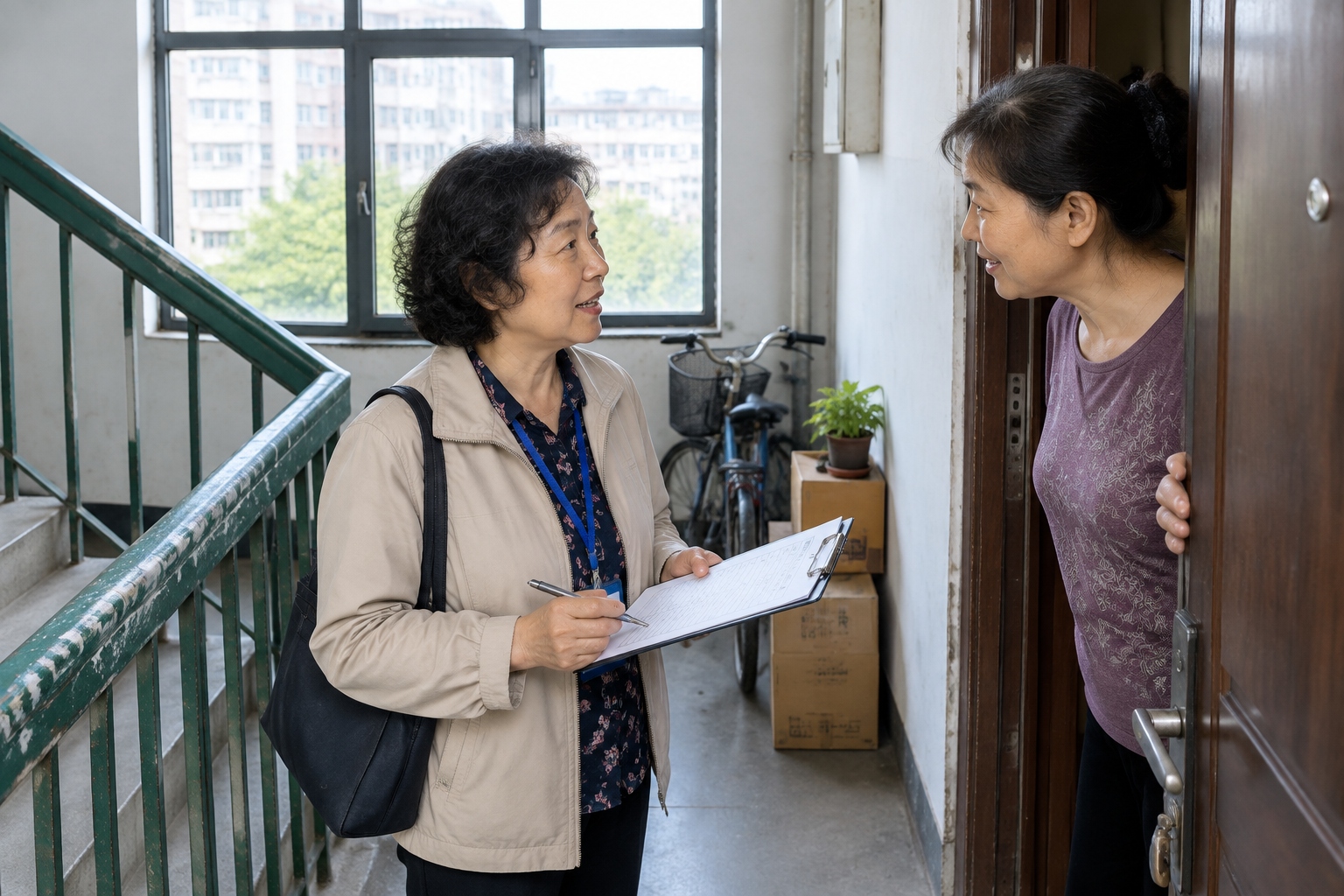
Chen’s first move was not a meeting. It was a list.
China’s Civil Code sets the legal bar for altering a building’s shared structures: two-thirds of owners must take part in the vote, and three-quarters of those voting must agree. Beijing adds a condition on top — a supermajority within the specific stairwell, and no unresolved objections from the other owners. In plain terms, you can override a neighbor on paper. You cannot override a neighbor in a stairwell you both use every day.
So Chen walked the building. Ground floor: two retired households, both certain to object. Second floor: two households, indifferent, because they can use the stairs. Third floor and above: six households, all interested.
The ground floor’s objection is not irrational. A steel shaft bolted to the outside wall takes light from the windows beside it, adds noise at the landing, and eats part of the courtyard where bicycles and drying racks live. In the resale market, a first-floor flat in a walk-up is worth more than a fifth-floor one. An elevator flips that.
Chen found two allies on the fourth and fifth floors. The three of them became the organizing committee, and they went to the ground floor before anyone else — a retired railway worker, Mr. Wang — sitting in his living room with tea, before any plan existed and before anyone had something to defend.
Step 2: Work out who pays what
The elevator company quoted 780,000 yuan for a six-stop unit with a steel shaft: survey, design, utility relocation and the first year of maintenance included.
Beijing’s subsidy is 240,000 yuan per elevator from the municipal budget, and the district is required to match it at no less than one to one. That covered 480,000. The remaining 300,000 had to come from residents — under one rule that is near-universal here and almost never written into the formal documents: the ground floor pays nothing.
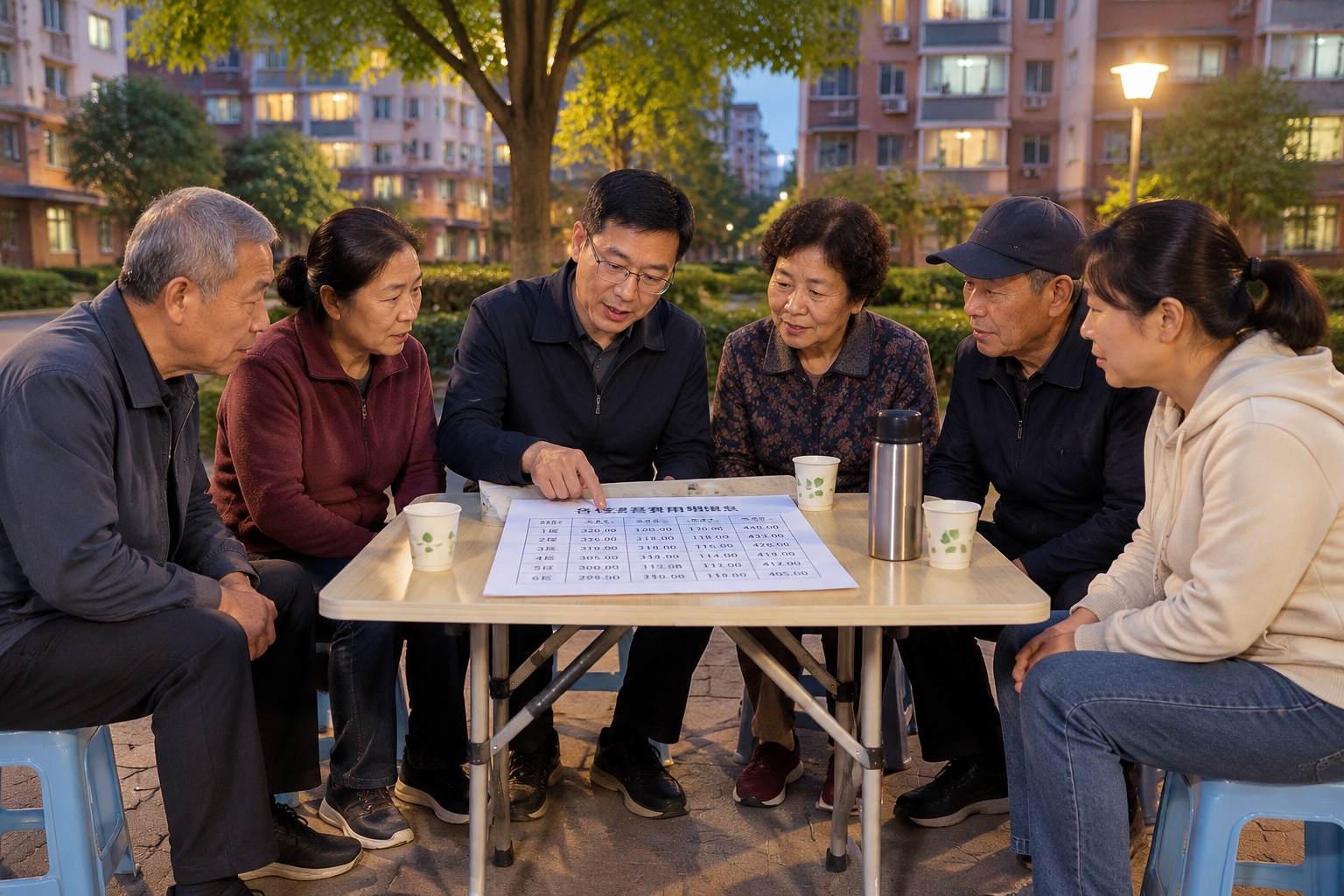
The ten households on floors two through six agreed on a sliding scale, as a share of the 300,000:
Floor 2 — 4% per household, 12,000 yuan
Floor 3 — 7%, 21,000 yuan
Floor 4 — 10%, 30,000 yuan
Floor 5 — 13%, 39,000 yuan
Floor 6 — 16%, 48,000 yuan
Those numbers look arbitrary because they are. They took two weeks to reach, and the first proposal had the sixth floor paying 40% of the total. The sixth floor refused.
Two things softened the deal. First, Beijing lets owners withdraw from their housing provident fund — the mandatory savings account most Chinese workers hold — to cover an elevator share. Chen took 30,000 yuan out of hers, turning a 48,000 bill into 18,000. Second, the ten paying households quietly pooled an extra 30,000 yuan, 15,000 per apartment, for the two ground-floor families. That compensation appears in no regulation. It is the price of a signature, and everyone involved knows it.
Step 3: The signatures take longer than the construction
The first drawing put the shaft on the south side of the building, where there was more room. Mr. Wang read it on his kitchen table for twenty minutes and said no. It would sit four meters from his living room window and take his afternoon light.
The designers came back with a narrower shaft on the north side, beside the stairwell, clad in glass instead of painted steel. Glass costs about 40,000 yuan more, absorbed by the upper floors in proportion. The elevator stops at floors two through six; the ground floor has no door and pays no running costs.
Then came the official process. Under Beijing’s rules the plan had to be posted in the stairwell and on the compound notice board for ten days, during which any owner could file an objection. Chen photographed the notice every morning — partly out of caution, partly because she had heard too many stories about paperwork going missing.
If Mr. Wang had objected at that stage, the file would have gone to the street office and the residents’ committee for mediation, and the project could have stalled for a year. He didn’t. What moved him was not the glass or the paint. It was the residents’ committee director, a woman in her forties who had handled eleven elevator projects in the neighborhood, sitting in his living room for two hours, explaining exactly what construction would involve and exactly whom to call when it went wrong.
Step 4: The paperwork nobody sees
From completed signatures to the excavator arriving: four months.
A brick-and-concrete building from 1988 has to pass a structural appraisal before anything can be attached to it, and Chen’s block was close to the line. Two of the four buildings on the plot failed theirs and are still waiting. A design institute produced drawings; the fire authority and the utility companies reviewed them.
The slowest part was underground. Water, gas, electricity, telecoms and drainage all run through the courtyard, and each belongs to a different company. Moving a gas line means a shutdown notice, a crew and a fixed window. Beijing now routes these relocations through a street-level coordination office; before that existed, residents made the calls themselves.
Chen’s job at this stage was to sign things and keep the WeChat group calm. She built a shared photo album so that every document — appraisal, design approval, subsidy application, utility agreements — was visible to all twelve households. It did not stop the arguments. It stopped the rumors.
Step 5: Eleven weeks of noise
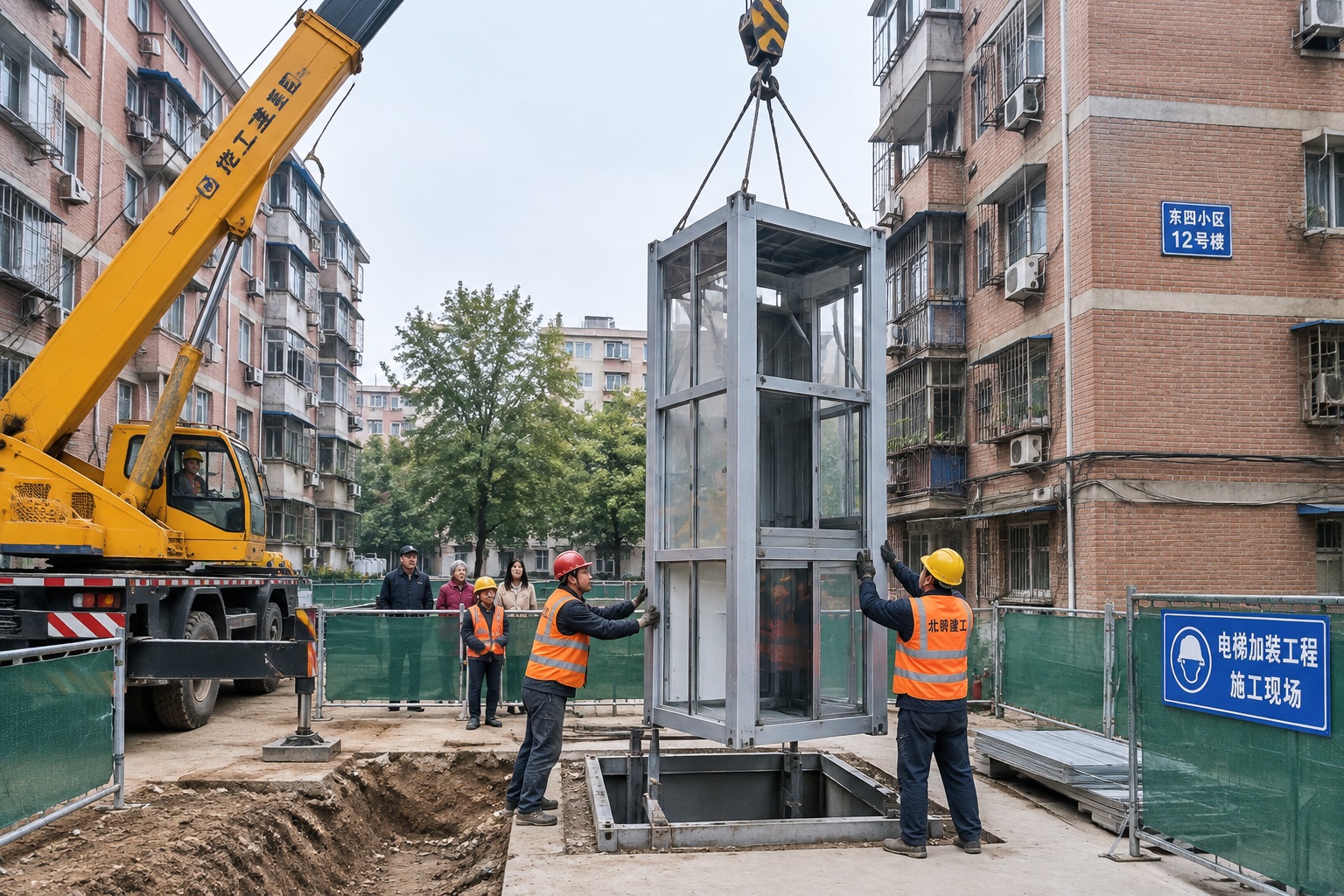
The steel shaft arrived prefabricated on two trucks and was bolted together in two days. That is the part everyone photographs.
The rest was slower. Digging the foundation in a courtyard barely wide enough for a mini-excavator took three weeks. Rerouting the drainage added two more. Work ran from eight to six, and the three other buildings in the compound heard every hour of it.
Chen’s flat is on the sixth floor, so the drilling was distant. What she noticed was the courtyard. For eleven weeks the space where neighborhood children played after school was a fenced construction site, and the drying racks moved onto the roof of the bicycle shed. Two neighbors stopped speaking to her in the corridor. Both started again after the elevator opened.
Step 6: Inspection, and the part that never ends
In China an elevator is classified as special equipment. It cannot carry a passenger until a government inspection body has tested it and issued a supervision inspection report. Only then can the building apply for a use registration certificate — the document that makes the whole thing legal.
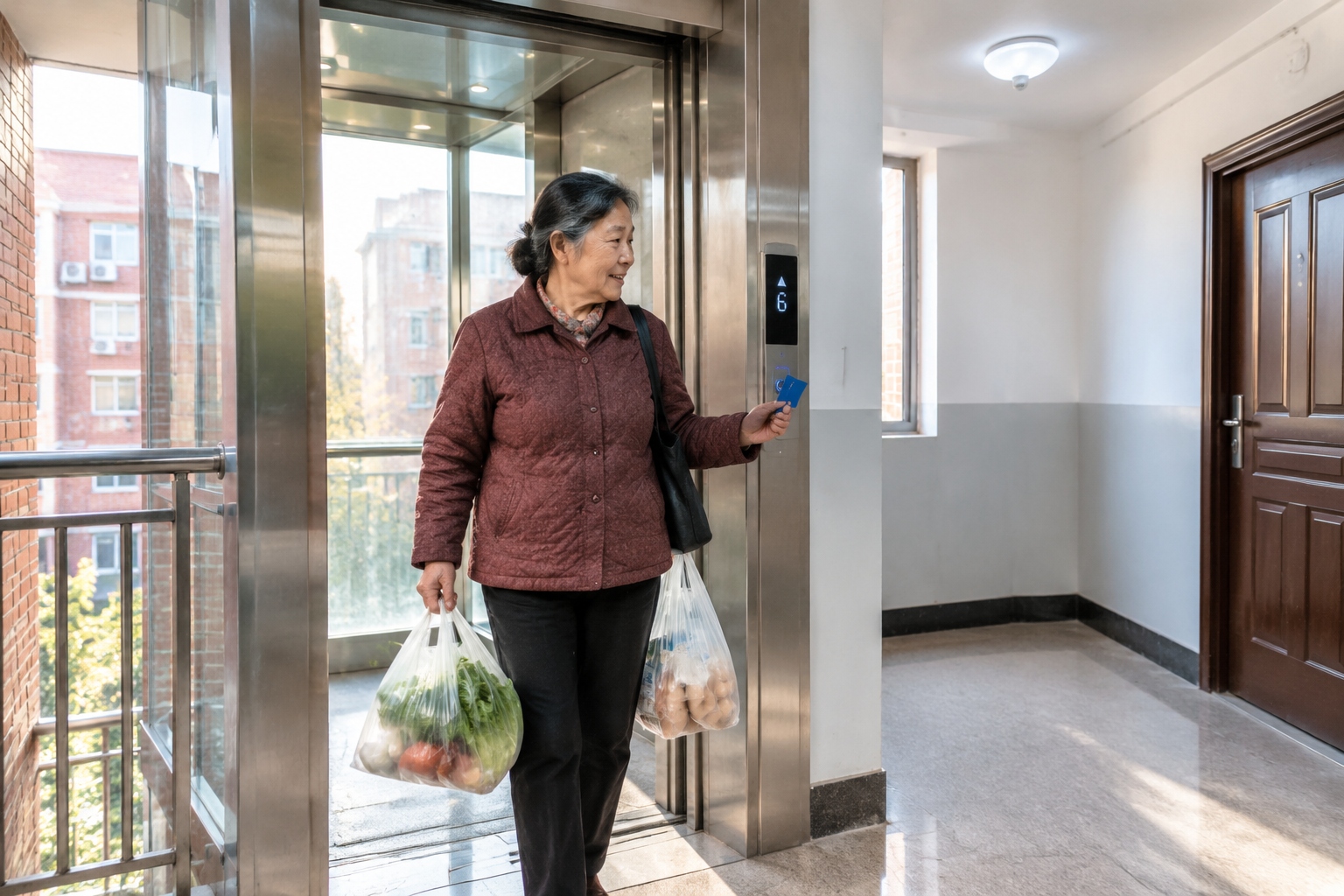
Chen’s building passed on the first attempt. She rode up on a Thursday afternoon in October 2024 with two bags of groceries, swiped an IC card, and reached the sixth floor in about twenty seconds.
Then the monthly costs started, and they do not stop. The eleven households that use the elevator pay for electricity and a maintenance contract, scaled by floor: roughly 30 yuan a month on the second floor, about 110 on the sixth. Residents hold cards, and the elevator only moves for cardholders, which keeps the ground floor from subsidizing the top floor. Ownership is registered jointly to the ten paying households, and the building signed a five-year maintenance contract.
What changes from city to city
Subsidies differ. Shanghai pays up to 280,000 yuan per elevator; Hangzhou about 200,000; Guangzhou around 100,000. Consent thresholds differ too — some cities require two-thirds of the stairwell, while others simplified the rule after years of complaints. In 2023, China’s Law on Building Barrier-Free Environments stated national support for adding elevators to existing apartment buildings, framed mostly as a response to an aging population: about 300 million people in China are over 60.
A newer model has appeared in some neighborhoods — the shared elevator, where a company pays for construction and residents pay per ride or by subscription. It removes the up-front cost and creates a different problem: a monthly bill for something you will never own.
What does not change is the shape of the negotiation. Attaching a steel box to a 1988 brick wall is a solved engineering problem. The hard part is social: someone on the ground floor loses light and loses value, and no regulation compensates them. Every successful project has some version of Chen’s two-page agreement and 15,000 yuan — or a residents’ committee director willing to spend two hours in a stranger’s living room.
If you want to try this in your own building
Five things Chen says she would do again.
Start with the ground floor, before a plan exists. Once there are drawings, the conversation becomes about drawings.
Find the residents’ committee before you find an elevator company. In Chinese cities, the street office and the residents’ committee are not spectators. They mediate, and they decide whether a disputed project moves.
Put the compensation in writing even though it has no legal basis. Verbal promises about parking and paint are what later objections are built on.
Show everyone every document. Secrecy, not disagreement, is what kills these projects.
Budget the maintenance fee before you sign, not after. Installation is a one-time cost. The elevator is a monthly one.
Chen’s building took nineteen months. A block two streets away, with a simpler structure and a less stubborn ground floor, took seven. The fastest case she has heard of in her district is three weeks — but every household there had already agreed before anyone filed a single form.
Start the discussion at forum.chinacomes.com