

A table with no menu
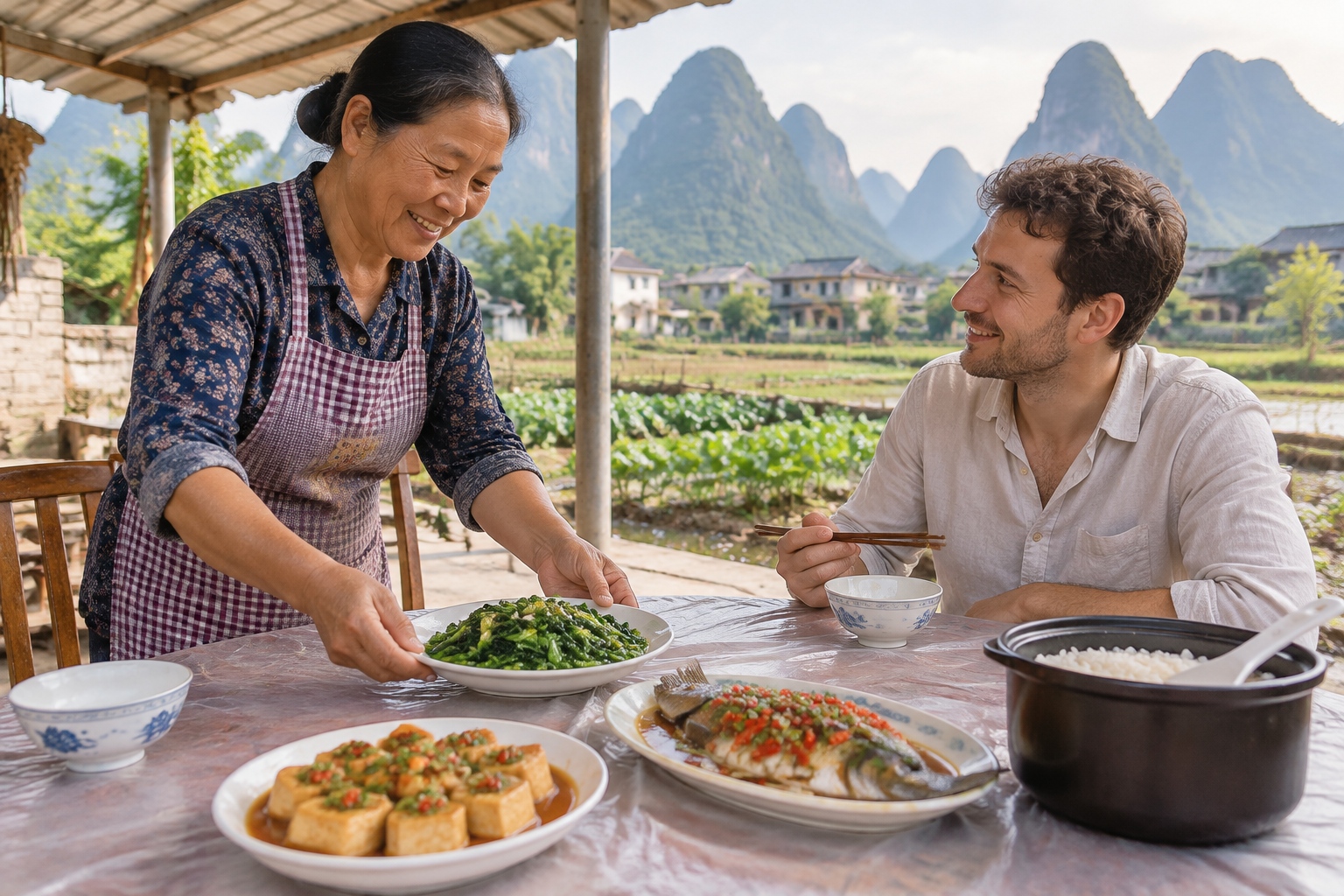
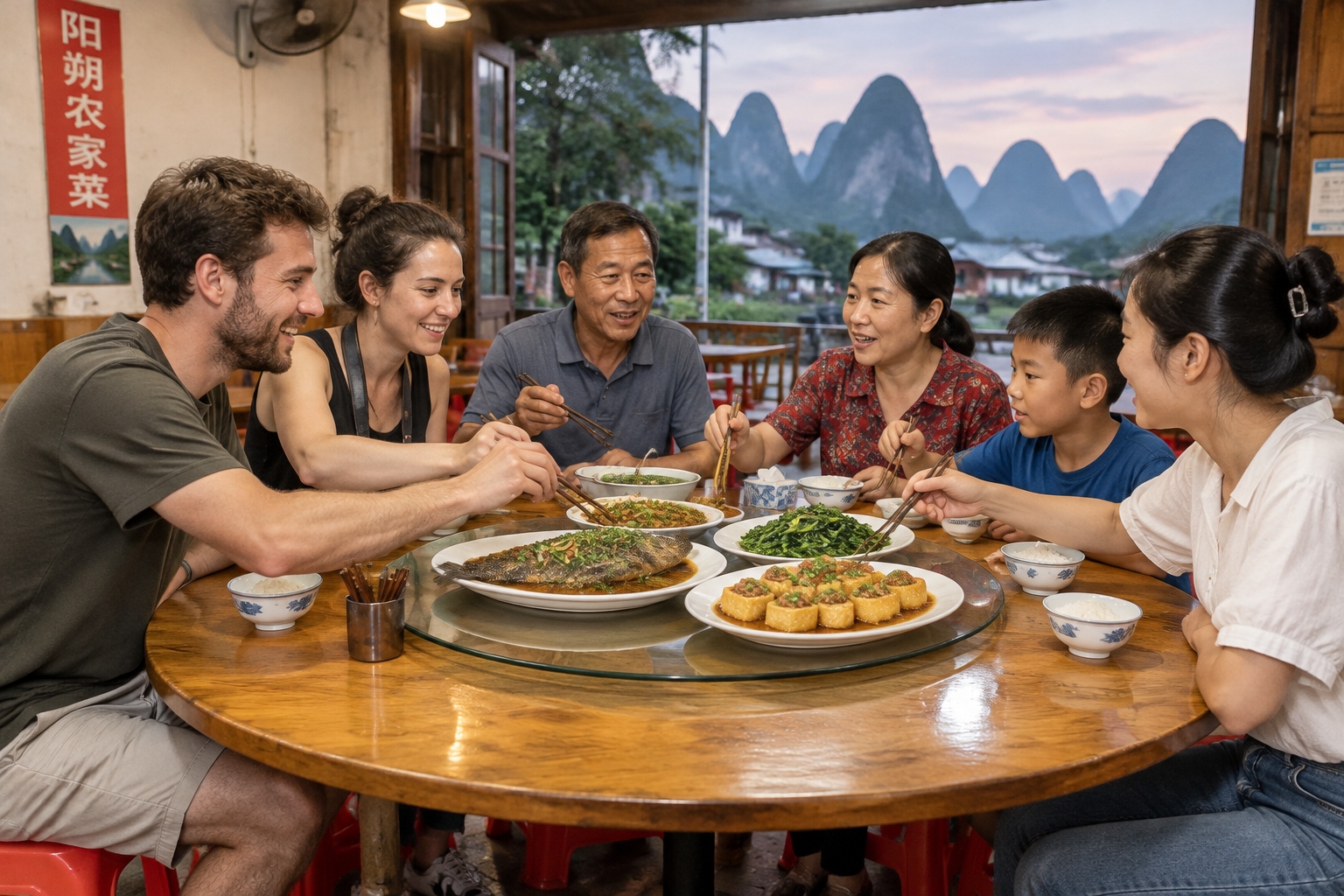
In Jiuxian, a village about fifteen minutes by scooter from Yangshuo’s West Street, a Canadian tourist named Maren sat down at a plastic table under a corrugated roof and asked to see the menu. The woman who owned the house laughed. “No menu,” she said, and nodded toward the vegetable plot behind the kitchen. “Whatever’s ready.”
That is what people mean by a “hidden menu” in Yangshuo. It is not a secret list of dishes only locals know about. It is dinner decided half an hour before it is cooked — by what came out of the garden that morning, what the fish seller had on his cart, and what the family happens to cook well.
Yangshuo is a county in Guangxi, in southern China, with roughly 300,000 residents and a landscape of limestone peaks that appears on the back of the 20-yuan banknote. In a normal pre-pandemic year it recorded around 20 million tourist visits. Almost everyone you meet lives with one foot in farming and the other in hospitality.
Where the food actually comes from
Karst scenery is beautiful and, from a farmer’s point of view, difficult. The soil sits in thin pockets between limestone rocks. Fields are small — often a fraction of a hectare — and shaped by whatever flat ground the hills left behind. The climate is humid and subtropical, with most of the yearly rain falling between April and August. That combination means fast growth, quick rot, and a food culture built around eating things fresh and eating them soon.
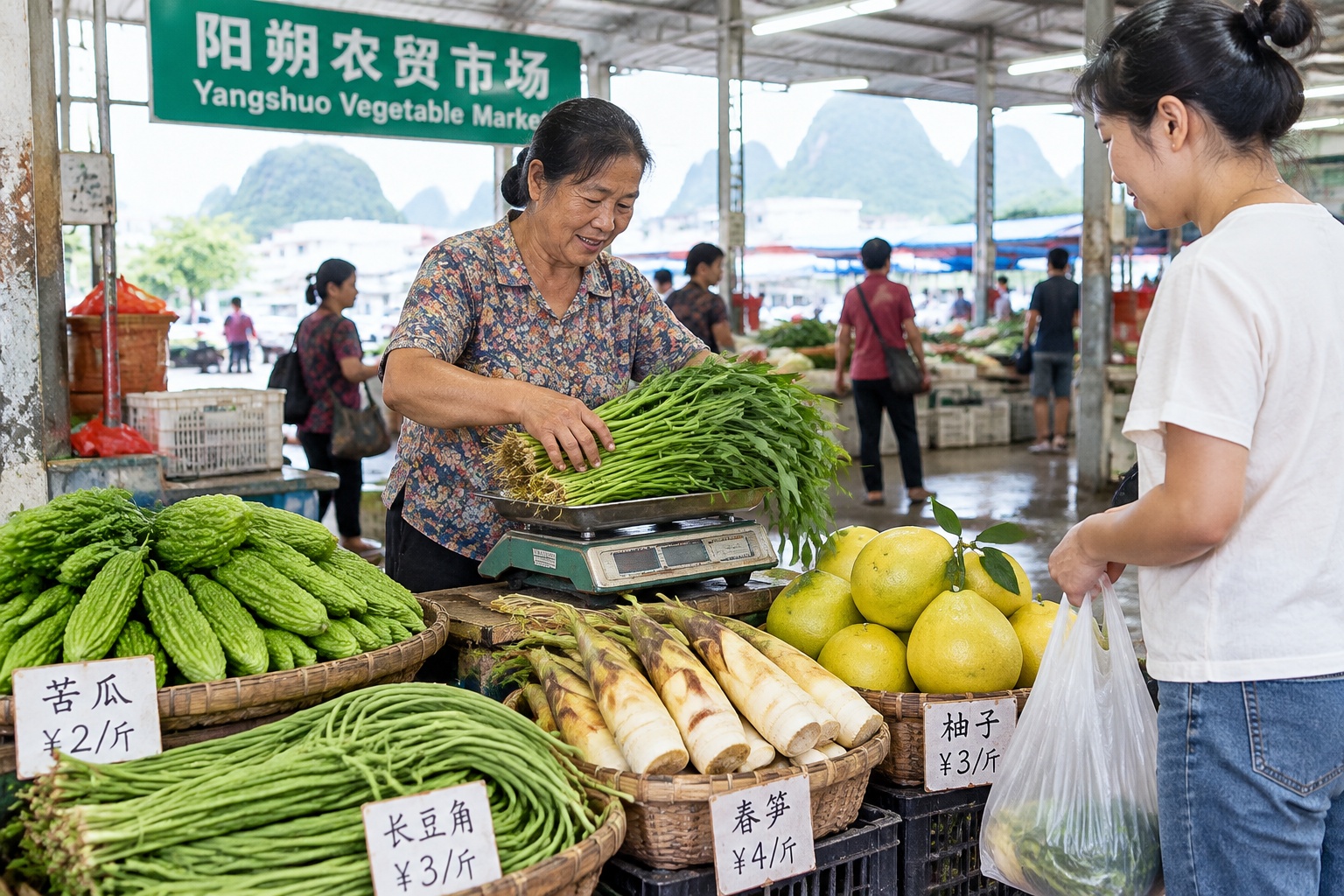
Walk into the covered market in Yangshuo town between 6:30 and 9:00 a.m. and you can see the supply chain in person. Older women from surrounding villages sit behind baskets of water spinach, bitter melon, yard-long beans and whatever bamboo shoots are in season. Spring brings the fat, pale shoots used for stir-fries; autumn brings pomelo, the thick-skinned citrus that grows well here and shows up both as fruit and, in some kitchens, as a stuffed dish made from the peel.
Rice comes from small terraces. Tofu is pressed daily by family workshops and sold in soft blocks that still feel warm. The fish is usually freshwater — grass carp, carp, or the small, spiny river fish that locals fry whole and eat with the bones. Much of it is kept alive in tanks or plastic tubs until the moment someone orders it. Nothing here travels far, and almost nothing is frozen.
What shows up when there is no menu
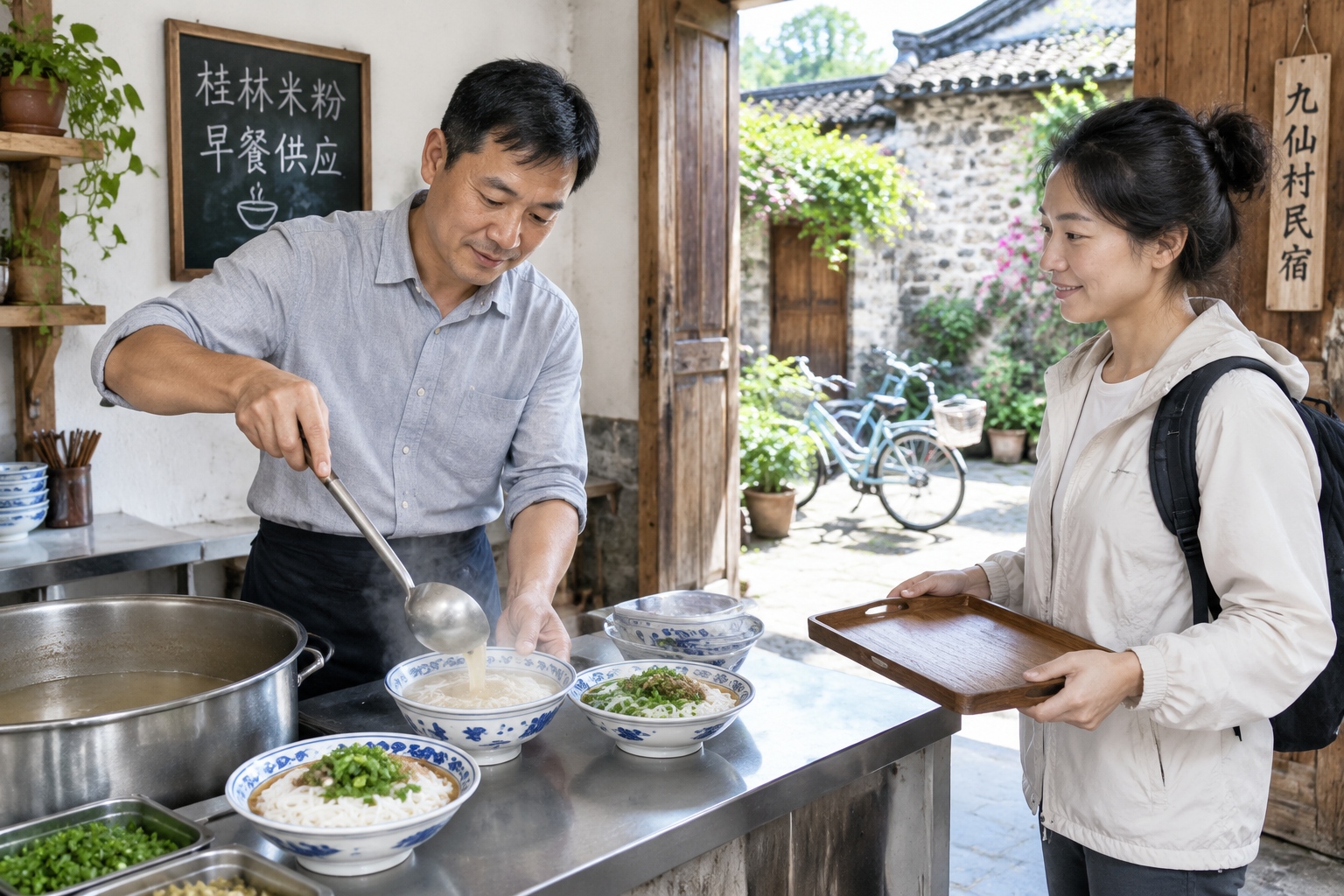
Breakfast is where Yangshuo residents and visitors overlap most. Guilin rice noodles — a bowl of soft rice noodles with braised meat, pickled beans and fried peanuts — costs about 5 to 8 yuan in a normal shop, less than a coffee in most Western cities. In the Yangshuo and Gongcheng area you also find oil tea: tea leaves pounded with ginger and garlic, then poured over puffed rice and peanuts. It is bitter, salty and not sweet at all, which surprises almost every foreigner the first time.
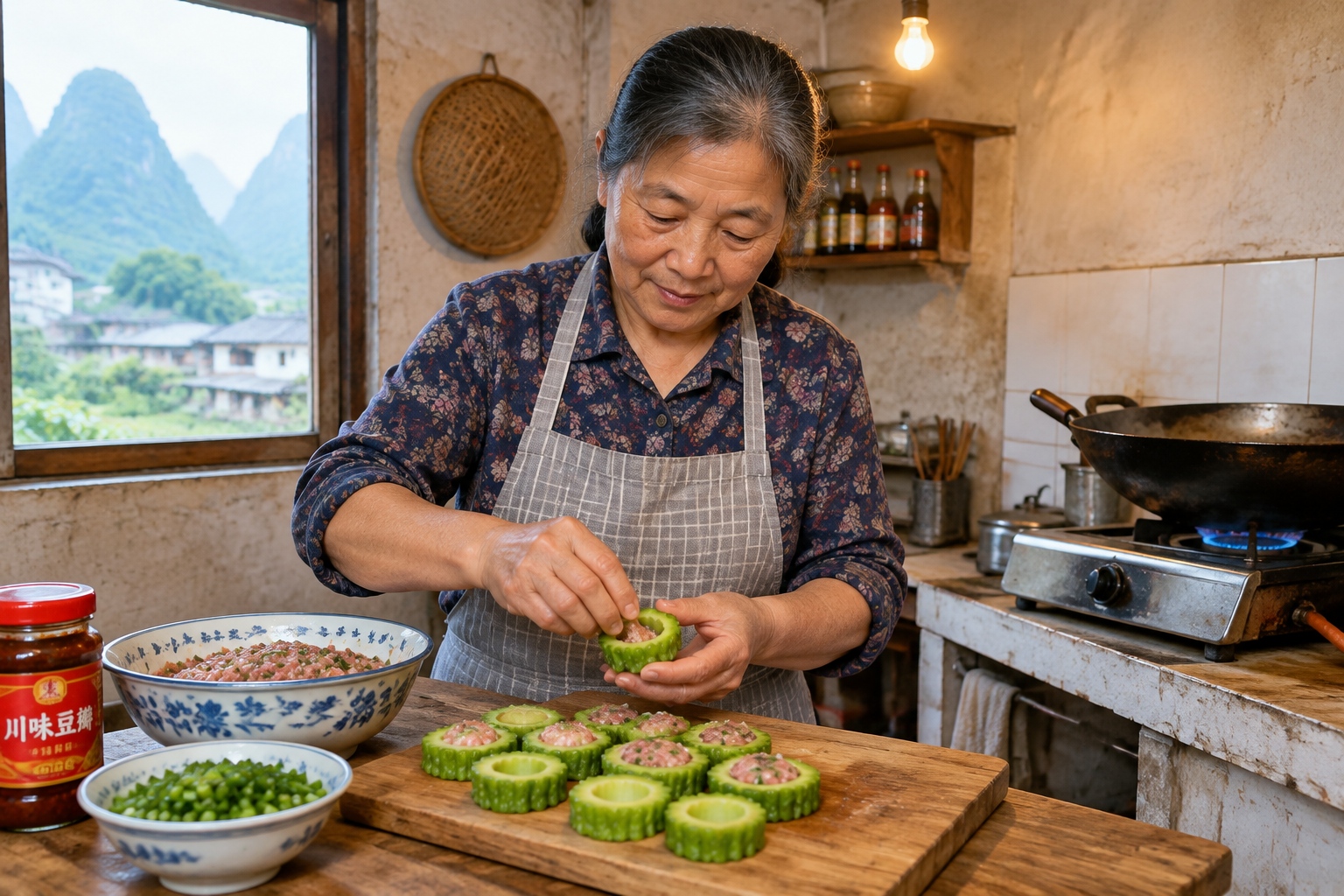
The dishes that rarely make it into guidebooks are the stuffed ones. The local tradition is called niang cai — vegetables hollowed out and filled with a minced pork and herb mixture. Bitter melon, tofu, eggplant, pomelo peel, even river snails get stuffed. A village kitchen will usually have three or four kinds on the table at once, and none of them look impressive. They taste like someone’s grandmother made a decision fifty years ago and never changed it.
Beer fish deserves an honest note. It is the dish every visitor is told to try, and it is genuinely good — carp simmered with beer, tomatoes, chili and fermented beans. But it is also a restaurant invention from the 1990s that grew with the tourist trade, often priced by weight at over 100 yuan per jin (500 grams). Locals eat it, but not on a Tuesday. The everyday table looks more like stir-fried bamboo shoots with cured pork, steamed taro with pork belly, pickled sour bamboo, and a plate of small river shrimp.
A day in the life: 4:30 a.m. to 7 p.m.
Ms. Liao is 58 and grows vegetables on a small plot outside Chaoyang village. She gets up at 4:30, cuts greens by headlamp, and rides her three-wheeled cart into town. On a good morning she sells out by nine and goes home with 100 to 200 yuan. On a bad one she takes the leftovers back and pickles them.
Mr. Xu runs a guesthouse in Jiuxian that used to be his family home. He converted eight rooms, kept the courtyard, and now cooks breakfast for guests every morning — rice noodles, boiled eggs, and whatever greens his sister brings over. The family moved upstairs. The ground floor, where his parents once dried grain, is now a dining area with good Wi-Fi.
Tourism numbers explain the shift. Twenty million visits a year against a population of roughly 300,000 residents means the county hosts dozens of visitors per person annually. For families near the Li River and Yulong River, that has turned spare rooms, cooking skills and a vegetable plot into income. It has also changed the rhythm of the week: weekends and holidays are work, Tuesdays are rest.
What foreign visitors actually notice
Ask tourists in Yangshuo what surprises them and the answers repeat. Freshness first — vegetables that were in the ground that morning, fish that was swimming an hour ago. Then flavor: more bitterness, more sourness, far less sugar than the Chinese food they ate at home. Then the way it is eaten. Everything arrives in the middle of a round table, everyone reaches in, and there are no individual portions.
Price is the third surprise. A village meal with a fish, two vegetables and rice usually costs 40 to 70 yuan per person. Market vegetables run 2 to 6 yuan per jin. Many English-speaking visitors compare it to a farmers’ market back home or a CSA box, except here the field, the stall and the table are all within a few kilometers of each other.
The most common question visitors ask a host is also the most useful one: “Is this from your garden?” In a village kitchen, the answer is often yes, and it usually leads to a longer conversation than any menu would.
The pressures behind the postcard
It would be dishonest to describe all of this as a smooth, romantic system. Peak season — October’s Golden Week, summer holidays — floods small kitchens that cannot scale. Some guesthouses respond by standardizing breakfast into scrambled eggs and toast, because it is faster and predictable. Officially licensed food service requires inspections, kitchen standards and paperwork that a family cooking for neighbors may not have. Many small kitchens simply cannot serve outsiders legally, which is why some village meals happen informally.
Waste is a real issue at tour-group restaurants, where tables are loaded and plates come back half full. And the stuffed-vegetable tradition takes hours of labor that younger villagers are less willing to spend, especially when a hotel job pays by the month. The flavor that makes this food worth traveling for is also, structurally, the thing most at risk.
How to eat closer to the real thing
Practical suggestions, from people who live here:
Go to the town market between 6:30 and 9:00 a.m. That is when farmers are still there and the fish is freshest.
Ask what is in season. “Xianzai shenme dangji?” works, or simply point and ask the price. Vendors are used to it.
Order one stuffed dish, one green vegetable and one river fish. That combination tells you more about local cooking than any set menu.
For fish, ask the price per jin before ordering, and confirm the weight. Fish is sold alive and priced by weight, so this is normal, not rude.
Carry a little cash and set up WeChat Pay or Alipay before you arrive. Outside West Street, small shops may not accept foreign cards.
Eat lunch at 11:15 or after 1:30. Noon is a crush.
Do not assume a farmhouse is a photo set. Ask before photographing people, especially in markets and kitchens.
And if you eat something you cannot identify, say so. In our experience, that is when the best explanations start.
The point of the hidden menu
Yangshuo’s scenery is what brings people here, and it deserves the reputation. But the meal at the end of the day — a table with no printed menu, a plate of stuffed bitter melon, a fish that was in the Li River that morning — is a clearer picture of how ordinary life works in this part of China. Someone grew it, someone carried it to market, someone decided what to cook, and someone is now asking you whether it tastes good.
The hidden menu is not hidden because it is secret. It is hidden because it changes with the season, the weather and the family, and it was never written down in the first place.
Start the discussion at forum.chinacomes.com