
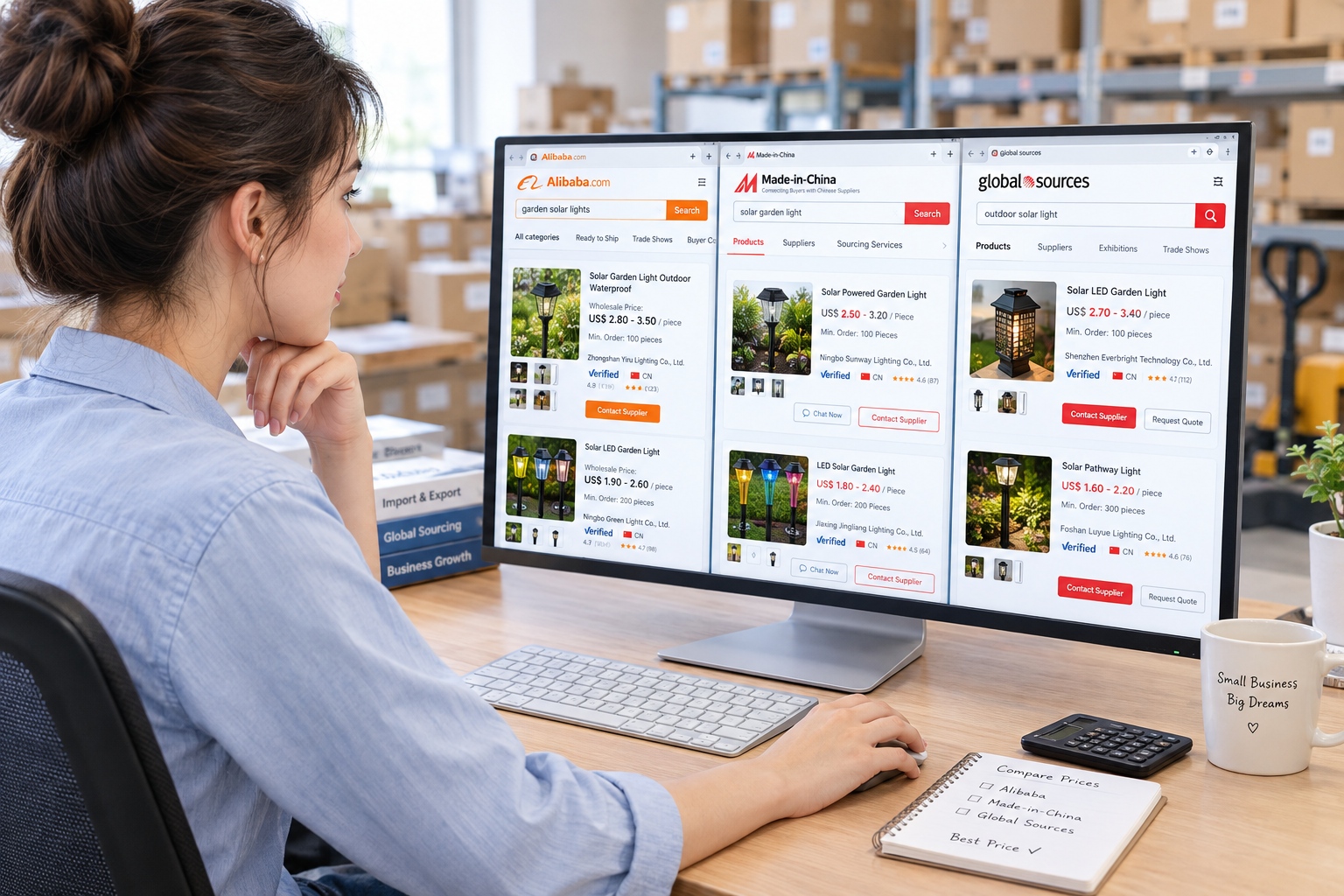

Three Platforms, Two Worlds
A few weeks ago, a friend who runs a cross-border e-commerce YouTube channel got a direct message from an American viewer. The viewer wanted to order 500 custom canvas bags from China. He had three tabs open — 1688, Alibaba.com, and Made-in-China — and asked: “Which one should I use?” He is not alone. Almost every first-time China buyer hesitates among these three websites.
Let’s clear up the fundamental difference first. 1688 is Alibaba Group’s domestic B2B marketplace, launched in 1999. It serves Chinese buyers and sellers. Prices are listed in yuan, sellers ship mostly within China, and payment usually goes through Alipay with a Chinese bank card. For overseas buyers, 1688 was never designed to offer a complete cross-border transaction experience. There is no built-in English translation, no international credit card acceptance, and no customs or export paperwork support.
Alibaba.com is the international arm of the same group. Suppliers on this platform have some experience dealing with foreign customers, or at least know how to quote in US dollars and book export shipping. The platform offers a Trade Assurance program that protects buyers’ payments until orders are accepted.
Made-in-China, operated by Focus Technology, is another long-standing B2B export site. It looks similar to Alibaba.com but tends to be stronger in machinery, industrial parts, and other verticals. The total number of suppliers is smaller than Alibaba.com, but in certain categories you may find fewer middlemen and more actual factories.
In short: 1688 is a domestic sales platform, while the other two are export platforms. Their pricing logic, communication style, and payment rules are completely different. If you don’t understand this, you will get frustrated on 1688. If you ignore 1688 entirely, you may pay too much for products that are readily available at a much lower price.
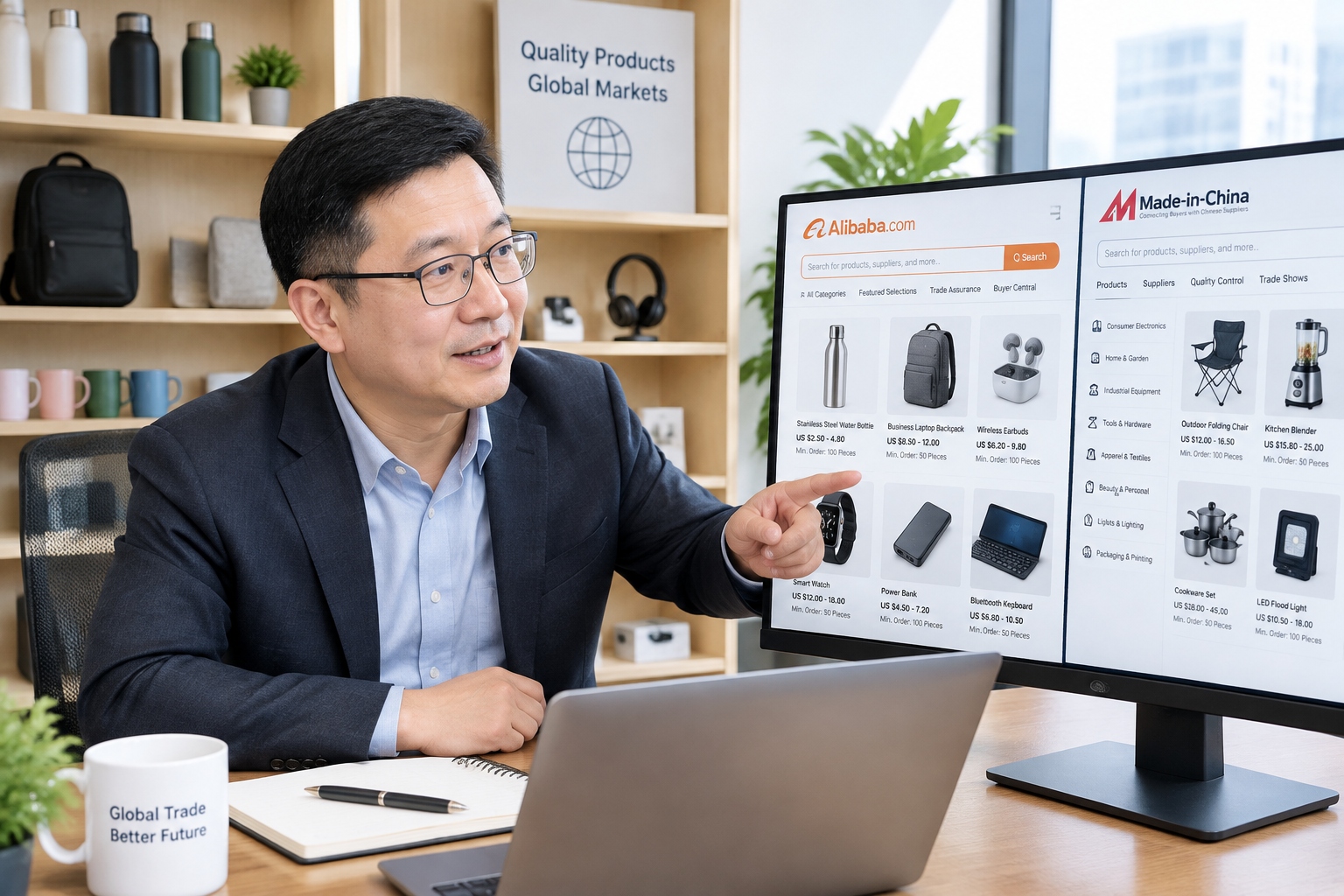
How Big Is the Price Gap? A Real Order Calculation
Take a common product we tested: a standard wireless Bluetooth earbud. On 1688, a similar specification is quoted at around 25 yuan (about $3.50). On Alibaba.com, the same product with a 100-piece minimum order is usually priced between $4.50 and $6.00. On Made-in-China, prices are comparable to Alibaba.com, but the minimum quantity is often higher.
The list price gap looks like 20–40%, but that is only the “naked” price. When you buy on 1688, you need to arrange your own freight forwarder to handle international shipping. You must also deal with export declarations, destination customs, and import duties. Domestic orders typically do not come with export-grade packaging — that thin cardboard box is not meant for a bumpy ocean-freight journey.
Let’s do the math. Suppose you buy 100 earbuds on 1688. The product cost is 2,500 yuan, or about $350. The shipment weighs around 10 kg, and a small parcel by air freight might cost $25–30 per kg. Add fuel surcharges and international payment fees, and your per-unit cost easily rises to $5. If a defect occurs, the return or replacement process is painful because you’re working across a language and time-zone barrier with a domestic seller.
On Alibaba.com, the quoted price generally includes export documentation, Trade Assurance coverage, English-speaking support, and simple packaging designed for export. The supplier understands the buyer is foreign, so they don’t throw the logistics problem back at you.
For small or inexperienced buyers, the total cost on Alibaba.com is often not much higher than on 1688. But if you are shipping full containers every week and have a freight agent you trust, 1688 can indeed save you a meaningful chunk of money.
Supplier Quality: Factory or Trader, Verified or Not
All three platforms claim to have “verified suppliers,” but the depth of verification differs wildly.
On 1688, you will find everything from backyard workshops to legitimate regional factories. The platform does not conduct the same rigorous on-site audits that export platforms require. It also doesn’t force sellers to prepare English product sheets. To judge a supplier, you have to chat and ask for samples. Chinese sellers use Alibaba’s instant messaging tool, often called Wangwang. If you can type Chinese, you can ask for a live video tour of the factory, a business license, or a test report. Many are happy to cooperate.
On Alibaba.com and Made-in-China, a supplier with an “on-site check” or “verified” badge has usually been visited by a third-party auditor like SGS or BV. The auditor confirms that production lines and workers actually exist. These suppliers are used to dealing with overseas clients and usually have more stable quality control. But be careful: many companies on these export platforms are trading companies. They may write “factory” in their profile, but they actually resell from local manufacturers. Trading companies can still be reliable, but you should know exactly who you are negotiating with and what that means for price, lead time, and after-sales service.
Here is a practical tip: regardless of the platform, always order samples before placing a bulk order. A sample costs a few tens of dollars including shipping, and you will receive it within a week. You can also check a supplier’s name in Chinese customs export data (some websites provide this service). If a company claims to be a factory but has no export record, you might be dealing with a middleman — which is okay, as long as the price and service reflect that.

Communication: Language, Time Zones and Cultural Translation
Using 1688 means accepting a set of “Chinese homework.” To register, you need a mobile number. Overseas numbers often fail to receive the verification code. Most sellers do not speak English. Quotes, contracts, and even shipping labels are in Chinese. WeChat’s built-in translation helps, but when it comes to technical details or quality disputes, gestures and translation apps are painfully slow.
Suppliers on Alibaba.com and Made-in-China are ready for international customers. Their sales teams can write and speak English at a functional level. The platforms also provide inquiry forms and product templates in English, and the website itself is fully localized. You don’t have to figure out how to navigate a Chinese UI.
Time zone differences matter too. On 1688, many sellers work standard business hours in Beijing time. If you send a message after 9 PM Beijing time, you may wait until the next morning. Export suppliers, on the other hand, are used to responding to late-night inquiries from America or Europe. Some arrange staggered shifts so that a customer in Chicago can get a reply early in their morning, which corresponds to evening in China.
Payment Security: Escrow, Letters of Credit and Off-Platform Risk
On Alibaba.com, if you choose “Trade Assurance,” your payment is held in escrow by the platform. If you are not satisfied after inspection, you can apply for a refund. This mechanism dramatically reduces the chance of being scammed. Made-in-China has similar buyer protection through affiliated payment services or contract templates.
1688 uses a “secure transaction” (担保交易) model through Alipay: the money is held by Alipay and released to the seller only after you confirm receipt. However, to use this system as a foreigner, you need a verified Alipay account. That normally requires a Chinese national ID or a Mainland travel permit for Hong Kong, Macau, and Taiwan passports. Ordinary overseas passports are rarely accepted. Some foreign buyers rely on a Chinese friend to pay and receive goods. That can work, but it adds a layer of interpersonal risk.
Another common but dangerous route is direct wire transfer (T/T) to the supplier with no platform protection. Imagine you find a “1688 gold supplier” on WhatsApp and they ask for a 30% deposit before production, with the balance due before shipment. If the order goes wrong, you have very little legal recourse from abroad. My strong advice: always use the platform’s escrow system for your first transaction. After you build a trusting relationship, you can explore more flexible payment methods.
Which One Should You Choose? Match Your Profile
Based on the analysis above, I would group buyers into a few archetypes.
1. The China-Savvy Small Importer
If you have a long-term Chinese friend or a local agent who handles logistics and payment, and your order size is large enough (hundreds of items per order), then 1688 can bring real savings. Many “sourcing agents” offer a service where they place orders on 1688 for foreign clients for a small fee. Ask for a transparent breakdown of all costs.
2. The Overseas Small-Business Owner or Independent Startup
If you have limited budget, little export experience, and need to buy samples or test orders quickly, Alibaba.com is your best first stop. The slightly higher price pays for the interface, communication, and transaction safety. Use the filter to select “Verified Supplier” and check that they manufacture your specific product category.
3. The Industrial Buyer
When you need machinery or mechanical parts, you often have to communicate complex technical specs. Made-in-China has a strong base of heavy-equipment suppliers who understand parameter sheets and are used to detailed technical discussions. But don’t ignore Alibaba.com; search for the same model there and compare prices.
4. The Large Long-Term Purchaser
If you plan to order large quantities every month, request quotations from all three platforms. Use the 1688 price as a negotiation lever with Alibaba.com suppliers. But before selecting a factory, verify its export qualifications. If you find a great factory on 1688 that has no export experience, you can hire a foreign-trade agent (usually charging 1–3% of the order value) to handle the contract and shipping documents.
It’s About Your Time, Not Just the Price
Choosing a sourcing platform is essentially asking how much convenience and security you are willing to pay for. 1688 is the money-saving but effort-intensive long-distance running partner. Alibaba.com and Made-in-China are the more expensive but smoother tour guides. China’s supply chain is so vast that these platforms are just entry points. The smartest approach is to order small sample orders across platforms, feel the difference in service, and then decide where to put your serious money.
Start the discussion at forum.chinacomes.com